Not yet, but the keels of carangids are very interesting too!
04.02.2025 18:41 —
👍 1
🔁 0
💬 0
📌 0
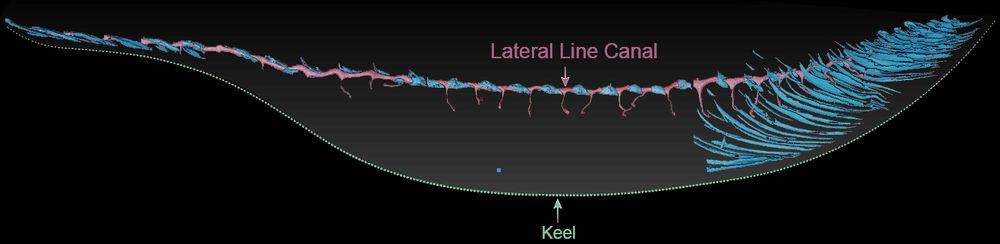
5. We hypothesize that tuna keels with their dorsal and ventral tubules act as flow sensors, perhaps providing information on tail beat frequency, amplitude, force, and water flow dynamics over the caudal region of the tuna body during locomotion.
03.02.2025 18:28 —
👍 3
🔁 0
💬 1
📌 0
4. The keel lateral line canal (pink color) is quite strange: neuromasts are surrounded by modified scales (shown in blue), and keels have an odd set of elongated skeletal elements posteriorly. Tuna keels are clearly mechanosensory.
03.02.2025 18:28 —
👍 3
🔁 0
💬 1
📌 0
3. Now, a team led by @juliachaumel.bsky.social and published in iScience @cp-iscience.bsky.social shows that tuna keels have a sensory function too! Each keel has a peculiar lateral line canal with small tubules that extend to the upper and lower keel surfaces (www.cell.com/iscience/ful...
03.02.2025 18:28 —
👍 1
🔁 0
💬 1
📌 0
2. And here’s a view of the caudal fin and keels from behind during #tuna locomotion. Our previous work has shown that the keels decrease power requirements during swimming, likely by reducing lateral forces and yaw torques. But wait, there's more!
03.02.2025 18:28 —
👍 0
🔁 0
💬 1
📌 0
1. #Tuna have well-developed bilateral keels extending to the right and left sides at the caudal peduncle area just in front of the tail. This movie shows the keel area during locomotion in yellowfin tuna. What is the function of keels in #tuna? A🧵 and new hypothesis.
03.02.2025 18:28 —
👍 13
🔁 3
💬 1
📌 0
Our new paper is out as OA! shorturl.at/BueUy
Tuna keels aren't just for hydrodynamics—they're mechanosensory! 🐟 They contain a modified lateral line, possibly adapted to detect stimuli in high-noise environments
@georgelauder.bsky.social @jackiew8.bsky.social + Dylan Wainwright + Connor White
28.01.2025 19:56 —
👍 13
🔁 6
💬 1
📌 0
Thanks, yes. The tail is an amazing sensory structure, but nobody has looked before!
22.01.2025 17:23 —
👍 5
🔁 1
💬 1
📌 0
We propose that the ray tail acts like a “hydrodynamic antenna” providing detailed information to the ray on water movement behind the body. This video shows the effect of moving water near the tail of a cownose ray as it passes by.
22.01.2025 17:18 —
👍 9
🔁 2
💬 1
📌 0
There are paired lateral line canals along both sides of the entire length of the tail with a remarkable branched structure that ends at the tail surface with clusters of pores. Each canal has a continuous neuromast that extends the entire tail length!
22.01.2025 17:18 —
👍 26
🔁 2
💬 1
📌 1
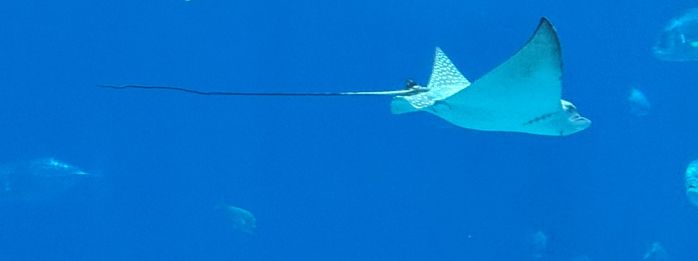
The elongate tail of a ray
What is the function of the elongate tail in elasmobranch #rays? A 🧵 and a new hypothesis. A paper with @juliachaumel.bsky.social in @royalsociety.org Proceedings B (shorturl.at/PmfYD) shows that the tail of cownose rays (and a few other species studied so far) has an elaborate lateral line.
22.01.2025 17:18 —
👍 85
🔁 31
💬 3
📌 7
What is the significance of the tremendous diversity of #shark skin #denticles? Presenting our experimental approach to understanding this at the Atlanta #SICB2025 meetings. Come to the session for all things shark skin!
31.12.2024 17:55 —
👍 33
🔁 4
💬 0
📌 1
Thanks Valentina! The manuscript should be out soon ... we're waiting for proofs now.
15.12.2024 21:38 —
👍 2
🔁 0
💬 0
📌 0
Overall this supports the new “turbulence sheltering hypothesis” for why fish might group together, especially during active migratory movements where water flow is chaotic and turbulent: fish in a school can save a considerable amount of energy compared to swimming alone.
28.06.2024 17:27 —
👍 2
🔁 0
💬 1
📌 0

This occurs largely because individuals within the school alter the flow environment with their undulating bodies and proximity: fish within schools in turbulence swim more closely together as speed increases compared to schools in laminar flow:
28.06.2024 17:27 —
👍 4
🔁 0
💬 1
📌 0

We showed that swimming in turbulence by fish schools dramatically reduces both the cost of swimming (orange curve, left panel, compared to purple curve), and the cost of transport (right panel) when in turbulence compared to individuals swimming alone.
28.06.2024 17:27 —
👍 0
🔁 0
💬 1
📌 0
Collective movement of schooling fish reduces the costs o...
What are the benefits of collective behavior? This study ...
@TheYangfanZHANG led the project with @mcalicc7, @HungtangK, and Prof. Rui Ni @JohnsHopkins to test this hypothesis, comparing individuals swimming alone to energy use by small schools swimming in turbulent conditions: paper at https://tinyurl.com/yc764d74
28.06.2024 17:27 —
👍 0
🔁 0
💬 1
📌 0
Most studies of fish schooling have involved swimming in still or slowly flowing water. But fish in groups often move through turbulent water conditions. Could swimming collectively act to mitigate the increased energy needed to swim in turbulence?
28.06.2024 17:27 —
👍 0
🔁 0
💬 1
📌 0

A new idea: the “turbulence sheltering hypothesis”. Fish in a school could modulate surrounding turbulence so that chaotic fluid motion increasing swimming cost is less. Fish in a group would use less energy compared to swimming alone in turbulent conditions.
28.06.2024 17:27 —
👍 1
🔁 0
💬 1
📌 0
Why do #fish swim in #schools? A🧵and new hypothesis. Schooling could help fish avoid predators, navigate, communicate, find mates and food, and save energy. Here we propose and test a new hypothesis: https://tinyurl.com/yc764d74
28.06.2024 17:27 —
👍 7
🔁 0
💬 1
📌 0

There are a wide variety of hydrodynamic mechanisms that allow energy savings as fish swim near each other and in each others wake, and fish in schools are changing relative positions dynamically through time.
21.02.2024 18:35 —
👍 0
🔁 0
💬 0
📌 0
Our results also cast doubt on using only simple kinematic metrics such as tail beat frequency as a proxy for energy savings: fish in schools can save energy even when tail beat frequency does not change.
21.02.2024 18:35 —
👍 0
🔁 0
💬 1
📌 0
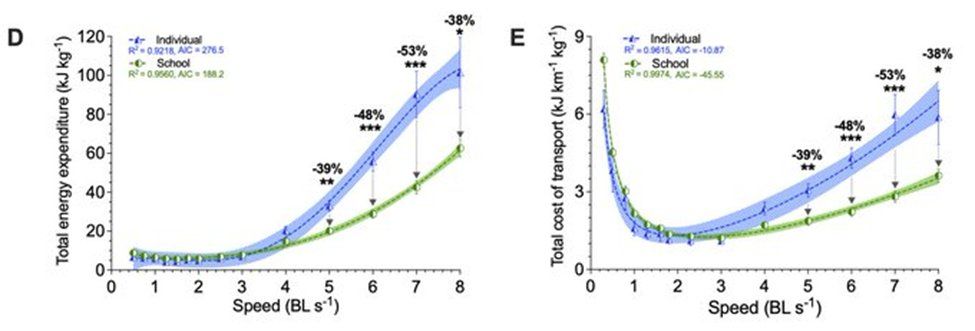
We also showed that schooling fishes saved relatively more energy as they moved faster compared to solitary fish, and that the cost of transport curve is also U-shaped with clear benefits to swimming in a group.
21.02.2024 18:35 —
👍 0
🔁 0
💬 1
📌 0

By swimming both schools and solitary fish over a wide range of speeds, we showed that (1) very low speed swimming involves as much energy use as swimming at 3 body lengths/sec, and that the metabolism-speed curve is U-shaped over this speed range.
21.02.2024 18:35 —
👍 0
🔁 0
💬 1
📌 0

And, we need to study school and solitary swimming over a range of speeds and measure energy use both during swimming and during post-exercise recovery to quantify EPOC: the energy used to sustain swimming at high speeds beyond the aerobic threshold.
21.02.2024 18:35 —
👍 0
🔁 0
💬 1
📌 0
Do #fish swimming in a #school actually save energy? A🧵on this as our paper in @eLife https://elifesciences.org/articles/90352 by @TheYangfanZHANG addresses this question. This is a challenging issue to study: energy use by a school should be compared to solitary locomotion
21.02.2024 18:35 —
👍 0
🔁 0
💬 1
📌 0

Do #fish swimming in a #school actually save energy? Our paper on this in eLife elifesciences.org/articles/90352 addresses this question. This is a challenging issue: energy use by a school needs to be compared to solitary locomotion on a per gram basis under the same swimming conditions.
21.02.2024 18:27 —
👍 11
🔁 4
💬 0
📌 0

The shark #denticle #multiverse will be on display at #sicb2024 this week. See talks in the
@SICB_DCB_DVM
sessions. So much diversity, so little time ... below the #ontogeny of sleeper shark denticles from Vaz et al. 2023: mdpi.com/1424-2818/15...
02.01.2024 20:13 —
👍 5
🔁 0
💬 0
📌 0

The shark #denticle #multiverse will be on display at #sicb2024 this week. See talks in the @SICB_DCB_DVM sessions. So much diversity, so little time ... below the #ontogeny of sleeper shark denticles from Vaz et al. 2023: https://www.mdpi.com/1424-2818/15/11/1105
02.01.2024 20:12 —
👍 0
🔁 0
💬 0
📌 0