Christina Simoglou Karali's Avatar

Christina Simoglou Karali

@christinask.bsky.social

Postdoctoral researcher @ National & Kapodistrian University of Athens | @imm.ox.ac.uk University of Oxford Haematopoietic Stem Cell Biology | Single-Cell | Genome regulation | Myelopoiesis | Neutrophils | Inflammation | Bone marrow microenvironment

133 Followers  |  330 Following  |  3 Posts  |  Joined: 22.11.2024  |  1.5512

Latest posts by christinask.bsky.social on Bluesky

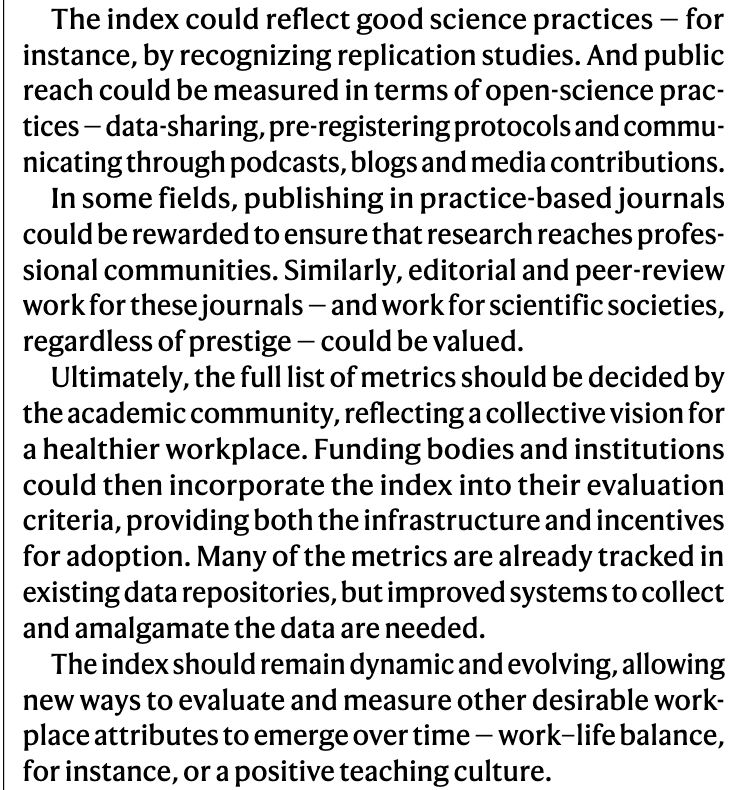
Excerpt from article by Prof Kelly-Ann Allen:

The index could reflect good science practices — for
instance, by recognizing replication studies. And public
reach could be measured in terms of open-science prac-
tices — data-sharing, pre-registering protocols and commu-
nicating through podcasts, blogs and media contributions.
In some fields, publishing in practice-based journals
could be rewarded to ensure that research reaches profes-
sional communities. Similarly, editorial and peer-review
work for these journals — and work for scientific societies,
regardless of prestige — could be valued.
Ultimately, the full list of metrics should be decided by
the academic community, reflecting a collective vision for
a healthier workplace. Funding bodies and institutions
could then incorporate the index into their evaluation
criteria, providing both the infrastructure and incentives
for adoption. Many of the metrics are already tracked in
existing data repositories, but improved systems to collect
and amalgamate the data are needed.
The index should remain dynamic and evolving, allowing
new ways to evaluate and measure other desirable work-
place attributes to emerge over time — work–life balance,
for instance, or a positive teaching culture.

Excerpt from article by Prof Kelly-Ann Allen: The index could reflect good science practices — for instance, by recognizing replication studies. And public reach could be measured in terms of open-science prac- tices — data-sharing, pre-registering protocols and commu- nicating through podcasts, blogs and media contributions. In some fields, publishing in practice-based journals could be rewarded to ensure that research reaches profes- sional communities. Similarly, editorial and peer-review work for these journals — and work for scientific societies, regardless of prestige — could be valued. Ultimately, the full list of metrics should be decided by the academic community, reflecting a collective vision for a healthier workplace. Funding bodies and institutions could then incorporate the index into their evaluation criteria, providing both the infrastructure and incentives for adoption. Many of the metrics are already tracked in existing data repositories, but improved systems to collect and amalgamate the data are needed. The index should remain dynamic and evolving, allowing new ways to evaluate and measure other desirable work- place attributes to emerge over time — work–life balance, for instance, or a positive teaching culture.

Move beyond ‘publish or perish’ by measuring behaviours that benefit academia

Perspective in #Nature 🧪 suggesting a new "G+ index" — G representing generosity, giving and other ‘good things’ in academia

Wouldn't this be great 🤔

By Prof. Kelly-Ann Allen

www.nature.com/articles/d41...

26.02.2025 16:45 — 👍 37    🔁 6    💬 0    📌 1
Post image Post image

Had the best time at #ASH24 presenting with Simone Riva our work at the @imm.ox.ac.uk with Prof. Adam Mead and Prof. Jim Hughes on the construction of a novel multi-omic resource atlas for human granulopoiesis and the identification of molecular machinery underlying IMiD-induced neutropenia.

10.12.2024 16:54 — 👍 12    🔁 1    💬 0    📌 0
Post image 07.12.2024 02:02 — 👍 3    🔁 1    💬 1    📌 0

Warming up for #ASH24 at the JMML summit. @ellouka.bsky.social presenting exciting multiomic single-cell and functional studies highlighting the role of HSC-cDC interactions in altering the leukaemia microenvironment.

07.12.2024 02:02 — 👍 4    🔁 0    💬 1    📌 0

@christinask is following 20 prominent accounts