first page of "Dependent development in digital capitalism: The politics of startup policies in the new periphery." abstract: As digital technology’s economic importance increases, policymakers pivot to supporting startups – new, small, high-risk firms that produce technological innovation. Tracing the passage of startup policies in Brazil and Spain between 2014 – 2022, this article argues that startup policies do little to reduce peripheral countries’ dependence on the core. In each case, startups advocated for these policies by relying on financial and organizational resources from the giant US-based technology firms known as “Big Tech.” The article makes three contributions to the framework of dependent development. First, it reinforces existing observations that dependence on Big Tech extends beyond the Global South. Second, it revives political analysis of dependency, exploring the political conditions for economic development in the periphery. Lastly, it shows how startups’ political dependence on Big Tech implies important limits on startups’ ability to lead peripheral economies out of dependence on the core.
Out now in Competition & Change
@compchange.bsky.social
“Dependent development in digital
capitalism: The politics of startup
policies in the new periphery”
@journals.sagepub.com
#polisky
journals.sagepub.com/doi/abs/10.1...
1/n
06.10.2025 14:15 — 👍 33 🔁 10 💬 1 📌 1

🌍 New in @nature.com: The geoeconomic turn in decarbonization, with data from Simon Evenett et al. and @industrialpolicy.bsky.social @ucberkeleyofficial.bsky.social @natureatcal.bsky.social www.nature.com/articles/s41... 🧵
25.09.2025 17:03 — 👍 64 🔁 24 💬 2 📌 3

We're also happy to announce the calendar for the 2025-2026 CONNECT Seminar Series, featuring a brilliant line up of CONNECT members from @unibo.it and SPS visiting scholars @fbulfone.bsky.social (Leiden) & Anuscher Farahat (UWien). Every first Tuesday of the month, 1-2pm - all welcome!
02.09.2025 12:06 — 👍 4 🔁 2 💬 0 📌 0
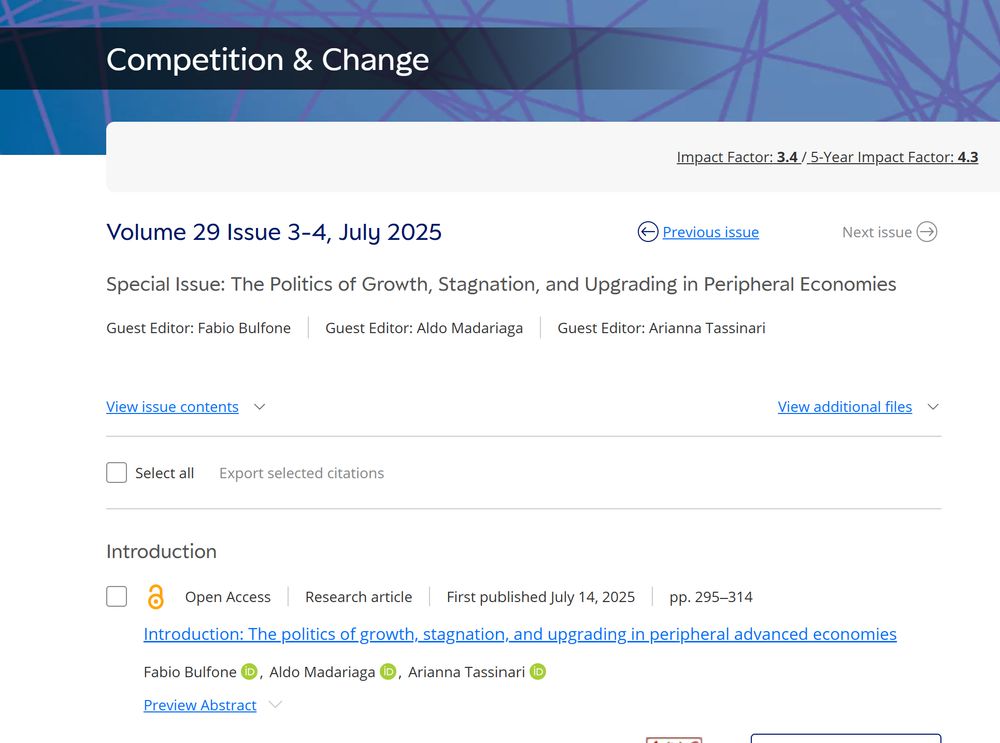
We are delighted that our Special Issue on "The Politics of Growth, Stagnation and Upgrading in Peripheral Economies" coedited w/ @fbulfone.bsky.social & Aldo Madariaga is now out in Competition & Change @compchange.bsky.social, Vol. 29(3–4).
🔗 doi.org/10.1177/1024...
18.07.2025 10:01 — 👍 36 🔁 16 💬 14 📌 1
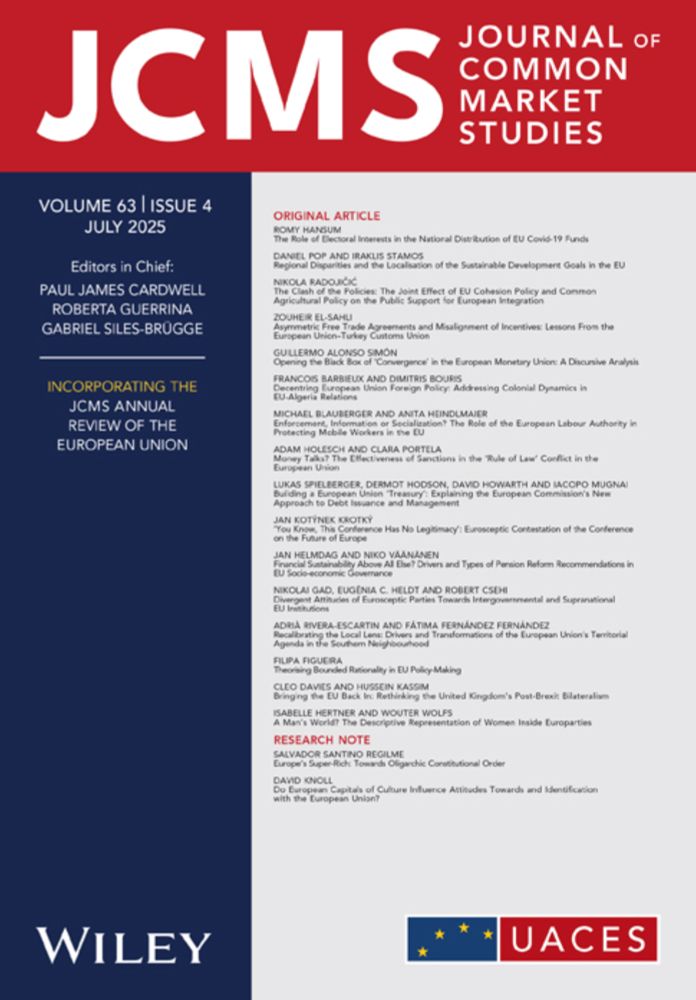
Much More Than a Report: The Search for Europe's New Political Identity and the Politics of Competitiveness
Click on the article title to read more.
📘🇪🇺 Much more than a report
In our new @jcms-eu.bsky.social piece, Lucia Quaglia and I argue that the Draghi and Letta reports go beyond competitiveness - they mark a shift in the EU’s political identity. But this entails huge challenges!
Open access here: onlinelibrary.wiley.com/doi/10.1111/...
16.07.2025 11:43 — 👍 28 🔁 11 💬 2 📌 3

The power of the golden share
When President Trump approved the merger between Nippon Steel and U.S. Steel he demanded a so-called “golden share.” It gives the White House a say in key business decisions. So, what happens when the...
Trump took a "golden share" in US Steel. What does this say about the steel industry, Trump's priorities, and how industrial policy is being used in 2025?
@fbulfone.bsky.social and I spent the hour with On Point getting into it.
Margaret Thatcher makes an appearance!
www.wbur.org/onpoint/2025...
07.07.2025 20:36 — 👍 6 🔁 2 💬 0 📌 0

Title page "Shifting Paths? The Evolution of Southern European Growth Trajectories Between the Global Financial Crisis and the Covid Pandemic." Authors Fabio Bulfone, Mischa Stratenwerth, and Adrianna Tassinari

Abstract
Keywords: Comparative political economy, economic sectors, export growth, growth models, post-austerity, Southern Europe
This paper traces the growth trajectories of the Southern European economies (Greece, Italy, Portugal, and Spain) from the financial to the covid crisis. From a review of the comparative political economy literature focusing on Southern Europe, we derive three propositions regarding the growth profile, the development of high value-added services and manufacturing exports, and employment outcomes. To assess the accuracy of these propositions, we conduct
growth decompositions based on import-adjusted demand components as well as on sectoral output and employment indicators. The data show that Southern European economies are similar in that export-led growth has not been sufficient to boost aggregate growth, stimulate high value-added services or manufacturing, reverse pro-cyclical employment declines, or create high-wage employment opportunities. But the Southern European economies also differ, both in terms of their sectoral growth profiles and their aggregate performance. In the second half of the decade, Portugal and Spain managed to combine domestic demand and exports to achieve stronger growth than Italy and Greece. Sectoral developments in Portugal and Spain (and to a lesser extent in Italy) tentatively suggest a potential “Iberian growth path” that is compatible with euro area constraints but ultimately peripheral. The paper concludes by considering the empirical and theoretical implications of these findings for the study of the Southern European model of capitalism.
In a new MPIfG Discussion Paper, @fbulfone.bsky.social, @m-stratenwerth.bsky.social, and @aritassinari.bsky.social trace the growth trajectories of Greece, Italy, Portugal, and Spain from the financial crisis to the covid pandemic.
🔗 pure.mpg.de/pubman/faces...
26.06.2025 07:25 — 👍 10 🔁 5 💬 0 📌 1
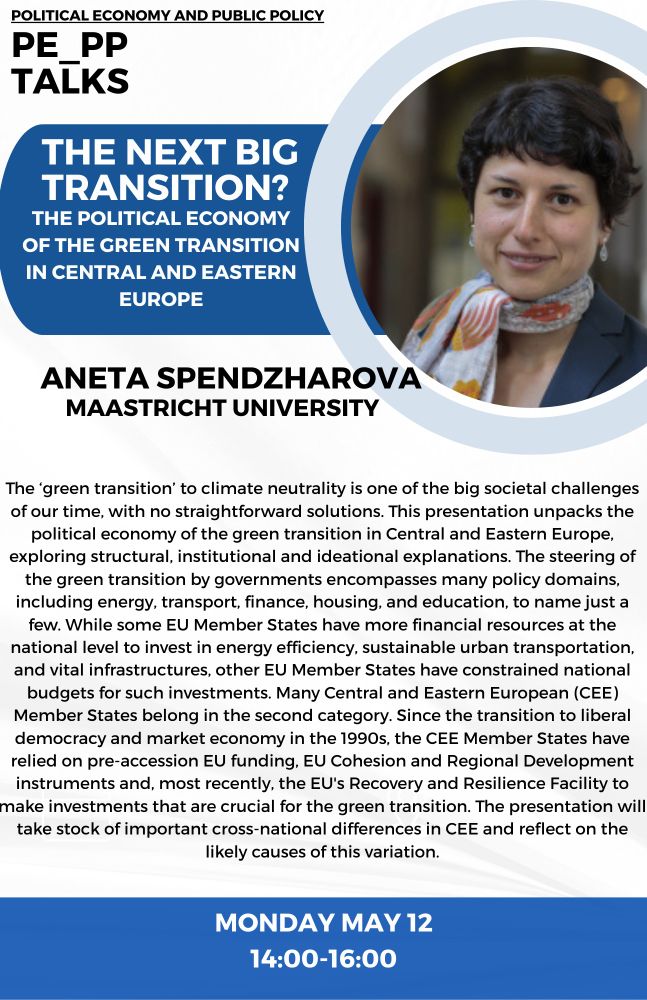
The PEPP group at Leiden University’s Institute of Public Administration is pleased to announce the next PE_PP Talk by Aneta Spendzharova (Maastricht University) on May 12!
Details below
Please PM if interested
@sebdiessner.bsky.social @nataschavanderzwan.bsky.social @alexandreafonso.bsky.social
06.05.2025 13:35 — 👍 6 🔁 2 💬 0 📌 0
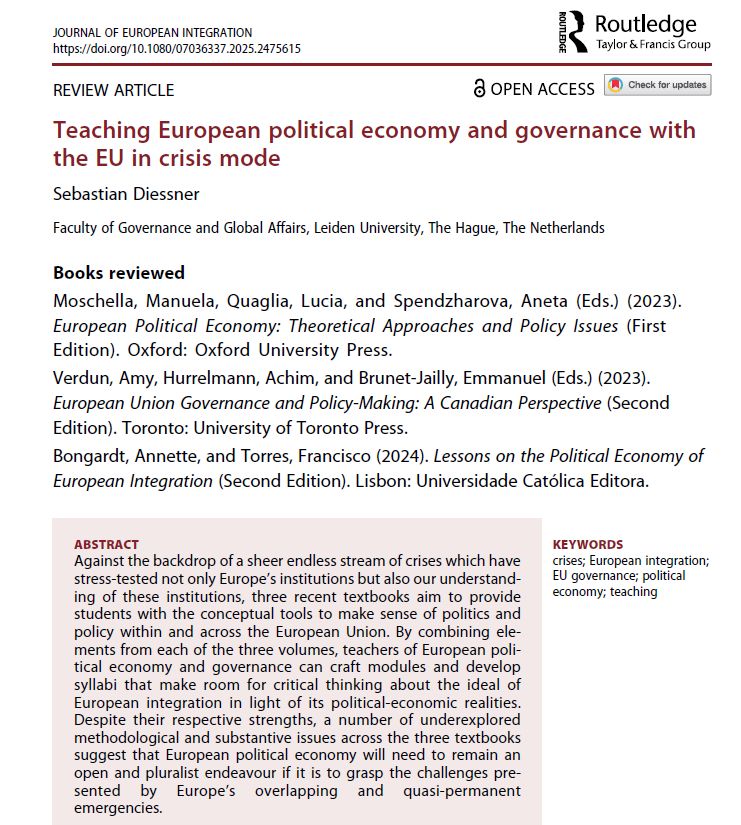
Interested in teaching EU governance, political economy and crises—but don't know where to start?
Then this one’s for you
doi.org/10.1080/0703...
Thanks to 3 excellent recent volumes by @manuelamoschella.bsky.social+co-authors @amyverdun.bsky.social @achimhurrelmann.bsky.social
A Bongardt/F Torres
06.03.2025 13:00 — 👍 71 🔁 20 💬 2 📌 3


On my way to Bochum where I'll spend the next days discussing the nuts and bolts of industrial policy with a stellar line-up of scholars.
This workshop, co-organized with Salih Bora and @fbulfone.bsky.social, is hosted and generously supported by the Center for Advanced Internet Studies (CAIS).
👇
16.09.2024 16:59 — 👍 5 🔁 2 💬 0 📌 0

PhD candidate
The Institute of Public Administration at Leiden University is looking for aPhD Candidate for the research project ‘Political Economy of the Green and Digital Transition between the Local, National an...
Come work with us! 📢
Fully-funded PhD position (4 years) at the Institute of Public Administration at Leiden University on political economy of the green and digital transition
Deadline: March 31 🚨
Supervised by the amazing @fbulfone.bsky.social & myself
www.universiteitleiden.nl/vacatures/20...
15.02.2024 15:11 — 👍 13 🔁 16 💬 0 📌 1
Political Economy and Public Policy
Many of the big challenges of the 21st century (climate change, international migration, financial instability, socio-economic inequality) find their origins in the organisation of the global economy....
Our Political Economy and Public Policy research group at Leiden University finally has a website! Check out our work 🔽
With @alexandreafonso.bsky.social, @fbulfone.bsky.social @sebdiessner.bsky.social, Samir Negash, Emily Anne Wolff, Janna Goijaerts and Roelien van der Wel
27.11.2023 07:48 — 👍 24 🔁 5 💬 1 📌 0
Money, markets, politics & culture; industrial policy; EU stuff. Prof at Georgetown University. Writings @kathleenrmcnamara.wordpress.com
Political scientist. Associate Professor at the University of Bologna.
Writes about IOs and comparative regionalism. https://www.unibo.it/sitoweb/giovanni.agostinis2/en
Author of Hidden Politics in the UN SDGs & Professor @ Moo U in Guelph - critical thoughts on commodities, sustainability & CSR + check out www.theicsdp.org and https://adamsneyd.com
Political scientist. Author of 𝑅𝑒𝑐𝑜𝑑𝑖𝑛𝑔 𝑃𝑜𝑤𝑒𝑟 (http://tinyurl.com/RePwr). Tech, labor politics, curiosities of capitalism.
Public education advocate, craft beer enthusiast, union strong, spouse of @cjmoose
Climate policy at CSE India
“The fact that we cannot save everything does not mean we cannot save anything and everything we can save is worth saving.” - Rebecca Solnit
Social protection and M&E in low-and-middle-income countries, especially in Latin America and the Caribbean.
Researcher at fgvclear.org
Views are my own.
Leveraging public data to build an equitable & inclusive economy that benefits everyone. Currently at Pioneer Valley Planning Commission. Alum of EARN/Economic Policy Institute, Connecticut Voices for Children and others.
Interested in labour struggles towards emancipating and just ways of working
Lausanne - Bern
CriticalGeography - justice and sustainability transformation - commons - marxism - degrowth - CareEconomies - JustTransition - LabourGeography
Associate Professor in Social Policy at University of Edinburgh. PhD from EUI Florence. New book: "How the Radical Right Has Changed Capitalism and Welfare in Europe and the USA" with Oxford University Press.
Website: www.philiprathgeb.com.
PhDing @JohnsHopkins | Fellow @ceprdc | (geo)politics of climate and infrastructure| @SOAS Alum | (she/her) views my own RT != E
she/her
Organizer - turkopticon.bsky.social
My time is spent on advocacy including worker rights, environmental concerns, and queer rights
🌈🍉
Malicious compliance is my resistance plan.
Walks in forests, swamps and fells in Finland. Commutes by bicycle.
I have a Mastodon profile at https://mastodon.social/@juuhaa
Professor of Sociology @UHelsinki, Vice Director & PI @CoE AgeCare. #minätutkin Migration studies x personal lives x inequalities. Professionalism x medical work x health occupations.
#Proffahommat #sosiologistaläppää yms usein suomeksi
Seuratoiminta ja sosiaaliturva.
Kirjoitin jalkapallokirjan;
https://kirjakauppa.bod.fi/pallon-kulmalta-arto-mononen-9789528068563
Director-General Analysis&Monitoring, Federal Public Service Social Security (BE). Posts in own name.
Policy advisor & academic - Political Scientist
Sociologist | Labor | Global China | Property | Globalization | @uni-jena.de
Migration researcher. Copenhagen. Forced migrants. Temporary protection. Camps. Postdoc @ AAU Sociology & Social Work.
https://scholar.google.dk/citations?user=zI3QLMkAAAAJ&hl=en
Employment Relations and HRM Professor at LSE. BJIR Editor-in-Chief. Avid runner and dog lover. Aotearoa born and raised.