Are there any Hindi speakers who could help proofread some LLM-generated translations for pkgdown? github.com/r-lib/pkgdow...
20.10.2025 18:58 — 👍 14 🔁 6 💬 0 📌 0
@abkumar.bsky.social
• 🎓PhD from Panjab University, Chandigarh 🇮🇳 • 🙋Member @sortee.bsky.social; @iavs5.bsky.social • 🌱Ecology ⛰️Macroecology 🌳Distribution • 🍂Decomposition 📚Synthesis 📊RStats • 🔍More at akumar.netlify.app
Are there any Hindi speakers who could help proofread some LLM-generated translations for pkgdown? github.com/r-lib/pkgdow...
20.10.2025 18:58 — 👍 14 🔁 6 💬 0 📌 0Thanks! That’s a great suggestion. This dataset could indeed work for #TidyTuesday biodiversity themes. 🌿
25.10.2025 07:49 — 👍 2 🔁 0 💬 1 📌 0That's fantastic to hear! Delighted that the work might be useful in a teaching context.
Please feel free to use the paper! Let us know if you or your students have any questions when working through the methods.
7️⃣ Data and #RStats codes available from @github.com
🔗 github.com/kumar-a/rich...
a copy is archived at @figshare.com
🔗 doi.org/10.6084/m9.f...
#OpenData #OpenScience #ReproducibleResearch
6️⃣ Conservation Takeaway
🔑Mid-elevational zones for conservation priorities, where #SpeciesRichness is greatest.
🧭 Read the full #OpenAccess article for the detailed analyses:
🔗 doi.org/10.3390/f161...

5️⃣ Influence of observed species?
As more species were added, elevational richness became more distinctly unimodal, converging toward the MDE predictions.
This effect also varies with extent and position of elevational gradients.

4️⃣ Is this just a random geometric effect?
We tested the Mid-Domain Effect (MDE) null model and found substantial deviations from its predictions.
This means plant distribution in the Himalayas is NOT a simple game of chance!

3️⃣ What did we find?
While species richness often showed complex non-linear unimodal (hump-shaped) patterns, simple linear decreasing pattern was also observed.
Patterns vary with extent and position of elevational gradients!

Map of study sites in the Western Himalayas
2️⃣ We compiled the elevational ranges of >1100 vascular plant species from three #ProtectedAreas — Morni Hills, Chail WLS, and Churdhar WLS. This contributes to knowledge gap for the #WesternHimalayas.
25.10.2025 05:41 — 👍 2 🔁 0 💬 1 📌 0
Graphical abstract showing varied elevational patterns of plant species richness across study sites with varying extent and position of elevational gradients.
🌿 Where are greatest number of #PlantSpecies in #Mountains? 🏔️
Our recent study in @mdpiopenaccess.bsky.social explored elevational patterns of plant #SpeciesRichness. A quick thread 👇
#Biodiversity #Biogeography #Ecology #ElevationalGradients #Himalayas #ProtectedAreas

🌍 Join SORTEE – A worldwide Open Science community for ecology and evolution! 🌱🧬
🌐 Join trainings, code clubs & our annual online conference
🚀 Help shape the future of Open Science
Membership is inclusive and flexible.
👉 Learn more: www.sortee.org/join/
#OpenScience #Ecology #Evolution

🌍 Join SORTEE – A worldwide Open Science community for ecology and evolution! 🌱🧬
🌐 Join trainings, code clubs & our annual online conference
🚀 Help shape the future of Open Science
Membership is inclusive and flexible.
👉 Learn more: www.sortee.org/join/
#OpenScience #Ecology #Evolution
🚨Introducing the @sortee.bsky.social Guidelines for Data and Code Quality Control in Ecology and Evolutionary Biology🚨 doi.org/10.32942/X24...
Increasingly E&E journals are recruiting data editors. We provide standardised guidelines for journals with data editors and those wanting to recruit them 🧵
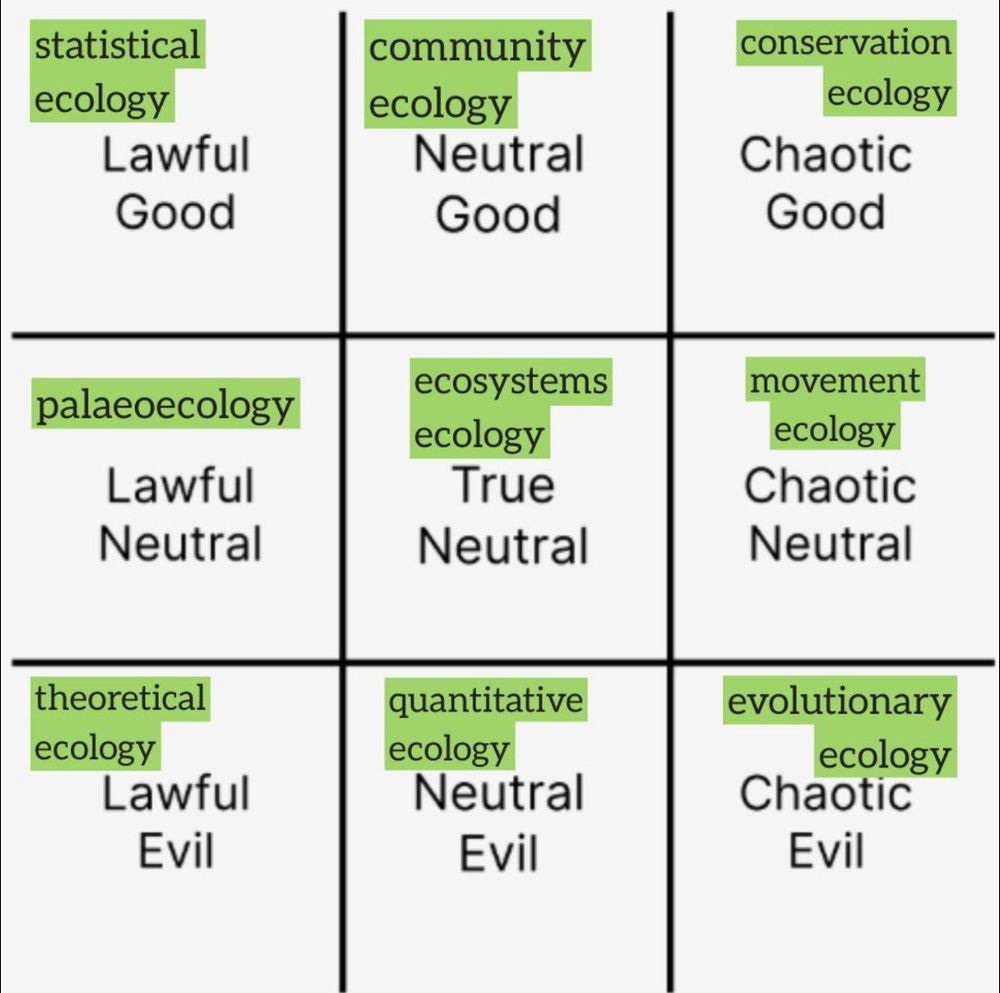
Was just sent this, author unknown. There's plenty to debate but they're right about evolutionary ecology. 🌏
25.07.2025 15:49 — 👍 50 🔁 17 💬 2 📌 2
Would you like to promote & support Open Science in Ecology & Evolution?
Become SORTEE's In-person Socials Manager to promote & support local open science meet-ups at conferences
Examples here: buff.ly/7ipduY5
Interested? Email sortecoevo@gmail.com for more info

Our new paper - manage to put @sortee.bsky.social in keywords
link.springer.com/article/10.1...
Still some time to apply for this #trait-based #ecology #postdoc
✔️in supportive group within a lively faculty
✔️in beautiful Helsinki with forests🌲, shoreline and islands 🏕️

Postdoc opportunity: Drivers of biodiversity change across time 🌿 🦅 🌍
Come work with fabulous Naia Morueta-Holme (and a bit with me)
2-year position starting March 1, 2025
Naia's lab page: lnkd.in/drHQBGdU
Apply here (deadline 5 Jan 2025) candidate.hr-manager.net/ApplicationI...
There is still space left in the #biodiversity #redistribution starter pack ⬇️ If you are working on or interested in biodiversity responses, aka #species #range #shifts & #community #composition #changes, to global change drivers, I'd be happy to add you in the list 😀
go.bsky.app/6KqEpb9

📢#WeAreHiring! I am looking for a #postdoc (2yr position) either in ecological modelling or experimental trait-based ecology to join us in Northern Biodiversity and Ecosystem functioning group at @helsinkiuni.bsky.social
Thanks for reposting!
jobs.helsinki.fi/job/Helsinki...
Archived Data and #RStats codes are openly available from figshare doi.org/10.6084/m9.f...
Also, maintained at github.com/kumar-a/rich...
#OpenScience #ReproducibleResearch

Direct effects are stronger than the indirect effects
Indirect effects are strongly mediated by water-energy dynamics than energy availability
Overall, our study supported:
1️⃣Climate tolerance hypothesis > 2️⃣Water-energy dynamics > 3️⃣Species-energy hypothesis

Climate is more important than the topographic heterogeneity at broader scales
Richness is regulated by multiple mechanisms involving direct indirect and interaction effects of environmental variables

Model suggested by Francis and Currie (2003, doi.org/10.1086/368223) better represented climate-richness relationship.
www.journals.uchicago.edu/doi/10.1086/...

Species richness seems to be regulated by 💦 liquid-water availability, i.e. interaction between temperature and water-deficit.
03.12.2024 16:44 — 👍 0 🔁 0 💬 1 📌 0
What determines the plant species richness along elevational gradients?
In this latest study, we explored the direct, indirect and interaction effects of environmental variables.🧵
#Biodiversity #ElevationalGradients #Himalayas #Macroecology #PlantEcology #SpeciesRichness
doi.org/10.1186/s137...

Profile pic of the Journal of Vegertation Science.

Profile pic of the journal Applied Vegetation Science.
The two @iavs5.bsky.social journals @applvegsci.bsky.social and @jvegsci.bsky.social have arrived here.
29.11.2024 07:07 — 👍 27 🔁 9 💬 1 📌 2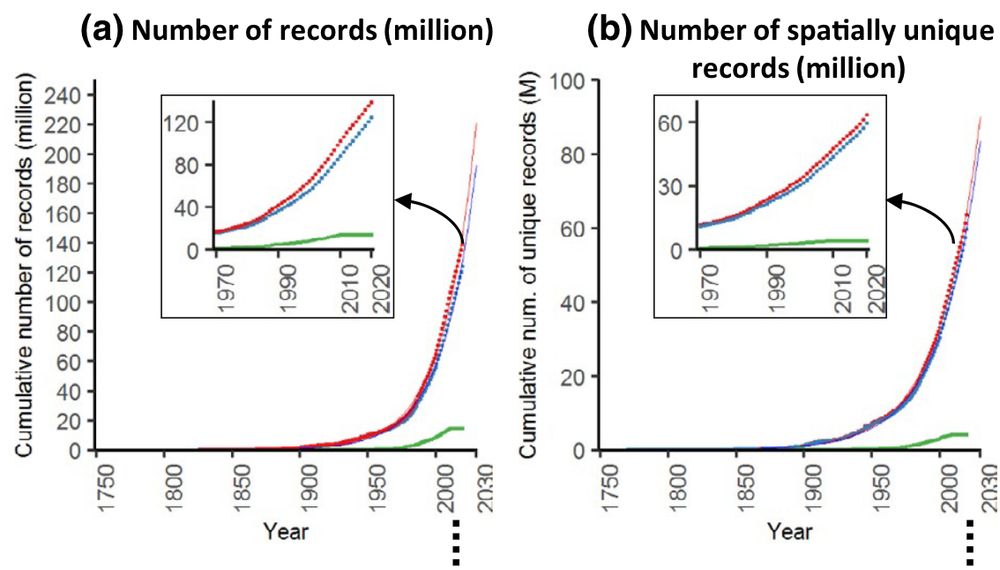
patial and taxonomic coverage of terrestrial plant occurrence data. Georeferenced plant observations, as illustrated by observation dates in Global Biodiversity Information Facility (GBIF; the largest biodiversity informatics infrastructure), have increased exponentially over the past 200 years (panels a, b), though the number of species recorded in these databases is reaching saturation (panel c). By integrating additional data sources compiled by Botanical Information and Ecology Network (BIEN; i.e., non-GBIF sources comprising ~15 million records; panel d), the georeferenced plant observations in GBIF can be expanded by an additional ~4 million spatially unique records (panel e) and ~20,000 species (panel f). Still, the gaps in plant distributions warrant our attention: areas in Russia, central Asia, and northern Africa (red colour in panel g) are missing publicly available occurrences. The grey colour in panel (g) represents the presence of plant data, and the black colour represents ice-covered areas
The biodiversity data deluge is here - the equivalent of #MooresLaw but for biodiversity data? "we estimated that the total number of plant distribution records doubles every 17 years and the number of spatially unique records doubles every 21 years." onlinelibrary.wiley.com/doi/full/10.... 🌎🧪🦋🦫
27.11.2024 15:26 — 👍 121 🔁 37 💬 1 📌 2
This year's contribution to Citizen Science 🌱👇
27.11.2024 16:05 — 👍 0 🔁 0 💬 0 📌 0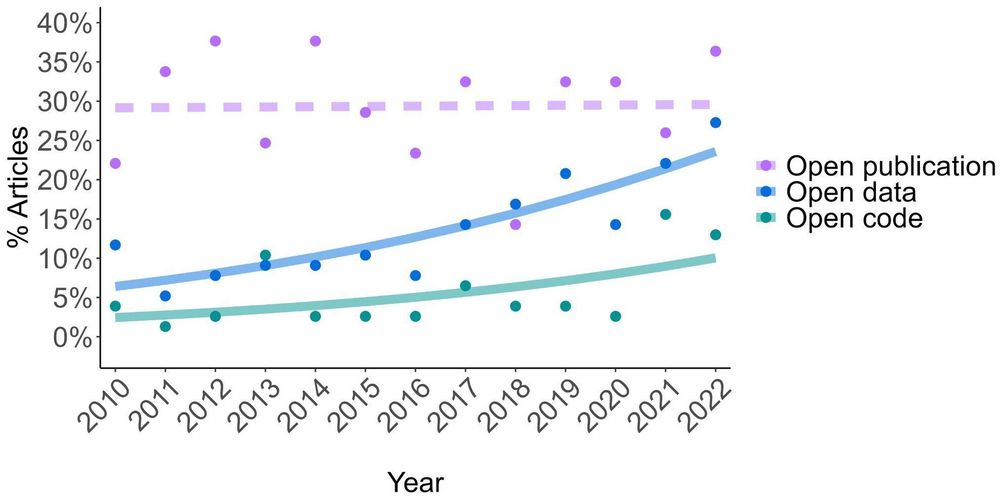
I'd like to encourage folks to publish their code. Not only does it make studies more transparent and reproducible, but it also increases citation rates!
onlinelibrary.wiley.com/doi/full/10....