3 weeks ago
I totally agree, that's why I change the automatic language and say we'll adjust the deadline to the reviewer's needs.
2
0
1
0
3 weeks ago

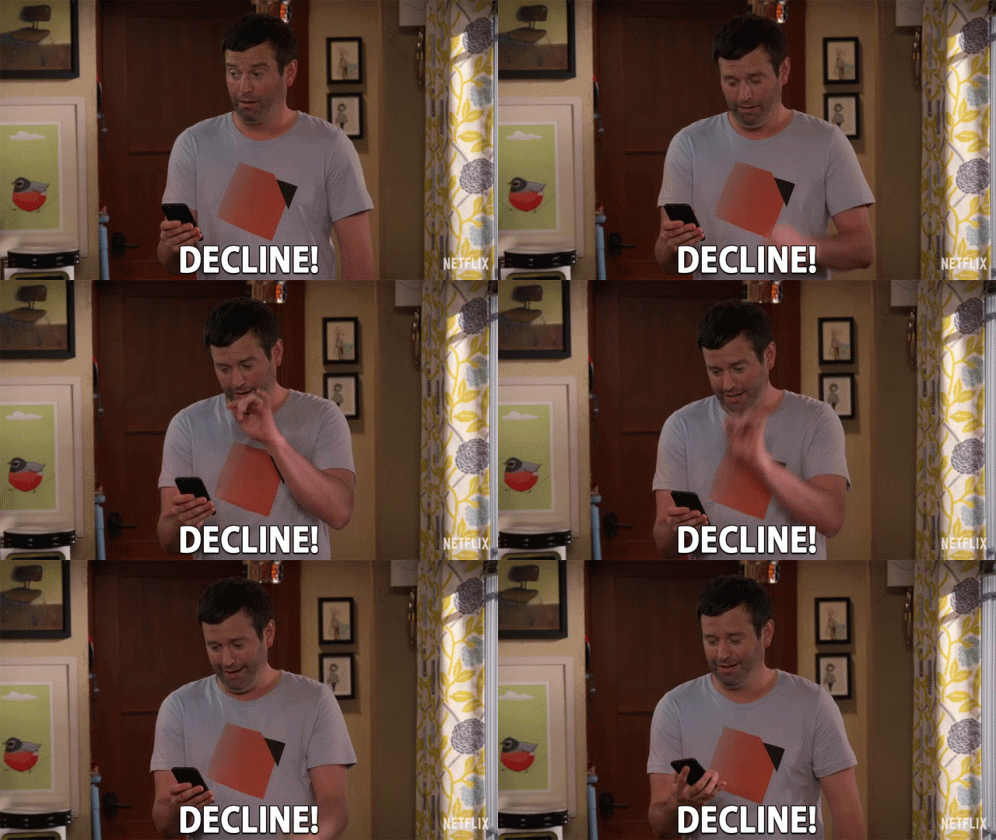
a man holding a cell phone with the word decline on his shirt
ALT: a man holding a cell phone with the word decline on his shirt
Editor perspective: finding 2–3 reviewers often means sending >20 invites. The peer-review system doesn’t run on magic. Worth remembering before clicking “decline” and later complaining about extremely slow reviews.
8
2
1
0
1 month ago
#Tel_Aviv still has a few things going for it in February.
3
0
0
0
2 months ago

snoopy is standing in front of a fireworks display and says `` so proud of you ! ''
ALT: snoopy is standing in front of a fireworks display and says `` so proud of you ! ''
3/3 shout out to Yael Admoni the PhD student who led this project with help from Rubi Aharoni and Magda Lewandowska and our amazing collaborators at the lab of Qi Chen (Utah)
0
0
0
0
2 months ago

a man wearing headphones and a red hoodie with the word limited on the bottom right
ALT: a man wearing headphones and a red hoodie with the word limited on the bottom right
2/3 Yet, their RNAi response is surprisingly short-lived and we show that most probably secondary siRNAs are not formed (good luck with proving 100% that something doesn't happen). This strongly suggests that RNAi takes part in the antiviral response in Cnidaria but in a limited capacity ->
0
0
1
0
3 months ago

elmo with fireworks behind him and the word fireworks
ALT: elmo with fireworks behind him and the word fireworks
5/5 kudos to Ton Sharoni, the PhD student who bravely led this long and challenging project, and to all the other researchers in my lab who participated and helped along the years, and special thanks to our amazing collaborators at the lab of Adam Reitzel!
0
0
0
0
3 months ago

a woman in a black dress is standing in front of a white background and smiling .
ALT: a woman in a black dress is standing in front of a white background and smiling .
4/5 we show that CARDIB and it's RLR partners are indeed crucial for antiviral immunity. Take home message: not every positive BLAST result tell you the function and orthology of a protein in another organism, and, CARDIB rocks!
0
0
1
0
3 months ago

a woman is holding a newspaper and says that 's wild netflix
ALT: a woman is holding a newspaper and says that 's wild netflix
3/5 we present transcriptomic and functional data from unprecedented number of #Nematostella mutant lines, and "rewildering" experiments where we expose the mutants to native conditions and water full with viruses from the blackish lagoons where Nematostella comes from!
1
0
1
0
3 months ago

two basketball players are dancing on the court and one of them has the number 1 on his jersey
ALT: two basketball players are dancing on the court and one of them has the number 1 on his jersey
2/5 CARDIB is the best reciprocal BLAST hit to MAVS (aka IPS, VISA and CARDIF) of mammals. Yet, we show it is not an ortholog of MAVS and works in a completely opposite fashion: it inhibits RIG-I-based signaling and antiviral response rather than promoting it!
2
0
1
0
4 months ago
Very happy and honored for being invited to give a keynote lecture at the 5th ISFSI conference in beautiful Tainan (and no, sea anemones are not fish or shellfish, but they are certainly marine invertebrates and have a fascinating immune system).
10
0
0
0
5 months ago

a man is holding a microphone and saying yes i love technology
ALT: a man is holding a microphone and saying yes i love technology
3/3 this is a co demonstration how adaptation of experimental methods in genomics and cell biology into less conventional model organisms can shed light on evolutionary questions. Kudos to Itamar and to Daria Aleshkina, Adrian Jaimes-Becerra & Matan Levy from our lab who helped him.
0
0
0
0
5 months ago
2/3 stinging cells, aka cnidocytes, are the cells that define Cnidaria. Their organelles are the ones injecting venom when you are stung by a 🪼 or 🪸. Itamar's work highlights their molecular complexity and how they can be divided epigenetically into distinct populations. >>>
0
0
1
0
5 months ago
bsky.app/profile/yehu...
9
1
0
0
5 months ago
There’s a reason no one remembers philosophers from Sparta: they had none. Athens valued ideas, Sparta only force.
A 21st-century leader dreaming of a “super-Sparta” isn’t being visionary, he’s showing deeply flawed judgement.
Oh, my country, what a train wreck you’ve become.
5
1
0
0
5 months ago
I'm super proud of this guy!!! 👇
7
0
1
0
6 months ago

two men are standing next to each other with blood on their faces . one of the men is wearing a plaid shirt .
ALT: two men are standing next to each other with blood on their faces . one of the men is wearing a plaid shirt .
A journal drags our review process for months over months. Even the final round after "accepted in principle" with some light text editing drags for weeks. Then the proofs come in, in the least convenient time possible, "we expect you to return your comments within 48 hours" 😖
5
0
0
0
6 months ago

An ancient and essential miRNA family controls cellular interaction pathways in C. elegans
A microRNA that arose at the origin of eumetazoans regulates cell adhesion and signaling in C. elegans through conserved targets.
Our work on the function of miR-51/miR-100 is out! miR-100 is widely conserved across eumetazoans but its function has been mysterious. Emilio Santillán found in worms it regulates signaling and extracellular matrix genes, some of which seem to be conserved targets! www.science.org/doi/10.1126/...
93
35
5
7
6 months ago
Very cool! Congratulations, Luisa!
1
0
0
0
7 months ago
We sent a paper to a "posh" journal. Waited for more than a month, Finally today the editor rejects the paper without external review. The logic is as follows: "I wanted 🍕, but you sent me a 🍔, and despite my expectations, there was no 🍕! I admit it's a fine 🍔, but where is the 🍕 I was expecting?"
3
0
0
0
8 months ago
Achievement unlocked!
Now, I can finally rest 🤪
5
0
1
0
8 months ago
Hello, old friend.
Didn't expect to meet you here...
#Berlin #aquarium #Anemonia
9
0
0
0
8 months ago
Well, I would say that relying on where a paper was published is still not a good proxy (that's an understatement), for the quality of a paper but far less terrible than thinking that high impact factor equals a "good" journal while low impact factor equals a "bad" journal.
1
0
1
0