Hi - I'm fundraising for Doctors Without Borders to provide clean water in Gaza where over 80% of water infrastructure has been destroyed. To learn more about the campaign please click here : www.justgiving.com/team/ultracy...
21.08.2025 09:09 — 👍 6 🔁 2 💬 0 📌 0
1/3. We're thrilled to announce the publication of: “The Declining Kingdom? Emotional Ascription, Emotional Expectations, and Humour in the International Framing of the UK in Crisis” by Anne-Marie Houde
@annemhoude.bsky.social
@polstudiesassoc.bsky.social
@sagepub.com
25.07.2025 10:38 — 👍 2 🔁 2 💬 1 📌 0
Thanks @ericvanr.bsky.social !
24.07.2025 13:21 — 👍 0 🔁 0 💬 0 📌 0
Massive thank you to the special issue's editors, the Politics team, and the reviewers for making the publication process so smooth. A special thank you also to @ngellwitzki.bsky.social and @benrosher.bsky.social for their feedback on an earlier draft of the paper.
24.07.2025 10:45 — 👍 2 🔁 0 💬 0 📌 0
These negative framings challenge the narrative of Global Britain, undermining national image, soft power, and status aspirations. However, the article also finds that such critiques are primarily directed at British politicians rather than the population or culture.
24.07.2025 10:45 — 👍 1 🔁 0 💬 1 📌 0
It introduces the concepts of emotional ascription and emotional expectations, and incorporates humour into the analysis. Drawing on international media, the article identifies two dominant portrayals: the UK as a pitied, “broken” country, and as a mocked “laughing stock.”
24.07.2025 10:45 — 👍 1 🔁 0 💬 1 📌 0
Over the last few years, the UK has faced some crises, including Brexit, the COVID-19 pandemic, the death of Queen Elizabeth II, and a deepening cost-of-living crisis. This article examines how foreign media have portrayed the UK in relation to these events, with a focus on the politics of emotions.
24.07.2025 10:45 — 👍 0 🔁 0 💬 1 📌 0

Sage Journals: Discover world-class research
Subscription and open access journals from Sage, the world's leading independent academic publisher.
journals.sagepub.com/doi/10.1177/...
My latest article, "The Declining Kingdom? Emotional Ascription, Emotional Expectations, and Humour in the International Framing of the UK in Crisis”, is now available in @politicsjournal.bsky.social as part of a special issue on Global Britain. 🇬🇧
24.07.2025 10:45 — 👍 10 🔁 4 💬 1 📌 1
Massive thank you to the special issue's editors, the Politics team, and the reviewers for making the publication process so smooth. A special thank you also to @ngellwitzki.bsky.social and @benrosher.bsky.social for their feedback on an earlier draft of the paper.
24.07.2025 10:42 — 👍 2 🔁 0 💬 0 📌 0
These negative framings challenge the narrative of Global Britain, undermining national image, soft power, and status aspirations. However, the article also finds that such critiques are primarily directed at British politicians rather than the population or culture.
24.07.2025 10:42 — 👍 0 🔁 0 💬 1 📌 0
It introduces the concepts of emotional ascription and emotional expectations, and incorporates humour into the analysis. Drawing on international media, the article identifies two dominant portrayals: the UK as a pitied, “broken” country, and as a mocked “laughing stock.”
24.07.2025 10:42 — 👍 0 🔁 0 💬 1 📌 0
Over the last few years, the UK has faced some crises, including Brexit, the COVID-19 pandemic, the death of Queen Elizabeth II, and a deepening cost-of-living crisis. This article examines how foreign media have portrayed the UK in relation to these events, with a focus on the politics of emotions.
24.07.2025 10:42 — 👍 0 🔁 0 💬 1 📌 0
Find mine and @ngellwitzki.bsky.social’s new article on EU-UK relations and the emotional (de)politicisation of the Covid-19 vaccine in International Affairs' new issue 📄
01.07.2025 11:37 — 👍 7 🔁 3 💬 0 📌 0
It’s held in Newcastle, UK 😊
12.06.2025 09:04 — 👍 0 🔁 0 💬 1 📌 0
Last day to send your paper proposal to our “Global Politics of Hope” workshop! @indrajitroy.bsky.social @mybisa.bsky.social @isanet.bsky.social
12.06.2025 08:07 — 👍 1 🔁 2 💬 1 📌 0
You’re a star ⭐️
11.06.2025 11:50 — 👍 1 🔁 0 💬 0 📌 0
Delighted to see this out! It was a real pleasure to co-author this piece with the brilliant @annemhoude.bsky.social on the emotional (de)politicisation of the ‘Oxford’ vaccine and its significance for EU–UK relations. It’s open access - do have a look!
🔗: academic.oup.com/ia/advance-a...
🧵👇
10.06.2025 16:29 — 👍 17 🔁 6 💬 0 📌 0
Thank you to the editors and reviewers, and to @louis-stockwell.bsky.social for his feedback on an early draft of the article!
10.06.2025 11:00 — 👍 2 🔁 0 💬 0 📌 0
Our article shows how emotions drive (de)politicisation, shaping what is contested—and what is not.
It contributes to debates on affect in IR, EU politicisation, and Brexit’s ongoing emotional resonance.
10.06.2025 10:59 — 👍 0 🔁 0 💬 1 📌 0
Domestically, emotional appeals depoliticised the government’s vaccine response.
Internationally, those same emotions politicised EU–UK relations.
This dual process reveals the emotional architecture of post-Brexit legitimacy.
10.06.2025 10:59 — 👍 0 🔁 0 💬 1 📌 0
We call this Gefühlspolitik: policymaking through emotion.
The British public was entitled to feel proud.
The EU was obligated to feel ashamed.
These emotional claims shaped how blame and credit were distributed.
10.06.2025 10:59 — 👍 0 🔁 0 💬 1 📌 0
Meanwhile, EU concerns over safety were framed in British discourse as retribution, incompetence, or even spite.
A vaccine war narrative emerged, casting Britain as heroic underdog.
10.06.2025 10:59 — 👍 1 🔁 0 💬 1 📌 0
We unpack how emotions shaped the politics of the COVID-19 vaccine post-Brexit. We show that the UK media and government framed the 'Oxford' vaccine as proof that Brexit was right; a moment of national pride and vindication.
10.06.2025 10:59 — 👍 1 🔁 0 💬 1 📌 0
🚨New Publication🚨I'm thrilled to share my latest article on the emotional (de)politicisation of the ‘Oxford’ COVID-19 vaccine and its impact on EU-UK relations, now available on @iajournal.bsky.social's website. 🇬🇧🇪🇺
As always, it has been a joy to work with @ngellwitzki.bsky.social on this project.
10.06.2025 10:59 — 👍 15 🔁 7 💬 2 📌 1
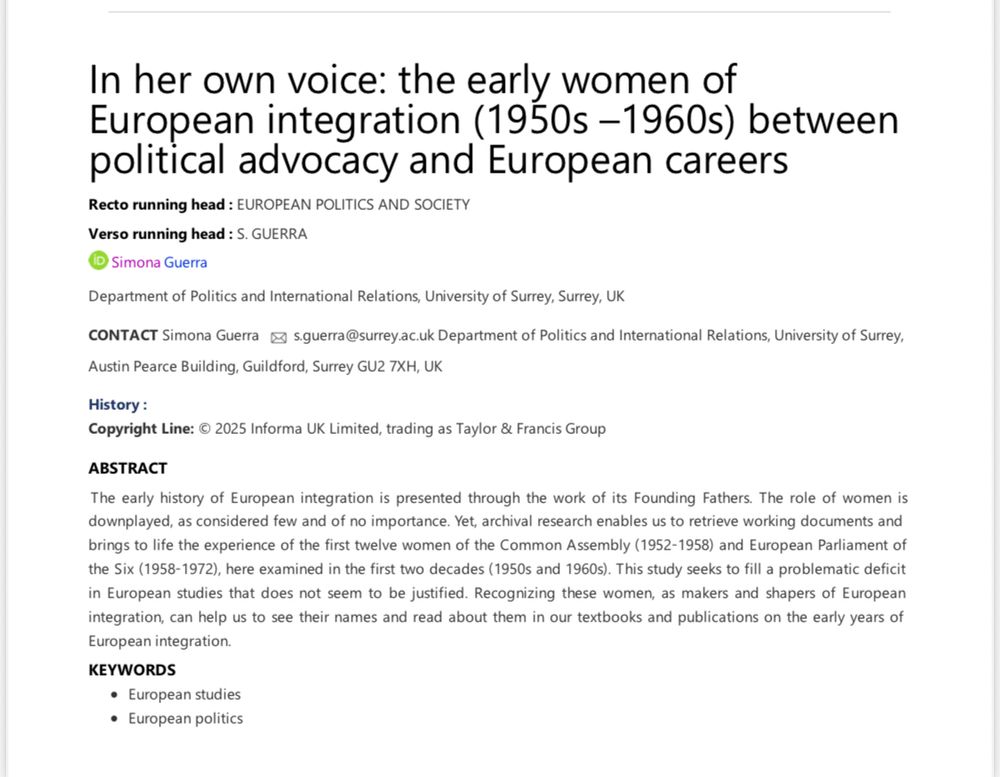
Title and abstract of the forthcoming article on the European Common Assembly, later European Parliament of the Six, women and their career. ‘In their own voice: the early women of European integration (1950s-1960s) between political advocacy and European careers’, soon out in European Politics and Society.
📬 Forthcoming on European Politics and Society,the 2nd article on my @esrciaasurrey.bsky.social project on the early women of European integration,thanks to the writing time at ULB with @nathaliebrack.bsky.social more on this at the nxt @uaces.bsky.social annual general conf @cbesurrey.bsky.social
05.06.2025 07:04 — 👍 15 🔁 5 💬 1 📌 1
Thank you☺️
04.06.2025 08:48 — 👍 1 🔁 1 💬 0 📌 0
Honoured to be this year’s winner of the @epir-bisa.bsky.social @mybisa.bsky.social best thesis prize, and to share this recognition with the amazing @ubaspehlivan.bsky.social ⭐️ Thank you to the judges!
04.06.2025 08:46 — 👍 15 🔁 3 💬 1 📌 0
Congratulations Karl!
30.05.2025 09:00 — 👍 1 🔁 0 💬 1 📌 0
Congratulations! Great article, well deserved
30.05.2025 09:00 — 👍 2 🔁 0 💬 0 📌 0
Departmental Lecturer, Oxford University (and Univ College). Mostly thinking about international criminal law and human rights, sometimes about pandemic politics.
European Political Science Review (EPSR) is an #OpenAccess journal of the European Consortium for Political Research (ECPR).
Publishing original and substantial contributions to the study of comparative European politics. A journal from the European Consortium for Political Research (ECPR) https://ejpr.onlinelibrary.wiley.com/journal/14756765
PhD candidate Northwestern @polisciatnu.bsky.social
Political violence, social movements, IR
Professor of Political Science, University of Copenhagen. Research interests: European and Nordic Politics, Political Economy. Collector of modern ceramics, Faroese paintings and Christine Swane paintings. Lifelong fan of Bob Dylan and modernist poetry.
100+ years as a leading international relations journal.
Published by @chathamhouse.org & @oxunipress.bsky.social. Views individual not institutional.
📖 Read: internationalaffairsjournal.com
🛒 Subscribe: https://academic.oup.com/ia/subscribe
Political science PhD @univie.ac.at | she/her
Researching how citizen respond to independent politicians | Political behavior, parties, technocracy, women & politics
https://jeannezmarlier.notion.site/
CivilWarPaths Fellow | FHEA | PhD UoMPolitics | Visual Politics | Memory and Trauma | Timor-Leste. MA/BA IRI_PUCRIO | BISA EPIR Convenor
Official journal of the Australian Political Studies Association (@auspsa.bsky.social). Find us at https://www.tandfonline.com/journals/cajp20
grad student @NorthwesternU, politics, ir, affect. thinking about melodrama and seriousness in world politics.
The Department of Politics and International Relations (DPIR) at the University of Oxford
* Associate Prof. of Political Science, St. Lawrence University
* Transparency International Consultant
* Good Authority Fellow
* International organization; the EU; good governance, corruption, populism in Europe, and a bit of Turkey
* 💛💙Fenerbahçe💛💙
Political scientist at the Autonomous University of Barcelona. Working on public opinion, political attitudes and democracy
www.enriquehernandez.eu
PhD Candidate in International Relations @UofGSPS
📚Researching #VisualPolitics and #Migration
Husband|Dad|Professor @UniOfYork| D.Phil @UniofOxford|Author
@CambridgeUP @routledgebooks @OxUniPress |Council@devcomms| Trustee @PolStudiesAssoc| EC @ipsa_aisp
PhD student UVA
violence, democracy, riots, research methods, politique québécoise et canadienne
https://alexisbibeau.weebly.com/
Postdoctoral Research Associate @ Queen Mary University London. Studying memes, digital politics, critical theory, and subjectivity.
Compte officiel des Canadiens de Montréal • Official account of the Montreal Canadiens #GoHabsGo instagram.com/canadiensmtl facebook.com/canadiensmtl
Compte officiel des Canadiens de Montréal · Official account of the Montreal Canadiens #GoHabsGo 🏒🥅