Header and abstract page of an original research article in History and Philosophy of the Life Sciences (2026, volume 48, article 12) titled "Modeling versatility as the hallmark of model organisms," authored by Guido I. Prieto and Alejandro Fábregas-Tejeda.
Abstract
In recent years, discussions on the epistemology of model organism-based research have emerged in the philosophy of science. A key topic of discussion is how the epistemic insights gained from model organisms differ from those gained through other experimental organisms used in laboratory and field research. Here, we argue that model organisms are epistemically special due to their nature as ontogenetically changeable, standardized, and evolved material model carriers. These characteristics afford six important kinds of modeling versatility that biologists marshal in their investigations: (i) synchronic target versatility; (ii) synchronic scope versatility; (iii) diachronic target versatility; (iv) diachronic scope versatility; (v) manipulation versatility; and (vi) discovery versatility. In presenting these dimensions of modeling versatility, we also clarify key notions such as ‘representational target,’ ‘representational scope,’ and ‘representational power’ as these apply to modeling practices that involve model organisms.
It has been argued that what sets model organisms apart from other experimental 🐋🌱 is their high representational power. In our latest 📃, we argue otherwise: the hallmark of MOs lies in the dimensions of modeling versatility they afford to scientists 👇 link.springer.com/article/10.1... #philsci #HPS
25.02.2026 13:42 — 👍 37 🔁 13 💬 2 📌 0
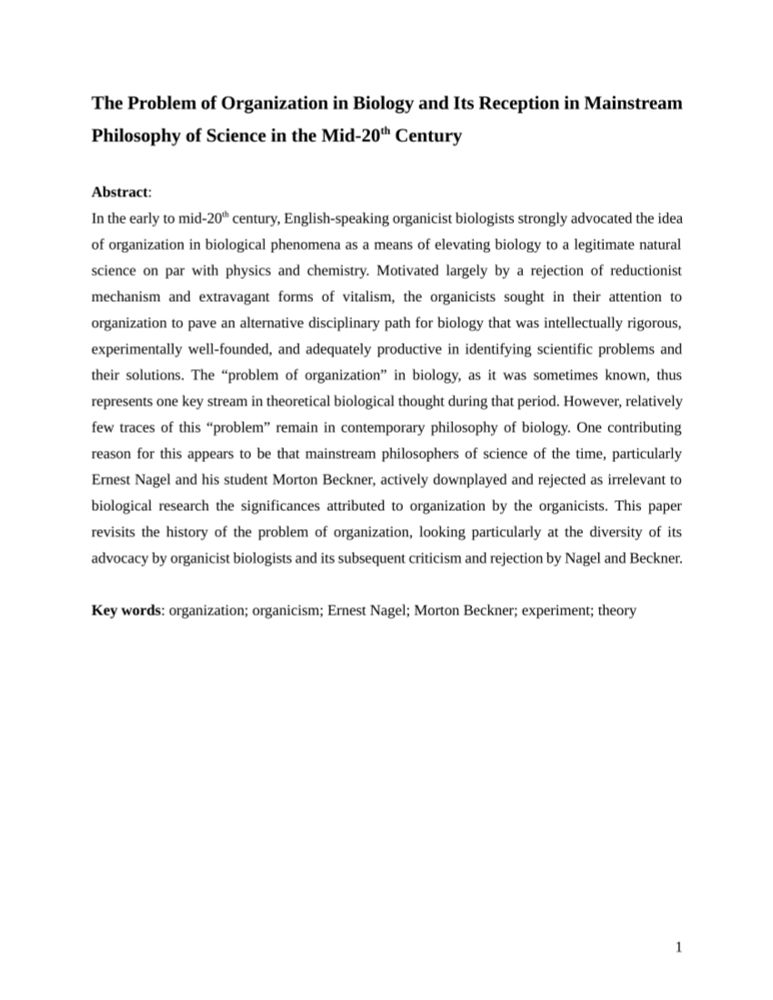
In case you're interested in the history of the philosophical engagement (or lack thereof) with biological organization, HOPOS has provided me with a link to download my forthcoming paper (limit of 50) at the following link: www.journals.uchicago.edu/eprint/RGWQP...
#hpbio #philbio #philsci
23.02.2026 16:38 — 👍 12 🔁 5 💬 0 📌 0

Join us for this workshop with @petinozappala.bsky.social
Details+registration: www.imseam.uni-heidelberg.de/en/heinzelma...
#Philosophy #philsci #ethics #politics
18.02.2026 13:51 — 👍 18 🔁 10 💬 1 📌 1

What Is Life? Revisited
Cambridge Core - Philosophy of Science - What Is Life? Revisited
This short book by @djnicholson.bsky.social is extraordinarily good for understanding not just the genesis, message and myths of Schrödinger's book but also why molecular biology developed in the way it did (and what's problematic about that).
www.cambridge.org/core/element...
14.01.2026 22:18 — 👍 79 🔁 21 💬 2 📌 2
#philsci #psychology
Abstract and link to join here 👉 www.imseam.uni-heidelberg.de/en/heinzelma...
08.01.2026 12:25 — 👍 5 🔁 2 💬 0 📌 0
My biggest piece yet for the #Rudolphina research magazine of #UniVienna on Rupert Riedl and thread of meta-inquiry that led to the creation of marine biology, theoretical biology, electron microscopy and cognitive biology at the University of Vienna. rudolphina.univie.ac.at/en/the-intel... #evobio
12.11.2025 13:51 — 👍 27 🔁 5 💬 2 📌 0
An excellent paper by @petinozappala.bsky.social on gatekeeping between disciplines nominally expected to integrate! #PhilSci #HPBio #evobio
05.11.2025 14:21 — 👍 8 🔁 0 💬 0 📌 0

<i>What Is Life?</i> Revisited
Cambridge Core - Philosophy: General Interest - <i>What Is Life?</i> Revisited
My little book on Schrödinger's famous classic 'What Is Life?' is out! Offering the most comprehensive analysis ever undertaken of the book's origins, reception, impact, and legacy, it uncovers Schrödinger's motivations in writing it, and shows how it has shaped our current understanding of the cell
10.10.2025 13:52 — 👍 124 🔁 42 💬 11 📌 6
YouTube video by Carnegie Mellon University Libraries
Author Pamela McCorduck Interviews Herb Simon
absolutely fascinating - Pamela McCorduck interviews Herbert Simon in 1974, history of #ai www.youtube.com/watch?v=TFkO...
27.09.2025 06:14 — 👍 7 🔁 2 💬 0 📌 0
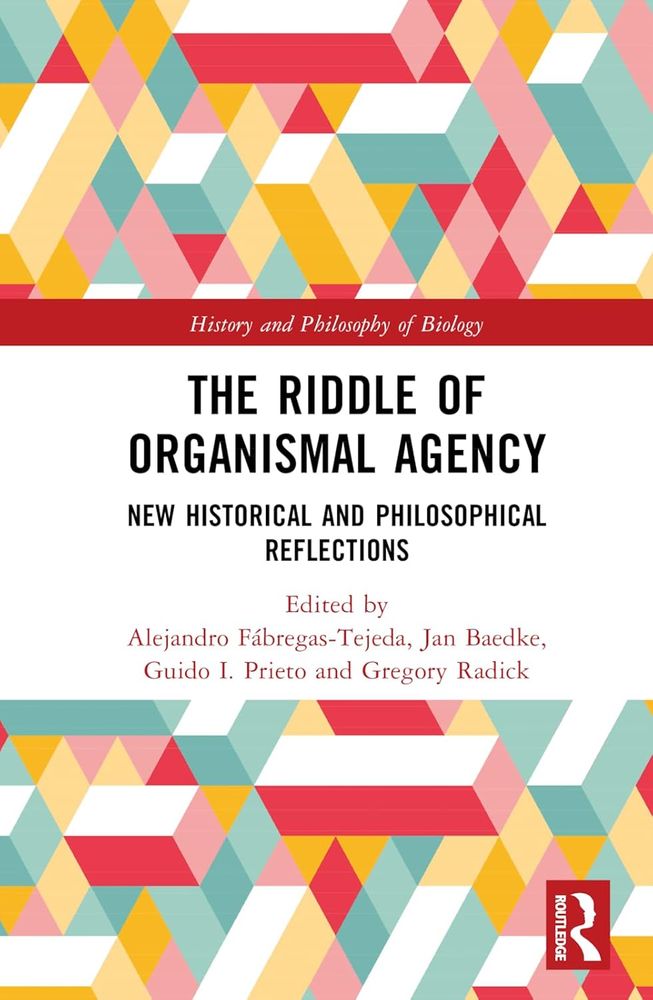
Book cover of "The Riddle of Organismal Agency: New Historical and Philosophical Reflections" (Routledge, 2024). The book belongs to the "History and Philosophy of Biology" series. The editors are Alejandro Fábregas-Tejeda, Jan Baedke, Guido I. Prieto, and Gregory Radick. The design features a geometric pattern of interlocking, multicolored triangles in shades of red, yellow, teal, white, and pink. The Routledge logo appears in the lower right corner.
Organismal agency is one of today's liveliest debates in the life sciences. Our volume—published a year ago—brings historians, philosophers & scientists into the conversation, offering the kind of nuanced treatment this complex issue deserves 👇 www.routledge.com/The-Riddle-o... #HPS #evosky #philsky
04.08.2025 13:04 — 👍 79 🔁 24 💬 2 📌 0
This paper was nine (!) years in the making, beginning as a side project about methodological disputes in philosophy of science before becoming a committed attempt to engage in a historically rich vein of conceptual theory in biology. It ended up at almost 19K words (!!).
29.07.2025 11:38 — 👍 2 🔁 0 💬 0 📌 0
*Or rather referred to organicist ideas as 'vitalism.'
29.07.2025 11:38 — 👍 1 🔁 0 💬 1 📌 0
Pushback against the organicists in mainstream philosophy of science, especially by Ernest Nagel and his student Morton Beckner, was harsh. They dismissed organization as an unspecified concept that promoted conviction over rational argument. Others like Hempel ignored organicism entirely*
29.07.2025 11:38 — 👍 1 🔁 0 💬 1 📌 0
Devastated to hear this. His books shaped how I thought about development, evolution, history, and science in general. I corresponded with him during grad school when it was less acceptable to be a Marxist in science. His encouragement kept me in the game, and made the field seem less lonely.
10.07.2025 22:57 — 👍 17 🔁 1 💬 0 📌 0
@epsaphilsci.bsky.social junior scholar online series came to an end yesterday with a great talk about "How to deal with Imposter Syndrome and self doubt" by Azita Chellapo, @dsbrooks.bsky.social, @mjbuedo.bsky.social and @abigailnd.bsky.social. Thanks for the personal stories and helpful advices! 💐
11.07.2025 08:51 — 👍 6 🔁 2 💬 0 📌 0
DEADLINE EXTENDED to Apr 7 (midnight, CET)
For those of you who struggled with the submission system (we do to!), and those that didn't realize the deadline was on midnight **Central European Time**. 😉
Submit your motivation letter & CV at the link below:
#VeniceEvoDevo
01.04.2025 14:52 — 👍 5 🔁 5 💬 0 📌 0
Deadline extended to April 7th -- Please consider applying!
02.04.2025 06:49 — 👍 0 🔁 0 💬 0 📌 0
Deadline is TOMORROW night (Mar 31).
Not tonight, like wrongly announced at first.
And that's good news: because you get another 24hrs to apply, if you have not yet done so!
What are you waiting for!? 😉
Registration link below:
30.03.2025 13:57 — 👍 2 🔁 3 💬 0 📌 0
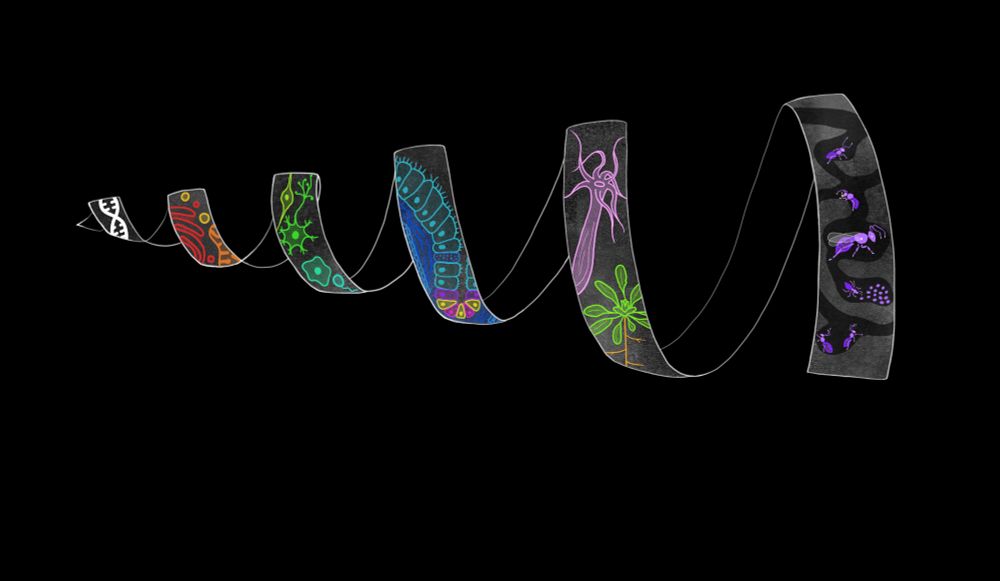
Venice Summer School 2025: Emergence & Evolution of Multi-Level Regulatory Systems
Biological systems comprise multiple levels of organization , from molecules, organelles, and cells, to the multi-cellular structures that form whole tissues, organisms, and ultimately societies and …
If you're interested in theory in biology, please consider applying for this EMBO|FEBS Lecture Course "Emergence & Evolution of Multi-Level Regulatory Systems", organized by @yoginho.spore.social.ap.brid.gy, @nrepina.bsky.social, and James DiFrisco. meetings.embo.org/event/25-mul... #philsci #evobio
26.01.2025 15:53 — 👍 45 🔁 32 💬 1 📌 0
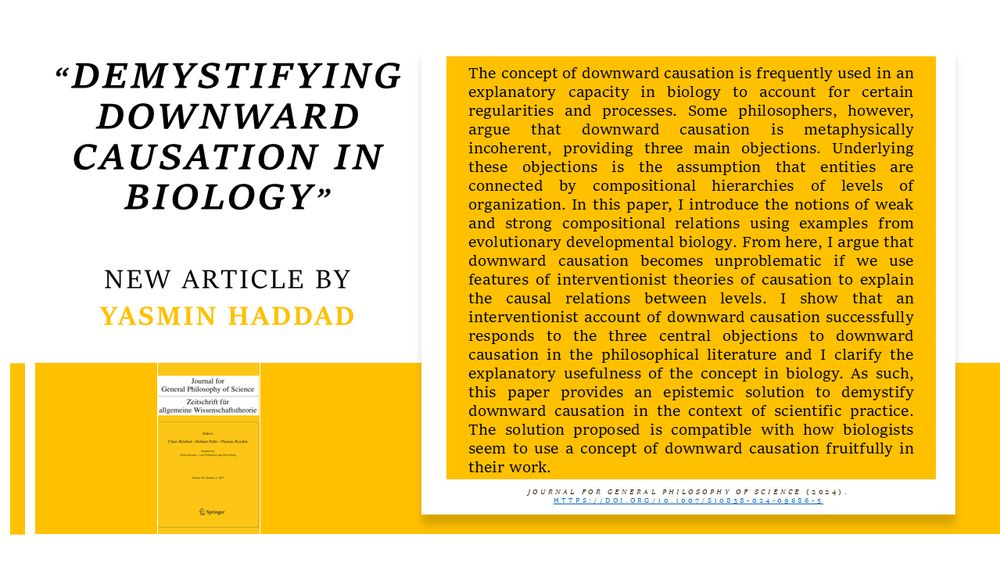
Promotional p;icture with the abstract of the article “Demystifying Downward Causation” by Yasmin Haddad, published in the Journal for General Philosophy of Science (JGPS).
The concept of 'downward causation' has faced many strong critiques. In her recent 📄 @yashaddad.bsky.social argues that, when adopting an interventionist view of causation and a levels of organization framework, we can explanatorily use the notion 👇 link.springer.com/article/10.1... #philsci #hpbio
10.03.2025 15:49 — 👍 31 🔁 11 💬 3 📌 1
Really looking forward to this year's EMBO|FEBS Lecture Course: Emergence & Evolution of Multi-Level Regulatory Systems in Venice this year (meetings.embo.org/event/25-mul...). Applications for participants open until 31 March! #phlsci in #evobio & #devbio
24.02.2025 17:45 — 👍 14 🔁 4 💬 0 📌 1
 12.02.2025 16:15 — 👍 2 🔁 0 💬 1 📌 1
More information and updates on the lecture course will be provided by following @veniceevodevo.bsky.social as well as from the instructors (including myself!) and the organizers -- The deadline for applications is 31 March, 2025!
26.01.2025 15:53 — 👍 2 🔁 0 💬 0 📌 0
The course will tackle questions like how levels originate and integrate in development and evolution, what interactions exist between levels, how to measure and manipulate biological systems across multiple scales, and how to model feedback across different levels.
26.01.2025 15:53 — 👍 2 🔁 0 💬 1 📌 0
The venue is in Venice, Italy, and the meeting spans the whole week from 17 – 22 August 2025. Speaking from experience, these meetings are a excellent source for enduring and dynamic dialogues. This year the meeting will be feature levels of organization in #devbio, #evodevo, #evobio, and others!
26.01.2025 15:53 — 👍 3 🔁 0 💬 1 📌 0
PhD student in philosophy of biology, researching memory, imagination and consciousness.
Also interested in teaching, sci-comm, pedagogy and dance.
Philosopher of science; works on evo bio, ecology, some history of bio/philo; kant, organisms, emergence, complexity, algo & big data etc
Latest Books : Why ? (Stanford UP); Death (Palgrave); Societes du profilage (Payot)
IHPST (CNRS/Paris I sorbonne)
epistemology of science and artificial intelligence // asst prof purdue university // argonne national lab // phd, university of chicago
www.eamonduede.com
Historian of science; Principal Curator of Science at National Museums Scotland & Hon Fellow, STIS, Uni of Edinburgh. VP British Society for the History of Science #histSTM. Views own.
Formerly known as @beckyfh
https://teleskopos.wordpress.com/profile
Internet Archive is a non-profit research library preserving web pages, books, movies & audio for public access. Explore web history via the Wayback Machine.
Hosting and publishing talks on philosophy since 1880.
http://www.aristoteliansociety.org.uk
Philosopher of biology | Post-doc at the ImmunoConcept Lab (Bordeaux) & affiliated researcher at IHPST (Paris) | Research interests: Biological Individuality, cancer, stem cells, evolution | Author: https://link.springer.com/book/10.1007/978-3-031-94744-5
Group Leader Mathematical and Physical Biology Lab @TheCrick and @UCL Physics. Interested in how size, shape and patterns develop and evolve; https://www.hadjivasilioulab.com/.
The Centre for Logic and Philosophy of Science (CLPS) at the Institute of Philosophy (@kuleuvenuniversity.bsky.social) focuses on #logic and #philsci, with a concentration on the philosophies of the special sciences • https://hiw.kuleuven.be/clps #philsky
Academic society promoting research in philosophy, history, and social studies of biology and medicine. Founded 1989. Interdisciplinary network worldwide. More info: www.ishpssb.org
Professor UCMadrid, educated Edinburgh & LSE, now often @Cambridge. Author of Inference and Representation (Chicago 24): https://press.uchicago.edu/ucp/books/book/chicago/I/bo207912978.html
More about me: https://sites.google.com/ucm.es/mauriciosuarez
Research Assistant Professor, Philosophy Department at Lingnan University & Hong Kong Catastrophic Risk Centre. Formerly: HPS Cambridge. Philosophy of Mind & AI from a Biological Perspective. 🏳️🌈
https://scholar.google.com/citations?user=qlNi3AoAAAAJ&hl=en
Philosophy postdoc at the University of Iceland. PhD from HPS Cambridge. Previously Visiting Fellow at Institute Vienna Circle. Interested in philosophy of science, logic, language, and pragmatism.
Philosopher of science at UNamur (Belgium).
Philpeople page: philpeople.org/profiles/olivier-sartenaer
Decoding how the gut thinks 🦠🪱🧠💪
Neuroscientist with interests in
#EnergyMetabolism #EntericNeurons #Fats
@crick.ac.uk @institutducerveau.bsky.social
Developmental biologist 🐟🧬
Postdoc @mdc-berlin.bsky.social
Previously @espciparispsl.bsky.social | PhD @sorbonne-universite.fr
Interested in: transcending the objective/subjective dichotomy; Gestalt-related philosophy; phenomenology, Merleau-Ponty especially.
Scientist/Engineer. Assistant Professor @ Yale School of Medicine. Tissue Biology, Lung Regeneration, Data Visualization. Here to learn. https://RaredonLab.com