Universities blame ‘societal shift’ for axing foreign language degrees
Numbers taking languages at A-level and beyond has been falling for decades, although Duolingo says its app is most popular with young people
'Michael Lynas, the UK country director for the Duolingo language app, who argues there is no good substitute for the hard graft of learning a language as a way of seeing another country’s culture from the inside.' 1/3
22.11.2025 12:14 — 👍 36 🔁 22 💬 1 📌 3
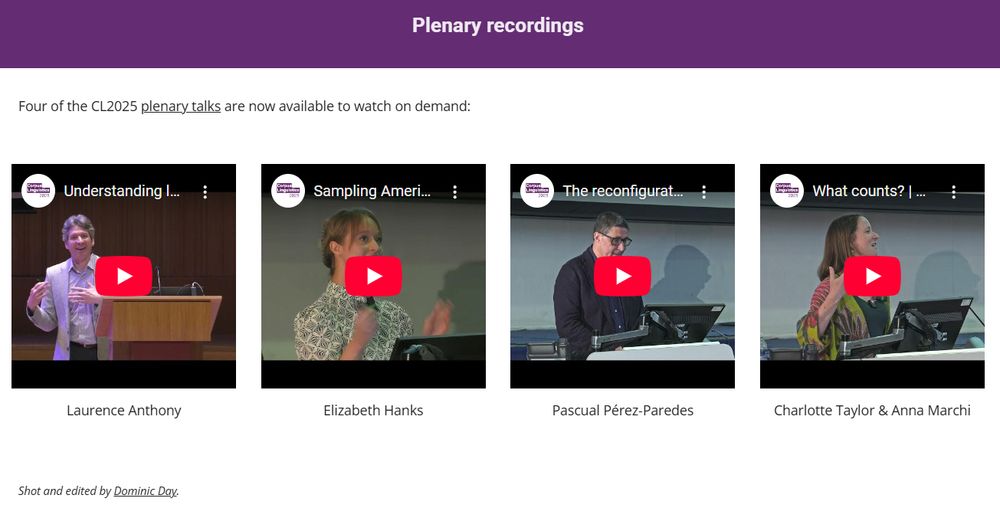
Missed out on #CL2025? Four of our wonderful plenary talks are now available to watch on demand!
YouTube links on conference website and in replies:
www.cl2025.co.uk/home
11.08.2025 10:15 — 👍 37 🔁 21 💬 2 📌 0
Bill Labov: Looking Back, Looking Forward
Bill Labov passed away peacefully at home on December 17, 2024, with his wife and fellow Penn linguist Gillian Sankoff by his side. He leaves behind a legacy so large that it is hard to put into word...
@jslx.bsky.social are proud to publish an obituary for William Labov, written by three of Bill’s students @betsysneller.bsky.social, @laurelmack.bsky.social & M Tamminga. We are grateful to Bill’s colleagues and family for the OA costs onlinelibrary.wiley.com/doi/10.1111/... @lhlew.bsky.social
08.08.2025 11:59 — 👍 17 🔁 6 💬 0 📌 0
LOL
17.05.2025 22:14 — 👍 1 🔁 0 💬 0 📌 0
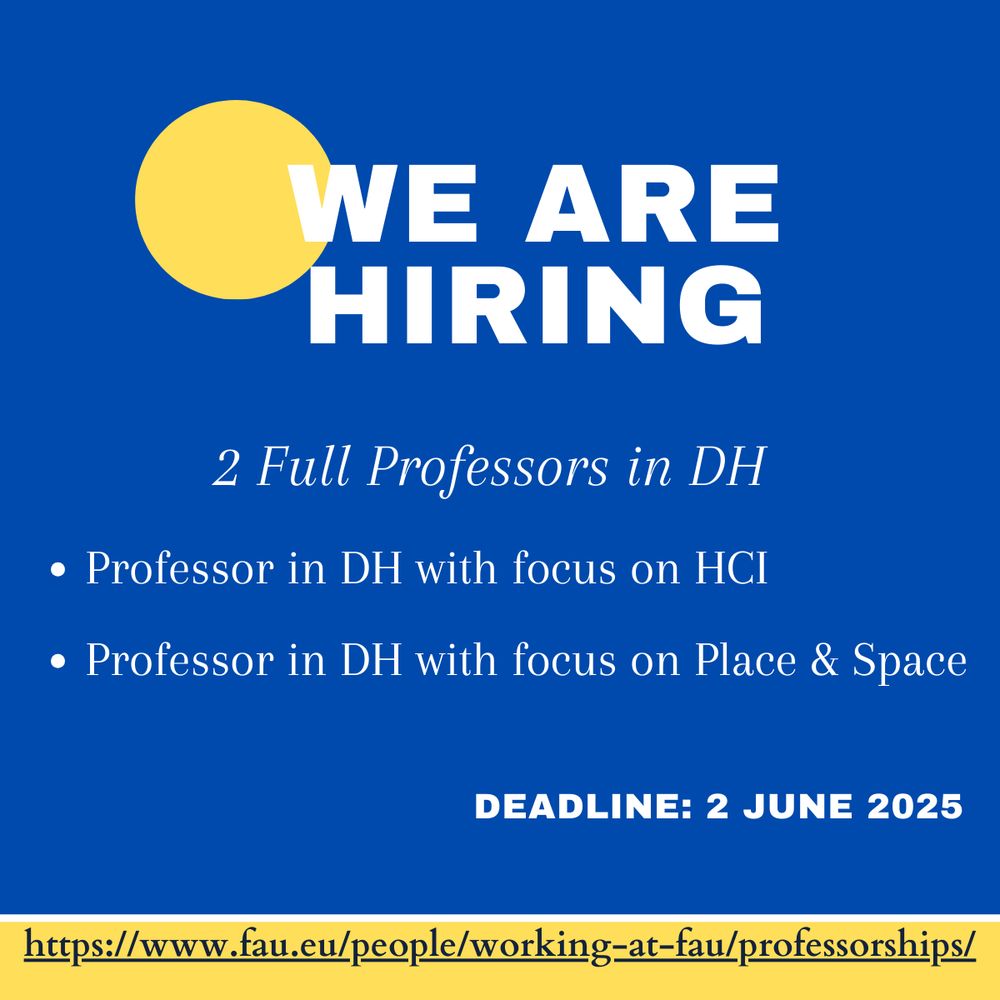
We are hiring 2 full professors in DH
Join our team @dhssfau.bsky.social @fau.de
2 full professorships in #DigitalHumanities
‼️ Professor in #DH with focus on #HCI
‼️ Professor in #DH with focus on #Place&Space
⏰ Deadline: 2 June 2025
www.fau.eu/people/worki...
@fauphil.bsky.social
15.05.2025 12:54 — 👍 33 🔁 41 💬 0 📌 2

Is the UK failing its graduates?
Young people are bearing the brunt of a long-term slowdown in the labour market, data shows
'The evidence suggests a degree does still pay off over time, but that the path into well-paid work may be longer and bumpier than in the past.' Low number of graduate jobs, influx of AI cvs and online recruitment processes and shrinking graduate premium (esp. for young women) at issue.
12.05.2025 06:30 — 👍 16 🔁 4 💬 0 📌 3
This kind of wider discussion and engagement is exactly what I was hoping for when I was writing this review. I think it's important that as a field we consider the ethical and pedagogical uses of AI, calling all stakeholders, including reviewers and publishers, for more attention to this topic.
08.05.2025 14:56 — 👍 1 🔁 0 💬 1 📌 0

Record number of universities in deficit
Worsening cash crisis presents a ‘grave risk’ to the future of some institutions and courses, say MPs
Now approaching half of all Britain's universities in deficit. Still nothing is done. Every day without a plan will make the eventual reset even more expensive.
www.telegraph.co.uk/news/2025/05...
07.05.2025 19:20 — 👍 24 🔁 9 💬 2 📌 0

EUROCALL 2025 - Milano
Università Cattolica | 27-30 August 2025
🎉 Registration for #EUROCALL2025 is now OPEN!
We’re heading to Milan this August—join colleagues from around the world for four days of talks, networking, and great Italian vibes 🇮🇹
📅 27–30 August 2025
🔗 Register now: eurocall2025.com
#ELT #appliedlinguistics #Edlang #CALL
07.05.2025 18:36 — 👍 4 🔁 4 💬 0 📌 0

International university students
Let’s not shoot ourselves in the foot again.
“To govern is to choose: my policy recommendation is that the government does not make the UK poorer by curtailing international student migration.”
Excellent piece from @timleunig.bsky.social & Public First colleagues here 👇
timleunig.substack.com/p/internatio...
06.05.2025 16:35 — 👍 18 🔁 7 💬 0 📌 1
Many congratulations!
29.04.2025 21:04 — 👍 1 🔁 0 💬 0 📌 0
Many congratulations!
14.04.2025 15:03 — 👍 3 🔁 0 💬 1 📌 0
Baker & Brookes (2025) 'Masculinities and Language' in #openaccess
14.04.2025 15:02 — 👍 3 🔁 0 💬 0 📌 0

Schemas, Chunking and Working Memory - kirschner-ED
How do we manage to process and retain complex or lengthy information—such as sentences, problem-solving steps, or visual configurations—when our WM capacity is so limited?
How do we manage to process and retain complex or lengthy information—such as sentences, problem-solving steps, or visual configurations—when our WM capacity is so limited?
Simple: We use cognitive schemas and chunking!
#EduSky
www.kirschnered.nl/2025/04/11/s...
11.04.2025 07:53 — 👍 9 🔁 3 💬 1 📌 1
![Preamble
All research at our institution, from ideation and execution to analysis and reporting, is bound by the Netherlands Code of Conduct for Research Integrity. This code specifies five core values that organise and inform research conduct: Honesty, Scrupulousness, Transparency, Independence and Responsibility.
One way to summarise the guidelines in this document is to say they are about taking these core values seriously. When it comes to using Generative AI in or for research, the question is if and how this can be done honestly, scrupulously, transparently, independently, and responsibly.
A key ethical challenge is that most current Generative AI undermines these values by design [3–5; details below]. Input data is legally questionable; output reproduces biases and erases authorship; fine-tuning involves exploitation; access is gated; versioning is opaque; and use taxes the environment.
While most of these issues apply across societal spheres, there is something especially pernicious about text generators in academia, where writing is not merely an output format but a means of thinking, crediting, arguing, and structuring thoughts. Hollowing out these skills carries foundational risks.
A common argument for Generative AI is a promise of higher productivity [5]. Yet productivity does not equal insight, and when kept unchecked it may hinder innovation and creativity [6, 7]. We do not need more papers, faster; we rather need more thoughtful, deep work, also known as slow science [8–10].
For these reasons, the first principle when it comes to Generative AI is to not use it unless you can do so honestly, scrupulously, transparently, independently and responsibly. The ubiquity of tools like ChatGPT is no reason to skimp on standards of research integrity; if anything, it requires more vigilance.](https://cdn.bsky.app/img/feed_thumbnail/plain/did:plc:tfyqeo3tprov5lejatxoi6lb/bafkreidtloh77ocmijnfeddey4fmme43s2mhahdpmr7otrrmvpzjca5kn4@jpeg)
Preamble
All research at our institution, from ideation and execution to analysis and reporting, is bound by the Netherlands Code of Conduct for Research Integrity. This code specifies five core values that organise and inform research conduct: Honesty, Scrupulousness, Transparency, Independence and Responsibility.
One way to summarise the guidelines in this document is to say they are about taking these core values seriously. When it comes to using Generative AI in or for research, the question is if and how this can be done honestly, scrupulously, transparently, independently, and responsibly.
A key ethical challenge is that most current Generative AI undermines these values by design [3–5; details below]. Input data is legally questionable; output reproduces biases and erases authorship; fine-tuning involves exploitation; access is gated; versioning is opaque; and use taxes the environment.
While most of these issues apply across societal spheres, there is something especially pernicious about text generators in academia, where writing is not merely an output format but a means of thinking, crediting, arguing, and structuring thoughts. Hollowing out these skills carries foundational risks.
A common argument for Generative AI is a promise of higher productivity [5]. Yet productivity does not equal insight, and when kept unchecked it may hinder innovation and creativity [6, 7]. We do not need more papers, faster; we rather need more thoughtful, deep work, also known as slow science [8–10].
For these reasons, the first principle when it comes to Generative AI is to not use it unless you can do so honestly, scrupulously, transparently, independently and responsibly. The ubiquity of tools like ChatGPT is no reason to skimp on standards of research integrity; if anything, it requires more vigilance.
A year ago our faculty commissioned & adopted guidance on GenAI and research integrity. Preamble below, pdf at osf.io/preprints/os..., text also at ideophone.org/generative-a...
Key to these guidelines is a values-first rather than a technology-first approach, based on NL code of research conduct
09.04.2025 09:45 — 👍 86 🔁 45 💬 6 📌 4

Learning to speak like a lawyer
In her 2007 ethnographic study of eight US law schools, Elizabeth Mertz traces the process through which law students learn to “think like a lawyer” in order to become one. She shows how this proce…
New on Language-on-the-Move: for international students, bilingualism is an optional benefits that comes with the real risk of being seen as less competent
@lauraskh.bsky.social shares her latest research with aspiring migration agents
www.languageonthemove.com/learning-to-...
03.04.2025 02:45 — 👍 13 🔁 7 💬 0 📌 0
Exciting news. Many congratulations!
01.04.2025 13:41 — 👍 2 🔁 0 💬 0 📌 0
An AI generated colorful image, trying to catch the eye of potential PhD students.
Two Fully-Funded PhD positions at Auckland Uni!
Come help us understand the past and future of global cultural and linguistic diversity.
#linguistics #evolution #academia #phd
www.findaphd.com/phds/project...
24.03.2025 02:13 — 👍 56 🔁 65 💬 7 📌 3

On the responsibilities of intellectuals and the rise of bullshit jobs in universities
You may never have considered yourself to be one. Why would you? But if you’re reading this, there is more than a likelihood that you are one. If you’re a
Very good on The Great University Disaster. Note it's *not* attacking administrators: indeed unis may be *under*-managed. The point is that extreme, inappropriate corporatization and bureaucratization has destroyed their very purpose, like a virus from within. (1/2)
academic.oup.com/brain/articl...
12.03.2025 10:56 — 👍 49 🔁 15 💬 3 📌 4
Writing, Rhetoric, Multimodality @ CWU: History of composition & standardizing writing; feedback & assessment; and multimodal pedagogies. Digital rhetoric & disinformation.
Reviews Coeditor @kairostp.bsky.social
https://paulmartin61.wixsite.com/mysite/cv
The University of Nottingham conducts world-leading research, bringing about real change and shaping our future. Ranked 7th in the UK for research power by THE.
Organised representation for all academic staff, postgraduates, and APM staff level 4 and above at the University of Nottingham. Here in solidarity with workers the world over.
https://uonucu.org/
UK trade union for academics, lecturers, trainers, researchers and professional services staff in further education, higher education, prison education, and adult and community education.
Leverhulme Early Career Research Fellow @york.ac.uk
Interested in language learning, teaching, and assessment
The Center for International Foreign Language Teacher Education (CIFLTE) at Teachers College, Columbia University.
Double agent 🥷
Editor of The Letters Page at Uni of Nottingham
http://theletters.page
PDRA at Uni of Liverpool
http://www.liverpool.ac.uk/digital-media-and-society-institute.
Parlance newsletter editor | LTS marketing lead
Set up in 2003, the BAAL Corpus Lingusitics Special Interest Group provides linguists a space to discuss the use of corpora and corpus methodologies in applied linguistics research.
https://baal-clsig.weebly.com/
(Account managed by @linguistlawyer.com)
Phonetics & Phonology Research Group at Newcastle University. Researchers uniting around language and sound. For enquiries, please contact us at phoneticsphonology.ncl@gmail.com.
https://revistes.ub.edu/index.php/teisel
https://revistes.ub.edu/index.php/teisel/video
Researching modern languages education at primary school.
Leading the Progression in Primary Languages research project.
Associate Professor in Second Language Education in the Institute of Education at the University of Reading.
Open-access, peer-reviewed journal dedicated to publishing research on language, language use, language acquisition, language teaching, and language assessment. https://tesolal.columbia.edu
Author, Speaker, Peace Researcher: josef.muehlbauer@uni-graz.at
Senior Lecturer in French and Linguistics, Westminster | Research on language in society | Associate Editor, Journal of Sociolinguistics | Research Notes Editor, Journal of French Language Studies.
https://sites.google.com/view/jonathan-kasstan/home
Tenured Teaching Staff @ Cyprus University of Technology. Researches Virtual Exchange & Technology Enhanced Language Learning.
Linguist, with a general interest in science and nature. Poland.
Opinions expressed here are my own and strictly private.
If anyone wants to use my photos, obey the terms of CC BY-NC 4.0.
https://www.inaturalist.org/observations?user_id=piotr_gasiorowski
Retired linguist. Gay. Small town journalist. West Virginian. Dabbler in politics to stay edgy, Buddhism to get enlightened (someday). The wordy me hangs at https://medium.com/@sojneighbor or https://sojneighbor.org.
Linguist, reader, educator and a beginning writer. Lover of non-fiction and translated fiction. University of Nottingham graduate - BA Hons Modern Languages & PGCE.