I believe @acowtan.bsky.social can comment on extensions to parallelize in more general contexts of higher overlap between Pauli logicals. arxiv.org/abs/2503.050...
12.12.2025 23:26 — 👍 0 🔁 0 💬 0 📌 0
So in order to parallelize, one would simply attach the auxiliary graphs simultaneously to the base code.
12.12.2025 23:25 — 👍 0 🔁 0 💬 1 📌 0
@sejaques.bsky.social Currently we've shown this works for sparsely-overlapping logical Paulis,
that is, cases where the logical operators overlap atmost a constant number of physical qubits (see Theorem 11, proof in Appendix B)
12.12.2025 23:24 — 👍 1 🔁 0 💬 1 📌 0
In latest update, available now:
arxiv.org/pdf/2410.036...
12.12.2025 00:43 — 👍 1 🔁 0 💬 0 📌 0


LDPC Logic gates started looking a lot more concrete -- explicit constructions with realistic overheads for near but interesting codes we know (BB, lifted product codes,..) coming soon.
05.11.2025 04:47 — 👍 15 🔁 0 💬 2 📌 0

Fault-tolerant logical measurement just got a lot faster!
In new work, we show that code surgeries based on hypergraphs, rather than graphs, allow fast and parallel fault-tolerant logical measurements with low qubit overhead (without requiring the code to be single-shot).
arxiv.org/abs/2510.14895
17.10.2025 05:36 — 👍 27 🔁 8 💬 1 📌 0
some visuals to complement 3 recent papers on logical gate schemes for arbitrary quantum LDPC codes. :)
10.03.2025 05:09 — 👍 1 🔁 0 💬 0 📌 0

Here are slides from our @qip2025.bsky.social talk on Logical gates on quantum LDPC codes by surgery / Universal Adapters. doi.org/10.5281/zenodo.14997472
10.03.2025 04:56 — 👍 22 🔁 0 💬 1 📌 0
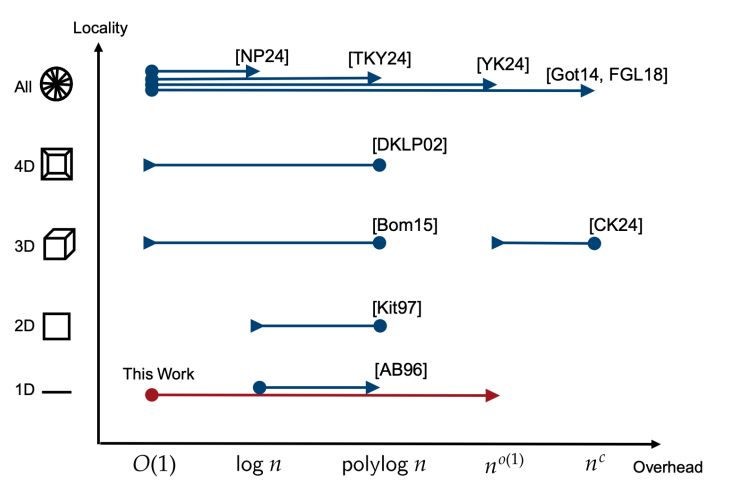
Thiago put together a nice plot summarizing how this result fits into other results about bounds of time/space overhead vs locality. In terms of this plot, the paper's goal was to put a circle in the O(1) column, but not in the "all" row.
25.02.2025 09:23 — 👍 4 🔁 1 💬 0 📌 0
Next week is QIP, which is the main conference in theoretical question information science. I am delighted that three of my group members have accepted talks: Paula Belzig, Esha Swaroop, and Peixue Wu.
With an acceptance rate of 20%, this is a big accomplishment for each of them!
20.02.2025 14:15 — 👍 33 🔁 1 💬 1 📌 0
there must be some trickle down effect onto efficacy of two stages?
06.02.2025 15:51 — 👍 0 🔁 0 💬 1 📌 0
ah, P_{1,17} is ~e^14 so it's still cubic suppression, but the qutrit code offers much better constants.
Trading hundreds of qubits for just 20 qutrits isn't a big ask in terms of temporarily switching dimension of the system either.
06.02.2025 03:40 — 👍 0 🔁 0 💬 1 📌 0
where is this from?
if one throws out everything but the leading order, error^16 suppression sounds pretty good...
05.02.2025 23:47 — 👍 0 🔁 0 💬 1 📌 0
Curious how did you get the initial depth as 4 specifically? guessing here that a minimum of 3 time steps arise from pairwise gates between 3 pairs of qubits, and an extra gate somewhere?
Will check out the relevant section for technical details
05.02.2025 20:52 — 👍 1 🔁 0 💬 1 📌 0
I see, it's depth 1 exactly, not just depth O(1). That would be a pretty specialized code indeed.
Pieceably transversal CCZs (which are applicable to arbitrary CSS codes) are targeted, but they would need a depth of O(d).
Interesting to see how much better tailored targeted codes can do!
05.02.2025 19:05 — 👍 1 🔁 0 💬 1 📌 0
quick edit in my previous comment: the adapters were designed for LDPC regime, but simplifications for higher-weight codes would only make it easier to teleport info. But this is all side-tracking from the main story, for which I'll check out your paper.
05.02.2025 18:53 — 👍 1 🔁 0 💬 1 📌 0
ah so the motivation is towards code construction tailored towards these gates rather than a generic gate scheme. Pretty neat! One can still hook these codes up to arbitrary LDPC codes using our adapters (arxiv.org/abs/2410.03628) for using these more generically in other codes.
05.02.2025 18:47 — 👍 1 🔁 0 💬 1 📌 0
Congrats on these results on a very interesting problem -- Looking forward to reading this work! Are the check weights bounded during the CCZ circuit? (If not by constants, then what is the extent to which they increase?)
05.02.2025 15:56 — 👍 2 🔁 0 💬 1 📌 0

Experimental Demonstration of Logical Magic State Distillation
Realizing universal fault-tolerant quantum computation is a key goal in quantum information science. By encoding quantum information into logical qubits utilizing quantum error correcting codes, physi...
Interesting paper implementing magic state distillation with neutral atoms: arxiv.org/abs/2412.15165
They're in a weird regime: below the distillation threshold but over the color code threshold. They see improvements!... But hit a ceiling imposed by their d=3 memory error (because d=5 does worse).
20.12.2024 08:47 — 👍 24 🔁 4 💬 1 📌 0
Congrats! Curious, how did you verify the quantum computer's output is correct? (due to inability to reproduce this classically in feasible time)
10.12.2024 22:38 — 👍 0 🔁 0 💬 1 📌 0
👋 Anyone need some codes? We've got 566 classical & quantum codes.
10.10.2023 07:49 — 👍 15 🔁 2 💬 2 📌 1
ahhh it's LDPC specific. thanks for clarifying!
24.11.2024 18:39 — 👍 2 🔁 0 💬 0 📌 0
thanks! ok i see why good soundness isn't contained in the good confinement condition (as small syndromes can be caused by large errors).
Reg the other way around (good confinement ⊆ good soundness), it's also somehow implicit that small errors trigger a small syndrome?
24.11.2024 18:34 — 👍 0 🔁 0 💬 1 📌 0
my current guess it's the same inequality (f(|σ(e)|) ≥ |e|_red) , but enforced on a smaller set of errors to get a weaker condition.
24.11.2024 16:19 — 👍 0 🔁 0 💬 0 📌 1

@quantumearl.bsky.social A question: maybe i'm missing something obvious, but confinement and soundness like the same thing here? 🙈 As I understand it, they both involve a proportionality between the weight of the syndrome (perhaps addnl wrapped as input to a function) and the weight of the error.
24.11.2024 15:47 — 👍 4 🔁 0 💬 3 📌 0

Universal adapters between quantum LDPC codes
We propose the repetition code adapter as a way to perform joint logical Pauli measurements within a quantum low-density parity check (LDPC) codeblock or between separate such codeblocks. This adapter...
Sharing our work "Universal adapters for quantum LDPC codes" posted today to arxiv arxiv.org/abs/2410.03628
We provide a flexible tool to enable joint measurements between logical operators in arbitrary LDPC codes, and also a variant to implement targeted CNOT gates using Dehn twists.
07.10.2024 09:33 — 👍 2 🔁 0 💬 0 📌 0
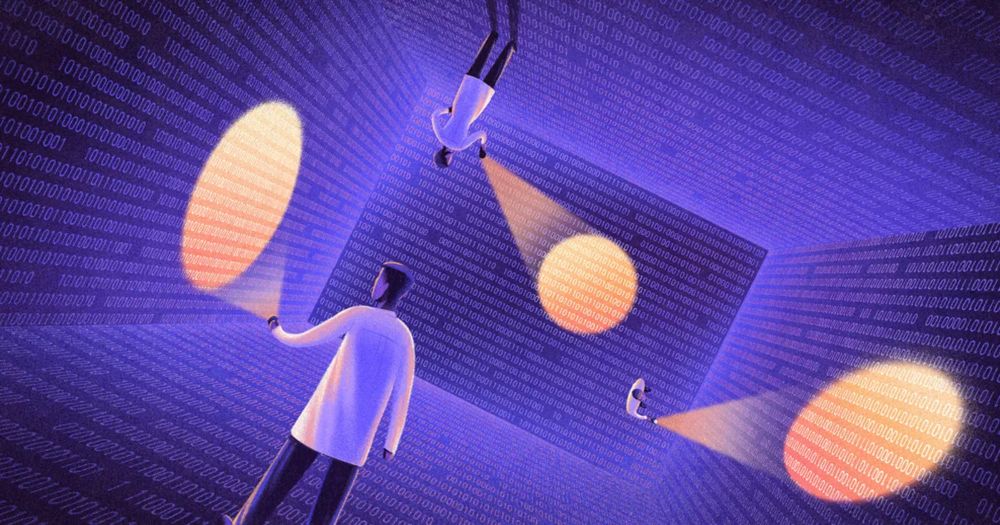
‘Magical’ Error Correction Scheme Proved Inherently Inefficient | Quanta Magazine
Locally correctable codes need barely any information to fix errors, but they’re extremely long. Now we know that the simplest versions can’t get any shorter.
Wonderful article by @benbenbrubaker.bsky.social on the recent breakthrough result of Pravesh Kothari and Peter Manohar on locally correctable codes (LCCs). Even beyond this result, one of the best expositions of error-correcting codes I've read!
www.quantamagazine.org/magical-erro...
09.01.2024 21:31 — 👍 1 🔁 2 💬 0 📌 0
co-founder @ Iceberg Quantum
quantum phd student at Caltech
PhD student in math. physics & quantum info @IPParis.
Formerly TUM&LMU, UniofCam 🇪🇺🏳️🌈
kochanowski.notion.site
Was @danbrowne77 on Twitter. Got here early enough to drop the 77. Also here as @profdanbrowne.bsky.social
Building the world’s first useful quantum computers.
Quantum error correction, fault tolerance, and benchmarking researcher, views are my own (I think).
Engineer, Physicist, Father, Son, Person.
More info at https://marcusps.github.io/
On the fediverse I am @themarcusps at tiny.sengis.net
Prof in Quantum Information Theory at NUS and CQT, an information theorist at the quantum frontier, ETH Zurich alumnus, opinions my own
I'm trying to build a quantum computer in sunny Los Angeles, CA, USA.
I like discussing other people's research papers and ideas. As always, any insights should be credited to the authors themselves, and any misconceptions to me alone.
Scientist working in the field of computational quantum chemistry and physics. More recently, I’ve started exploring quantum computation for electronic structure calculations.
A team of #QuantumErrorCorrection (QEC) experts, helping quantum computers scale and tackle errors across qubit types 🧪
www.riverlane.com
phd student @ caltech | interested in quantum info, math education, watercolors, marine bio
https://reionize.github.io
Assistant Professor of Quantum Info/Theoretical Quantum Computation at DAMTP, University of Cambridge. Working on quantum information and mathematical physics.
🇦🇺 Postdoc and Humboldt fellow at FU Berlin, interested in all things quantum. Big cricket fan, occasional astrophotographer.
Assistant Professor at the University of Michigan.
I design fast graph algorithms in dynamic/distributed/local settings.
https://sites.google.com/site/thsaranurak/
QEC researcher at IQM Germany