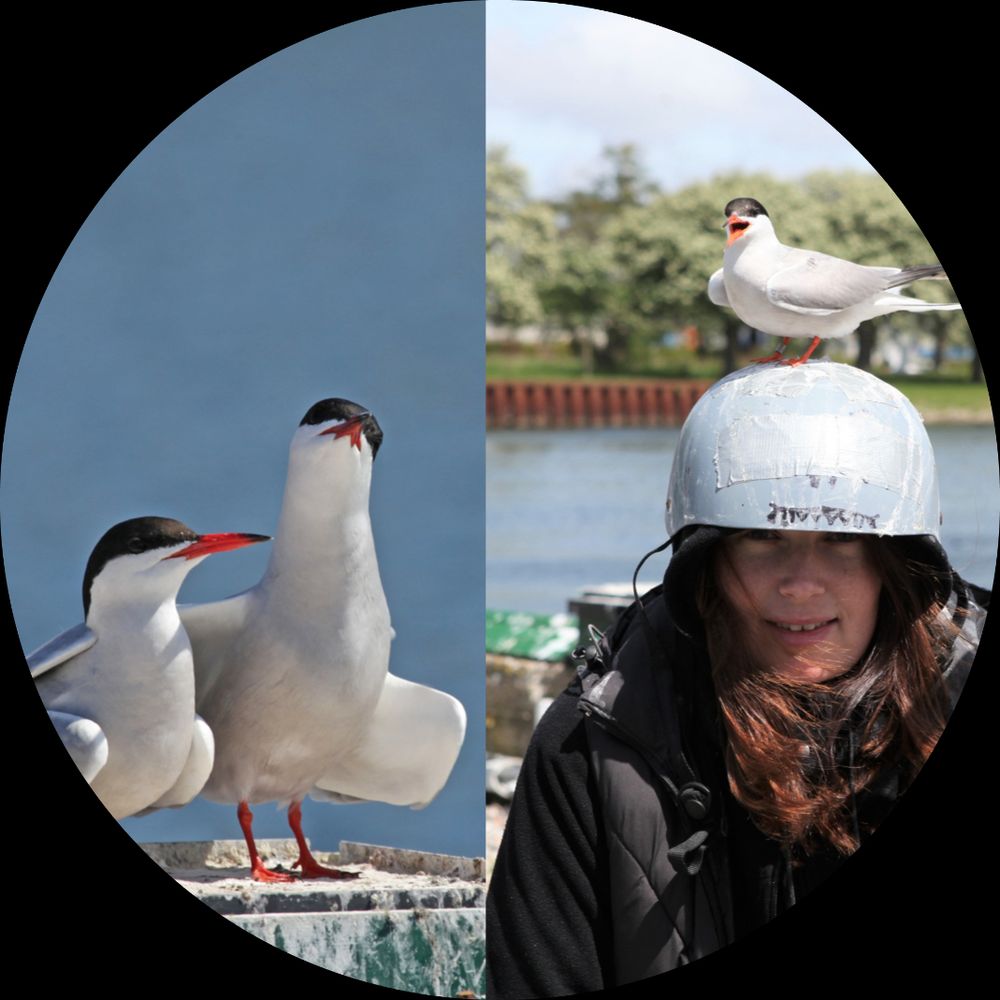
It really was lots of fun to design this with Maria Röbbelen, funded by the Lower Saxonian Ministry of Science and Cultural Affairs, and with the help of my own two daughters. :-)
02.02.2026 14:51 — 👍 0 🔁 0 💬 0 📌 0
And to match years of the long-term study for food availability (herring abundance) and reproductive success, discussing what other sources of variation there might be.
02.02.2026 14:47 — 👍 0 🔁 0 💬 1 📌 0
Or to play bingo with tern names as I read out a story and thereby reconstruct the social pedigree of our colony, noticing differences in success among families, which we then discuss.
02.02.2026 14:45 — 👍 0 🔁 0 💬 1 📌 0
Another assignment is to complete a puzzle that displays how mercury pollution reaches the terns, and to brainstorm about what this means. Yet another one is to draw a tern and name its defining features.
02.02.2026 14:44 — 👍 0 🔁 0 💬 1 📌 0
We created postcards 'sent' to the kids by common terns as they travel south. The assignment is to reconstruct the routes taken, and use dates and distances to calculate travel speeds. The kids can then see how different birds go to very different places, and be impressed by distance and speed.
02.02.2026 14:39 — 👍 0 🔁 0 💬 1 📌 0

Proud to present: Suitcase Science, a new outreach format containing 6 assignments to take on a journey to schools in the region, to teach kids about terns, how to study them, their fascinating behaviour and some of the things that threaten them. Wanna book us? Drop me a line. :-)
02.02.2026 13:44 — 👍 15 🔁 5 💬 1 📌 0

NEW PAPER in #ornithology compares the responses of 200 vertebrate populations to climate change, and finds that increasing temperatures affect population growth via changes in phenology, but not morphology: buff.ly/IT66GOK
21.01.2026 07:37 — 👍 23 🔁 12 💬 0 📌 0

Led by Viktoriia Radchuk, an international collaboration shows phenological shifts in response to changing temperatures allow populations to remain stable or even increase in numbers.
Support from #sDiv @idiv-research.bsky.social
18.01.2026 11:16 — 👍 29 🔁 16 💬 1 📌 5

A selection of studied species is shown, with each inset giving information for that species on its generation time (T, in years; also depicted by the black bar next to it), its diet (carnivore: C, herbivore: H, and omnivore: O) and whether the species is a migrant (M) or a resident (R). The inset shows the number of studies per taxon and trait category. Illustration credits for the species pictures taken from Wikipedia: Svalbard reindeer—Bjørn Christian Tørrissen, four-striped grass mouse—C.R. Selvakumar, silver gull—JJ Harrison, snow petrel—Samuel Blanc, northern giant petrel—Liam Quinn, green turtle—Brocken Inaglory, green-rumped parrotlet—Jam.mohd, Columbian ground squirrel—Martin Pot, red-winged fairy-wren—John Anderson, grey-headed albatross—John Harrison. Two species pictures were provided by the co-authors of this study: painted turtle (credit: FJ) and Atlantic yellow-nosed albatross (credit: SOp). The remaining pictures were taken from Pixabay (https://pixabay.com/photos/).
In Nature Communications, our paper led by Viktoriia Radchuk shows that phenological change mediates global vertebrate responses to temperature. The study compiles 213 time series of phenotypes and population sizes, including data from Bylot. Read: urls.fr/w7ZKp9 @natcomms.nature.com 🧪🌿🌎🌐🦉🦑🦊🐻❄️
14.01.2026 16:20 — 👍 60 🔁 25 💬 0 📌 0
A huge thanks to Viktoriia Radchuk from the @ecodynizw.bsky.social for leading the work, and to all of the scientists and funding agencies supporting the long-term studies that facilitated it.
19.01.2026 14:07 — 👍 2 🔁 0 💬 0 📌 0

Out in @natcomms.nature.com, a collaborative paper showing that, across 73 species (including common terns), warmer years are associated with earlier phenology, and that populations in which such an association was observed have often been stable or increasing: www.nature.com/articles/s41...
19.01.2026 14:07 — 👍 41 🔁 14 💬 1 📌 0
We're also very grateful to @dornitholges.bsky.social for supporting this project with a "Sonderauslobung zum Vermächtnis Ursula Honig": www.do-g.de/foerdern/for...
05.01.2026 10:38 — 👍 0 🔁 0 💬 0 📌 0
A lovely collaboration with @robertrollins1892.bsky.social, @ingomue.bsky.social, Martin Irestedt, @jgcecere.bsky.social, Lorenzo Serra, @jsgutierrez.bsky.social, José Masero, @gullbilledterns-de.bsky.social and @genmig.bsky.social.
05.01.2026 10:38 — 👍 3 🔁 0 💬 1 📌 0
Figuring out the exact nature of the population connectivity will be an important next step, as will be the continued monitoring and protection of the last and endangered Central European population of gull-billed terns to assess its population trend and ensure its long-term viability.
05.01.2026 10:38 — 👍 0 🔁 0 💬 1 📌 0
Nucleotide diversity and inbreeding coefficients of birds of the contemporary Central European population, however, do not differ from those of birds in two thriving Mediterranean populations, and further analyses suggest population connectivity, although some population structure might be emerging.
05.01.2026 10:38 — 👍 0 🔁 0 💬 1 📌 0
She finds that museum specimens from the historic Central European population have higher genetic diversity and significantly lower inbreeding coefficients than birds making up the contemporary and endangered population.
05.01.2026 10:38 — 👍 0 🔁 0 💬 1 📌 0

Out now in ‘Evolutionary applications’, the last chapter of Anna’s PhD thesis, in which she used whole genome sequencing data of contemporary and historic European gull-billed terns to assess whether the population decline in part of their range has had genetic consequences: doi.org/10.1111/eva....
05.01.2026 10:38 — 👍 31 🔁 12 💬 1 📌 0

📚 our latest Special Feature, "Using Movement Ecology to Connect Individuals, Communities, and Ecosystems", is open to proposals!
⏲️ deadline: 15 February 2026
📝 read more and submit your proposal here: buff.ly/5PCHtCS
@allegralove.bsky.social
05.12.2025 13:01 — 👍 7 🔁 2 💬 0 📌 2

Egg Characteristics of Female Common Terns Are Repeatable, and Vary With Maternal Age and Laying Order | doi.org/10.1002/ece3... | Ecology and Evolution | #ornithology 🪶
01.12.2025 17:59 — 👍 26 🔁 7 💬 0 📌 0

🔊 KEYNOTE NOMINATIONS
Who would you like to see deliver a keynote at #BOU2027 ?
#BOU2027 | Avian disease ecology | 6 - 8 April 2027 | Nottingham, UK & Zoom & Bluesky
Nominate via link ⬇️
bou.org.uk/event/avi...
#ornithology 🪶
01.12.2025 14:00 — 👍 6 🔁 8 💬 0 📌 0
There are still two more weeks to apply for the PhD position on nematodes, isotopes, metals and PFAS in the terns. Don't be shy to reach out when having questions about it either. :-)
28.11.2025 11:54 — 👍 5 🔁 8 💬 0 📌 0

🎉 Abstract submission is open for the EOU Fledglings Meeting 2026 in Gdańsk, Poland (27–29 March 2026)!
📝 Submit your oral/poster abstract:
docs.google.com/forms/d/e/1F...
📅 Deadline: 16 Jan 2026
More info: eounion.org/fledglings
#EOU26 #Ornithology
26.11.2025 11:58 — 👍 17 🔁 17 💬 0 📌 3

CALL FOR PAPERS: Avian senescence: patterns, mechanisms and new perspectives. Photo showing zebra finches of different ages. Photo: Paul Jerem & Glasgow University, courtesy of Pat Monaghan
📣CALL FOR PAPERS - NEW SUBMISSION DEADLINE: 30 JUNE 2026📣
Avian senescence: patterns, mechanisms and new perspectives
More info: vist.ly/4fn5i
Guest editors: @jj255.bsky.social #RoxanaTorres, @brittheidinger.bsky.social @jaime-muriel.bsky.social @toblermichi.bsky.social
Please repost 🙏
23.11.2025 00:04 — 👍 19 🔁 8 💬 0 📌 1

We’re so excited to launch the website for the EOU Fledglings Meeting 2026 and to share that pre-registration is officially open! 🎉
👉 Scan the QR code or visit our website (eou-fledglings.github.io/2026/registr...) to pre-register now!
Photo: Tom Koerner / USFWS (CC BY 2.0)
21.11.2025 13:49 — 👍 17 🔁 14 💬 0 📌 0
A lovely collaboration with @coralinebcht.bsky.social, @mmoiron.bsky.social, Nathalie Kürten and @oscarvedder.bsky.social.
19.11.2025 14:26 — 👍 0 🔁 0 💬 0 📌 0
Finally, egg volume, pointedness, elongation and polar asymmetry decrease across the laying order of the eggs within clutches, which may be part of the brood reduction strategy we know common terns adopt.
19.11.2025 14:26 — 👍 1 🔁 0 💬 1 📌 0
In addition, females produce larger and spottier eggs as they grow older, but females producing large and spotty eggs are also most likely to disappear from the breeding population, suggesting large and spotty eggs to be more costly to produce.
19.11.2025 14:26 — 👍 2 🔁 0 💬 1 📌 0
Using photographs of 1589 eggs from 687 clutches produced by 330 females, we show repeatability of egg characteristics to be high both within and among years.
19.11.2025 14:26 — 👍 1 🔁 0 💬 1 📌 0

There’s such beauty in variety – and the eggs laid by our terns show it too. In our newest paper we try to find patterns in this variety and test how female identity and age, as well as laying order, affect the colour, spottiness, shape, and size of eggs: doi.org/10.1002/ece3...
19.11.2025 14:26 — 👍 41 🔁 16 💬 2 📌 0

This week's EGI seminar is being given by Dr Maria Moiron @mmoiron.bsky.social of the University of Bielefeld at 3.30pm on Friday 21 Nov in LT1 in the Life & Mind Building @biology.ox.ac.uk. See below for online joining details - all welcome!
17.11.2025 09:11 — 👍 19 🔁 8 💬 0 📌 2
Kathryn (Katy) Willcox | PhD @ecobird.bsky.social | social environments <-> bird behaviour and cognition | 🐥🐦🧠🦦🐝 | ❤️ welfare & outreach | also 🎶🎨🎮🎲👩🍳🌿 | she/her
Master’s by Research @ Exeter University
Social Evolution, Ecology, Conservation, Seabirds | BTO C-Permit Ringer 🪶
Postdoctoral Researcher— UGA Warnell—Individual variation in movement behaviour
PhD Candidate in Behavioural Ecology @ University of Groningen 🇳🇱 | Researching how personality variation drives mating patterns & reproductive isolation | Birder
Ecologist and researcher interested in #biodiversity #ecosystemfunctioning #conservation and #ornithology @vogelwarte.bsky.social
Recently mostly working on #bird #movement, #behaviour and #ecosystemfunctions in a changing world
I am a scientist focussing on #ornithology and #conservation and work at the Swiss Ornithological Institute (www.vogelwarte.ch)
Quantitative wildlife biologist based at IZW Berlin 🇩🇪 / datazoogang.de / #wildlife #ecology #demography #conservation #evolution #rstats #linux
Professionally active in nature conservation with a love for grassland birds and terns.
PhD student @Xi'an Jiaotong-Liverpool University @University of Liverpool
studying #antipredatory_behaviour #interspecific_information_flow #interspecific_interactions #mobbing_behaviour #mixed_species_flocks #bird_communities
The German Centre for Integrative Biodiversity Research (iDiv). Posts by iDiv Media & Communications. Imprint: https://idiv.de/impressum
mammals | wildlife | ecology | movement | disease | biodiversity | demography | behaviour | distribution | modelling
News about science, research, and resources: https://ecodynizw.github.io/
Based in New Zealand. Research: #seafood #genomics #adaptation. Editor-In-Chief for @EvolAppJournal. Prof at @AucklandUni. Science Group Leader @plantandfood
https://marenwellenreuther.com/
Postdoc researcher in the Sociable Weaver project (CiBIO&CEFE) •
Evolutionary Ecology
🪶
Studying the #MovementEcology of #WhiteStorks in Portugal
She/they | Birder | Bander and graduate researcher studying the impact of wildfire smoke on oxidative status of migratory birds in the Ramos Lab | Southern Colorado | Goose Posting
🪶🦉
AvH post-doc at Humboldt Uni: info in rhythm & evolution of rhythm in vocal learners. Bioacoustics, emotions, information, seabirds. PhD. she/they 🏳️🌈 BLM
Animal ecologist at the University of Extremadura.
🌈👩🏼🔬postdoc at Aarhus University studying the importance of seamounts for seabirds • she/her
Conservation science | Ornithology | Field ecology | Conservation strategies | Animal migration | Flyways | Bird ringing & tracking | Bioacoustics | Conservation technology
(he/him)
ಸಾಗರ Sailor ⛵️ | #sail_to_bird | #sail_for_flyways | #sail_for_wildlife
research wildlife biologist @usda | colorado | habitat selection • movement ecology • population dynamics • ornithology