Tianyang Chen's Avatar

Tianyang Chen

@cty-chem.bsky.social

A chemisrt and chemical engineer focusing on material innovations for electrochemical energy storage. Currently a postdoc with Prof. Zhenan Bao at Stanford. PhD with Prof. Mircea Dinca at MIT. Undergrad at CCME of Peking University.

15 Followers  |  12 Following  |  7 Posts  |  Joined: 11.12.2024  |  1.4787

Latest posts by cty-chem.bsky.social on Bluesky

Preview
High-Energy, High-Power Sodium-Ion Batteries from a Layered Organic Cathode Sodium-ion batteries (SIBs) attract significant attention due to their potential as an alternative energy storage solution, yet challenges persist due to the limited energy density of existing cathode...

Princeton Chemistry demonstrates high-performance Sodium-ion cathode towards new battery technology

"High-Energy, High-Power Sodium-Ion Batteries from a Layered Organic Cathode"

pubs.acs.org/doi/10.1021/...

20.02.2025 01:16 โ€” ๐Ÿ‘ 25    ๐Ÿ” 4    ๐Ÿ’ฌ 0    ๐Ÿ“Œ 1
Preview
How to sell your science without selling out A five-step guide to communicating your science ethically and accurately.

A five-step guide to communicating your science ethically and accurately

https://go.nature.com/3Et4j3V

06.02.2025 12:32 โ€” ๐Ÿ‘ 59    ๐Ÿ” 17    ๐Ÿ’ฌ 0    ๐Ÿ“Œ 1
Post image

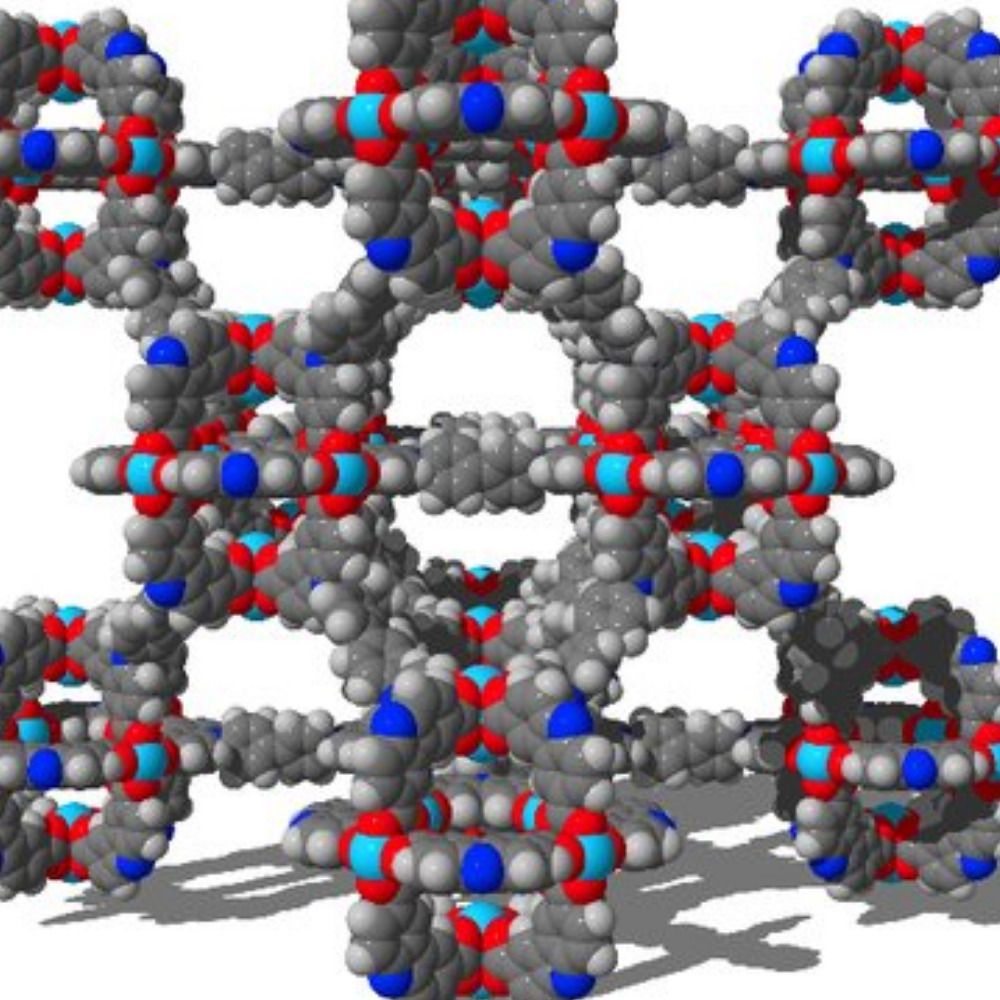
I am excited to share our group's latest manuscript, now live on the #ChemRxiv! We show by electron diffraction that Zn3(HOTP)2 isn't a typical 2D MOF, but is instead a 3D connected structure with incommensurate modulations. #crystallography

Read the preprint here: doi.org/10.26434/che...
18.12.2024 17:46 โ€” ๐Ÿ‘ 11    ๐Ÿ” 3    ๐Ÿ’ฌ 0    ๐Ÿ“Œ 0
Preview
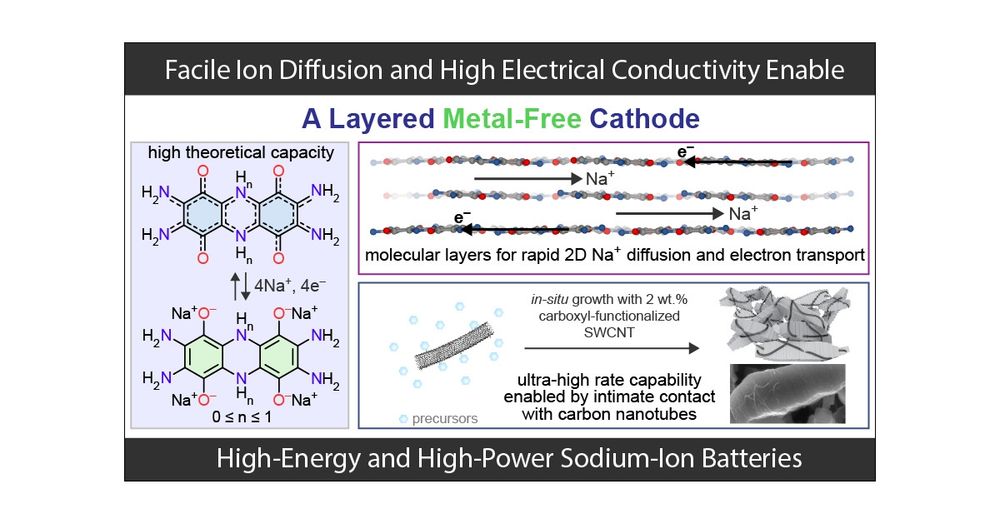
High-Energy, High-Power Sodium-Ion Batteries from a Layered Organic Cathode Sodium-ion batteries (SIBs) attract significant attention due to their potential as an alternative energy storage solution, yet challenges persist due to the limited energy density of existing cathode materials. In principle, redox-active organic materials can tackle this challenge because of their high theoretical energy densities. However, electrode-level energy densities of organic electrodes are compromised due to their poor electron/ion transport and severe dissolution. Here, we report the use of a low-bandgap, conductive, and highly insoluble layered metal-free cathode material for SIBs. It exhibits a high theoretical capacity of 355 mAh gโ€“1 per formula unit, enabled by a four-electron redox process, and achieves an electrode-level energy density of 606 Wh kgโ€“1electrode (90 wt % active material) along with excellent cycling stability. It allows for facile two-dimensional Na+ diffusion, which enables a high intrinsic rate capability. Growth of the active cathode material in the presence of as little as 2 wt % carboxyl-functionalized carbon nanotubes improves charge transport and charge transfer kinetics and further enhances the power performance. Altogether, these allow the construction of SIB cells built from an affordable, sustainable organic small molecule, which provide a cathode energy density of 472 Wh kgโ€“1electrode when charging/discharging in 90 s and a top specific power of 31.6 kW kgโ€“1electrode.

Best sodium-ion battery cathode out there, bar none! High energy, high power, long lasting, safe and cheap batteries made from C, N, O, H, and Na! #organicbattery #Sodiumbattery pubs.acs.org/doi/10.1021/...

05.02.2025 15:07 โ€” ๐Ÿ‘ 26    ๐Ÿ” 4    ๐Ÿ’ฌ 0    ๐Ÿ“Œ 1

In addition to this work, we have previously demonstrated the use of sustainable redox-active organic materials as electrodes for pseudocapacitors (cell.com/joule/fullte... and Li-ion batteries (pubs.acs.org/doi/full/10....)

06.02.2025 21:08 โ€” ๐Ÿ‘ 1    ๐Ÿ” 0    ๐Ÿ’ฌ 0    ๐Ÿ“Œ 0

Altogether, these allow the construction of SIB cells built from an affordable, sustainable organic small molecule, which provide a cathode energy density (at the electrode level) of 472 Wh/kg when charging/discharging in 90 s and a top specific power of 31.6 kW/kg.

06.02.2025 21:08 โ€” ๐Ÿ‘ 0    ๐Ÿ” 0    ๐Ÿ’ฌ 1    ๐Ÿ“Œ 0

We then synthesized composites with carboxyl functionalized SWCNTs through an in-situ growth method utilizing H bonding/covalent bonding. The resulting composites contain ~2 wt.% SWCNTs which wrap intimately around active material crystallites, leading to enhanced conductivity.

06.02.2025 21:08 โ€” ๐Ÿ‘ 0    ๐Ÿ” 0    ๐Ÿ’ฌ 1    ๐Ÿ“Œ 0

Combining electrochemical and operando studies, we found that the (de)intercalation and solid-state diffusion of Na-ion are not the limiting factors of the battery performance. Instead, enhancing the electron transport and transfer are the key to further improve the performance.

06.02.2025 21:08 โ€” ๐Ÿ‘ 0    ๐Ÿ” 0    ๐Ÿ’ฌ 1    ๐Ÿ“Œ 0

Due to the strong intermolecular interactions, our material is also highly insoluble in common organic solvents and the corresponding electrodes exhibit no dissolution problem even with a high active material content of 90 wt.%. 60~70 wt.% is common for other organic electrodes.

06.02.2025 21:08 โ€” ๐Ÿ‘ 0    ๐Ÿ” 0    ๐Ÿ’ฌ 1    ๐Ÿ“Œ 0

This cathode material consists of H-bonded 2D molecular layers that stack through ฯ€โ€“ฯ€ interaction, leading to extended conjugation and low bandgap (<0.5 eV). The layered structure also provides quasi-2D diffusion pathways for Na-ion, a characteristic for high rate performance

06.02.2025 21:08 โ€” ๐Ÿ‘ 0    ๐Ÿ” 0    ๐Ÿ’ฌ 1    ๐Ÿ“Œ 0
Preview
High-Energy, High-Power Sodium-Ion Batteries from a Layered Organic Cathode Sodium-ion batteries (SIBs) attract significant attention due to their potential as an alternative energy storage solution, yet challenges persist due to the limited energy density of existing cathode materials. In principle, redox-active organic materials can tackle this challenge because of their high theoretical energy densities. However, electrode-level energy densities of organic electrodes are compromised due to their poor electron/ion transport and severe dissolution. Here, we report the use of a low-bandgap, conductive, and highly insoluble layered metal-free cathode material for SIBs. It exhibits a high theoretical capacity of 355 mAh gโ€“1 per formula unit, enabled by a four-electron redox process, and achieves an electrode-level energy density of 606 Wh kgโ€“1electrode (90 wt % active material) along with excellent cycling stability. It allows for facile two-dimensional Na+ diffusion, which enables a high intrinsic rate capability. Growth of the active cathode material in the presence of as little as 2 wt % carboxyl-functionalized carbon nanotubes improves charge transport and charge transfer kinetics and further enhances the power performance. Altogether, these allow the construction of SIB cells built from an affordable, sustainable organic small molecule, which provide a cathode energy density of 472 Wh kgโ€“1electrode when charging/discharging in 90 s and a top specific power of 31.6 kW kgโ€“1electrode.

Excited to share our lastest work about high-performance Na-ion batteries from a sustainable organic cathode (pubs.acs.org/doi/10.1021/...). This cathode we (Dinca lab) developed solves the dissolution and insulating problems of organic electrodes for SIBs. Details in ๐Ÿงต

06.02.2025 21:08 โ€” ๐Ÿ‘ 1    ๐Ÿ” 0    ๐Ÿ’ฌ 1    ๐Ÿ“Œ 0

@cty-chem is following 12 prominent accounts