Delighted to see this incredible work by the superb @joelleba.bsky.social + a stellar team out as a preprint. Joelle provides a compelling set of results showing that canonical white matter tracts that traverse the cortical hierarchy are linked to cognitive diversity. Congrats Joelle!!!
05.01.2026 17:55 — 👍 9 🔁 5 💬 0 📌 0
Thanks for the figure @bttyeo.bsky.social 🙂🧠🙏🏽!
01.10.2025 23:09 — 👍 37 🔁 9 💬 0 📌 0
Just delighted to see this out in the world !! This is the first installment of SYPRES -- our living meta-analysis + open data resource focused on psychedelics. Led by the incomparable @parkersingleton.bsky.social and @bsevchik.bsky.social. Check it out + and give us your feedback!!!
18.08.2025 14:37 — 👍 16 🔁 9 💬 0 📌 0
Very interesting paper!!! Huge Congrats!!!👏👏
08.07.2025 13:30 — 👍 2 🔁 0 💬 1 📌 0
These population-specific brain charts not only reveal biologically significant East-West divergences in maturation timelines, but also establish a scalable framework for developing ethnically-specific standards worldwide - an essential step toward truly precision medicine. (6/6)
21.06.2025 05:09 — 👍 0 🔁 0 💬 0 📌 0


These Chinese-specific brain charts outperform Western-derived models in predicting Chinese healthy brain phenotypes and detecting pathological deviations in Chinese clinical cohorts (Alzheimer’s, schizophrenia, and depression). (5/6)
21.06.2025 05:09 — 👍 0 🔁 0 💬 1 📌 0

Using the Chinese-specific neuroimaging data, we present the lifespan normative growth trajectories for 296 structural brain phenotypes, encompassing global, subcortical, and cortical measures. (3/6)
21.06.2025 05:09 — 👍 0 🔁 0 💬 1 📌 0
Human brain charts provide unprecedented opportunities for decoding developmental milestones and establishing clinical benchmarks. However, current brain charts are primarily derived from European and North American cohorts, with Asian populations severely underrepresented. (2/6)
21.06.2025 05:09 — 👍 0 🔁 0 💬 1 📌 0
Check our latest preprint!
www.biorxiv.org/cgi/content/...
We present the first population-specific brain charts for China, developed through the Chinese Lifespan Brain Mapping Consortium (Phase I) using high-quality neuroimaging data from 43,037 participants (aged 0-100 years, 384 sites). (1/6)
21.06.2025 05:09 — 👍 1 🔁 0 💬 2 📌 0
Thanks, Prof. Boeckx! 😄
09.04.2025 02:12 — 👍 1 🔁 0 💬 0 📌 0
Our cover is now live at Nature Neuroscience @natureneuro.bsky.social !
08.04.2025 02:07 — 👍 10 🔁 1 💬 0 📌 0
Thanks!😄
05.04.2025 14:03 — 👍 1 🔁 0 💬 0 📌 0
Our findings elucidate the lifespan evolution of the functional connectome and can serve as a normative reference for quantifying individual variation in development, aging and neuropsychiatric disorders. (5/5)
04.04.2025 05:48 — 👍 1 🔁 0 💬 0 📌 0

We showed that lifespan growth of regional connectivity is organized along a spatiotemporal cortical axis, transitioning from primary sensorimotor regions to higher-order association regions. (4/5)
04.04.2025 05:48 — 👍 4 🔁 2 💬 1 📌 0


After constructing a fine-grained, lifespan-wide suite of system-level brain atlases, we generate person-specific parcellation maps and further elucidate distinct maturation timelines for functional segregation within different subsystems. (3/5)
04.04.2025 05:48 — 👍 1 🔁 0 💬 1 📌 0

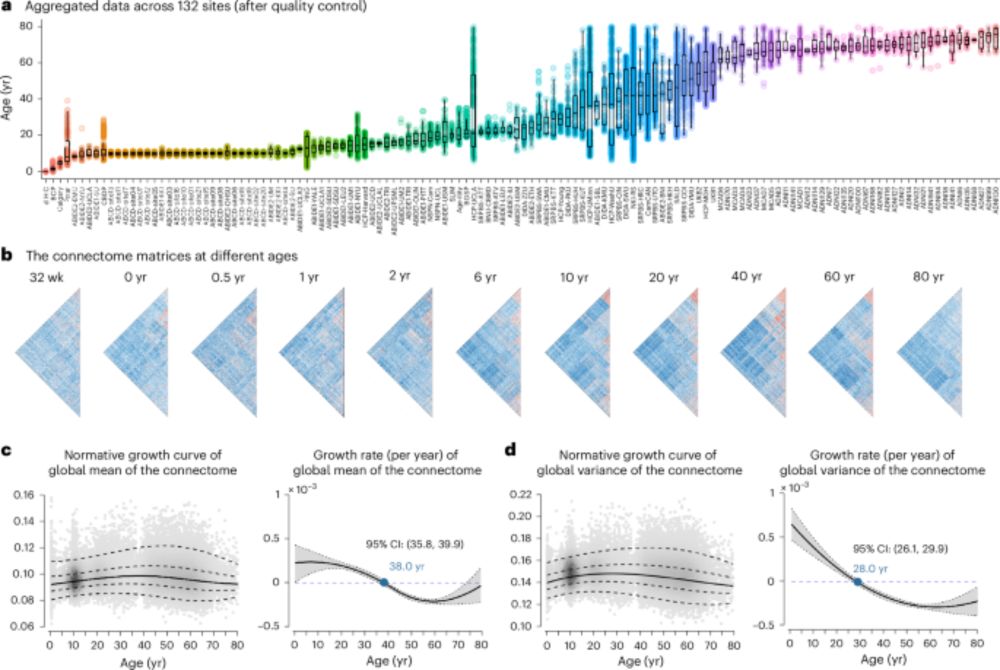
We report critical inflection points in the nonlinear growth curves of the global mean and variance of the connectome, peaking in the late fourth and late third decades of life, respectively. (2/5)
04.04.2025 05:48 — 👍 1 🔁 0 💬 1 📌 0
Using task-free functional from 33,250 individuals at 32 weeks of postmenstrual age to 80 years from 132 global sites, we delineated the nonlinear growth patterns of the functional connectome across multiple scales. (1/5)
04.04.2025 05:48 — 👍 1 🔁 0 💬 1 📌 0
魏朝行, Post-doc in Cognitive and Affective Neuroscience Lab @dartmouth. Brain-spinal fMRI, Placebo and Neuromodulation.
Interested in genetics, development, and brain. Associate prof of neurodev. research at Cambridge.
Math Assoc. Prof. (on leave, Aix-Marseille, France)
Interest: Prob / Stat / ANT. See: https://sites.google.com/view/sebastien-darses/research?authuser=0
Teaching Project (non-profit): https://highcolle.com/
PhD candidate in MCIN Lab @Neuro_MNI @Douglas @McGill | My 🧩 in Neurodevelopment🧠/ Mental Health🧑⚕️/ Machine Learning🤖 | Exploring Postdoctoral Opportunities
We are an interdisciplinary group studying human development across the lifespan at the Max Planck Institute for Human Development in Berlin. See https://www.mpib-berlin.mpg.de/research/research-centers/lifespan-psychology
Postdoc@Jacob Vogel ⬅️ PhD@Thomas Yeo. Neurodegenerative Disease, Brain Imaging, Machine Learning, Multi-omics
https://anlijun.cn
Reader (Associate Professor) - Birkbeck, University of London
Leading the Vaghi Lab (https://www.vaghilab.org/)
Research track resident in psychiatry at UPenn | PennLINC
Neuroimaging, development, precision psychiatry
Neuroscientist: pain perception, human neuroimaging, networks and graphs, cautious Neuro AI, clinical translation
Professor and Director of #Neurology, Saarland University, Germany
www.uks.eu/neurologie
Cognitive neuroscientist interested in how our life experiences change our brains. #ageing | #parenthood | #fMRI | #fPET | #simultaneousPETMR | #MolecularConnectivity
Neuroscientist - Wellcome Trust Early Career Fellow, Assistant Research Professor, MRC Cognition and Brain Sciences Unit, University of Cambridge (Currently visiting Northwestern University)
https://neuroscience.cam.ac.uk/member/mimma2/
ICREA Research Professor. Evolution, Genetics, Neuroscience, Linguistic Cognition
https://www.cedricboeckx.com
Sungkyunkwan University (in south korea , MS/Phd course)
I enjoy academic conversations. Please feel free to contact me anytime.
1. Connectome based predictive modeling
2. Network neuroscience
3. Brain inspired AI
4.structure-function coupling
PhD candidate @MICA Lab (https://mica-mni.github.io/index.html) @McGill University @Montreal Neurological Institute
epilepsy | neuroimaging | connectomics
Max Planck School of Cognition PhD candidate
MPI for Empirical Aesthetics, Behavior Genetics Unit
Typos are my owl
PhD candidate Computational neurogenetics @mpi-nl.bsky.social | EiC MPI TalkLing | #SciComm | #neuroimaging | #genomics | #language | #stats | #ML | #scienceblog | swim-bike-run | dad
postdoctoral researcher @Penn. chaotic good. creativity, art, jazz, brains, networks.