📣 Applications for the 23rd Summer Institute on Bounded Rationality are now open!
✨Join us in Berlin @arc-mpib.bsky.social June 08–16, 2026, to explore the topic of “Decision Making in the Age of AI”.
✏️ More details + application form (deadline: March 16): www.mpib-berlin.mpg.de/research/res...
10.02.2026 12:41 — 👍 22 🔁 24 💬 0 📌 2
Who we are - Center for critical computational studies
Big news: I started a new position as Professor for Computational Social Science (W1 tenure track) at the Center for Critical Computational Studies (C3S) at Goethe University in Frankfurt am Main!
www.c3s-frankfurt.de/who-we-are#m...
02.02.2026 15:34 — 👍 93 🔁 11 💬 13 📌 1
Very happy to see our ice-fishing paper on the cover of @science.org this week! 🎣🎉
We tracked large groups of Finnish competitive ice-fishers to study how social foragers use social information when searching for resources. 🐟
Link: www.science.org/doi/10.1126/... (contact me for open access)
30.01.2026 12:36 — 👍 93 🔁 42 💬 4 📌 2

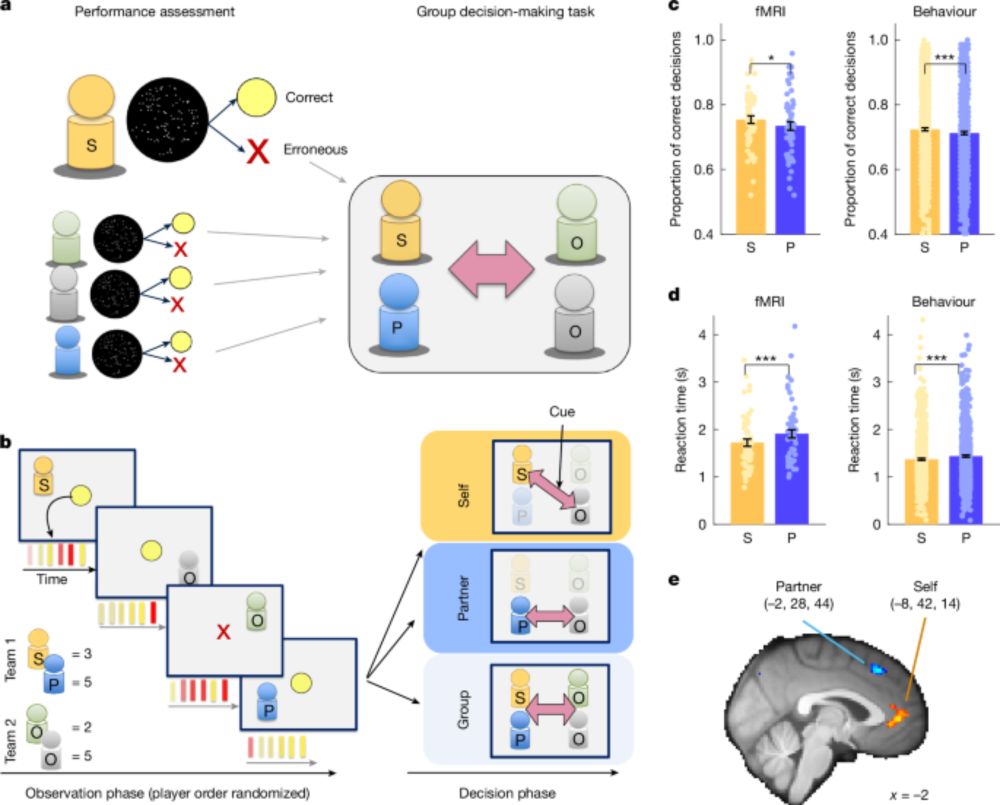
🎉 My PhD work has just been published in @natcomms.nature.com!
How do we learn who caused what - and how much control we had - when outcomes depend on multiple people? We studied how humans do so using a new social learning task, computational modelling and fMRI.
www.nature.com/articles/s41...
🧵👇
21.01.2026 13:27 — 👍 51 🔁 19 💬 1 📌 2

Low socioeconomic status amplifies the perceived rarity of large rewards
Decision-making relies on heuristics derived from past experiences that likely vary with socioeconomic status. We investigate socioeconomic difference…
NEW: We show and replicate socioeconomic gradients in heuristics for decision-making under uncertainty, possibly reflecting adaptations varying levels of scarcity and competition for resources 🫰
Shoutout and thanks to @danielnettle.bsky.social & @coraliechevallier.bsky.social ❤️🔥
tinyurl.com/mu7rzz6k
23.12.2025 11:28 — 👍 24 🔁 11 💬 0 📌 0

Low socioeconomic status amplifies the perceived rarity of large rewards
Decision-making relies on heuristics derived from past experiences that likely vary with socioeconomic status. We investigate socioeconomic difference…
Do people judge what is going to happen in unknown situations differently depending on their socioeconomic position? Yes, if you experience lower socioeconomic position, you think the big rewards are even more unlikely to come your way: www.sciencedirect.com/science/arti...
22.12.2025 09:49 — 👍 9 🔁 5 💬 0 📌 0

Waiting time during admission procedures increases social inequalities in higher education | PNAS
Many domains in life require people to wait to access better outcomes, such as waiting
in line to access prized tickets for a show, waiting to obta...
Happy to share our latest study published in PNAS.
Using data from 274,316 French students, we find that lower-SES students are less likely to wait for better university offers, even when waiting would lead to more prestigious or better-fit programs.
www.pnas.org/doi/10.1073/...
26.11.2025 09:26 — 👍 44 🔁 19 💬 1 📌 0
Simulating theories about how solving this task could develop (see teaser picture), we show that the most likely candidate here is the developmental increasing tendency to parse complex information into simplifying abstract social basis functions, like the brain does in other domains all the time 😍
21.11.2025 16:02 — 👍 1 🔁 0 💬 0 📌 0

🥳!!NEW PREPRINT!!🥳
We show that the tendency to compress complex social information into priors about social structures becomes more pronounced during adolescence.
osf.io/preprints/ps...
I am soooooo excited to share this work, together with @mkwittmann.bsky.social and @yongling.bsky.social.
21.11.2025 16:02 — 👍 20 🔁 7 💬 1 📌 3
Just 1 week to apply! 4 year @erc.europa.eu funded PhD position working in an interdisciplinary team to study #culturalEvolution as a process of reuse, recombination, and creative re-engineering of past solutions. Details 👉 hmc-lab.com/ERCPhDCultur... 🙏Please share!
05.11.2025 10:24 — 👍 33 🔁 21 💬 0 📌 0
ERC funded PhD position on Cultural Evolution
ERC funded PhD position on Cultural Evolution
posted on October 16, 2025
We are currently seeking a highly motivated individual for a ful...
Fully-funded 4-year #PhD in Cultural Evolution! Join my @erc.europa.eu project exploring how compression & compositionality drive cultural innovation: hmc-lab.com/ERCPhDCultur...
Apply by Nov 12!
Maybe of interest to folks from #COSMOS2025 or @eslr.bsky.social? Please feel free to share! 🙏
20.10.2025 09:32 — 👍 65 🔁 62 💬 1 📌 3

Help us strengthen trust in climate scientists in the US! Join our megastudy 👇
15.10.2025 10:03 — 👍 16 🔁 12 💬 2 📌 0
If you’re in London next week, why not swing by?
02.10.2025 14:35 — 👍 7 🔁 2 💬 0 📌 0

Hello everyone! Along with our first post here on Bluesky, we look forward to the new academic year, hosting our first #LJDM2025 session next week with Dr Simon Ciranka @simyciri.bsky.social. For more info and to keep updated, check our website!
02.10.2025 14:32 — 👍 8 🔁 3 💬 0 📌 2
... does this now mean that young people are even LESS uncertainty tolerant, because they listen more to what others say? We have opinions :) Get in touch! Happy to hear yours!
Also, big shoutout of course to @connectedmindslab.bsky.social 🤗
29.09.2025 09:07 — 👍 0 🔁 0 💬 0 📌 0
It also means that notions of uncertainty tolerance require additional explanation. It may be that younger people feel unsure about what to choose, which masks as an increased propensity for risky choice at first glance. But at the same time they use social info more, reducing their uncertainty 🤺
29.09.2025 09:07 — 👍 1 🔁 0 💬 1 📌 0
This internal uncertainty explains age differences in social influence in our experiment. We manipulated social signals by showing the choices of previous participants to ours. The more uncertain our participants were, the more likely they were to follow others. 🌈 This was true irrespective of age.🌈
29.09.2025 09:07 — 👍 0 🔁 0 💬 1 📌 0
Bayesian modelling reveals that younger participants' choices were characterized by greater uncertainty about the utility of choice options, which was distinct from the increased randomness of participants' choices that is usually shown in higher softmax-temperature in younger participants 🤔
29.09.2025 09:07 — 👍 0 🔁 0 💬 1 📌 0
We hope to bring more clarity to the notion of uncertainty tolerance among youth 😶🌫️. Asking for decisions from description or experience, where uncertainty is low and high, respectively, we demonstrate that adolescents indeed make more risky decisions than adults when uncertainty is high vs low.
29.09.2025 09:07 — 👍 0 🔁 0 💬 1 📌 0
Did you manage to steal it?
20.09.2025 14:59 — 👍 0 🔁 0 💬 1 📌 0

UCL – University College London
UCL is consistently ranked as one of the top ten universities in the world (QS World University Rankings 2010-2022) and is No.2 in the UK for research power (Research Excellence Framework 2021).
📢 Job announcement: Two (!) 3-year postdoc jobs in our lab at UCL 📢
🧠💫🔊 We are looking for postdocs interested in the abstract mechanisms underlying social cognition. Modelling, fMRI and non-invasive ultrasound, a new deep-brain stimulation method.
Please RT
www.ucl.ac.uk/work-at-ucl/...
07.08.2025 14:25 — 👍 63 🔁 55 💬 3 📌 4
Very glad to finally share our paper on replay and successor representation learning! ✨
24.08.2025 06:32 — 👍 26 🔁 4 💬 1 📌 0
We are hiring for several research positions for this grant, starting early next year. Please reach out if you're interested!
More details on the jobs here: devcompsy.org/wp-content/u...
24.07.2025 06:46 — 👍 25 🔁 25 💬 0 📌 0
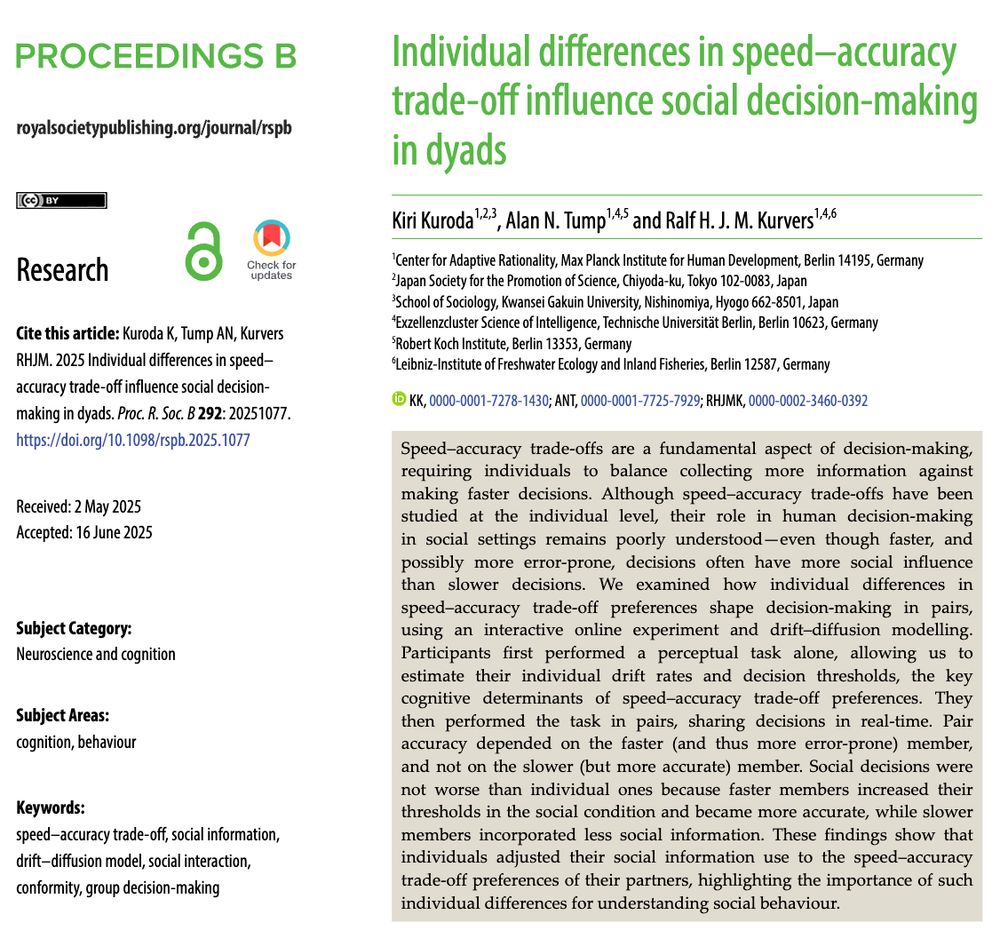
Abstract: Speed–accuracy trade-offs are a fundamental aspect of decision-making, requiring individuals to balance collecting more information against making faster decisions. Although speed–accuracy trade-offs have been studied at the individual level, their role in human decision-making in social settings remains poorly understood—even though faster, and possibly more error-prone, decisions often have more social influence than slower decisions. We examined how individual differences in speed–accuracy trade-off preferences shape decision-making in pairs, using an interactive online experiment and drift–diffusion modelling. Participants first performed a perceptual task alone, allowing us to estimate their individual drift rates and decision thresholds, the key cognitive determinants of speed–accuracy trade-off preferences. They then performed the task in pairs, sharing decisions in real-time. Pair accuracy depended on the faster (and thus more error-prone) member, and not on the slower (but more accurate) member. Social decisions were not worse than individual ones because faster members increased their thresholds in the social condition and became more accurate, while slower members incorporated less social information. These findings show that individuals adjusted their social information use to the speed–accuracy trade-off preferences of their partners, highlighting the importance of such individual differences for understanding social behaviour.
"Individual differences in speed–accuracy trade-off influence social decision-making in dyads"
🚨Our paper has been published in Proceedings of the Royal Society B doi.org/10.1098/rspb...
w/ Alan Tump @alantump.bsky.social, Ralf Kurvers @ralfkurvers.bsky.social
@royalsocietypublishing.org
1/ 🧵👇
16.07.2025 09:34 — 👍 36 🔁 12 💬 3 📌 0
The deadline has been extended until July 16th!
👉 PhDs: hmc-lab.com/ERC_PhDs.html
👉 Postdoc: hmc-lab.com/ERC_Postdoc....
08.07.2025 09:22 — 👍 27 🔁 13 💬 0 📌 1
Yay; andrea @andgr.bsky.social is here now too 🚀 :)
26.06.2025 12:11 — 👍 1 🔁 0 💬 0 📌 0
Psych PhD @cornelluniversity.bsky.social & NSF-GRFP @jowylie.bsky.social's WyLab studying moral curiosity / reward. Data Science @ Liberty Mutual, prev. Discover Financial. @duke-university.bsky.social '21 | 🇺🇸-🇹🇼 he/him | https://1nathanliang.github.io
PhD student at Cornell studying intergroup cognition | NSF GRFP fellow | baking enthusiast | she/her
kirstanbrodie.github.io
Ph.D. candidate in affective and cognitive neuroscience at UC Santa Barbara. Interested in self-other representations, emotion, and memory. Passionate about bridging the gap between findings in laboratory and naturalistic settings.
33 yo, computational cognitive science 🇩🇰 🇫🇷 @AarhusUni_int
| music producer 📀X2 💿 X1 | also 🐶📸🧗
Psychology & behavior genetics. Author of THE GENETIC LOTTERY (2021) and ORIGINAL SIN (coming 3.3.2026). Speaking as an individual
EiC team: Johan Wagemans, Ian Dobbins, Ori Friedman, and Katrien Segaert
Working on social evolution theory, kinship, inequality, and competition. Probably not the interdisciplinarian you’re looking for. https://www.saltlab.org
Professor of Anthropology at Washington State University.
Faculty page: https://anthro.vancouver.wsu.edu/people/hagen/
Views expressed are my own and do not reflect those of my employer or other organizations I'm affiliated with.
Ph.D. Candidate in Cognitive Science
Working on poverty, time discounting, trust and pro-environmentalism
Institut Jean Nicod, CNRS, Paris
www.danielnettle.eu
Cognitive computational neuroscientist at Yale interested in decision making, happiness & mangosteens.
Play games for science! https://happinessquest.app
Research Group Leader MPRG Biosocial | Max Planck Institute for Human Development | Jacobs Foundation Fellow
Ph.D. Candidate in the social neuroscience lab (ICN, UCL).|| Interested in social cognition, hyperscanning and group behaviour.
An international graduate program in Germany with a unique network of researchers in the field of #cognition.
We offer excellent teaching, research opportunities and full funding. Learn more here:
cognition.maxplanckschools.org
Scot abroad and post-doc at KCL in computational psychiatry. Interested in natural and artificial thinking and learning
https://ingrdmrtn.github.io/
I'm a bot that posts new preprints from PsyArXiv.
Maintained by @remoschmutz.bsky.social & @malte.the100.ci
PhD student in Computational Cognitive Sciences | ENS-PSL. Currently working on the dynamics of impression formation, reputation management, and how it impacts our behavior.
https://mariusmercier.github.io
Actual evolutionary psychology by actual evolutionary psychologists.
Website: https://epthepod.podbean.com
Support us on patreon: patreon.com/epthepod
Youtube: https://www.youtube.com/@EvolutionaryPsychologyThePod
Associate Professor at @durhampsych.bsky.social. I look at how culture influences children's learning, and how learning makes us human.
LIFE: A joint PhD program of the Max Planck Institute for Human Development, Freie Universität Berlin, Humboldt-Universität zu Berlin, Technische Universität Berlin, and the Universities of Michigan, Virginia, and Zurich: https://www.imprs-life.mpg.de/