I am so proud to receive the #Foulon price from the French Academy of Sciences 🤩 This is a huge recognition & it means a lot to me 🙏 I dedicate this price to all my close colleagues & collabortors in 🇨🇵, 🇪🇺 & 🌐🌏🌎🌍 without whom it would not have been possible
@academiesciences.bsky.social
26.11.2025 19:58 — 👍 65 🔁 4 💬 11 📌 0
Two years ago we got together in a beautiful mountain to learn and develop #rstats packages for ecology
After {labeleR} (ecologyr.github.io/labeleR/) and {BlueCarbon} (ecologyr.github.io/BlueCarbon/), {mappestRisk} is now officially out! See thread by lead author @dario-ssm.bsky.social 👇
20.11.2025 19:17 — 👍 21 🔁 12 💬 1 📌 0
Amazing output of our #BIEN - #bigdata on #plants - project! Big congrats & thx to @gabrielmoulatlet.bsky.social for leading! 🌿🌴🌲🌳🌐🌍🌎 #macroecology
13.11.2025 22:29 — 👍 18 🔁 7 💬 0 📌 0
In this game, the player needs to balance nature conservation with socioeconomic pressures. A great collaboration with the games engineers led by my former student Daniel Vedder!
08.11.2025 23:20 — 👍 4 🔁 2 💬 0 📌 0
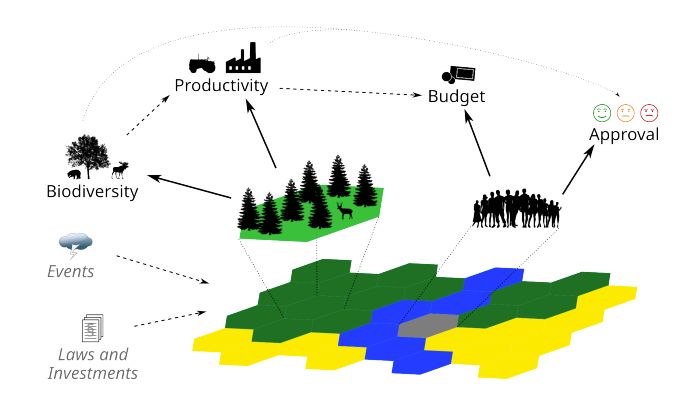
Components of the game’s social-ecological model. The landscape consists of hexagonal tiles, each of which have an associated biodiversity and productivity value. The combined biodiversity and productivity values of the entire landscape determine the player’s available budget as well as their approval ratings in the population. Stochastic events may influence certain parts of the game world, while laws and investments can be used by the player to influence game mechanics.
"Natural Heritage: A Teaching Game For Biodiversity Conservation"
doi.org/10.32942/X20...
07.11.2025 08:01 — 👍 3 🔁 1 💬 0 📌 1

El IP del proyecto presenta el proyecto al resto de participantes de la reunión.
El pasado 20 de septiembre, el IP del proyecto DUNE asistió a la reunión de inicio en la sede de la @fbiodiversidad.bsky.social. Allí tuvimos la oportunidad de presentar #DUNE, conocer el resto de proyectos de la convocatoria y establecer sinergias. @fondoseuropeoses.bsky.social #FEDER @uco.es
30.10.2025 12:50 — 👍 4 🔁 2 💬 1 📌 0
🌿Presentamos el #ProyectoDUNE, que evalará la conservación y conectividad de la #FloraAmenazada en dunas, arenales y acantilados costeros de Andalucía, y los servicios ecosistémicos que proveen estos hábitats.
@fbiodiversidad.bsky.social @fondoseuropeoses.bsky.social #FEDER
28.10.2025 11:22 — 👍 7 🔁 4 💬 2 📌 0
🔉Version 2.0-1 of our #KISSMig #Rstats package for #SpeciesMigration modeling is now live on #CRAN. This #bugfix addresses overprediction in version 2.0-0 that may arise when using time series of binary suitability maps. More Information about #KISSMig → www.wsl.ch/en/services-...
27.10.2025 21:46 — 👍 4 🔁 3 💬 0 📌 0
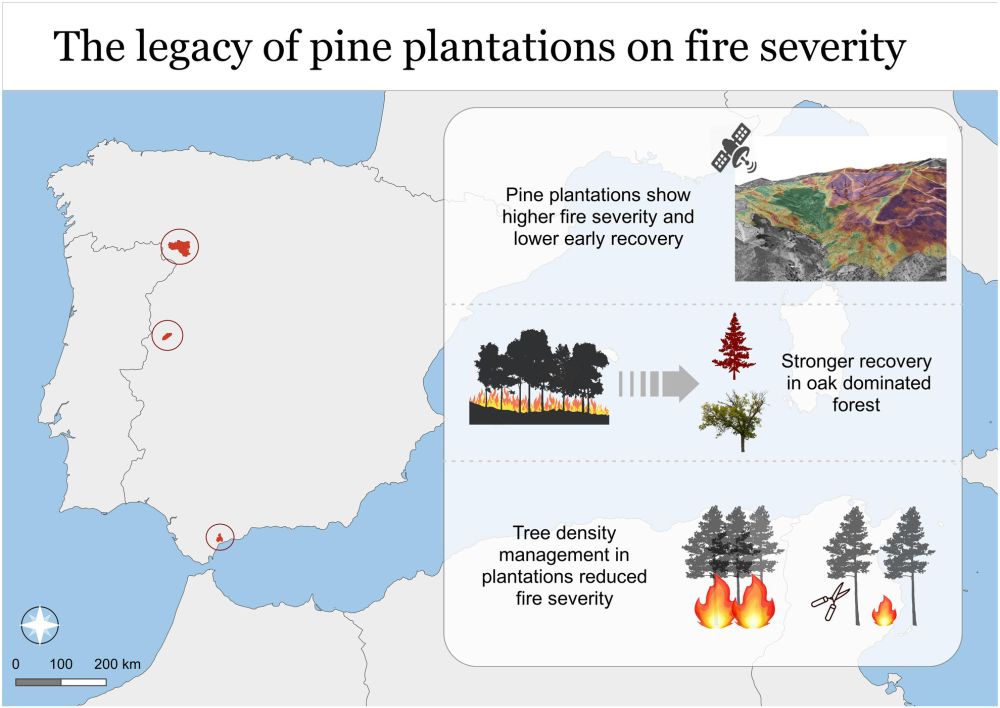
The legacy of pine plantations on fire severity
Our findings provide quantitative evidence that pine plantations can exacerbate fire severity under contemporary climate conditions, and that, once burned, these areas seldom recover. Effective spati....
Spain's fire-ridden summer 2025 sparked big debates about how forests are managed. Now new research in @jappliedecology.bsky.social shows that pine plantations in Spain can increase fire severity, that post-fire recovery is rare, & but that tree density management can help tinyurl.com/mf33xrt8
23.10.2025 09:23 — 👍 14 🔁 7 💬 1 📌 0

Please pass along - Our CAMBIUM NSF NRT provides fellowships to support new PhD students at @uarizona.bsky.social To train & prepare a new generation of scientists to harness the revolution in biodiversity big data to adapt to & mitigate the impacts of climate change. cambium.arizona.edu 🧪🌐🌾
21.10.2025 05:17 — 👍 26 🔁 16 💬 0 📌 1

¡Hemos subido a YouTube las seis últimas charlas del ciclo de Cafés Sistemáticos ☕️🍀!
Las temáticas van de la genómica a la taxonomía, pasando por la etnobotánica, la paleobotánica y la biogeografía. ¡Qué las disfrutéis! 🧵
📺 youtube.com/playlist?lis...
13.10.2025 12:33 — 👍 15 🔁 5 💬 1 📌 0

Our new online application EVA-MAP provides interactive maps of vegetation plots from the European Vegetation Archive and ReSurveyEurope databases. It enables filtering the plots by various criteria. More details can be found in this new article in the IAVS Bulletin:
www.sci.muni.cz/botany/chytr...
11.10.2025 05:53 — 👍 37 🔁 12 💬 0 📌 0

Huge congratulations to Andrés Baselga, who has just been promoted to Full Professor of Zoology at Univ. Santiago de Compostela @usc.gal
Yesterday we enjoyed his talk - from collecting beetles as a teen to developing methods for studying biodiversity.
@andresbaselga.bsky.social
@cretus.usc.gal
11.10.2025 08:37 — 👍 14 🔁 1 💬 1 📌 1

Joint species-trait distribution modeling: The role of intraspecific trait variation in community assembly
The links between intraspecific trait variation and community assembly remain little studied, partially due to the lack of statistical methods to jointly model intraspecific trait variation and species abundances at the community level. Here, we extend the joint species distribution modeling (JSDM) framework into the joint species-trait distribution modeling (JSTDM) framework to explicitly link species abundances to phenotypic variation in traits for multiple species simultaneously. Using a case study of 65 tundra plant species abundances and 3 key functional traits measured across 325 sites, we show how the JSTDM approach (1) estimates the statistical associations among species abundances, species-level traits, and site-level traits, relative to environmental variation; (2) improves predictions on trait variation by using information on species abundances; and (3) generates hypotheses about trait-driven community assembly mechanisms. The JSTDM methodology presented in this study allows assessing the interplay between species abundances and traits at the community level, providing the much needed modeling tools to quantify the role of phenotypic trait variation in eco-evolutionary community assembly.
An extension of joint SDM to jointly model species abundances and intraspecific trait variation. #ecopubs @esajournals.bsky.social
doi.org/10.1002/ecy....
08.09.2025 11:20 — 👍 30 🔁 13 💬 1 📌 0

Fresh off the press! Our perspective in @natrevbiodiv.nature.com discusses the wealth of information on biodiversity contained in historical sources, and its integration for long-term ecological knowledge and biodiversity conservation. A thread on the paper and what led to it:
rdcu.be/eEcIt
05.09.2025 13:53 — 👍 177 🔁 73 💬 8 📌 17

🌍 The International Biogeography Society’s 12th Biennial Conference — TIBS Aarhus 2026 — will take place Jan 6–10 in Aarhus, Denmark: conferences.au.dk/tibs-aarhus-... 🐘🍃🌴We're looking forward to hosting it!
#Biogeography is central to understanding the #biosphere & is more important than ever!♨️
04.09.2025 19:48 — 👍 51 🔁 20 💬 1 📌 1
Punctuated equilibrium, a concept introduced by paleontologists in 1972, reimagines evolution’s tempo as a stochastic burst rather than a steady beat. A new model finds support for their theory in both molecular and fossil data. @jakebuehler.bsky.social reports www.quantamagazine.org/the-sudden-s...
28.08.2025 14:11 — 👍 48 🔁 22 💬 2 📌 1
YouTube video by Córdoba Ciencia
#UCONEWS | Miles de años de datos climáticos para predecir mejor los cambios ecológicos del futuro 🌄
📽️ Vídeo completo:
18.07.2025 07:47 — 👍 2 🔁 1 💬 0 📌 0
🌳 Conocer cómo ha respondido la biodiversidad a los cambios en el clima y predecir cómo cambiará ante los efectos del cambio climático es el objetivo de este trabajo, elaborado por personal investigador de la @uco.es en colaboración con @universidadgranada.bsky.social.
👨🏻🔬 Nos lo cuenta Diego Nieto:
18.07.2025 07:47 — 👍 3 🔁 1 💬 1 📌 0
Desde el grupo de Ecoinformática de la AEET hemos creado un punto de encuentro para las personas que trabajamos con el medio natural y usamos herramientas computacionales - únete a la comunidad respondiendo a este mensaje o contactándome por privado!
go.bsky.app/FWR2yEM
🌱🐻💚🖥️
12.07.2025 17:18 — 👍 18 🔁 16 💬 9 📌 0
Gracias por la iniciativa!
13.07.2025 23:49 — 👍 1 🔁 0 💬 0 📌 0

Búsqueda de ilustrador o ilustradora con especialidad en botánica
Para toda persona a quien pueda interesar
19.06.2025 12:47 — 👍 258 🔁 445 💬 15 📌 12
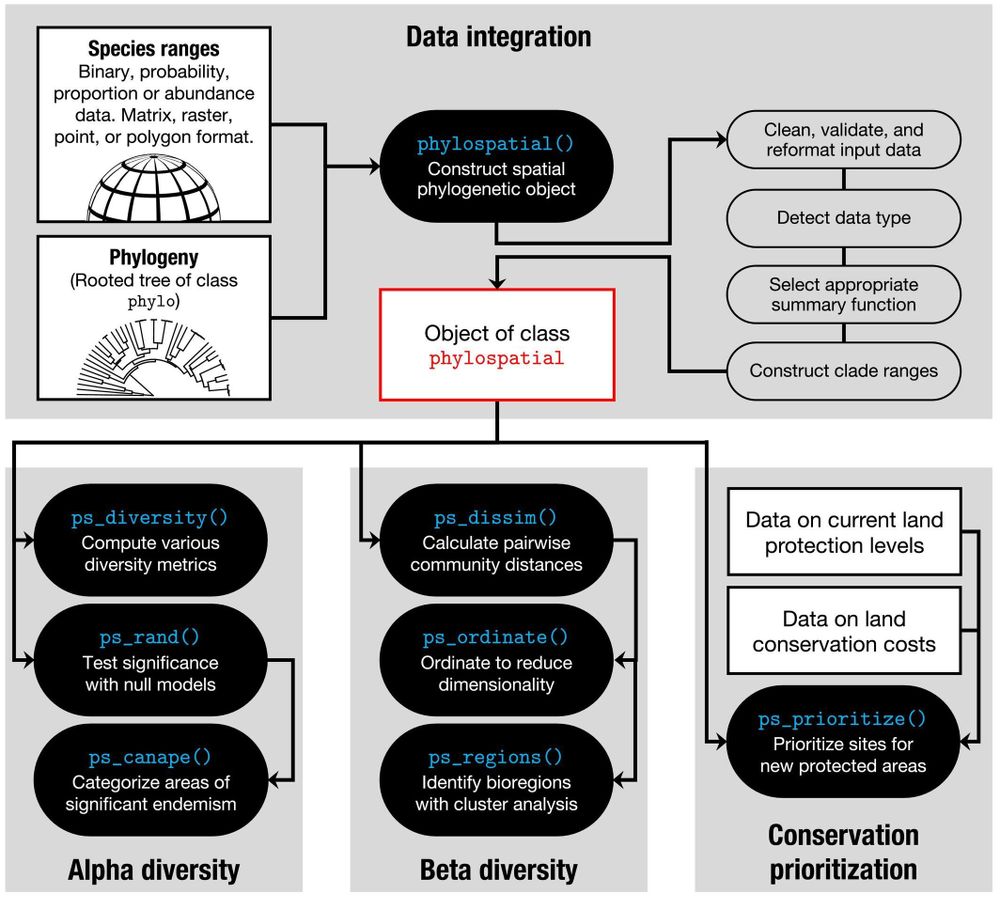
📖Published📖
Matthew Kling presents phylospatial, a new R package that fully supports probability, abundance, and binary community data across a range of spatial phylogenetic diversity (PD) analyses 🌎 🧪 Check the article out here 👇
buff.ly/onf4BV6
26.05.2025 11:03 — 👍 35 🔁 15 💬 0 📌 2

We are super excited to have @jacquelyngill.bsky.social give a Funk lecture! To learn more and to register, please visit our website: www.biogeography.org/news/feature...
19.05.2025 16:13 — 👍 10 🔁 4 💬 0 📌 2
Limited evidence for range shift–driven extinction in mountain biota
Mountain biodiversity reorganizes rapidly as species shift upslope to track temperatures. Pervasive species redistribution poses substantial threats to mountain ecosystems, a phenomenon sometimes desc...
🏔 species redistribution
We found limited evidence, so far, for #mountaintop #extinction, lowland #biotic #attrition & #range-shifts gaps despite climate-driven upslope range shifts 🌡📈
Biotic homogenization on its way along mountain slopes 🗻🏔⛰️
🧪🌐🌍🏔🌳🌲🦋🦎🐦🦔
@science.org
shorturl.at/Fdrlo
15.05.2025 20:17 — 👍 83 🔁 24 💬 2 📌 6
#AcademicSky
12.05.2025 18:17 — 👍 11 🔁 3 💬 0 📌 0
Environmental scientist and PhD candidate advancing precision conservation and watershed modeling through geospatial analytics, hydrological modeling, and machine learning. Bridging science and policy for sustainable agriculture.
Proyecto subvencionado por la @fbiodiversidad.bsky.social (@miteco.gob.es) y cofinanciado por el Fondo Europeo de Desarrollo Regional (@fondoseuropeoses.bsky.social #FEDER) para el impulso de la investigación en #infraestructura_verde.
Fundación (F.S.P.) del @miteco.gob.es que trabaja para preservar la biodiversidad y los ecosistemas e impulsar un cambio de modelo económico, social y cultural
Assistant Professor @uarizona – Biological data science and macroevolution – Website: https://datadiversitylab.github.io/
IICG-URJC. Plant conservation and evolutionary biology. Plant adaptation to marginal areas. In situ conservation of crop wild relatives. Mediterranean alpine habitats and climate change. Biotic interactions. IUCN Conservation Translocation and CWR SGs
Ecologist working on island ecology 🏝️, tropical ecology, ecological networks, species interactions, seed dispersal 🐦🐢🫐, restoration ecology, biological invasions 👽, community ecology, global change 🌍
📍Postdoctoral researcher at @IMEDEA_UIB_CSIC
Mexican Historian & Philosopher of Biology • Postdoctoral Fellow at @theramseylab.bsky.social (@clpskuleuven.bsky.social) • Book Reviews Editor for @jgps.bsky.social • https://www.alejandrofabregastejeda.com • #PhilSci #HistSTM #philsky • Escribo y edito
Marine Ecologist. 🤿🪸 Postdoctoral researcher at @medrecover.bsky.social (@ub.edu & @irbio-ub.bsky.social). Marine biodiversity | Global change | Marine heatwaves | Coral ecosystems
🪸 Data manager for Class Octocorallia at www.coraltraits.com
PhD in River Ecology (ULisboa)
Postdoctoral researcher at Senckenberg Research Institute
From Spain, based in Berlin
Specialised in Data Science and Landscape Ecology
Mostly #rstats in #Ecology, #Nature and #LifeScience
🌿 PhD candidate at @ebdonana.bsky.social
🤓 Interested in biogeography, grassland communities and socioecology
📱 Coordinadora Comunicacion y Divulgación @jovenesbotanica.bsky.social
🆔 https://orcid.org/0009-0000-0638-5237
🐈⬛ https://github.com/cecegl
🌍 Exploring the ecological complexity of species interactions under global change
🌱 Forests, seed dispersal, and restoration dreams
🏝 Island ecology (sometimes!)
#Ikerbasque Fellow #BC3Research | #Humboldt & #MSCA alumni | Yoga lover 🧘🏽♀️🤸🏽
Postdoctoral researcher at @CEF_CFR @UQAM. Interested in quantitative ecology, forest resilience, and post-disturbance dynamics. Forest engineer.
RyC fellow at Spanish National Research Council (Doñana Biological Station). Global-change ecology| forecasting| multi-species demographic models. For more info: https://globalchangeeco.com/ and also https://euro-ecoforecast.wordpress.com/
PhD in Biodiversity and Conservation
Global Change Research Institute (IICG-URJC)
Rey Juan Carlos University
Madrid, Spain
Institutional website: https://gestion2.urjc.es/pdi/ver/carlos.lara
#Ecology #Botany
Ecologist working on biodiversity, species interactions, and ecosystem functioning, @CSIC
Postdoc @ebdonana.bsky.social
Exploring ecological interactions through the lens of Complex Systems 🌱
violetavivi.github.io
Ecólogo informatizado, amante de la #Biodiversidad, la #Bioacústica y #Rstats!
Ecology, forests, global change, biogeography, rstats, data science | Ekosistemetan ematen diren aldaketak ulertzeko ahaleginean