Seeking With Sentiment: Emotional Attachment and the Use of Generative AI as an Information Intermediary | Article | Media and Communication
Bingbing Zhang, Nihar Sreepada
Generative artificial intelligence (GenAI) is quickly becoming a key intermediary for information access, shaping how people search for and evaluate knowledge. But what drives people to rely on GenAI for information? Check my newest publication for it:
www.cogitatiopress.com/mediaandcomm...
06.03.2026 00:02 —
👍 0
🔁 0
💬 0
📌 0

Ross Dahlke presents in a lecture room, gesturing toward a slide titled “Ideological Information Environments” with bullet points comparing the open web and personal messaging.

Ross Dahlke points at a projected slide with two bar charts comparing “Web Browsing” vs. “Personal Messaging,” showing congruent vs. cross-cutting content for Democrats and Republicans.

Ross Dahlke speaks at the front of a conference room while a slide shows scatterplots of “Percentage of Messages by Type,” with colored dots representing different messaging platforms.

Ross Dahlke leads a small-group meeting in the Moeller Lab “Media Research” room, seated at a conference table with laptops while a wall screen displays a simple diagram about “Untrustworthy Websites.”
Thanks to University of Iowa School of Journalism and Mass Communication for hosting me for their Communication and Media Colloquium series and to Sang Jung Kim, @bingbingzhang.bsky.social and Jamil Marques for inviting me to your classes!
05.03.2026 20:29 —
👍 2
🔁 1
💬 0
📌 0

📣 Extension of Deadline for Travel Grants Applications!
We invite applications for travel grants from ICA attendees without sufficient funding. These grants are especially directed at students and junior scholars from Tier B/C.
Apply here: docs.google.com/forms/d/e/1F...
18.02.2026 08:57 —
👍 1
🔁 4
💬 1
📌 0
It’s a good reminder that impact isn’t just about breaking news, it’s about how journalism serves people’s lives and decisions.
11.02.2026 22:56 —
👍 0
🔁 1
💬 0
📌 0
Thank you, Brian!
25.06.2025 15:56 —
👍 1
🔁 0
💬 0
📌 0

Sage Journals: Discover world-class research
Subscription and open access journals from Sage, the world's leading independent academic publisher.
🧠Big shoutout to Homero Gil de Zúñiga, Rebecca Scheffauer, and @bingbingzhang.bsky.social for winning the 2024 JMCQ Outstanding Article Award! 👏 Their study on how cable news relates to conspiracy mentality is a must-read. 📺https://journals.sagepub.com/doi/abs/10.1177/10776990231171929 #commsky
25.06.2025 04:47 —
👍 7
🔁 3
💬 0
📌 3
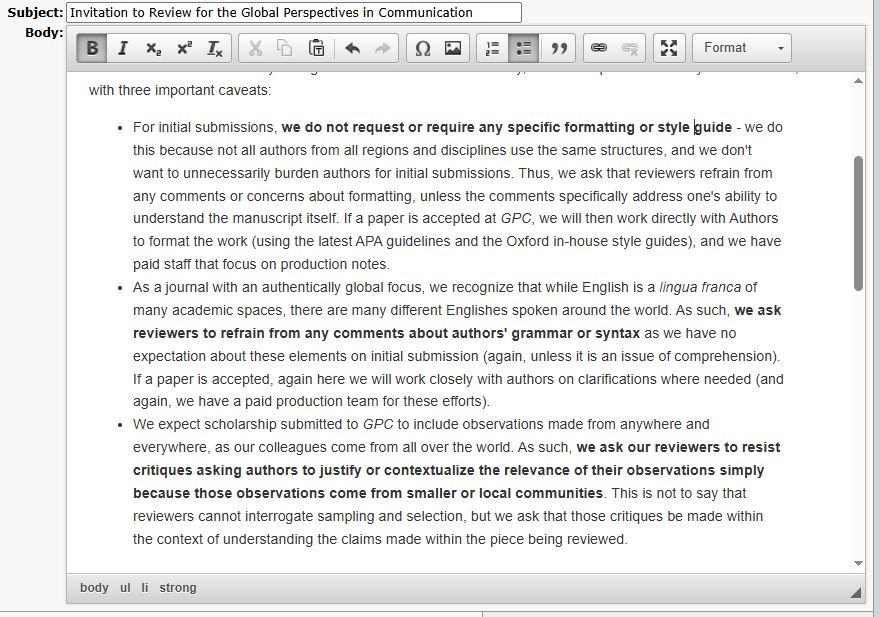
The Three Caveats of GPC reviews:
For initial submissions, we do not request or require any specific formatting or style guide - we do this because not all authors from all regions and disciplines use the same structures, and we don't want to unnecessarily burden authors for initial submissions. Thus, we ask that reviewers refrain from any comments or concerns about formatting, unless the comments specifically address one's ability to understand the manuscript itself. If a paper is accepted at GPC, we will then work directly with Authors to format the work (using the latest APA guidelines and the Oxford in-house style guides), and we have paid staff that focus on production notes.
As a journal with an authentically global focus, we recognize that while English is a lingua franca of many academic spaces, there are many different Englishes spoken around the world. As such, we ask reviewers to refrain from any comments about authors' grammar or syntax as we have no expectation about these elements on initial submission (again, unless it is an issue of comprehension). If a paper is accepted, again here we will work closely with authors on clarifications where needed (and again, we have a paid production team for these efforts).
We expect scholarship submitted to GPC to include observations made from anywhere and everywhere, as our colleagues come from all over the world. As such, we ask our reviewers to resist critiques asking authors to justify or contextualize the relevance of their observations simply because those observations come from smaller or local communities. This is not to say that reviewers cannot interrogate sampling and selection, but we ask that those critiques be made within the context of understanding the claims made within the piece being reviewed.
Our first peer review requests are going out today! We'll continue to "massage" our language, but here's how we're codifying our "three caveats" for GPC reviewers - we don't enforce style guides, we don't police Englishes, and we don't ask for rote justification of samples. =)
22.06.2025 13:46 —
👍 8
🔁 3
💬 0
📌 1
How can you tell if your paper is a good editorial fit for us? We're very open to the "anything under the tent" at @icahdq.bsky.social. If a paper had been priorly accepted at #ICA25 (or even earlier), let us know in your editorial letter - that's at least a good signal for fit!
19.06.2025 13:06 —
👍 4
🔁 4
💬 1
📌 0
Does source of inoculation matter? Check our study about how source credibility interacts with the inoculation process against climate misinformation.https://www.tandfonline.com/eprint/Y2YIKWUTKRMYDWI5P5KM/full?target=10.1080/08934215.2025.2465306
21.02.2025 00:49 —
👍 0
🔁 0
💬 0
📌 0
Will people accept disparagement more when it is disguised in humor? You can find out about it in my new publication~https://www.tandfonline.com/eprint/SFHYDMXBVIAJXSWPAVUJ/full?target=10.1080/15358593.2025.2461070
21.02.2025 00:48 —
👍 0
🔁 0
💬 0
📌 0

CFP Deadline Extend~ Now accepting proposals! Visit cp3.org.uiowa.edu for preconference details and submission guidelines.
31.01.2025 20:56 —
👍 0
🔁 0
💬 0
📌 0

Now accepting proposals! Visit cp3.org.uiowa.edu for preconference details and submission guidelines.
03.01.2025 23:46 —
👍 1
🔁 0
💬 0
📌 0

Navigating Political Disagreement on Social Media: How Affective Responses and Belonging Influence Unfollowing and Unfriending | Article | Media and Communication
Bingbing Zhang, Heather Shoenberger
What makes us unfriend people with different political views?
@bingbingzhang.bsky.social and Heather Shoenberger show that perceived political disagreement can lead to intense emotions like anger and anxiety, driving us to disconnect on social media. www.cogitatiopress.com/mediaandcomm...
10.12.2024 09:39 —
👍 1
🔁 2
💬 0
📌 0