I collect animal figures and let me tell you that things are pretty bad round here
29.05.2024 22:10 — 👍 56 🔁 4 💬 3 📌 2
@denoudenderek.bsky.social
Evo Bio PhD student @ASU. Paleo MS @ETSU, Bio+Geo BS @IowaStateU. Trying to tame shrews, enjoyer of all Cenozoic oddballs. He/him, views mine.
I collect animal figures and let me tell you that things are pretty bad round here
29.05.2024 22:10 — 👍 56 🔁 4 💬 3 📌 2
Follow the Yellow Leaf Road 🍃
Haolong dongi

A colorful March Calendar listing extinct fauna. Wednesdays are listed as rest days. 1: Megaconus, 2: Maiopatagium, 3: Rugosodon, 5:Indohyus, 6: Anthracobune, 7:Birbalomys, 8:Palaeosyops, 9:Paratritemnodon, 10: Pakicetus, 12: Ptolemaia, 13: Antilohyrax, 14: Bothriogenys, 15:Apidium, 16: Masrasector, 17: Moeritherium, 19: Proscelidodon, 20:Agryolagus, 21: Lagostomus, 22: Macroeuphractus, 23: Huayqueriana, 24: Thylacosmilus, 26: Teleoceras, 27: Eocoileus, 28: Arctomeles, 29: Mylohyus, 30: Pristinailurus

How to participate and rules. Any art form is welcome, and will accrue raffle tickets for one of the models I make. Winners of the raffle will get their choice of the models I make for this month.
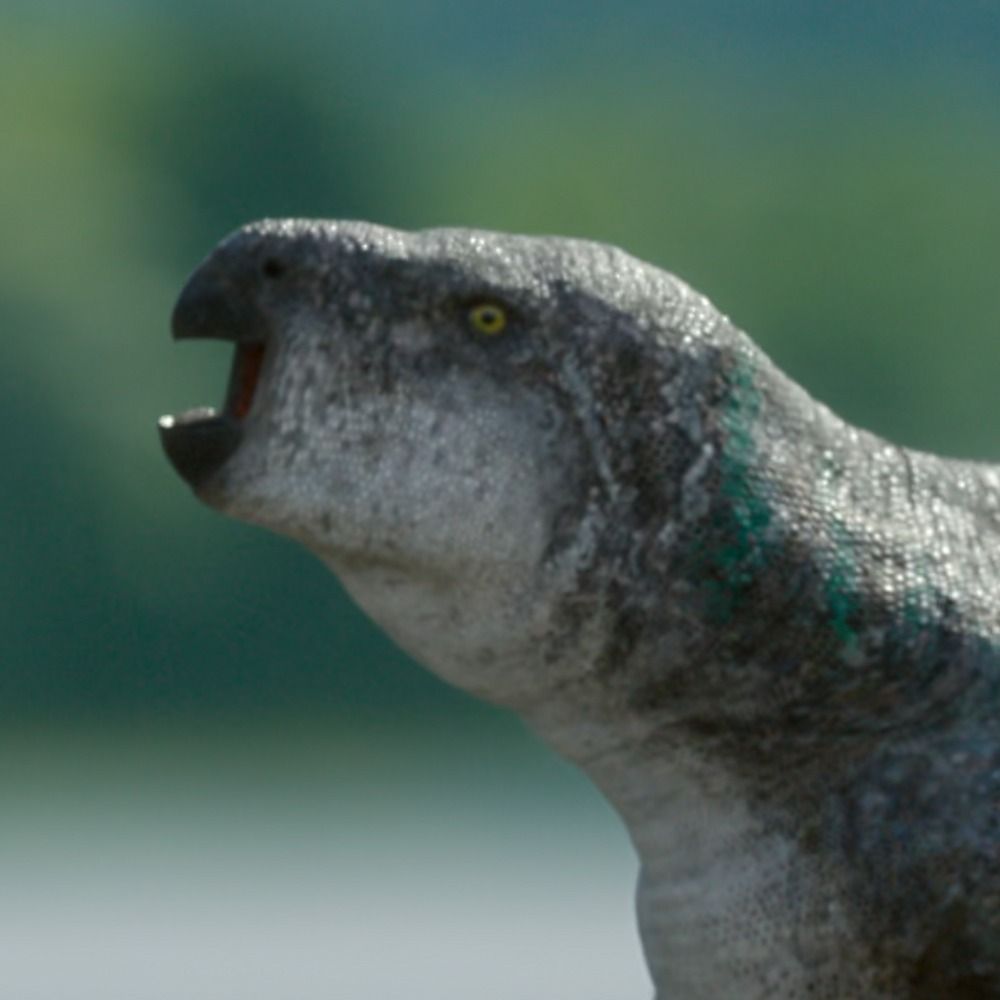
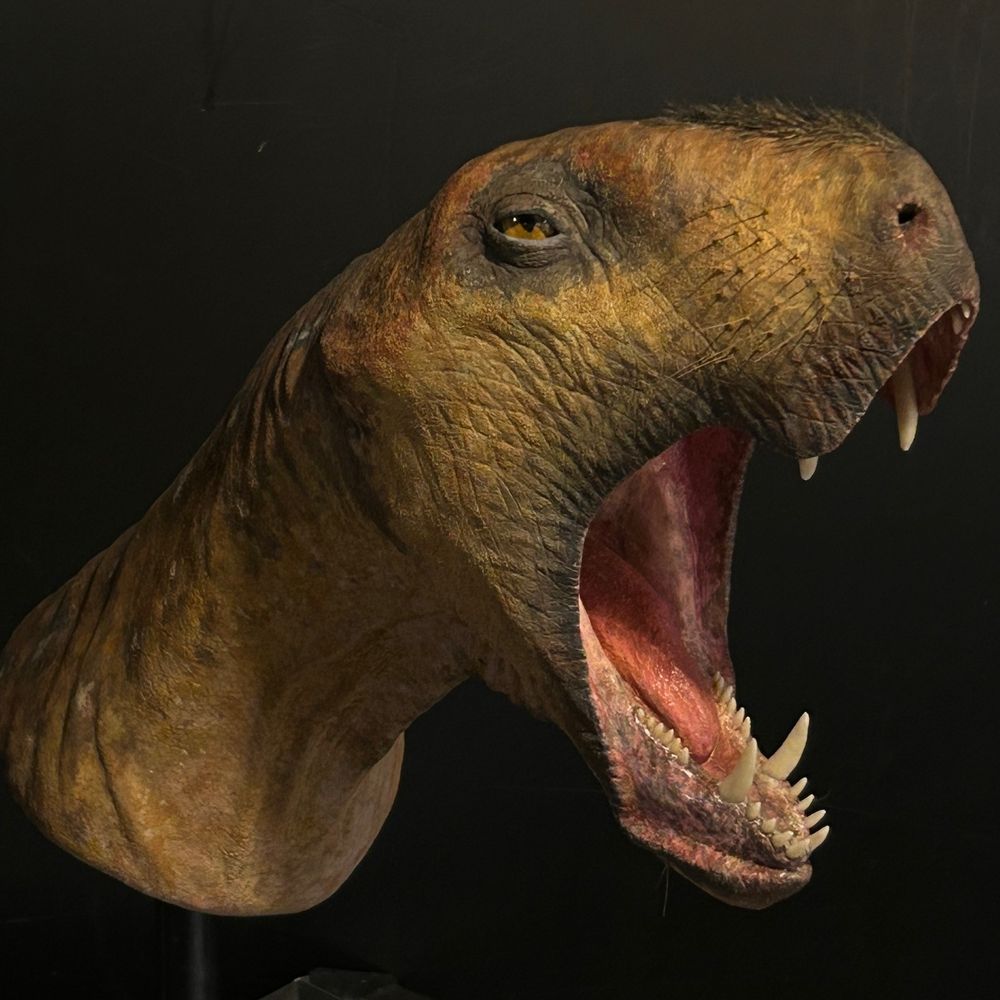
Welcome back to another year of #marchofthemammals2026 ! We'll be going from formation to formation again, going from gliding mammaliaformes to rotund early elephants to Appalachian red pandas, and everything in between. I hope to see y'all participate!
16.02.2026 20:45 — 👍 14 🔁 4 💬 0 📌 2This figure models a corrugated metal surface moving over an ice-face. The open hexagons are crystalline ice.
The blue: amorphous ice produced by sticking/slipping of ice molecules in the crystal to the metal surface.
Hydrophobic/hydrophilic surface interactions further lower friction.

The billion-dollar case for sustaining palaeontology’s digital databases 🧪 www.nature.com/articles/s41...
Dowding et al survey palaeontological databases, documenting their contributions to science as well as vulnerabilities, and provide recommendations for the future of open science databases

Kinematics and morphology reveal how mammals descend trees safely, showing posture and movement strategies that suggest early upright behaviours in ancestral primates.
buff.ly/EnUkzYd


I always thought the term “billfish” implied toothlessness, and while that’s true for swordfish, all the other billfishes are exactly the opposite: their mouthes and bills are COVERED in tiny teeth.
They also have these awful tooth filled pockets all along their bills. Awful.
I always thought the term “billfish” implied toothlessness, and while that’s true for swordfish, all the other billfishes are exactly the opposite: their mouthes and bills are COVERED in tiny teeth.
They also have these awful tooth filled pockets all along their bills. Awful.

3/10 We discovered that sing different types of commonly used genome-wide markers, such as UCEs and BUSCO genes, produce fundamentally different hypotheses about shark and ray evolution! Depending on the type used, sharks are NOT necessarily their own clade!
15.02.2026 20:30 — 👍 9 🔁 3 💬 1 📌 1
1/10 ⏰⏰ New stuff from me &
@tjnear.bsky.social
! We show that sharks themselves might not be a natural group ... it depends on what spots in the genome you analyze!
Preprint here: www.biorxiv.org/content/10.6...

The Koobi Fora tortoise scaled to an adult man. The shell alone is as tall as the mans hip

A photograph of a man (Abdikadir Kurewa) kneeling next to the shell remains of a giant tortoise, the man could easily fit inside the shell.
Turns out theres giant bloody tortoises in the Pleistocene of Kenya
15.02.2026 20:01 — 👍 27 🔁 9 💬 0 📌 1
Happy International Women In Science Day! I had an amazing time speaking with fellow female scientists and paleoartists on todays paleoart panel with @extinctfineart.bsky.social . Pictured here is me and one of the key Diplodocus skin specimens that led to our recent discovery on Dippy Colors 🦕🌈
12.02.2026 01:12 — 👍 80 🔁 15 💬 1 📌 0
Lambeosaurus neck vertebrae with skin preserved around them
Did someone say dinosaur skin?
11.02.2026 22:44 — 👍 58 🔁 10 💬 3 📌 0![Comic. [2x2 chart. Top left quadrant: seem like dinosaurs x are dinosaurs. Silhouettes of dinosaurs stegosaurus, triceratops, tyrannosaurus, velociraptor, and long-neck dinosaur. Top right quadrant: seem like dinosaurs x are not dinosaurs. Silhouettes of mosasaur, quetzalcoatlus, dimetrodon, plesiosaur, and pteranodon. Bottom left quadrant: don’t seem like dinosaurs x are dinosaurs. Silhouettes of penguin, egret, ostrich, pigeon, falcon. Bottom right: don’t seem like dinosaurs x are not dinosaurs. Silhouettes of squirrel, stapler, plant, person, and bicycle.]](https://cdn.bsky.app/img/feed_thumbnail/plain/did:plc:cz73r7iyiqn26upot4jtjdhk/bafkreihcxd5wcrrf5nxz3g4riglsrccbucmdns6kxrtmtj6gjgwqibp3fi@jpeg)
Comic. [2x2 chart. Top left quadrant: seem like dinosaurs x are dinosaurs. Silhouettes of dinosaurs stegosaurus, triceratops, tyrannosaurus, velociraptor, and long-neck dinosaur. Top right quadrant: seem like dinosaurs x are not dinosaurs. Silhouettes of mosasaur, quetzalcoatlus, dimetrodon, plesiosaur, and pteranodon. Bottom left quadrant: don’t seem like dinosaurs x are dinosaurs. Silhouettes of penguin, egret, ostrich, pigeon, falcon. Bottom right: don’t seem like dinosaurs x are not dinosaurs. Silhouettes of squirrel, stapler, plant, person, and bicycle.]
Dinosaurs And Non-Dinosaurs
xkcd.com/3204/

Four incomplete fossil fish specimens on a black background. The specimens preserve scales, vertebrae, spines, and so on, and are dark gray on lighter gray to mustard-colored slabs.
Remarkable. Report of a Brazilian spiny-rayed fish dating to the Barremian stage of the Early Cretaceous, preceding the oldest known acanthomorphs by ~20 million years. Gondwanacanthus extends the roots of one of today's most prominent vertebrate radiations: onlinelibrary.wiley.com/doi/10.1002/...
10.02.2026 14:48 — 👍 84 🔁 27 💬 2 📌 4
The idea that humans sit atop an evolutionary hierarchy dates back to 1866, when a scientist drew the first tree of life with "Man" at the top.
This inaccurate view still shapes how we think of the animal world, despite decades of genomic evidence proving evolution has no hierarchy.
buff.ly/dpXwi1r

Sevenfingered threadfin (Polydactylus virginicus) from iNaturalist user kenman2000

Pteronisculus changae, figure 3 from Yi and Guang-Hui (2021)
Threadfins look like you plucked an early ray finned fish from the Permian or Triassic and brought it to the modern day
Close enough, welcome back Pteronisculus

Mounted Barylambda faberi skeleton in a display case in front of a mural showing a reconstruction of the animal eating with a green background (only seen in photo from neck down). At the Field Museum.
The bulky herbivore, Barylambda faberi, a pantodont from the Paleocene. #FossilFriday ⚒️🧪
06.02.2026 12:55 — 👍 42 🔁 12 💬 1 📌 0
here's a better link, not sure what happened with the one above www.nature.com/articles/s41...
06.02.2026 10:44 — 👍 30 🔁 10 💬 0 📌 0
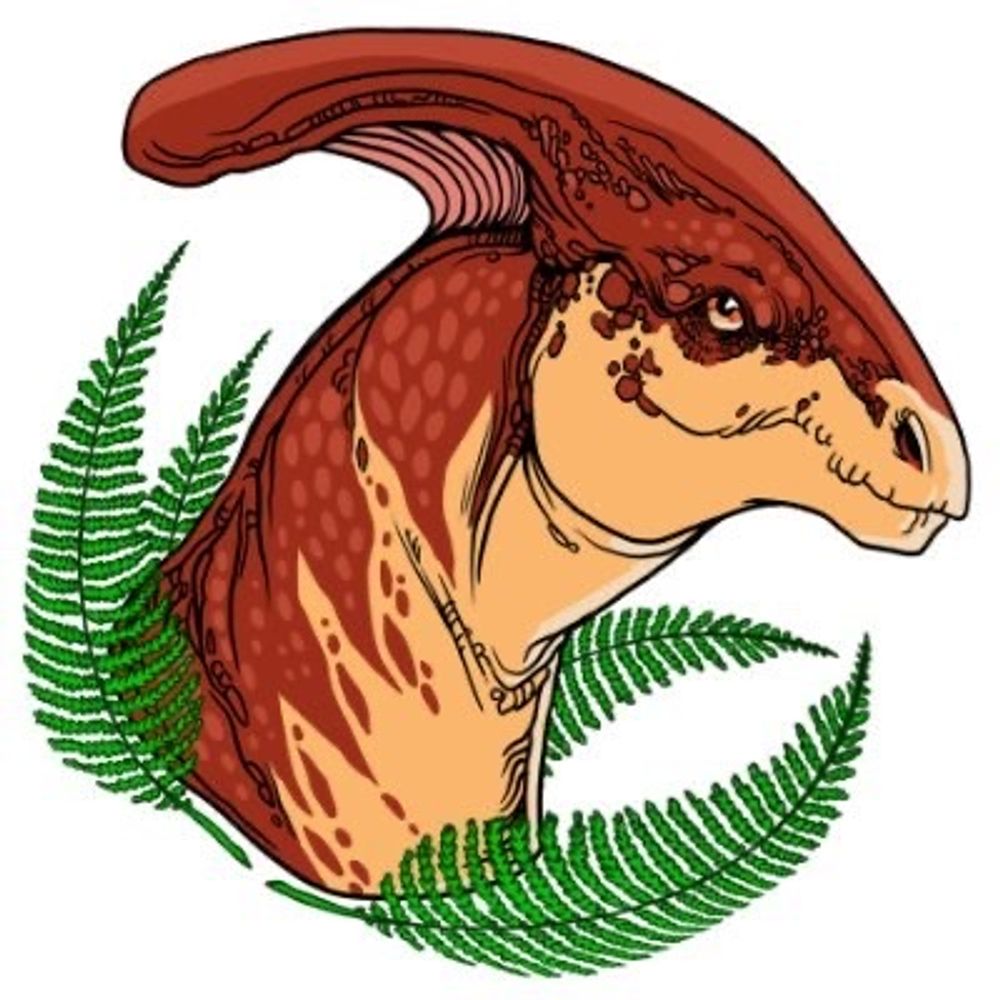
art depicting two haolong individuals, depicted with the unique spikey integument preserved with the holotype
a very warm welcome to haolong dongi, a fascinating hadrosauroid from the early cretaceous yixian formation described by huang et al. 🎉 the near-complete holotype preserves highly unique integumentary structures unknown in other dinosaurs
www.nature.com/articles/s41
(art by fabio manucci)
Sevenfingered threadfin (Polydactylus virginicus) from iNaturalist user kenman2000
Pteronisculus changae, figure 3 from Yi and Guang-Hui (2021)
Threadfins look like you plucked an early ray finned fish from the Permian or Triassic and brought it to the modern day
Close enough, welcome back Pteronisculus

Terror birds (Phorusrhacidae) ruled South America for ~40 Ma, but their growth was a mystery. New hindlimb osteohistology shows rapid, uninterrupted growth, heavy remodeling & cursorial stress in Oligocene Andrewsornis & Physornis.
Dreyer et al.: anatomypubs.onlinelibrary.wiley.com/doi/10.1002/...

Mongolian Titan 🦕
25.01.2026 21:48 — 👍 43 🔁 18 💬 1 📌 0
Vector illustration of Speleotherium logani, a mid sized relative of muskox and takin from the late Pleistocene of New Mexico, Mexico, and Belize. It is looking at the viewer and calling. The stocky bovid has a short skull with short, backwards curving horns on its head. It is dark brown on its underside with a lighter back and white marks on its lips and around its feet. Text reads: Speleotherium logani. Richard S. White, Jimi Mead and Gary S. Morgan. "Logan's Austral Scrubox, A New Ovibovine (Mammalia: Bovidae) from Muskox Cave, Eddy County, New Mexico." Fossil Record 11. New Mexico Museum of Natural History and Science Bulletin 101. Oct 15 2025
#Cenozoicrewind2025 Meet Speleotherium logani!
#paleoart #vectorart #iceage

The Art and Science of #PrehistoricPlanetIceAge ... a new discussion from @skeletoncrewpaleo.bsky.social on YouTube, featuring me and Framestore's Russ and Dorothy youtu.be/IVu9Mfc38Es?...
25.01.2026 11:34 — 👍 56 🔁 28 💬 1 📌 1
Glass is an important aspect of specimen storage in most major natural history collections 🫙
By observing specimens housed in the Smithsonian National Museum of Natural History, this study outlines the impact of glass deterioration on their preservation:
doi.org/10.3897/nhcm.3.173156

As a paleontologist, I'm not usually invested in any particular outcome of research, except to learn new things. However, I was saddened by the results of this one. Great work by Alex, but it doesn't look good for bison in the lower 48 over the next 75 years. www.frontiersin.org/journals/eco...
20.01.2026 16:10 — 👍 3 🔁 1 💬 0 📌 0
🔴BREAKING NEWS:
NEW #SurvivingEarth FOOTAGE FEATURING BABY ISCHIGUALASTIA RELEASED!

Author disagrees with blog article. Posts entire review of a manuscript, 7 pages long and over 11000 words, in the blog comments. Don't believe me? Go see comments at... tetzoo.com/blog/2026/1/...
13.01.2026 23:53 — 👍 30 🔁 6 💬 2 📌 0