There are now millions of publicly-available AI models – which one is right for you?
We introduce CODA ( #ICCV2025 Highlight! ), a method for *active model selection.* CODA selects the best model for your data with any labeling budget – often as few as 25 labeled examples. 1/
@iccv.bsky.social
13.10.2025 18:00 — 👍 12 🔁 6 💬 2 📌 1


Too many mediocre men talk over capable women.
Study of problem-solving teams: Men dominate the conversation, taking 50% more turns and saying 69% more than women. Men with low skill speak more than women with high skill.
It's long past time to value competence over confidence.
12.12.2025 16:09 — 👍 130 🔁 38 💬 2 📌 7
Harnessing the power of AI for biodiversity monitoring with camera trap networks - From foundation model to edge processing
📢Please share📢 We have an opening for an exciting fully-funded PhD project on computer vision and machine learning applied to biodiversity monitoring with amazing Serge Belongie @belongielab.org and @aicentre.dk. Application deadline coming up on 15 January!
phd.tech.au.dk/for-applican...
02.01.2026 13:09 — 👍 19 🔁 15 💬 1 📌 3

Excited to share a new paper led by our colleagues at #DLR! We trained AI to recognize 15 European fly pollinator families and estimate how confident it is, helping ecologists use AI more responsibly.
Paper: lnkd.in/dBAWW3hB
Code: lnkd.in/du7dD2hc
#pollinators #aiforgood #aifornature #UFZ #iDiv
07.10.2025 12:44 — 👍 1 🔁 1 💬 0 📌 0
#AIForGood #Biodiversity #NatureTech #Pollinators #Research #OpenScience #AI #ObjectDetection #ComputerVision #DeepLearning #MachineLearning #NeuralNetworks
13.04.2025 18:03 — 👍 0 🔁 0 💬 0 📌 0

Our latest research explores how YOLO object detectors, trained on citizen science images, perform on unseen time-lapse images of pollinators captured with a fixed smartphone setup. While successful for larger pollinators, detecting smaller or blurrier flower visitors remains a challenge.
13.04.2025 18:03 — 👍 1 🔁 0 💬 1 📌 1
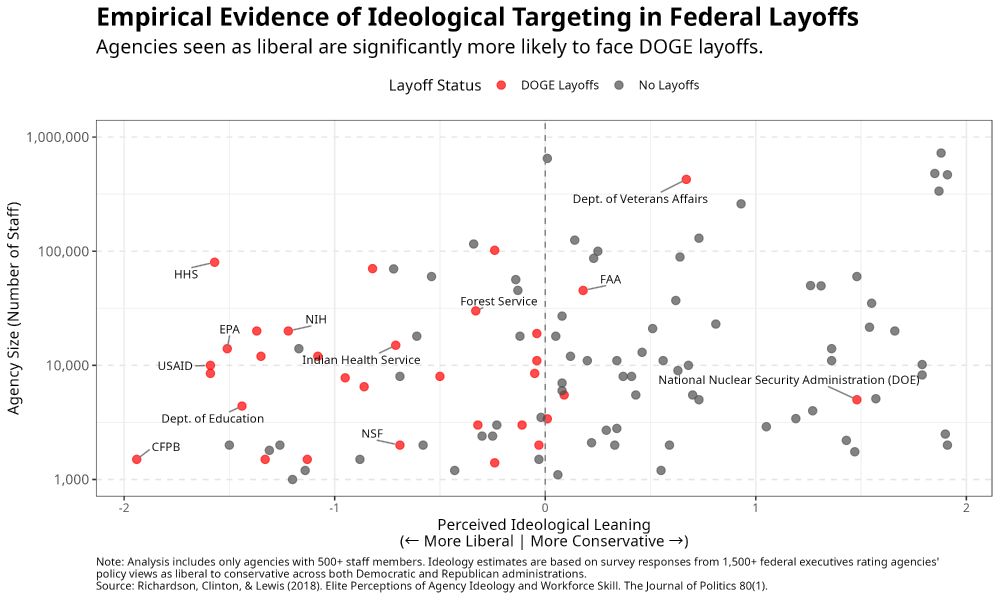
Scatterplot titled “Empirical Evidence of Ideological Targeting in Federal Layoffs: Agencies seen as liberal are significantly more likely to face DOGE layoffs.”
• The x-axis represents Perceived Ideological Leaning of federal agencies, ranging from -2 (Most Liberal) to +2 (Most Conservative), based on survey responses from over 1,500 federal executives.
• The y-axis shows Agency Size (Number of Staff) on a logarithmic scale from 1,000 to 1,000,000.
Each point represents a federal agency:
• Red dots indicate agencies that experienced DOGE layoffs.
• Gray dots indicate agencies with no layoffs.
Key Observations:
• Liberal-leaning agencies (left side of the plot) are disproportionately represented among red dots, indicating higher layoff rates.
• Notable targeted agencies include:
• HHS (Health & Human Services)
• EPA (Environmental Protection Agency)
• NIH (National Institutes of Health)
• CFPB (Consumer Financial Protection Bureau)
• Dept. of Education
• USAID (U.S. Agency for International Development)
• The National Nuclear Security Administration (DOE), despite its conservative leaning (+1 on the scale), is an exception among targeted agencies.
• A notable outlier: the Department of Veterans Affairs (moderately conservative) also faced layoffs despite its size.
Takeaway:
The figure visually demonstrates that DOGE layoffs disproportionately targeted liberal-leaning agencies, supporting claims of ideological bias. The pattern reveals that layoffs were not driven by agency size or budget alone but were strongly associated with perceived ideology.
Source: Richardson, Clinton, & Lewis (2018). Elite Perceptions of Agency Ideology and Workforce Skill. The Journal of Politics, 80(1).
The DOGE firings have nothing to do with “efficiency” or “cutting waste.” They’re a direct push to weaken federal agencies perceived as liberal. This was evident from the start, and now the data confirms it: targeted agencies overwhelmingly those seen as more left-leaning. 🧵⬇️
20.02.2025 02:18 — 👍 10694 🔁 4796 💬 253 📌 397
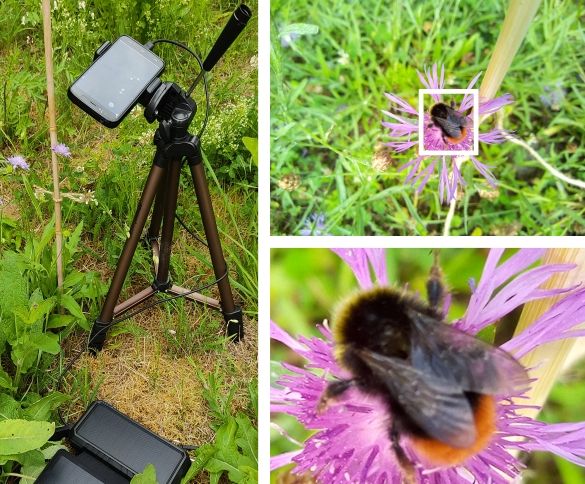
2025 starts with a methodology publication by Ștefan et al. on Utilising affordable smartphones and open-source time-lapse photography for pollinator image collection and annotation - Happy new year!
doi.org/10.26786/192...
10.01.2025 16:22 — 👍 30 🔁 15 💬 1 📌 3

Summerschool 2025: Deep learning for biodiversity and ecological research | iDiv
Our research center (iDiv) will host a very interesting summer school (25 – 29 August 2025) - Deep learning for biodiversity and ecological research.
More details here: www.idiv.de/events/summe...
#biodiversity #education #aiforgood #technology #idiv
28.01.2025 12:06 — 👍 0 🔁 0 💬 0 📌 0
PhD student at MIT. Machine learning, computer vision, ecology, climate. Previously: Co-founder, CTO Ai.Fish; Researcher at Caltech; UC Berkeley. justinkay.github.io
Ecology, pollination, networks, rstats & other personal stuff...
www.bartomeuslab.com
Bees, plants & dance -
I'm a researcher at the Institute for Bee Protection, Julius Kühn Institute in Brunswick, Germany
agroecology | ecotoxicology | wild bee diversity | plant-pollinator interactions | pollinator monitoring
🇩🇪🇨🇮🇺🇲 views are my own
#JKI 🐝🌱
A strategic interdisciplinary inititiative to advanc research and outreach in biodiversity science at WSL and Eawag.
Birmensdorf, Dübendorf and Kastanienbaum - Switzerland
https://biodiversitycenter.wsl.ch/en
Urban & landscape ecologist thinking about nature-based solutions for biodiversity, people, and climate in the cities we live in. Prof @ Concordia. Probably talking about trees on the radio. Potter. Knitter. Baker. Gardener. Year-round cyclist. 🇨🇦 (she/her)
Organizational psychologist @Wharton. #1 NYT bestseller: THINK AGAIN. Podcasts: Re:Thinking & WorkLife. Diver. Arguing like I’m right, listening like I’m wrong.
Für das Thünen-Institut, Bundesforschungsinstitut für Ländliche Räume, Wald und Fischerei, postet die Pressestelle.
Impressum: thuenen.de/de/impressum Datenschutz: thuenen.de/de/datenschutzerklaerung
Bio: Biology
I spend a lot of time counting the number of bugs that visit flowers, in order to say something about how the world works.
Theoretical ecology, metacommunities, functional ecology
Master student at iDiv
Postdoc @iDiv (German Centre for Integrative Biodiversity Research), interested in terrestrial vegetation patterns and dynamics: plant functional traits, photosynthesis, biodiversity; tools: remote sensing, process modelling, ML
Quantitative ecology | Statistics | Species interactions | Population dynamics
iDiv Leipzig, Germany
https://www.idiv.de/staff/benjamin-rosenbaum/
I am a field and theoretical ecologist studying the effects of vegetation diversity on microclimate and the consequences for ecosystem functioning: Biodiversity-Microclimate-Ecosystem Functioning nexus (B-M-EF).
@iDiv (Leipzig) & @CEFE-CNRS (Montpellier)
Macroecology | plant | iDiv
Insects, microbes, symbiosis, bioinformatics, molecular approaches in evolution & ecology. Emmy Noether Research Group Leader & Jun.-Prof. @iDiv & MLU Halle. he/him
Botany; Velloziaceae; biogeography; seed dispersal; fruits; macroevolution; macroecology; plant-frugivore interactions; botanical drawings.
Population genetics, macrogenetics, biodiversity🐿️🐿️🐿️ and drawing ✏️
Assistant Prof at Dalhousie University
https://www.schmidt-biodiversity-lab.org/
Senior Scientist at Naturalis Biodiversity Center NL; macroevolution ☄️, macroecology 🌎, botany 🌺, palms 🌴, megafauna 🐘, frugivory 🦧, traits ☘️
Professor of Ecology, Aarhus University, Denmark
Postdoc @Ufz and @iDiv. Fan of ecological experiments and synthesis to understand effects of global change on plant populations, communities & ecosystems.
Interests: changes in biodiversity, land use & society, data quality, causality, interdisciplinary science philosophy. Slow/open/inclusive science proponent, academia sceptic. Head of Macroecology & Society lab @iDiv.