Our paper is now online in Science Advances! Congrats @saskiahogenhout.bsky.social @johninnescentre.bsky.social and all coauthors!
www.science.org/doi/10.1126/...

@mmarzo.bsky.social
Mum and Scientist Deciphering how #phytoplasma manipulates plants 🌿🦠 Plant - Insect - Bacteria interactions🥼👩🏻🔬 Fascinated by aphids, genomes and evolution. PostDoc at Hogenhout Lab, John Innes Centre, UK She/her
Our paper is now online in Science Advances! Congrats @saskiahogenhout.bsky.social @johninnescentre.bsky.social and all coauthors!
www.science.org/doi/10.1126/...
Now published in @newphyt.bsky.social , congrats @matteogravino.bsky.social @saskiahogenhout.bsky.social et al @johninnescentre.bsky.social nph.onlinelibrary.wiley.com/doi/10.1111/...
31.07.2025 10:20 — 👍 15 🔁 5 💬 1 📌 0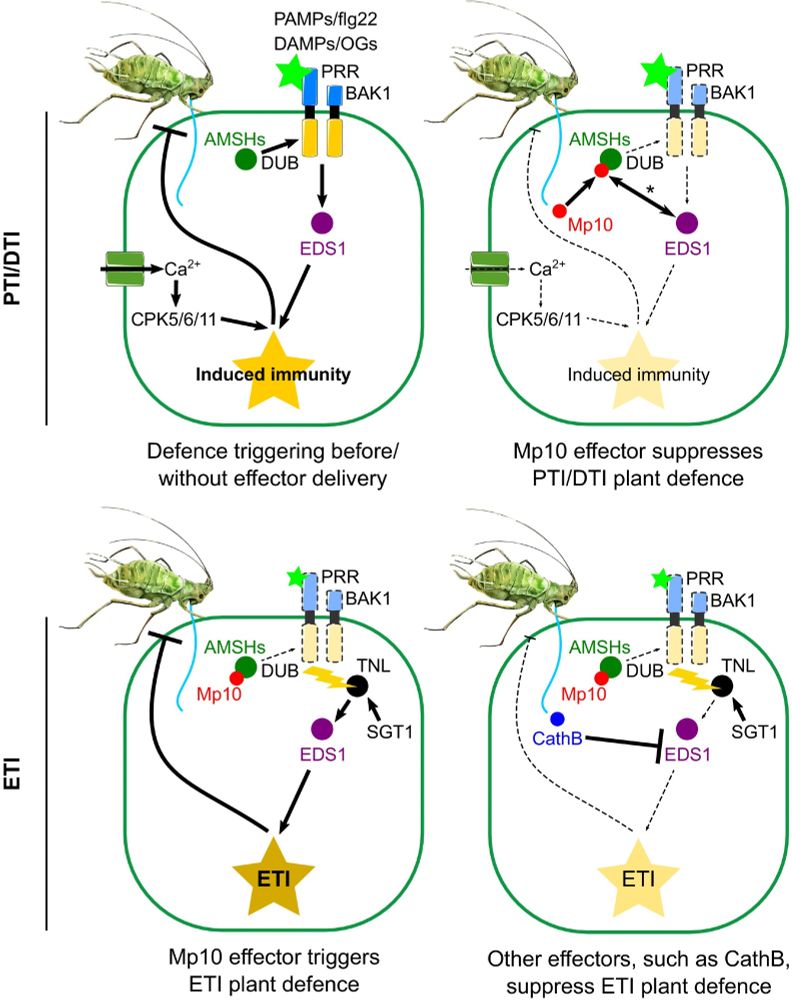
Model: Activation and suppression of defences in plant–aphid interactions. Upper left panel: aphid stylet penetration of the cell wall releases oligogalacturonides (OGs), which induce PAMP/DAMP-triggered immunity (PTI/DTI) in a process dependent on BRASSINOSTEROID INSENSITIVE 1-ASSOCIATED RECEPTOR KINASE 1 (BAK1), ENHANCED DISEASE SUSCEPTIBILITY 1 (EDS1), and CPK5/6/11 (data herein). The stabilisation of pattern recognition receptors (PRRs) and coreceptors at the plasma membrane may rely on the deubiquitination (DUB) activity of ASSOCIATED MOLECULE WITH THE SH3 DOMAIN OF STAM (AMSHs; Gravino et al., 2024). Upper right panel: the Mp10 effector, introduced by aphids into the cell cytoplasm (Mugford et al., 2016), suppresses OG-induced reactive oxygen species (ROS) (data herein) and flg22-induced PTI (Bos et al., 2010). Mp10 targeting of plant AMSHs is implicated in these processes (Gravino et al., 2024). EDS1 is essential for Mp10-mediated ROS suppression and PRR destabilisation (data herein), acting through an unidentified mechanism (denoted by the double-sided arrow with an asterisk). Lower left panel: effector-triggered immunity (ETI) is activated through EDS1, either directly or indirectly, upon recognition of Mp10 and/or its activities by a TNL (Gravino et al., 2024; Rao et al., 2024). Salicylic acid glucosyltransferase 1 (SGT1) is also required for TNL/ETI activation (Bos et al., 2010). Lower right panel: aphids secrete additional effectors, such as cathepsin B proteins (e.g. CathB6), which target EDS1 to suppress ETI (Liu et al., 2025). Solid arrows, increased activation; solid blunt-ended arrows, increased suppression; Dashed arrows, reduced activation; Dashed -blunt-ended arrows, reduced suppression.
🎉Thrilled to share our latest work, now published in @newphyt.bsky.social!
🧑🔬 @matteogravino.bsky.social, @samtmugford.bsky.social, @saskiahogenhout.bsky.social et al., @johninnescentre.bsky.social
#️⃣ #PlantScience #PlantImmunity
📄 Read the full paper👇
nph.onlinelibrary.wiley.com/share/8QSRJ9...
Very exciting to see this out in the world! @tcheaven.bsky.social did some excellent work and I'm happy to have played a (small) supporting role on this project
30.06.2025 07:52 — 👍 5 🔁 4 💬 0 📌 0Aphid Saliva fans, happy news, this amazing story is now out in Science Advances www.science.org/doi/10.1126/... congrats @qunliu07.bsky.social @saskiahogenhout.bsky.social et al @johninnescentre.bsky.social 24h after a triumphant presentation at #ismpmi2025
16.07.2025 18:35 — 👍 18 🔁 9 💬 0 📌 1Congratulations @reubenpjames.bsky.social 🎉🎉
07.03.2025 15:18 — 👍 5 🔁 0 💬 0 📌 0Huge congratulations to all people involved: @matteogravino.bsky.social, @samtmugford.bsky.social, Daniela Pontiggia, Joshua Joyce, Claire Drurey, David Prince, Felice Cervone, Giulia De Lorenzo, @saskiahogenhout.bsky.social
01.03.2025 10:11 — 👍 1 🔁 1 💬 0 📌 0
Our results indicate that mp10 is acting at the interface of PTI/DTI and ETI to manipulate plant immunity
01.03.2025 10:08 — 👍 2 🔁 2 💬 1 📌 0We are excited to share our latest preprint from the Hogenhout lab (@matteogravino.bsky.social @saskiahogenhout.bsky.social
, @johninnescentre.bsky.social
) on plant-aphid interactions, showing that the aphid effector Mp10 balances suppression of DAMP responses and activation of ETI via EDS1.

🌿Wielding genomics to understand disease vectors: Study uses Proximo & @pacbio.bsky.social to create #chromosome -level #genome assemblies of psyllids, shedding light on pathogen transmission. Congrats Heaven, @tom-mathers.bsky.social @samtmugford.bsky.social & team! www.biorxiv.org/content/10.1...
17.12.2024 20:12 — 👍 9 🔁 5 💬 0 📌 0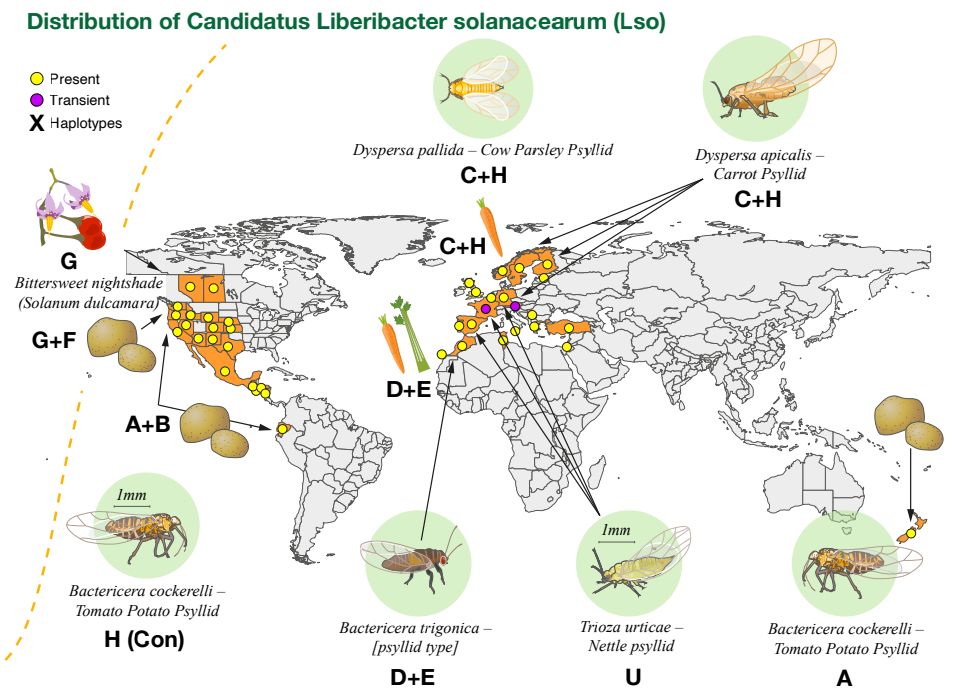
...recognised as the primary vector of 'carrot yellows' by carrot growers in Northern Europe. This research provides valuable insights into the evolution of psyllids and their interactions with phytopathogenic bacteria. Ultimately, this will lead to more effective pest management strategies. 🌱
06.12.2024 21:15 — 👍 6 🔁 2 💬 2 📌 0Our preprint is now live! We have sequenced the genomes of three psyllid species. These insects pests transmit devastating plant diseases like 'zebra chip' in potatoes and 'carrot yellows' in carrots. 🥕
#MolecularEntomology #MPMI #PlantPathology #psyllids #liberibacter

Science illustration schematic of a cranberry plant infected with false blossom disease and pest herbivory. There are arrows pointing down to the right and left of the plant containing increasing or decreasing responses to false blossom disease infection.
Here's a figure I made this year for Rutgers entomologist, Cesar Rodriguez Saona.
Cranberry false blossom disease (phytoplasma-caused disease) affects both host plant & herbivore traits. In short, diseased plants attract more herbivory, which worsens losses from disease alone.
#SciArt 🕷️🧪🌱🧬🎨🐡
We're happy to present a pre-print from the Hogenhout lab (@saskiahogenhout.bsky.social), describing how a family of proteases in aphid oral secretions suppress plant immunity.
21.11.2024 10:45 — 👍 24 🔁 12 💬 2 📌 4
Hi, BlueSky! Thanks for the warm welcome 😊
19.11.2024 14:22 — 👍 30 🔁 0 💬 0 📌 0We’re delighted to share our latest preprint from the Hogenhout lab (@saskiahogenhout.bsky.social) on the molecular mechanisms on plant-aphid interactions. Here we show how the aphid Mp10 effector protein acts as a local anaesthetic to suppress the plant perception of aphid attack
18.11.2024 09:58 — 👍 68 🔁 39 💬 1 📌 2