Happy Darwin Day to all! To celebrate can you comment with your favorite paper on evolutionary biology from the last few years? Whatever comes to mind and whichever paper that really changed your view of evolution.
12.02.2026 19:18 — 👍 27 🔁 13 💬 4 📌 1

New work from @miyapan.bsky.social and our team, bringing ant, bee, and wasp labs together. @chuanxinyu.bsky.social shows that the ANTSR locus we discovered in ants has determined sex for 150+ My across bees and stinging wasps 🐜🐝, despite virtually no sequence conservation 😮 doi.org/10.1073/pnas...
06.01.2026 03:01 — 👍 88 🔁 37 💬 2 📌 6
I spend a fair amount of time talking about this amazing ant paper from last year: www.nature.com/articles/s41... where the females produce offspring of two different species! Wild! 🐜
08.01.2026 13:49 — 👍 10 🔁 4 💬 0 📌 0
No contest. Just read the first two sentences of the abstract. www.nature.com/articles/s41...
21.12.2025 20:31 — 👍 69 🔁 16 💬 8 📌 2

The strangest ant reproduction yet 🐜
Some Messor ants make workers that are hybrids of two species, ensuring a stable workforce when environment cues fail.
Learn more with @selfishmeme.bsky.social in our FREE Brad Ashby Memorial Lecture (29 Jan 2026).
Register: www.eventbrite.co.uk/e/1970355572...
28.11.2025 13:35 — 👍 4 🔁 1 💬 0 📌 0

New @royentsoc.bsky.social #ResearchHighlight available!
Recent work by Juvé et al. in #RESSystematicEnt reveals the evolutionary history of Messor harvester ants, a genus adapted to arid environments & with some of the most complex reproductive systems known so far.
Read more ⬇️
buff.ly/xGeFrKr
23.10.2025 15:04 — 👍 5 🔁 2 💬 1 📌 0

This work benefited from the support of the @erc.europa.eu grant RoyalMess, hosted by @cnrs.fr , @isemevol.bsky.social and @umontpellier.bsky.social.
Article freely available here for more details: www.nature.com/articles/s41...
14.10.2025 12:00 — 👍 3 🔁 1 💬 0 📌 0

#Xenoparity shows how sexual parasitism can evolve to a self-sufficient unit of selection, where two species bind their lifecycles. Question: When two species sexually depend on each other and are produced by the same colonies, how should we consider the resulting superorganism?
14.10.2025 12:00 — 👍 2 🔁 0 💬 1 📌 0

This reveals a new reproductive mode: #xenoparity —"giving birth to alien species". By becoming xenoparous, M. ibericus queens allowed themselves to expand their range, cloning M. structor males in their colonies and invading Southern Europe with hybrid workers.
14.10.2025 12:00 — 👍 0 🔁 0 💬 1 📌 0

⚠️Wilder: workers have two father types - wild males (from M. structor nests) or clones (only in M. ibericus nests). This suggests that queens domesticated M. structor males by cloning them from the wild. Fun detail: clonal vs. wild males look different, like pigs vs. boars🐗→🐷!
14.10.2025 12:00 — 👍 1 🔁 0 💬 1 📌 0

🔬Other key result: this queen's spermatheca contains sperm from both species. For cross-species cloning to occur, this means that maternal DNA in the ova has been fully replaced by M. structor DNA stored in the spermatheca #androgenesis.
14.10.2025 12:00 — 👍 0 🔁 0 💬 1 📌 0

Lab evidences now 🧪:
🥚When isolating M. ibericus queens in the lab, we found that ~10% of their eggs carried ONLY M. structor nuclear DNA.
🔎Even better: after monitoring ~50 colonies in the lab during 18 months, we observed male adults of both species laid by a single queen.
14.10.2025 12:00 — 👍 1 🔁 0 💬 1 📌 0

🔍 How did we reach this odd conclusion? Field evidences first: we found M. structor males within 26 M. ibericus colonies (11 populations). All have:
✅100% M. structor nuclear genome.
✳️Mitochondria matching the M. ibericus queens of the colony, suggesting they're their mothers.
14.10.2025 12:00 — 👍 1 🔁 0 💬 1 📌 0

💡To ensure a sperm supply to mass-produce their hybrid workers, we found that M. ibericus queens clone M. structor males.
➡️Result? Males from the same mother have distinct genomes and morphologies, as they belong to species that diverged over 5 million years ago.
14.10.2025 12:00 — 👍 0 🔁 0 💬 1 📌 0

🧬Sequencing 390 ant genomes (5 species) shows that Messor ibericus queens depend on M. structor sperm to produce all their workers.
⚠️Problem: these hybrid workers invaded southern Europe, while M. structor colonies are missing. How's possible? Where do the fathers come from?
14.10.2025 12:00 — 👍 0 🔁 0 💬 1 📌 0
Messor harvester ants dominate Southern Europe by collecting seeds, turning them into "ant bread"🥖.
But this is not the coolest thing about them: in some species, queens are sperm parasites, as they rely on sperm from other species to produce their workers.
14.10.2025 12:00 — 👍 0 🔁 0 💬 1 📌 0

Cross-species cloning in ants 🐜
These two males belong to different species—but share the same mother. How? Why?
To celebrate the print release of our last paper in this week’s @nature.com (issue 8084), here’s a thread summarizing the results. Why? Let’s dive in🧵👇 www.nature.com/articles/s41...
14.10.2025 12:00 — 👍 30 🔁 19 💬 1 📌 0
SRA Archive: NCBI
NCBI Sequence Read Archive
Thanks for noticing it, here's a link for the raw data available in NCBI: trace.ncbi.nlm.nih.gov/Traces/?view...
29.09.2025 15:47 — 👍 1 🔁 0 💬 0 📌 0

The #OpenAccess #EditorsChoice article for the issue reports on the #phylogenomics of Messor harvester #ants (Hymenoptera: #Formicidae: Stenammini), and unravels their biogeographical origin and #diversification patterns.
Why not give it a read?
doi.org/10.1111/syen.12693
@selfishmeme.bsky.social
19.09.2025 15:04 — 👍 2 🔁 1 💬 0 📌 0

Chez les fourmis moissoneuses, des reines enfantent des mâles d’une autre espèce
Une nouvelle étude révèle un phénomène inédit dans le règne animal : certaines reines donnent naissance à des mâles d’une autre espèce. Ce mécanisme appelé « xénoparité » permet à leurs colonies de su...
🐜 Une nouvelle étude révèle un phénomène inédit dans le règne animal : certaines reines donnent naissance à des mâles d’une autre espèce. Ce mécanisme appelé « xénoparité » permet à leurs colonies de survivre.
Explications avec des GIF de fourmis ⬇️
16.09.2025 06:13 — 👍 147 🔁 60 💬 4 📌 8

These Ants Found a Loophole for a Fundamental Rule of Life
Thanks to @cjgiaimo.bsky.social for this nice article in @nytimes.com (www.nytimes.com/2025/09/15/s...) about our last study (www.nature.com/articles/s41...)
17.09.2025 00:01 — 👍 4 🔁 3 💬 0 📌 0
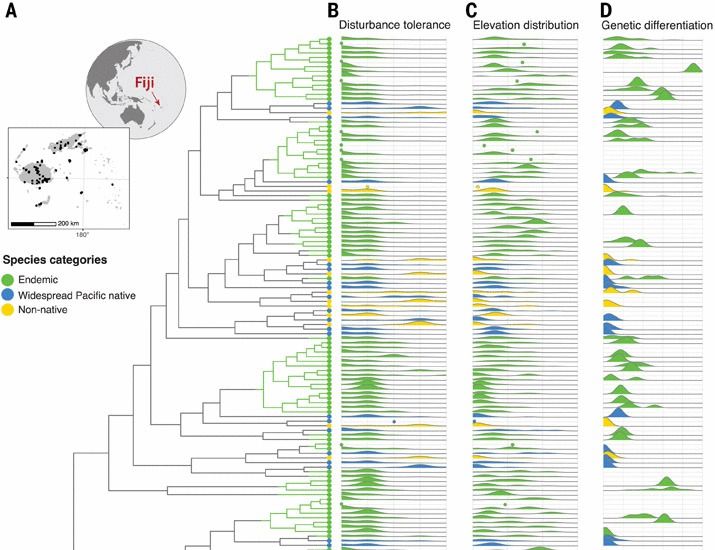
Genomic signatures indicate biodiversity loss in an endemic island ant fauna
Insect populations have declined worldwide, but the extent and drivers of these declines are debated. Most studies rely on field surveys performed in the past century, leaving gaps in our understandin...
A new Science study of ants in Fiji—involving genomic sequencing of over 4000 ant specimens from museum collections—shows that most native species have been in decline since humans first arrived in the archipelago 3000 years ago. https://scim.ag/489mI2o
15.09.2025 19:33 — 👍 48 🔁 17 💬 0 📌 1
This is one of the most accurate coverage of the study I’ve seen (including written articles), it really deserves to be shared with both scientists and non-scientists!
15.09.2025 19:03 — 👍 4 🔁 1 💬 0 📌 0
YouTube video by 7 Days of Science
The Ants That Broke Biology
If you’ve heard about our study on ants producing two different species but are still confused about how it works (and don’t have time to read the paper), this 10-minute video made by @bengthomas.bsky.social is very informative:
www.youtube.com/watch?v=Z-O4...
Paper: www.nature.com/articles/s41...
15.09.2025 16:04 — 👍 28 🔁 13 💬 1 📌 1
![Comic. [Building with large sign in front of it[ SIGN: Welcome to the *Biology Department* It has been [changeable sign: 3] days since we discovered something existentially horrifying about bugs that makes you question your whole reality](https://cdn.bsky.app/img/feed_thumbnail/plain/did:plc:cz73r7iyiqn26upot4jtjdhk/bafkreigvmzverlrjgqp4mazbkhm43fpvv2hdbkd2t2646dhihozrwdcy24@jpeg)
Comic. [Building with large sign in front of it[ SIGN: Welcome to the *Biology Department* It has been [changeable sign: 3] days since we discovered something existentially horrifying about bugs that makes you question your whole reality
Biology Department
xkcd.com/3140/
11.09.2025 21:24 — 👍 5020 🔁 690 💬 33 📌 31

Hybridization and introgression are major evolutionary processes. Since the 1940s, the prevailing view has been that they shape plants far more than animals. In our new study (www.science.org/doi/10.1126/...
), we find the opposite: animals exchange genes more, and for longer, than plants
12.09.2025 07:54 — 👍 203 🔁 121 💬 3 📌 3
Oh wow, I need to know now.
10.09.2025 22:59 — 👍 0 🔁 0 💬 0 📌 0

Line drawing of a two story institutional building with a sign in front, "Welcome to the BIOLOGY DEPARTMENT. It has been 3 days since we discovered something existentially horrifying about abugs that make you question your whole reality."
The new XKCD has to be a reference to the ant paper where ants just casually lay eggs of a different species, yes? Maybe? There are so many weird bugs its hard to know.
10.09.2025 17:32 — 👍 376 🔁 95 💬 11 📌 4
PhD student, population genetics, genomics, evolutionary biology
Senior Lecturer (≡ associate professor) in applied maths @citystgeorges.bsky.social, investigating the evolution and ecology of cancer. Dad of two small kids. Associate Editor @jevbio.bsky.social.
Physics, bubbles, oceans, hot chocolate and curiosity. Professor at UCL, writer, broadcaster. Author of Storm in a Teacup and Blue Machine https://linktr.ee/helenczerski Co-host of BBC Radio 4's Rare Earth
writer about animals, plants & (sometimes) people / guitar in sidebody band / https://antsandplanimals.substack.com
Evolutionary geneticist working on endosymbiosis, herbivory, and speciation - Wybouw Lab @ Ghent University
Assistant Professor, Biology, Washington University in Saint Louis
Regeneration, germ cells, segmented worms
Junior faculty representative for SDB
I also make Science Art (mostly pottery)
#SciArt #WormWednesday #Annelida
www.ozpolatlab.org
Illustration ~ Surface Design
Upcoming events - StoryCon | Lucky Bones | Anime Boston
linktr.ee/rachelquinlan
Portfolio - www.rachelquinlan.com
Shop- www.wizardtoothpress.com
Email - rachelquinlan.design@gmail.com
Ko-fi - https://ko-fi.com/rachelquinlan
Nature photographer, public defender representing young people, lover of burrowing owls. RPCV Niger.
Dreaming of a cloudy sky | Associate Prof. | Computer Science & BioFrontiers, CUBoulder | Ext. Faculty, Santa Fe Institute | www.peleglab.com
CT microscopist at UIUC's Beckman Institute (@beckmanillinois.bsky.social) 🔬
Entomologist and biomechanist by training 🐜 Sometimes tweet about Pokemon. Furret Aficionado. Opinions my own.
Associate Professor at the University of Maine. Specializes in tenrecs, treeshrews, and energetics of small furry things. 🇨🇦 living in 🇺🇸. She/her.
Evolutionary biologist | ants, sometimes shrimp | fossils, morphology, extinction, eusociality | associate professor at NJIT
bardenlab.org
Ph.D student in Ecology&Evolutionary Biology at the University of Arizona. Mutualism between ants and auchenorrhyncha, ecophysiology, indirect effects. Science communicator!
Doctoral student in the Toussaint Lab at the Natural History Museum of Geneva. Studying trait evolution of ground beetles using museomics
https://crcardenas.github.io/
🍉🍉🍉
Bike polo is okay
-------▯°