
PCP February Issue cover
confocal image showing root colonization by the endophytic fungus Colletotrichum fructicola expressing GFP, with A. thaliana plasma membranes visualized using an mCherry-fused aquaporin (magenta).
Photo credit: Shunsuke Miyashima, Ishikawa Prefectural University, Japan.
🔥Hot off the press....!🔥
⭐The February Issue of Plant & Cell Physiology is out now!⭐
🛋️ academic.oup.com/pcp/issue/67/2
@academic.oup.com
@jspp-news.bsky.social
#PlantScience 🌱
📸Photo credit: Shunsuke Miyashima, Ishikawa Prefectural University, Japan
📝Related paper: doi.org/10.1093/pcp/...
27.02.2026 12:24 —
👍 7
🔁 6
💬 0
📌 0

Really happy to see this one out: www.sciencedirect.com/science/arti... Alibek's drive & great coll w/ friends @gekaragoz.bsky.social & E. Hallacli resulted in a cool story that starts with our beloved #Marchantia and ends with iPSC-derived neurons 🤩🤪 A short 🧵
23.02.2026 17:05 —
👍 119
🔁 53
💬 6
📌 7

Join us on March 10, 2026 at Kyoto University 🇯🇵 for a day celebrating my long-time friend and collaborator Prof. Ryohei Terauchi.
"Kyoto Mini-Symposium on Plant–Microbe Interactions"
20.02.2026 09:11 —
👍 22
🔁 11
💬 2
📌 0
📣 Our latest story just dropped on bioRxiv:: A structurally unique effector shared between Verticillium dahliae and Fusarium oxysporum is involved in cotton defoliation and virulence on other hosts www.biorxiv.org/content/10.6... 🧵
14.02.2026 11:08 —
👍 44
🔁 30
💬 3
📌 1

TSL Summer Conference in Plant-Microbe Interactions, 20th – 31st July…
Inviting Early Career Researchers to join international experts in discussing the latest approaches and discoveries in Plant-Microbe Interactions …
Join us in Norwich this July for the TSL Summer Conference in Plant-Microbe Interactions! ☀️🌱🧬
Discuss the latest approaches & discoveries in plant health with international keynote and local speakers.
APPLY by 30 March '26 ⬇️ Click link for more info
www.tsl.ac.uk/tsl-summer-c...
14.01.2026 17:50 —
👍 29
🔁 30
💬 1
📌 4
Thank you very much for your nice commentary! we will do what you suggest in this.
14.01.2026 02:37 —
👍 5
🔁 2
💬 0
📌 0


In our latest study, we took a critical look at #fungal family #Nectriaceae by analyzing 1,530 #genomes! We built a robust #phylogenomic backbone that supports current taxonomy but also reveals gene-tree discordance and unresolved boundaries. More info www.biorxiv.org/content/10.6...
25.12.2025 21:26 —
👍 10
🔁 2
💬 0
📌 0
I’m very happy to see my fist article now officially published 🥳 great work by my partner in crime @wolki95.bsky.social and the rest of @teamthomma.bsky.social! Find it here: doi.org/10.1111/nph.... or have a look at the 🧵⬇️
30.10.2025 09:40 —
👍 20
🔁 7
💬 0
📌 0
It’s been 14 years since I uploaded a video on YouTube showing that Striga does not infect other members of the Orobanchaceae family.JSPS Fellow Simon came to Japan and carried out mutant screening to find mechanism and it was 10 years ago that the mutant was finally obtained. A long journey.
24.10.2025 00:46 —
👍 33
🔁 14
💬 0
📌 1
📣 New @biorxiv-microbiol.bsky.social preprint, another joint-venture of @wolki95.bsky.social & @antonkraege.bsky.social, co-directed by @nicksnelders.bsky.social. Here’s a 🧵
14.10.2025 20:05 —
👍 28
🔁 22
💬 1
📌 0
Our latest work is out! We set out to see if we could recreate soil-nurturing plant growth in vitro. The plants looked happy and we see microbiome-induced cell-type-specific responses! A modest step but a fun challenge 😁
12.10.2025 06:35 —
👍 25
🔁 14
💬 2
📌 0

Plant Biotechnology, Volume 42, Issue 3
Published by Japanese Society for Plant Biotechnology. OPEN ACCESS
We are pleased to announce the release of our special issue, “Diverse Symbiotic Relationships between Plants and Microbes in the Phyllosphere and Rhizosphere,” now available in Plant Biotechnology (open access)!
www.jstage.jst.go.jp/browse/plant...
13.10.2025 00:59 —
👍 4
🔁 2
💬 0
📌 0
https://academic.oup.com/pcp/article-abstract/doi/10.1093/pcp/pcaf126/8277635
We’re delighted to share that our paper has been just accepted in PCP!
We analyzed fungus–fungus competition that suppresses pathogenic colonization in Arabidopsis roots.Special thanks to Duke, Hiroyuki, Yuki, Nanami, and everyone who contributed!
t.co/obQyD1rzI1
13.10.2025 00:58 —
👍 8
🔁 6
💬 0
📌 1

Dynamic shifts in plant-microbe relationships
Plant-microbe interactions encompass a continuum from mutualism and commensalism to parasitism. Mutualists confer benefits such as nutrient acquisitio …
I am happy to see this out!
Plant-microbe relationship (mutualistic, commensalistic, parasitic) is not fixed, but rather dynamic, depending on the specific context.
We summarize the current knowledge on this.
Hope you enjoy~
www.jstage.jst.go.jp/article/plan...
25.09.2025 00:52 —
👍 19
🔁 11
💬 1
📌 0

We proudly present a new preprint by Leon Pierdzig et al: Wall teichoic acids, glycopolymers specific to Gram-positive bacteria, trigger defense and cell death in Arabidopsis. Cysteine-rich RLKs act as key components in their perception. doi.org/10.1101/2025...
22.09.2025 07:28 —
👍 26
🔁 14
💬 3
📌 0
WIND1 controls cell fate transition through histone acetylation and deacetylation during somatic embryogenesis https://www.biorxiv.org/content/10.1101/2025.08.07.669221v1
09.08.2025 19:03 —
👍 11
🔁 10
💬 0
📌 1
Nitrogen acquisition and selective bacterial attraction through fungal hyphae promote plant growth and health under nitrogen limitation https://www.biorxiv.org/content/10.1101/2025.08.05.668771v1
07.08.2025 17:02 —
👍 2
🔁 1
💬 0
📌 1
We have posted our latest preprint. We explore how an endophytic fungus promotes plant growth and fitness under fluctuating nitrogen-limited conditions in both field and laboratory settings, in additively with bacteria attracted to its hyphae. We hope you enjoy it!
08.08.2025 02:57 —
👍 10
🔁 5
💬 0
📌 0
Here comes the final version.
Congratulations Erika, Yasu, Ken, and all others involved!
@yasukadota.bsky.social @shirasulab.bsky.social
www.science.org/doi/10.1126/...
30.07.2025 19:37 —
👍 18
🔁 10
💬 0
📌 0

Emergence of isochorismate-based salicylic acid biosynthesis within Brassicales | PNAS
Salicylic acid (SA) is a major defense phytohormone. In Arabidopsis thaliana, the
isochorismate (IC) pathway is the primary route for pathogen-indu...
I'm very happy that this paper is now published in PNAS!
Isochorismate-based salicylic acid biosynthesis appears to have emerged in the Brassicales after the divergence of C. papaya, likely within the timeframe between the divergence of B. maritima and R. odorata.
www.pnas.org/doi/10.1073/...
18.07.2025 07:52 —
👍 71
🔁 24
💬 4
📌 1
Huge thanks to the amazing team at @currentbiology.bsky.social for highlighting fungi in this special issue. Many excellent reviews and perspectives from so many mycological heroes. Lots of great material to use in teaching/outreach. 🍄
09.06.2025 21:59 —
👍 35
🔁 9
💬 0
📌 0
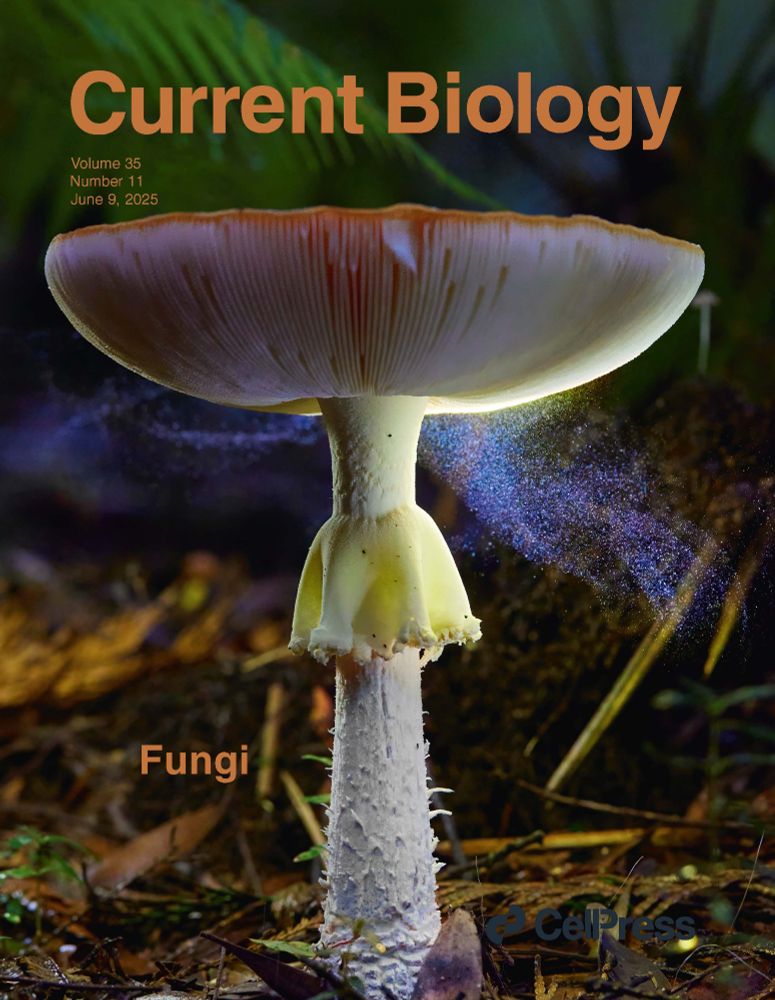
Our newest special issue is now live! Check it out to discover more about diverse and beautiful Fungi🍄🍄🟫🍄 On the cover: the fly agaric, Amanita muscaria, releasing its spores in the early morning light. www.cell.com/current-biol...
09.06.2025 15:45 —
👍 100
🔁 42
💬 2
📌 5

Professor Uta Paszkowski, Acting Head of the Crop Science Centre and Head of the Cereal Symbiosis research group at the University of Cambridge
Congratulations to Uta Paszkowski from @cropscicentre.bsky.social - elected to the National Academy of Sciences, USA in recognition of her significant contributions to understanding symbiotic relationships between plants & fungi.
@cambridgebiosci.bsky.social
@paszkowskilab.bsky.social
01.05.2025 14:34 —
👍 49
🔁 9
💬 1
📌 0


