🐸 🐟 Crikey! Wednesday again already, time for my “wind-back Wednesday” post!
An absolute cracker of a #Frogfish I think these are incredible, they can take some spotting too amongst the reef!
📍 Philippines, 2010.
📸 Panasonic.
🤿 🌊
#scubadiving #underwaterphotography #wildlifewednesday #marinelife
04.02.2026 20:44 — 👍 24 🔁 5 💬 0 📌 0
As we all settle back in at home after an amazing #ssb2026 in Baton Rouge, it seems fitting to share this recent pub from @mbomaaaron.bsky.social where he writes about the utility of taxonomic education. Aaron was a @systbiol.bsky.social mentee and so it is very exciting to see this work of his out!
16.01.2026 22:42 — 👍 4 🔁 3 💬 0 📌 0

Washington may ban sales of farmed octopus
After stalling in the last session, a bill to outlaw the sale, possession, transport, and distribution of farmed octopus advanced out of committee this week on a party-line vote.
Washington banned octopus farming in 2024, but a new bill is making its way through the Legislature that would also ban the sale, possession, transport and distribution of farmed octopus. The aim isn't to outlaw the culinary use of octopus, proponents say, but to ensure it is treated humanely.
15.01.2026 20:30 — 👍 21 🔁 6 💬 1 📌 1

Emily Graslie of Brain Scoop standing stage left presenting on the importance of natural history collections

Social event hosted at the LSU Museum of Natural Science. Meat service displayed directly near a large, glass encased, polar bear

Panel of scientists sat side by side on stage under the SSB26 logo on screen

Various herpetofauna displayed on a table
“What would our world look like if all natural history collections disappeared?”
Loved #SSB2026! Organized by @jembrown.bsky.social.
Great workshops, talks, panel discussion, and collections tours, plus an awesome social hosted by @prosanta.bsky.social. Great to meet some more fishy folks as well 🐠
13.01.2026 04:40 — 👍 15 🔁 1 💬 0 📌 0
Actual botanists don't feel like they need to lie to their neighbors about their jobs.
13.01.2026 03:13 — 👍 24 🔁 7 💬 0 📌 1


The great @jembrown.bsky.social closing out #ssb2026
It was a wonderful meeting thanks to the hardwork of Jeremy and funding from @lsu.bsky.social and other sources.
Systematic biology is alive and well. Especially proud of all the Global South who attended.
11.01.2026 23:04 — 👍 43 🔁 5 💬 0 📌 1
I’m so proud of @lsu.bsky.social Museum of Natural Science and @tropicalbotany.bsky.social Herbarium folks who volunteered for these tours to over 100 folks - I’m sure they won’t forget what they saw behind the scenes. #museums #naturalhistory
#ssb2026
10.01.2026 03:22 — 👍 27 🔁 5 💬 0 📌 0

The wonderful Emily Graslie talking to the #SSB2026 crowd about the importance of natural history museums. She has an art background and became enamored with the University of Montana natural history collections and created the #brainscoop series.
10.01.2026 22:45 — 👍 55 🔁 9 💬 0 📌 0

The American Fisheries Society extends our support to the furloughed fisheries and aquatics professionals affected by the U.S. federal government shutdown. Read our full statement on the shutdown and its impacts on natural resources here fisheries.org/2025/10/afs-...
07.10.2025 23:24 — 👍 41 🔁 17 💬 0 📌 0
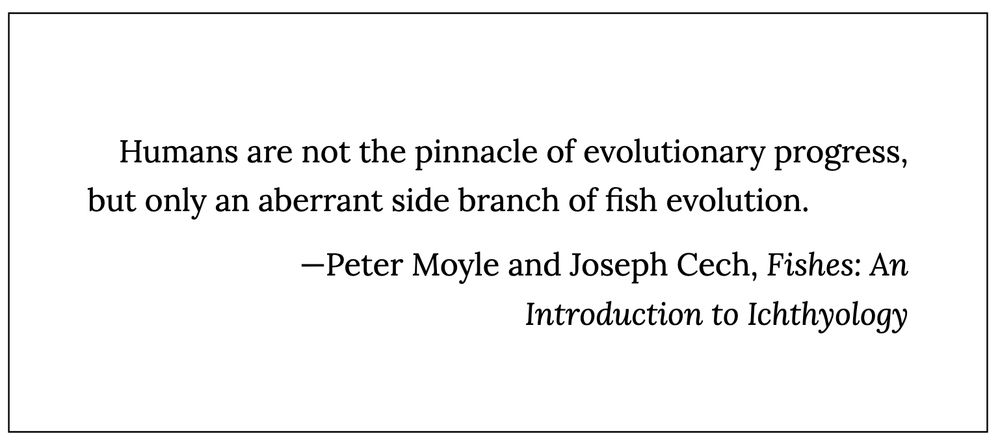
Quote of the Day,
as found in "Comparative Vertebrate and Human Anatomy: Ecology, Evolution, and Function"
pressbooks.palni.org/comparativev...
Check it out - looks great!
#EndlessFishMostBeautiful
31.07.2025 14:26 — 👍 35 🔁 10 💬 1 📌 0

orange clownfish, with white stripe amidst sea anemone tentacles, with isopod in mouth which parasitically replaces the tongue
NEMO! (a clownfish) with lil cymothoid isopod friend! Lembeh Photo by Dave Johnson Photography www.facebook.com/photo?fbid=4...
29.07.2025 16:03 — 👍 45 🔁 10 💬 1 📌 5
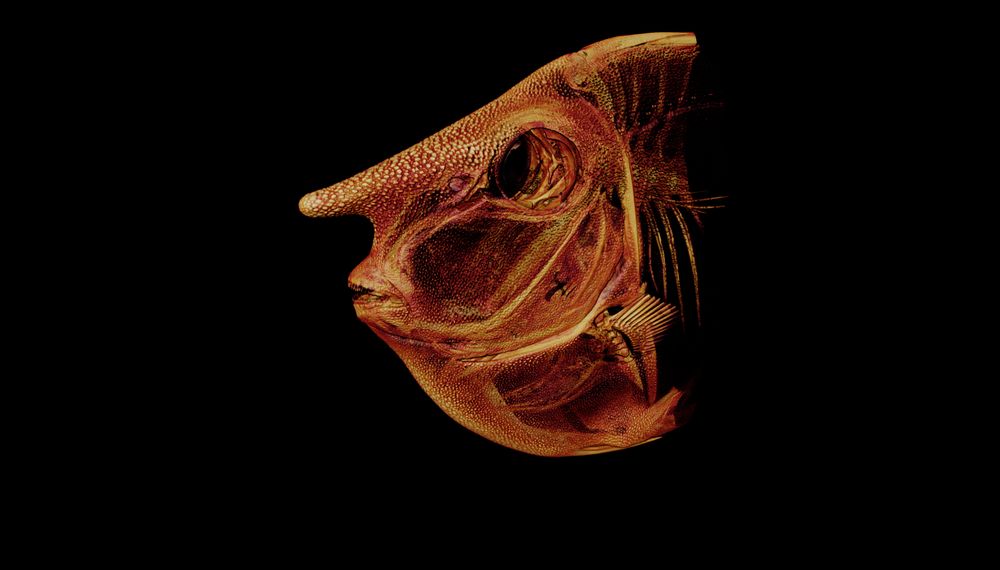
Every fish that we catch has a story, some are crazier than others. We caught this unicornfish during a night dive in Okinawa last year. The trip was memorable because we had to end the dive early when North Korea fired a missile in our general direction and we had to take cover
24.07.2025 16:32 — 👍 54 🔁 5 💬 0 📌 1
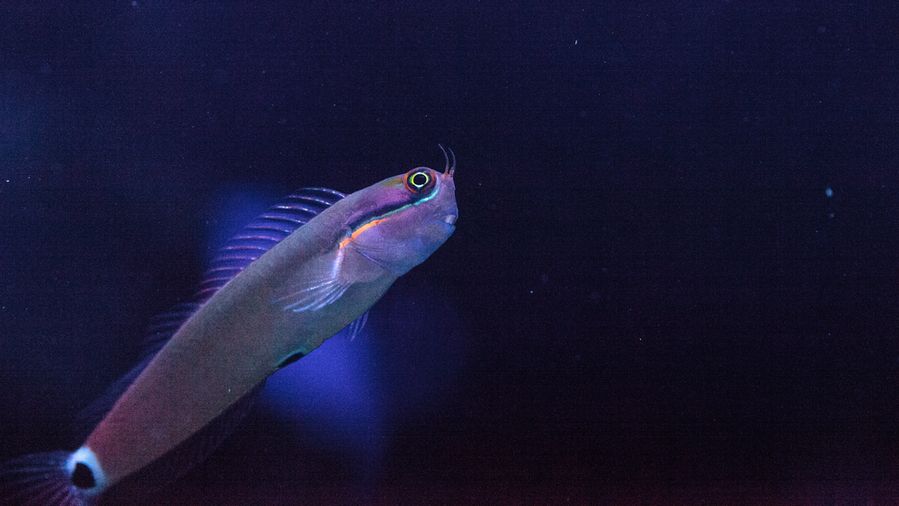
Tailspot Blenny Ecsenius stigmatura by LagunaticPhoto
July Editor's Choice article: "Parental care drives the evolution of male reproductive accessory glands across ray-finned fishes"
Lucas Eckert, Jessica S Miller, John L Fitzpatrick, Sigal Balshine, Benjamin M Bolker
academic.oup.com/evolut/artic...
@lucaseckert.bsky.social @bbolker.bsky.social
25.07.2025 06:36 — 👍 13 🔁 8 💬 1 📌 0
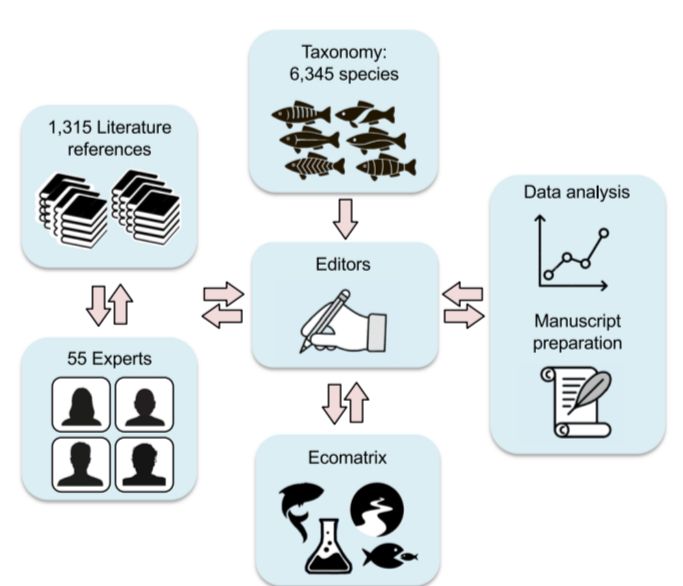
New paper alert: 42 ecological traits for all 6,000+ valid species of #Neotropical_freshwater_fishes, the most diverse continental vertebrate fauna on Earth. A foundation for future studies on the ecology and conservation of tropical aquatic biodiversity.
nature.com/articles/s41...
02.07.2025 12:55 — 👍 30 🔁 15 💬 1 📌 4

Hot off the press.
global.oup.com/academic/pro...
21.01.2025 22:32 — 👍 68 🔁 12 💬 0 📌 1
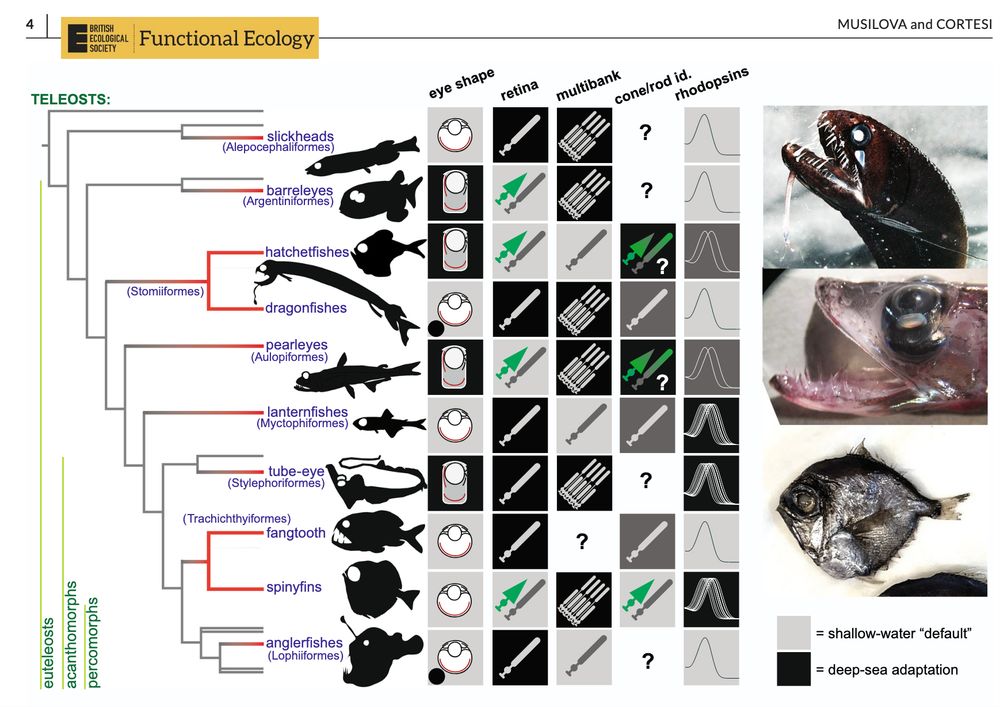
deep-sea adaptations have evolved independently in several groups.
Eye shape: A prominent morphological example is the evolution of an elongated tubular, barrel eye to maximize photon capture in several
deep-sea groups. Groups, where tubular eyes are common, are marked by a black square and a tubular eye scheme; groups with one/
few cases of tubular eyes but where the majority of species have a camera-type eye are marked with black dots (i.e. anglerfishes and
dragonfishes). Retina: Rod-only retinas are a common feature of many adult deep-sea fishes. In other cases, they possess the typical duplex
retina with cones (green cells) and rod cells (grey cells). Multibank: In some species, the rod cells are organized in multiple layers, forming a
multibank retina, while other deep-sea fishes have the typical vertebrate single layer. Cone/rod id: Some deep-sea fishes have photoreceptor
cells with an uncertain id that is intermediate between rods and cones due to a mismatch of the opsin and phototransduction cascade genes
(e.g. in Scopelarchidae and Evermanellidae; Aulopiformes), or thanks to the presence of transmuted cells (i.e. rod-like cones in Maurolicus
spp.; Sternoptychidae; Stomiiformes). Rhodopsins: Like other vertebrates, most lineages only have one rhodopsin (rh1) gene. Two rhodopsins
are found in pearleyes (Scopelarchidae; Aulopiformes), and hatchetfishes (Sternoptychidae, Stomiiformes), and more than three rhodopsin
genes are found in lanternfishes (Myctophiformes), spinyfins (Diretmidae), and tube-eye (Stylephoriformes). Photos (from top to bottom):
Threadfin dragonfish, Echiostoma barbatum (Stomiiformes; photo Zuzana Musilova); pearleye, Benthalbella sp. (Aulopiformes; photo Zuzana
Konvičková); and silver spinyfin, Diretmus argenteus (Trachichthyiformes; photo Vít Kaufman). Based on data from Collin and Partridge (1996),
De Busserolles et al. (2017), De Busserolles et al. (2020), Lupše et al. (2021) and Musilova, Cortesi, et al. (2
An (omics) perspective on the evolution of vision in deep-sea
fishes reveals exceptional adaptations to life in the extreme
Musilova & Cortesi 2025 Functional Ecology
besjournals.onlinelibrary.wiley.com/doi/pdfdirec...
#ichthyology #teamfish neat review of genetics of deep-sea vision in fishes
06.06.2025 12:07 — 👍 22 🔁 10 💬 0 📌 0

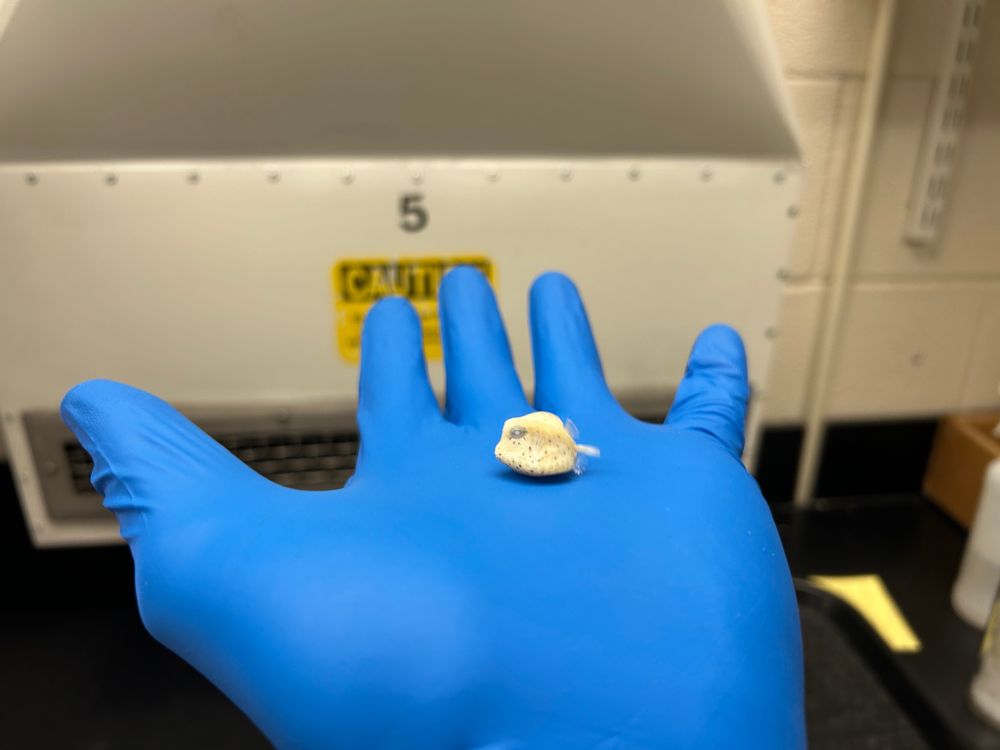
Have you ever seen a juvenile Buffalo Trunkfish (Lactophrys trigonus)? I absolutely love their weird skeleton which forms this bony carapace making their body rigid.
07.05.2025 12:15 — 👍 3 🔁 1 💬 0 📌 0

Photo-diagram and illustrations depicting the many forms of life in emergent freshwater marshes.
Life in emergent freshwater marshes. For my forthcoming book "PONDS: An Illustrated Guide," Yale University Press, 2026.
🧪🌿🌎 #sciart #wildlife #scicomm #sciviz #wildlifeart #iNat #scientificillustration #natureart #visualscicomm #sciviz #scicomm #marshes #freshwater #wetlands
04.05.2025 13:10 — 👍 147 🔁 28 💬 2 📌 1

Two fish, Emerald Bowfin, are seen on measuring boards during scientific field research. They have bright green fins and eyespots on their tales. Male bowfins develop these bright green colors during spawning season, which coincides with St Patrick’s Day throughout much of their range. Top fish is from Michigan, bottom fish is from Louisiana. Scientists still don’t know the mechanism for developing these super green fins!
Happy St. Patrick’s Day from the Emerald Bowfin!☘️🐟
From the Great Lakes to the Gulf Coast, few freshwater fishes are as festive as male bowfins! Their bellies and fins turn bright green during spawning season (right now in parts of their range!)🌎
*Gulf of MEXICO.
17.03.2025 12:53 — 👍 147 🔁 30 💬 3 📌 1
It’s true!
~ this lungfish, probably
17.03.2025 17:12 — 👍 66 🔁 7 💬 0 📌 0

ABC distributed 8 microgrants already this year totaling 1295 GBP. Next round of application opens in May.

Contribute to ABC by making a one time donation or becoming a monthly backer!
We granted 8 microgrants totalling £1295! 🥳🥳🥳
Our next funding round will open for applications on 26th May. Thank you to all our donors for making this possible!! 🫶
05.03.2025 15:43 — 👍 15 🔁 7 💬 1 📌 0
Oh HELL yeah look at that squid on the cover, beautiful reef squid we LOVE a reef squid in this household
01.03.2025 06:24 — 👍 521 🔁 39 💬 13 📌 0
Marine Ecologist, Deep-Sea Explorer, Climate Change Researcher, Science Communicator, Ed @deepseanews
PhD Student at Washington University in the Landis Lab!!
Polyploids Rock!!!
He/Him
Marine Vertebrate Collection Manager at Scripps Institution of Oceanography | Ichthyologist | Beer and bike lover | Horror fan
Scientist, Evolutionary Biologist & Entomologist / Ants / Genomes to Microbiomes / Professor & Curator at @Cornell / @CornellCALS / She/Her
Meet, network, exchange, empower.
http://womeningenomics.org
Postdoc - Latvis Lab, University of Arkansas. Interested in plant hybridization, evolution, phylogenetics and genomics. Opinions are my own. he/him 🏳️🌈🇧🇷
population genetics, phylogenetics, Bayesian inference, maximum likelihood, genomics, art, mountains, herpetology, food, electric cars
🇵🇭🇺🇸Associate Prof. (she/her) - Studying phylogenetics, evolutionary biology
http://phyloworks.org
Research Scientist @Zenil-Ferguson Lab, UKY. Macroevolution, Phylogenetics, Diversification, Model Adequacy, Causal Inference, Dung Beetles, Ericaceae. 🇨🇭 in 🇺🇸 Opinions=own. He/him Mastodon: @oschwery@ecoevo.social, X: orlando_schwery oschwery.github.io
Sytematics | Macroevolution | plants | Andes
Postdoc U of Arkansas
Inv. asociado MuseoHN UNMSM
Peruano 🇵🇪
él/he 🏳️🌈
evolutionary biologist (phylogenetic network methods, plant systematics) | postdoc @ University of Washington | PhD from University of Wisconsin-Madison | she/her | opinions mine etc etc 🏃🏻♀️✨🌈🌻🧬
NSF Graduate Research Fellow |
PhD student in Amphibian & Reptile Biodiversity Lab (🐸ARBL🐢) @ the University of New Mexico |
Disease ecology, host-parasite/species interactions, & popgen+ 🔬🦠(broad interests)
Assistant Professor @Princeton EEB. #phylogenetics/#macroevolution/#paleobiology
http://simoes-lab.com
Posts and views are of my own.
Botanist. Evolutionary biologist. Associate Professor and Herbarium Director, LSU. Passionate about plants, inclusive mentoring, and puzzles. I don't know what I'm doing here.
https://www.lagolab.net
Professor of Evolutionary Biology at Louisiana State University.
Phylogenomics, Molecular Evolution, Evolutionary History, Statistics, Computational Biology
Indiana and Texas Alum