31.01.2026 15:01 — 👍 1 🔁 0 💬 0 📌 1

Welcome to class everyone
25.01.2026 18:42 — 👍 1 🔁 1 💬 0 📌 0
Töredi, D., & Penrod, S. D. (in press). AI-based Investigation of Filler selection Strategies. Law and Human Behavior.
Preprint -> www.researchgate.net/profile/Dilh...
17.01.2026 11:57 — 👍 1 🔁 1 💬 1 📌 0
Just moved here from X (finally!). Here are some published research I shared there in the past year ➡️
17.01.2026 11:57 — 👍 3 🔁 1 💬 1 📌 0

#goodread
11.01.2026 17:33 — 👍 1 🔁 0 💬 0 📌 0
 05.01.2026 13:50 — 👍 2 🔁 0 💬 0 📌 0

#goodread
04.01.2026 17:50 — 👍 0 🔁 0 💬 0 📌 0
HRB Open Research Article: Collective intelligence informs mechanisms, protocol and toolkit to merge National Ambulance Service data and the Major Trauma Audit to inform the national trauma system.
Read the latest article version by Frank Doyle, Owen M. Harney, Brid Moran, Nora A Donnelly, Liam Watts, Louise Brent, Siobhan Masterson, Rory Quinn, David Hennelly, Fiona Boland, Anne Hickey, Jan Sor...
New Today:
Collective intelligence informs mechanisms, protocol and toolkit to merge National Ambulance Service data and the Major Trauma Audit to inform the national trauma system
hrbopenresearch.org/articles/8-1...
22.12.2025 17:35 — 👍 0 🔁 0 💬 0 📌 0
Learning for Long Lives in the age of AI
Well done, @geoffmulgan.bsky.social 👍
geoffmulgan.substack.com/p/learning-for…
20.12.2025 13:00 — 👍 1 🔁 0 💬 0 📌 0
 19.12.2025 16:47 — 👍 3 🔁 0 💬 0 📌 0
Spotify – Web Player
A commentary on 'Big Mind: How Collective Intelligence can change our world'
Playing from 0:00
open.spotify.com/episode/7BSx...
14.12.2025 21:53 — 👍 2 🔁 0 💬 0 📌 0
 14.12.2025 15:28 — 👍 1 🔁 0 💬 0 📌 0


🕊
07.12.2025 12:30 — 👍 1 🔁 0 💬 0 📌 0
 04.12.2025 14:29 — 👍 3 🔁 0 💬 0 📌 0
 04.12.2025 14:28 — 👍 1 🔁 0 💬 0 📌 0
Add a slow, reflective member to your team 😇
#CriticalThinking #CollectiveIntelligence #DecisionMaking #Teamwork #ThinkingFastandSlow
03.12.2025 12:01 — 👍 2 🔁 0 💬 0 📌 0
Very interesting 👍
03.12.2025 11:59 — 👍 1 🔁 0 💬 0 📌 0
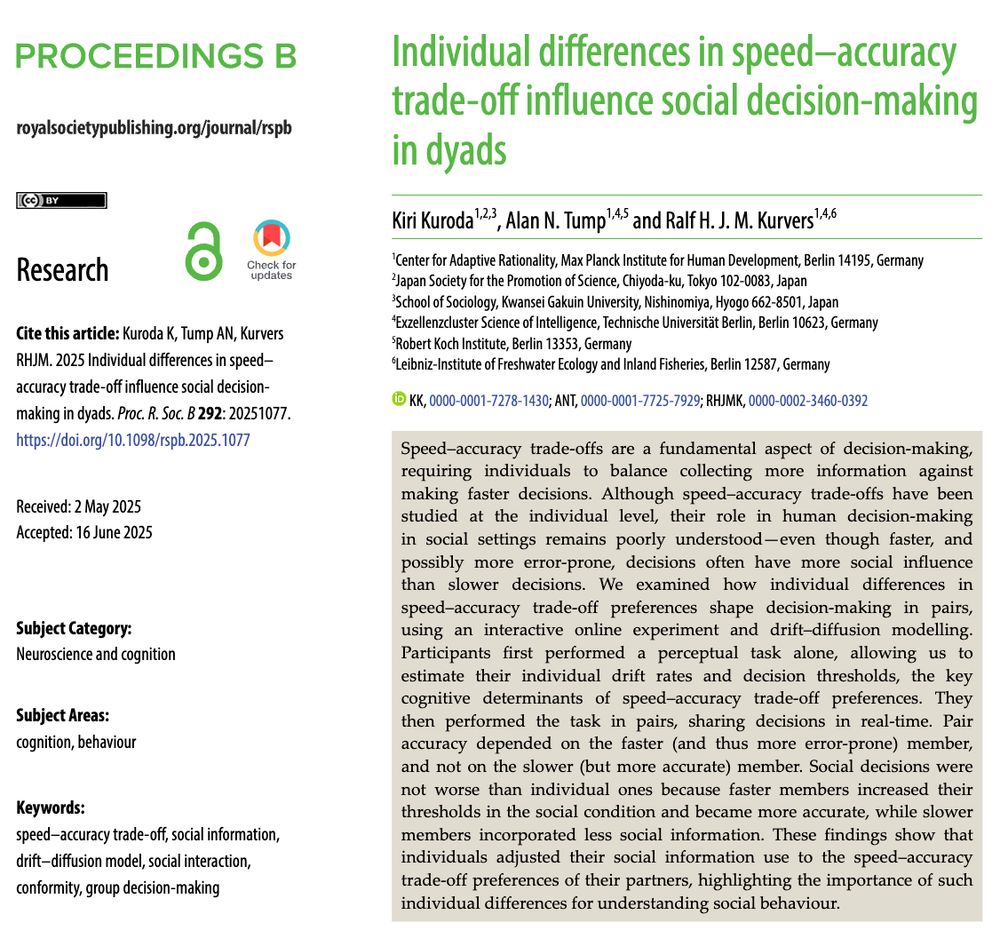
Abstract: Speed–accuracy trade-offs are a fundamental aspect of decision-making, requiring individuals to balance collecting more information against making faster decisions. Although speed–accuracy trade-offs have been studied at the individual level, their role in human decision-making in social settings remains poorly understood—even though faster, and possibly more error-prone, decisions often have more social influence than slower decisions. We examined how individual differences in speed–accuracy trade-off preferences shape decision-making in pairs, using an interactive online experiment and drift–diffusion modelling. Participants first performed a perceptual task alone, allowing us to estimate their individual drift rates and decision thresholds, the key cognitive determinants of speed–accuracy trade-off preferences. They then performed the task in pairs, sharing decisions in real-time. Pair accuracy depended on the faster (and thus more error-prone) member, and not on the slower (but more accurate) member. Social decisions were not worse than individual ones because faster members increased their thresholds in the social condition and became more accurate, while slower members incorporated less social information. These findings show that individuals adjusted their social information use to the speed–accuracy trade-off preferences of their partners, highlighting the importance of such individual differences for understanding social behaviour.
"Individual differences in speed–accuracy trade-off influence social decision-making in dyads"
🚨Our paper has been published in Proceedings of the Royal Society B doi.org/10.1098/rspb...
w/ Alan Tump @alantump.bsky.social, Ralf Kurvers @ralfkurvers.bsky.social
@royalsocietypublishing.org
1/ 🧵👇
16.07.2025 09:34 — 👍 36 🔁 12 💬 3 📌 0
 29.11.2025 13:50 — 👍 3 🔁 0 💬 0 📌 0
🎄
20.11.2025 19:07 — 👍 3 🔁 0 💬 0 📌 0
Building a Framework to Support Human-AI Teamwork
michaelhoganpsychology.wordpress.com/wp-content/u...
18.11.2025 19:08 — 👍 2 🔁 1 💬 0 📌 0
Building a Framework to Support Human-AI Teamwork
michaelhoganpsychology.wordpress.com/wp-content/u...
18.11.2025 19:08 — 👍 2 🔁 1 💬 0 📌 0
OSF
We have added a new paper to our OSF folder.
Hogan, M.J., Siwek, A. D., Dong, X., King, A., Kolodziej, A., Zhang, Y., Farrell, H., O'Brien, S., Kearney, L., Yuan, L. (2025). Building a Framework to Support Human-AI Teamwork. OSF. osf.io/fbkj8/files
lnkd.in/e4egT6QX
18.11.2025 19:07 — 👍 0 🔁 0 💬 0 📌 1
Robots run wild
17.11.2025 19:43 — 👍 3 🔁 0 💬 0 📌 0
Winter arrives ❄️❄️
17.11.2025 18:33 — 👍 3 🔁 0 💬 1 📌 0
Welsh history, people, and personality.
Essays on notable (and overlooked) Welsh figures — what we know, what we don’t, and why they matter.
✍️ Long-form on Substack: https://substack.com/@famouswelshminds
Social psychologist (currently working as educational psy) ➡️ Conspiracy theories, collective memory & intergroup relations
🏀/🎸
SCITT ITE Science / Computing lecturer. STEM/Edtech CPD provider. Science teacher. Author. Google Certified Educator. Craft Beer, gaming and geek. Science Fix book for primary teachers out now.
https://linktr.ee/dannynic
Lecturer in Mathematics Education. Programme Director of Bachelor of Mathematics and Education. Passionate about all things involving Numeracy and Mathematics.
she/her. My research topics are eyewitness psychology, cognitive individual differences, juror decision-making, asylum interviewing
@ Abo Akademi, Finland
Lecturer and Researcher in technology education at TUS, Ireland. Editor in Chief of International Journal of Technology and Design Education.
Psychologist | Assistant Professor (PhD) in Criminology at UCLM (Spain)| Criminology Research Center 🎓🔍 | Research Group on Victimology and Psychopathology of Childhood and Adolescence | Passionate about human behavior, plot twists & dark minds 🎬🕵️♀️
٣٤ ⋅ Doctor ⋅ Specialist Registrar (ST7) in Neurology 🧠 ⋅ PhD candidate @uclqsion.bsky.social — #HD-YAS https://orcid.org/0000-0002-0679-0117
Postdoc @arc-mpib.bsky.social, @mpib-berlin.bsky.social Interested in human social/group decision-making. Also working as a social media team at ARC. kirikuroda.com/en
Exploring open scholarship, AI, and digital ethics.
Ideas begin here, and sometimes return here.
Part of the Open Scholar Ecosystem (OSE) Project.
https://lnk.bio/AndrewFirr
PhD. Public and occupational health, dataviz and rstats. @ the Swedish School of Sport and Health Science.
Professor & Canada Research Chair at Brock University | Grad Program Director | neurocognitive aging, memory, & attention | mom of 3 | ally | mostly kvetching
PhD Researcher | Geographer, Intersectional Feminist, Planner & Policy Nerd | Foundation Chartered Manager (fCMgr) | RT /= endorsement
📍Belfast
Socialization of Motivation in Education (some) Research Lab at the University of Tennessee, Knoxville 🧡🐾
Directed by Dr. Xiao-Yin Chen 🤓
We are more than just some lab! ✨
Canadian Socialist in Alberta, Canada.
I pay taxes so you can have a Doctor and watch Heated Rivalry.
Recall Trump-Funded politicians in Alberta:
https://operationtotalrecall.ca/
#LandBack #EveryChildMatters #freepalestine #never51 #handsoffgreenland
Broadsheet features journalist, writer & editor (Independent, Guardian, Daily Telegraph, Houzz); interiors nerd; sustainability and anti-waste obsessive - see 'This is Rubbish' on Substack: https://substack.com/@kateburt
🔬 Assistant Prof, Pathology @Duke | Director, Clin Micro Lab
🧫 Former Clin Micro Fellow @Memorial Sloan Kettering
👩🏻🔬 Former Postdoc @broadinstitute.org
🎓 PhD @The Rockefeller University
Focus: Diagnostics, AMR, Structural Biology
Science, technology, and neuroscience educator, mostly retired but still kibitzing. Into cartooning, maker spaces, and storytelling. And because life demands it, politics.
Learning Specialist | AI British Sign Language | CLO100 | 📚 Co-Host of The Learning Network's L&D Book Club | Former Educator (QTS) | 📝 CIPD Assoc Dip in progress