📣📣📣Job alert Multimodal Language Department Max Planck Institute for Psycholinguistics MAX PLANCK RESEARCH GROUP LEADER POSITION (W2 BBESG) lnkd.in/eaq5MW9a
26.02.2026 20:32 — 👍 17 🔁 20 💬 1 📌 2📣📣📣Job alert Multimodal Language Department Max Planck Institute for Psycholinguistics MAX PLANCK RESEARCH GROUP LEADER POSITION (W2 BBESG) lnkd.in/eaq5MW9a
26.02.2026 20:32 — 👍 17 🔁 20 💬 1 📌 2
Very interesting attempt to trace back the early evolution of a “system of conventional signs” (proto-writing system) 🧪✍️
www.pnas.org/doi/10.1073/...

A surprising new study shows that baby chickens react the same way that humans do when tested for something called the "bouba-kiki effect," which has been linked to the emergence of language. n.pr/4rBdZgj
19.02.2026 22:13 — 👍 187 🔁 21 💬 8 📌 8
The main article - baby chickens show the bouba-kiki effect!
www.science.org/doi/10.1126/...

Just published in Science, baby chickens show the bouba-kiki effect! In an accompanying Perspective, @bodowinter.bsky.social and I argue a broader, multimodal framework of iconicity is needed to illuminate the origins of language.
www.science.org/doi/10.1126/...
This new paper in Science is also accompanied by a cool perspective piece by @mperlman.bsky.social & @bodowinter.bsky.social! #language #linguistics www.science.org/doi/10.1126/...
19.02.2026 21:52 — 👍 24 🔁 9 💬 0 📌 1
From this perspective, I argue that apes use a range of gestures that are homologous to the iconic gestures of humans, even if they are comparatively restricted in imaginative scope and anchored heavily in a here-and-now context.
8/10
However, I think this is the wrong framework for understanding the origins of iconic communication. In contrast, I view ape gestures through the lens of cognitive theories of human gesture and iconicity as rooted in sensorimotor simulation and mental imagery.
7/10
Yet, this recent work still maintains ape gestures are not truly iconic, taking an individual's capacity for Gricean intentionality and their ability to understand analogy as the operating criteria to determine whether a gesture is iconic. Experiments show apes are limited in these respects.
6/10

However, it is increasingly recognized that these theories cannot account for the variability and contextual tuning of many ape gestures. For example, see this recent paper by Graham et al (2025): onlinelibrary.wiley.com/doi/10.1111/...
5/10
Instead, they argue iconic-looking gestures arise as instrumentally effective actions are channeled into gestures through repeated use, either through an individual's experience or over generations of evolution.
4/10

However, recent theories of ontogenetic ritualization and biological inheritance have claimed this iconicity is in the eye of the human researcher and is not psychologically real for the gesturing apes. For example, see Tomasello and Call (2019): doi.org/10.1007/s100...
3/10
Apes are well documented to use a flexible and wide-ranging repertoire of gestures, many of which appear to be iconic representations of actions, including directive touches, visual directives, and pantomimed actions.
2/10

So excited to see the Oxford Handbook of Iconicity in Language come out!!
Here is my chapter on Experimental approaches to sound symbolism: academic.oup.com/edited-volum...

Our paper (w/ @bodowinter.bsky.social and @mperlman.bsky.social) is finally out, officially 🥳. In it, we set ourselves the lofty goal of defining iconicity, focusing on its subjectivity, context-dependence, and gradability. Let us know if you agree with our definition? 🤔
doi.org/10.1093/oxfo...
Really nice to see this reappraisal of "design features for language". Our book "A Multimodal Language Faculty" also discusses design features, and I believe presents the only model of language that satisfies the type of linguistic framework that they advocate www.bloomsbury.com/us/multimoda...
27.11.2025 09:34 — 👍 6 🔁 4 💬 1 📌 0
Super proud of this fabulous team for challenging old comparative frameworks and rethinking what makes language language.
Read more in the thread below 👇 or here 📖😊: www.cell.com/trends/cogni...

The title page
🚨NEW PUBLICATION ALERT!🚨
The 'Design Features' of Language Revisited (w/ @mperlman.bsky.social @glupyan.bsky.social Koen de Reus & @limorraviv.bsky.social)
Feature Review out now in #OpenAccess in @cp-trendscognsci.bsky.social! #language #linguistics
Paper: doi.org/10.1016/j.ti...

THE LINGUISTIC LIFE OF THE KUFR QASSEM DEAF COMMUNITY LANGUAGE EMERGENCE, VARIATION, CHANGE, AND PERSISTENCE by MARAH JARAISI A thesis submitted to the University of Birmingham for the degree of DOCTOR OF PHILOSOPHY Supervised by Professor Adam Schembri and Dr. Marcus Perlman Department of Linguistics and Communication School of English, Drama, and Creative Studies College of Arts and Law University of Birmingham September 2025

Dedication This thesis is dedicated to the resilient Palestinian people. (poem) Because I am not like match sticks, I light up once… and die. but I am like the fires of the Magi: I burn… from my cradle to my grave and from my predecessors to my descendants. Long as the horizon is my breath, and I have mastered the craft of ants, gently for history is written the way we dictate By - Tawfiq Ziad -
Very excited to announce that yesterday I submitted my PhD thesis: The Linguistic Life of the Kufr Qassem Deaf Community: Language Emergence, Variation, Change, and Persistence.
I dedicate this thesis to my people: the resilient Palestinian people
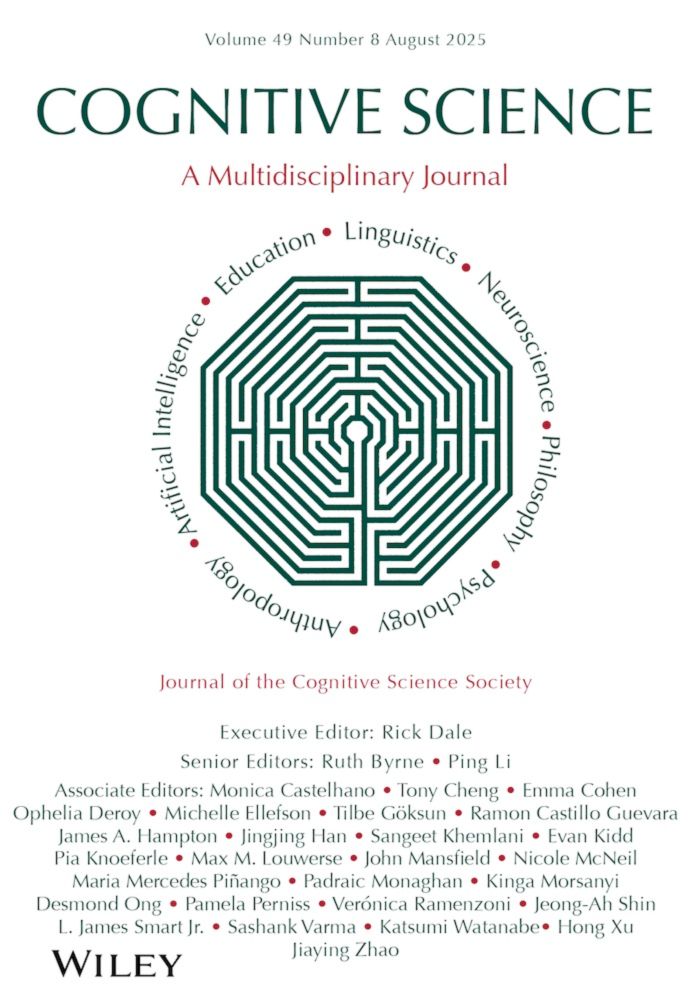
Super excited to share our new multimodal corpus analysis, "Iconic Words Are Associated With Iconic Gestures" 🥳
Project led by our PhD student Ell Wilding and in collab w/ @jeannettel.bsky.social & @mperlman.bsky.social:
doi.org/10.1111/cogs...
And it comes together with a reply! It was an interesting and fruitful discussion about the iconicity of different type of r-sounds :)
www.nature.com/articles/s41...
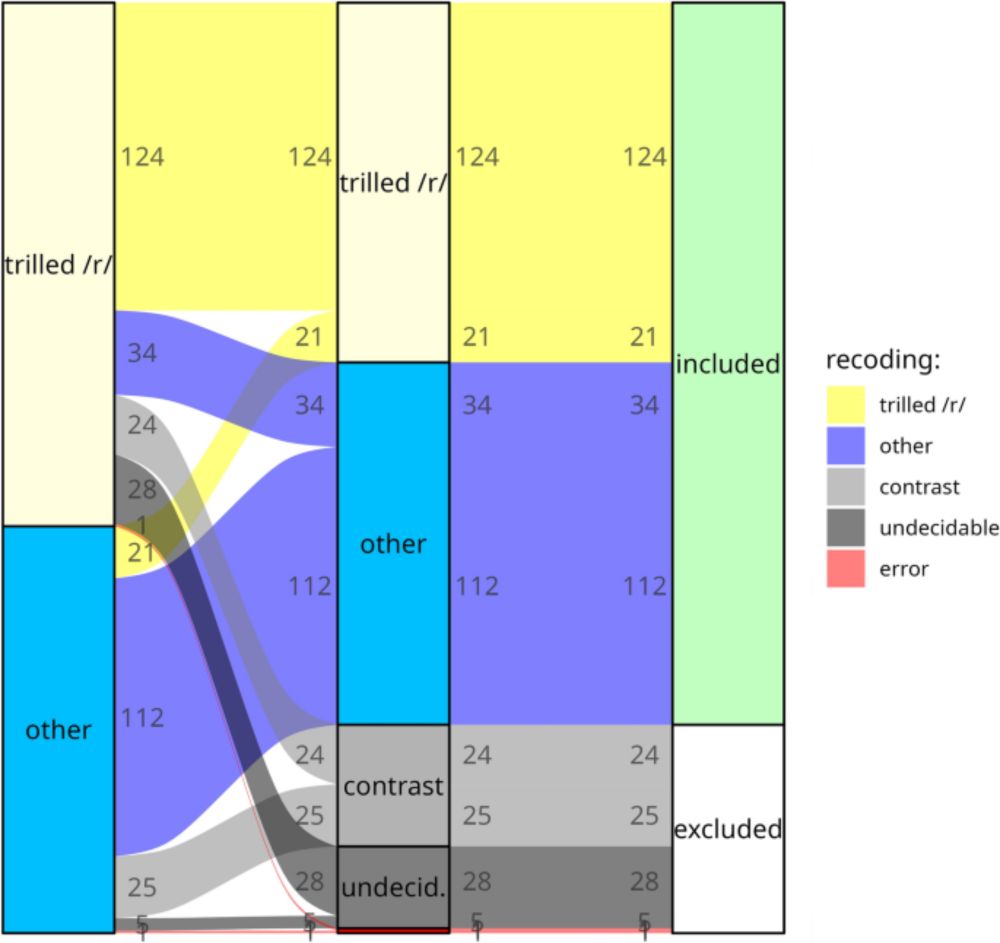
Remember the cool finding by @bodowinter.bsky.social et al. that the "trilled r" [r] is associated with roughness? Well, Rémi Anselme, François Pellegrino (@laboratoireddl.bsky.social) & myself show in www.nature.com/articles/s41... that this seems more general and applies to all "r-like" sounds.
15.04.2025 11:22 — 👍 25 🔁 7 💬 0 📌 1
New review/theory/argumentative paper is out: "The size and shape of sound: The role of articulation and acoustics in iconicity and crossmodal correspondences".
The paper delves deeply into what phonetic and cognitive mechanisms underpin spoken language iconicity.
Link: doi.org/10.1121/10.0...
My latest article, "Vocal gestures in early multimodal communication: A commentary on Karadöller, Sümer and Özyürek", is now available to read in First Language. There is a paywall, but I can share the electronic version with anyone who needs it.
doi.org/10.1177/0142...

Sign Language Contact, Variation, and Change 2025 conference at the University of Birmingham, UK: we are now inviting abstracts on any topic related to language contact/translanguaging, sociolinguistic variation, and language change in signing communities. sites.google.com/view/slcvc-w...
27.01.2025 10:50 — 👍 16 🔁 11 💬 1 📌 1
a picture of Torun old town in winter
JOB ALERT! Come work with me!
34-Month Postdoc Position here at the Center for Language Evolution Studies, Nicolaus Copernicus University in Toruń in my project "Paths to Polysemy"
Job offer here: www.umk.pl/en/jobs/?tas...
Please repost & share widely!
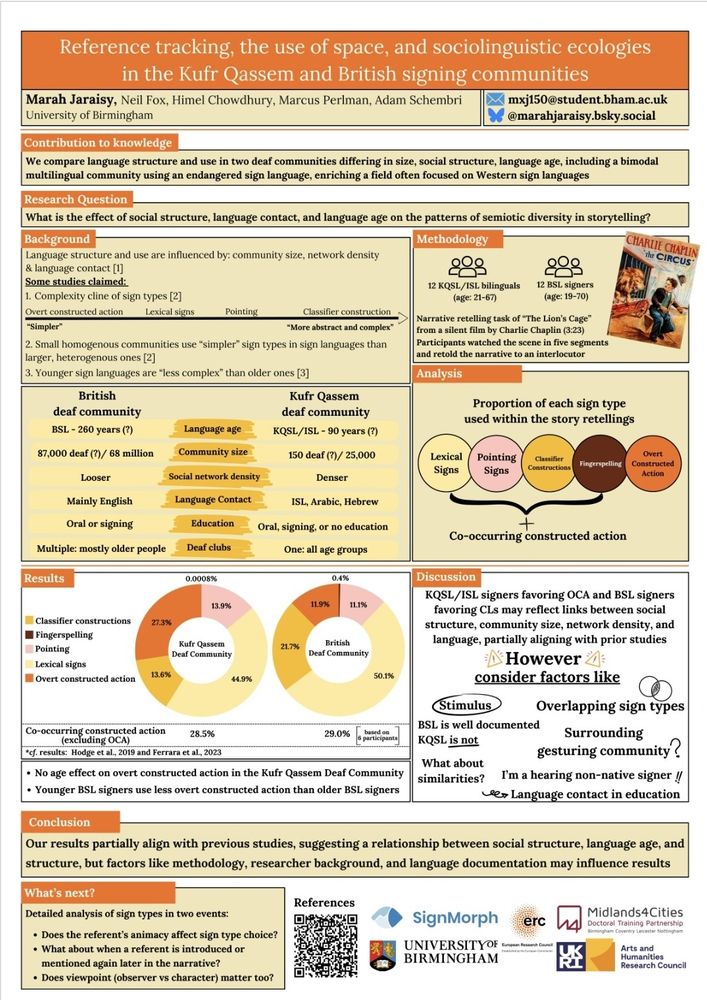
A research poster titled 'Reference tracking, the use of space, and sociolinguistic ecologies in the Kufr Qassem and British signing communities' by Marah Jaraissy and colleagues from the University of Birmingham. The poster compares language structures in two deaf communities: Kufr Qassem (using KQSL/ISL) and British (using BSL). It explores the effects of social structure, language contact, and language age on semiotic diversity in storytelling. Key sections include: 1. Background: Discusses influences on language use, including community size, network density, and language contact, with simpler sign types used in smaller communities. 2. Methodology: Includes narrative retellings of a silent film clip by participants (12 bilingual KQSL/ISL signers and 12 BSL signers). 3. Results: Highlights differences in the use of lexical signs, pointing, classifier constructions, and overt constructed action between the two communities. Signers of KQSL/ISL use overt constructed action more, while BSL signers use more classifier constructions 4. Discussion and Conclusion: Links findings to social and linguistic factors, but also suggesting influences of methodology and researcher background. 5. Future Directions: Proposes studying referent's animacy and narrative viewpoints effects on storytelling Charts and diagrams provide data on sign type proportions, while logos and QR codes for references appear at the bottom."
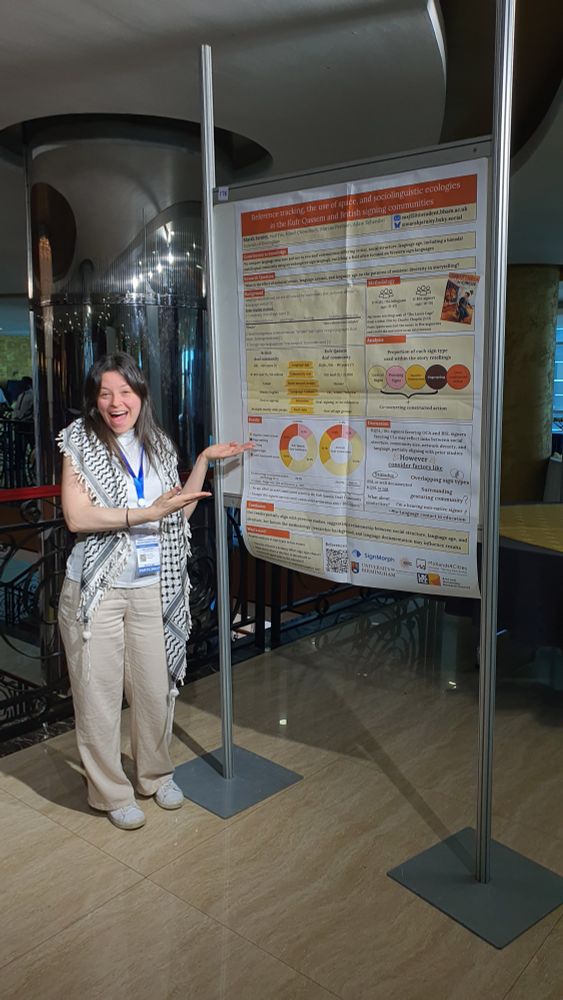
Very much enjoyed presenting my poster at #TISLR15 in Addis Ababa, Ethiopia today!
One important message in our poster is that factors like methodology, researcher's background, and language documentation may affect one's result.
Happy to share/discuss more via DM or Email!

New paper out today in Frontiers in AI!
The sociolinguistic foundations of language modelling
We argue sociolinguistics provides a foundation for understanding LLMs and addressing many challenges
www.frontiersin.org/journals/art...
doi.org/10.3389/frai...
techxplore.com/news/2025-01...
I'm excited to see this study published in Gesture, led by @kirstyrgreen.bsky.social. We get deep into the nitty-gritty of infants' early production of iconic gestures.
13.01.2025 17:21 — 👍 5 🔁 0 💬 0 📌 0