ConversationAlign: Open-source software for analyzing patterns of lexical use and alignment in conversation transcripts
Big paper release! ConversationAlign - methods for computing lexical and affective alignment between interlocutors in dyadic conversation transcripts. Open Access in Behavior Research Methods. link.springer.com/epdf/10.3758...
20.02.2026 18:15 — 👍 45 🔁 14 💬 4 📌 0
Models of Language and Communication - PSYC 51.17
Course materials for PSYC 51.17: Language Models from Scratch - Dartmouth College
Excited to be teaching a new undergraduate course on Models of Language and Conversation this term!
Check it out here: context-lab.com/llm-course/
I've added lots of fun interactive demos of chatbots and NLP techniques that let students dig into the approaches.
07.01.2026 13:10 — 👍 26 🔁 8 💬 0 📌 0

Various soups on a kitchen stovetop: a vegetarian chili, a potato-leek soup, a sweet pumpkin soup, and a cauliflower rosemary soup
If anyone's looking for ideas for wintertime lab activities, my lab did a soup exchange over the weekend. We had a great time on a day that was cold even by Chicago standards! Credit to @mystiesaturday.bsky.social for suggesting it and to @jadynpark.bsky.social for the photo.
20.01.2026 15:56 — 👍 8 🔁 2 💬 0 📌 0
With some trepidation, I'm putting this out into the world:
gershmanlab.com/textbook.html
It's a textbook called Computational Foundations of Cognitive Neuroscience, which I wrote for my class.
My hope is that this will be a living document, continuously improved as I get feedback.
09.01.2026 01:27 — 👍 583 🔁 237 💬 16 📌 10

netneurotools: a trainee-oriented approach to network neuroscience | doi.org/10.1101/2025...
Our lab’s internal toolkit for accomplishing everyday tasks in brain imaging ⤵️
18.12.2025 14:58 — 👍 74 🔁 36 💬 1 📌 3

Theory of Minds: Early Understanding of Interacting Minds
The idea that we understand others’ actions in terms of their underlying mental states has shaped decades of developmental research on social cognition. Existing work, however, has primarily focused o...
Officially out! In this review, Aaron Chuey and I discuss how existing work on ToM mostly focused on a single individual’s mental states (e.g., what Sally thinks). Extending ToM, we argue for ToMS—an understanding of how multiple individuals communicate and influence each others’ minds. t.ly/u4rtb
10.12.2025 23:30 — 👍 45 🔁 16 💬 0 📌 0
Overcoming distortion in multidimensional predictive representation
Thrilled to see this reviewed preprint by grad student extraordinaire (but bsky-less) Euan Prentis posted on @elife.bsky.social! doi.org/10.7554/eLif...
Thank you to the reviewers and editors for encouraging, insightful and helpful comments. We will be revising the paper, stay tuned!
21.11.2025 19:18 — 👍 6 🔁 4 💬 0 📌 0
Woohoo! Congrats, Matthias! 🎉
18.11.2025 15:22 — 👍 1 🔁 0 💬 1 📌 0

Interested in how the brain prepares for upcoming tasks? We trained a monkey on “6” different cognitive tasks and recorded prefrontal cortical activity. We examined the neural geometry and dynamics during task preparation. Come check out our poster on SUNDAY(Nov 16) from 1-5 PM!
15.11.2025 03:01 — 👍 9 🔁 4 💬 0 📌 0

I'm going to present our latest memory model that learns causal inference during narrative comprehension! Stop by the poster on Monday to chat about causality, memory, brain🧠, and AI🤖!
#sfn2025 #sfn25
15.11.2025 02:41 — 👍 24 🔁 5 💬 0 📌 1
OSF
Our latest hyperscanning study tracks how neural coupling unfolds during genuine conversation and how it differs from simply reading scripted dialogue: osf.io/preprints/ps...
14.11.2025 19:27 — 👍 12 🔁 4 💬 0 📌 0

New Research Explores What Makes Emotional Memories Stick - DSI
By Sarah Steimer We can think of emotional experiences as sticky, explains the study’s senior author Yuan Chang (YC) Leong, Assistant Professor in the Department of Psychology and DSI Affiliate Resear...
A new study in 'Nature Human Behavior' led by UChicago researchers combines fMRI data and natural language processing to understand how emotions lead to enhanced memory encoding, or "stickiness."
Learn more: bit.ly/3Lec2Gf
@jadynpark.bsky.social @ycleong.bsky.social
28.10.2025 22:26 — 👍 10 🔁 5 💬 0 📌 0
Thank you, Lydia! 😊
13.10.2025 19:21 — 👍 1 🔁 0 💬 0 📌 0
This was a huge team effort, with co-authors @kruthig03.bsky.social , @jinke.bsky.social, @matthiasnau.bsky.social, Ioannis Pappas, and @ycleong.bsky.social. This work would not have been possible without the MRI datasets made publicly available by Drs. Janice Chen, Hongmi Lee, and Emily Finn
13.10.2025 15:58 — 👍 2 🔁 0 💬 1 📌 0
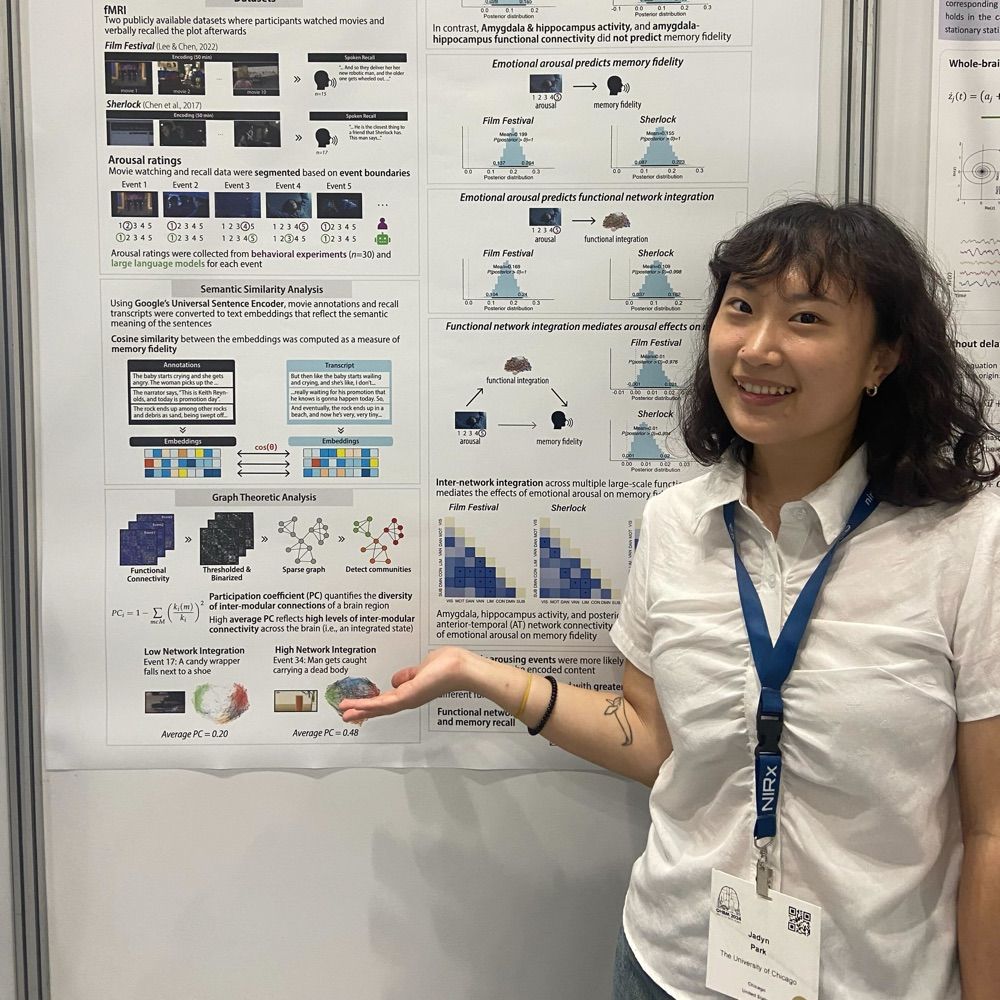
Out now in @nathumbehav.nature.com! We applied graph theoretic analyses to fMRI data of participants watching movies/listening to stories. Integration across large-scale functional networks mediates arousal-dependent enhancement of narrative memories. Open access link: rdcu.be/eKKAw
13.10.2025 15:55 — 👍 56 🔁 19 💬 1 📌 3
Really excited to share a review I contributed to, out now in @cp-trendsneuro.bsky.social. We explore how foraging can offer a framework for studying brain and behaviour in natural contexts. It’s been a pleasure working with colleagues across species and disciplines on this. Check it out! 👇
07.10.2025 13:22 — 👍 13 🔁 5 💬 1 📌 0

Ongoing thoughts at rest reflect functional brain organization and behavior
Resting-state functional connectivity (rsFC)-brain connectivity observed when people rest with no external tasks-predicts individual differences in behavior. Yet, rest is not idle; it involves streams...
New preprint! 🧠
Our mind wanders at rest. By periodically probing ongoing thoughts during resting-state fMRI, we show these thoughts are reflected in brain network dynamics and contribute to pervasive links between functional brain architecture and everyday behavior (1/10).
doi.org/10.1101/2025...
20.08.2025 13:53 — 👍 68 🔁 23 💬 4 📌 4

A neurocomputational account of motivated seeing
Do goals, beliefs, and desires affect visual experience? This question has long been controversial in cognitive science. There exists extensive litera…
Excited to share our new review on how neuroimaging and computational models can help uncover how people see what they want to see, now out at @cp-trendscognsci.bsky.social! It was a blast writing this with Haena Kim and @iancballard.bsky.social
www.sciencedirect.com/science/arti...
02.07.2025 16:52 — 👍 62 🔁 20 💬 1 📌 1
Icon image of computer screen with text messaging conversation shown
🗣️ New paper alert! Ever wonder how strangers navigate the messy world of casual conversation? We analyzed 200+ video calls to uncover the hidden structure behind "idle talk" – and found it's way more systematic than you'd think!
Thread 👇
21.06.2025 21:56 — 👍 32 🔁 11 💬 3 📌 2
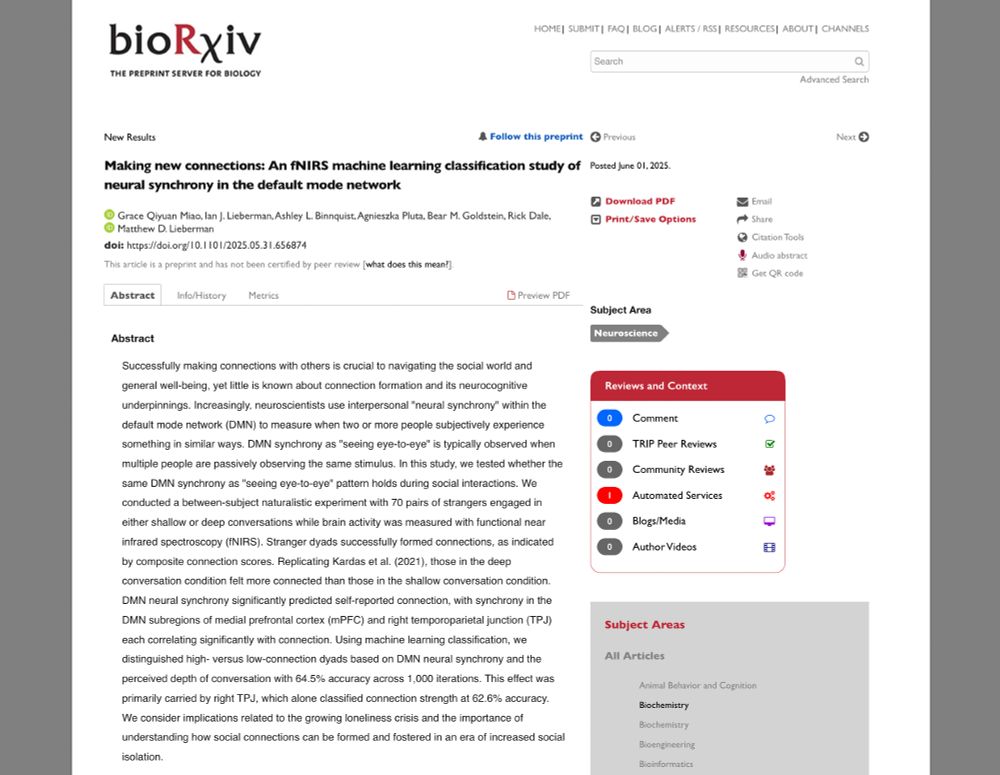
How do we make new connections? Ashley Binnquist, Agnieszka Pluta, Bear Goldstein, Rick Dale, @socialbrain.bsky.social and I just posted a new preprint on the neurocognitive processes that support meaningful social connection. 🧠🧠💬💬 [1/8] 🧵
02.06.2025 19:11 — 👍 11 🔁 2 💬 1 📌 0
Strangers chatted once a week for 6 weeks and as they became closer, their self-reported emotions were *less* aligned after conversations. Fits with recent work (by @sebospeer.bsky.social @dianatamir.bsky.social et al) suggesting friends are free to explore and diverge
12.05.2025 18:50 — 👍 54 🔁 14 💬 1 📌 3
Lab Manager at the Roman Family Center for Decision Research, University of Chicago, Booth School of Business
🤖🔁🧠 Minds in Interaction across Scales, Disciplines, and Theories
Multi-Brain Dynamics, Inter-Personalized Psychiatry, Social NeuroAI
Dad · Husband · Prof UMontreal / CHUSJ / Mila · PI of www.ppsp.team
WiAIR is dedicated to celebrating the remarkable contributions of female AI researchers from around the globe. Our goal is to empower early career researchers, especially women, to pursue their passion for AI and make an impact in this exciting field.
Associate Professor of Social/Personality Psychology at Michigan State University
My opinions do not reflect the views and opinions of my employer.
Chopiklab.com
I study language using tools from cognitive science and neuroscience. I also like snuggles.
Social Neuroscience Professor at UCL studying human brain and behaviour in real world social interactions
neuroscientist @berkeley_ai. NIH K00 + UC Presidential Postdoctoral Fellow. he/him
Statistical modeling, Bayesian inference, causal effect estimation, hierarchical structures; FMRI data analysis; classical music; jogging/hiking; reading; meandering
Computational social neuroscientist interested in person perception, emotion, and Neuro-AI | Graduate Student in the SCRAP Lab at Dartmouth
Ph.D. candidate in affective and cognitive neuroscience at UC Santa Barbara. Interested in self-other representations, emotion, and memory. Passionate about bridging the gap between findings in laboratory and naturalistic settings.
A field-defining intellectual hub for data science and AI research, education, and outreach at the University of Chicago
https://datascience.uchicago.edu
Psychology, neuroscience, music, game design.
asst prof of cog neuro at cal poly | dad | formerly uc davis, princeton, northwestern, lawrence | graying child | he/him | blm | dm for papers
Postdoc at @StanfordSNL. Studies social risk-taking & social networks in adolescents and young adults. Loves to climb rocks and drink bubble tea.
X: @ruipei_penn
Psychologist study social cognition, stereotypes, individual & structural, computational principles. Assistant Prof @UChicago
Research Asst Professor, National University of Singapore, Yong Loo Lin School of Medicine.
Cognitive neuroscientist curious about Motivation and Memory.
https://poh-brainmemlab.github.io/BrainMemLab/
Doctor of Cognitive Neuroscience
-
Postdoctoral Researcher at University of Chicago
Associate professor and neurobumpkin at University of Oregon. Attempting to study social cognitive neurons and oligodendrocytes with human neuroimaging. New Mexican expat, but I have friends everywhere. csnl.uoregon.edu
social neuro phd student @ ucla | brain basis of shared reality | she/her