Now published in Physical Review Letters! @physrevlett.bsky.social
journals.aps.org/prl/abstract...
02.12.2025 17:04 — 👍 0 🔁 0 💬 0 📌 0
The many-body BICs we propose here should be accessible for state-of-the-art experiments using superconducting circuits.
(4/4)
25.11.2025 20:31 — 👍 0 🔁 0 💬 0 📌 0
Such spatially localised states in a continuum have previously mostly been studied for single photons/excitations.
(3/4)
25.11.2025 20:31 — 👍 0 🔁 0 💬 1 📌 0

We show that bound states in the continuum (BICs) can form with strongly correlated two-photon states, so-called doublons, in setups with atoms coupling at multiple points to a waveguide.
(2/4)
25.11.2025 20:31 — 👍 0 🔁 0 💬 1 📌 0
We now show how these data-processing methods also work well for extracting the POVM elements that characterise a measurement device.
(4/5)
23.11.2025 12:39 — 👍 0 🔁 0 💬 1 📌 0

In this work, we complete the tomography trio (state, process, and measurement tomography) with gradient-descent-based data-processing methods.
(2/5)
23.11.2025 12:38 — 👍 0 🔁 0 💬 1 📌 0

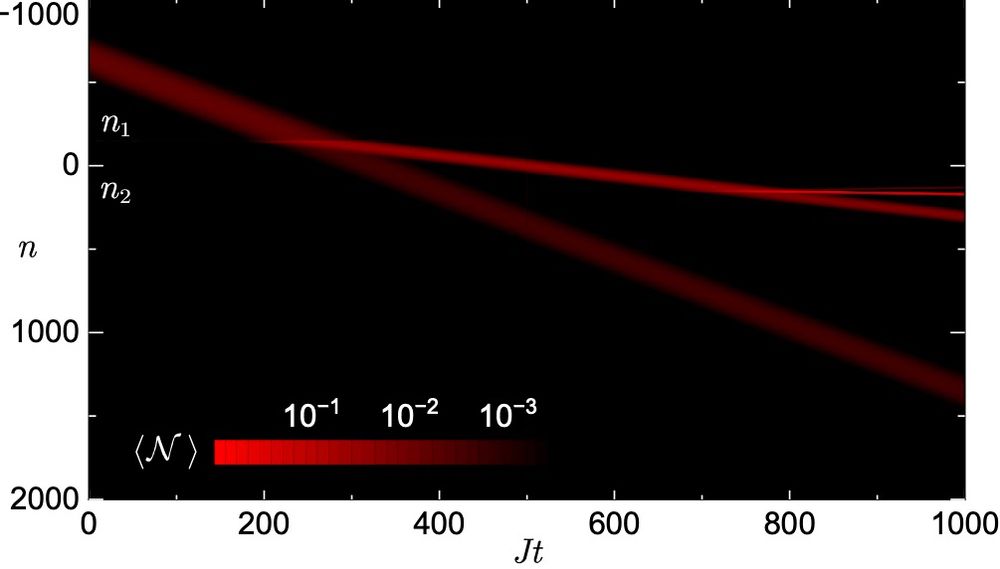
Adding more physical coupling point to create an actual giant atom, we can make the scattering unidirectional and the conversion into a desired multi-photon state perfect.
(5/5)
19.11.2025 10:50 — 👍 0 🔁 0 💬 0 📌 0

The states with different numbers of photons naturally separate in space due to having different group velocities.
(4/5)
19.11.2025 10:50 — 👍 0 🔁 0 💬 1 📌 0

The scattering potential becomes nonlocal due to the spatial extension of the multi-photon states; we term this a pseudo-giant atom.
(3/5)
19.11.2025 10:49 — 👍 0 🔁 0 💬 1 📌 0
We show how correlated two- and three-photon states (doublons and triplons) can be generated by scattering an incoming single photon off excited two-level emitters in a nonlinear waveguide.
(2/5)
19.11.2025 10:49 — 👍 0 🔁 0 💬 1 📌 0

New preprint out today together with Jia-Qi Li and Xin Wang at Xi’an Jiaotong University: ”Generating spatially separated correlated multiphoton states in nonlinear waveguide quantum electrodynamics” arxiv.org/abs/2511.14281
(1/5)
19.11.2025 10:48 — 👍 1 🔁 0 💬 1 📌 0

Overall, we see better logical error suppression per amount of entanglement (ebits) than for other protocols, although it comes at the cost of an increased number of physical qubits to achieve the same code distance.
(7/7)
16.10.2025 18:34 — 👍 0 🔁 0 💬 0 📌 0


To avoid propagation of errors from the interface, we use an alternating sequence of syndrome-measurement circuits, which may be of independent interest.
(6/7)
16.10.2025 18:33 — 👍 0 🔁 0 💬 1 📌 0

Our protocol is based on an equivalence between Bell measurements and Bell pairs, which can be seen through ZX calculus.
(5/7)
16.10.2025 18:33 — 👍 0 🔁 0 💬 1 📌 0
In our work, we show how to perform lattice surgery (logical operations between encoded error-corrected qubits) across modules in a way that requires roughly half the amount of entanglement compared to previous protocols.
(4/7)
16.10.2025 18:32 — 👍 0 🔁 0 💬 1 📌 0
Thankfully, it has been shown that such an architecture can work even if the links between modules are more noisy than operations within modules. However, establishing entanglement between qubits on different modules is still a bottleneck.
(3/7)
16.10.2025 18:32 — 👍 0 🔁 0 💬 1 📌 0
Getting to well-functioning large-scale quantum computers will most likely require quantum error correction and a modular architecture, where several smaller processors are connected.
(2/7)
16.10.2025 18:32 — 👍 1 🔁 0 💬 1 📌 0

New preprint out today with Trond Haug, @timohillmann.bsky.social, and Raphaël Van Laer, at the Wallenberg Centre for Quantum Technology, Chalmers University:
”Lattice surgery with Bell measurements: Modular fault-tolerant quantum computation at low entanglement cost”
arxiv.org/abs/2510.13541
(1/7)
16.10.2025 18:31 — 👍 5 🔁 0 💬 1 📌 0

As an application, we show these three-qubit gates could rapidly generate high-fidelity highly entangled GHZ states among three and five giant atoms along a waveguide.
(6/6)
07.10.2025 11:56 — 👍 0 🔁 0 💬 0 📌 0

Here, we show that three giant atoms can be tuned to points where they don’t lose any energy into the waveguide, but exchange excitations through the waveguide to implement three-qubit CCZS and DIV gates.
(4/6)
07.10.2025 11:55 — 👍 0 🔁 0 💬 1 📌 0
New preprint out today with my Marie Curie postdoc Guangze Chen: ”Efficient three-qubit gates with giant atoms”, arxiv.org/abs/2510.04545
(1/6)
07.10.2025 11:54 — 👍 1 🔁 0 💬 1 📌 0
These results are promising for the continued progress towards large-scale quantum computers. The number of control lines in a quantum computer can be significantly reduced without introducing much overhead in execution time for quantum algorithms.
(5/5)
29.08.2025 11:32 — 👍 0 🔁 0 💬 0 📌 0

For single-qubit gates, we find that the serialization overhead generally scales only logarithmically in the number of qubits sharing a drive line. We are able to explain this finding using queueing theory.
(4/5)
29.08.2025 11:32 — 👍 0 🔁 0 💬 1 📌 0
Quantum Bullshit Detector.
Tag for a reading.
Parody quantum computing startup from South London
https://dulwichquantum.github.io/
Caltech theoretical physicist
Google Quantum AI | Ex-Team Lead, IBM Quantum | MIT TR35 | Founder, Open Labs | Board, Yale Alumni Assoc | Yale PhD
Professor of Chemistry and Computer Science
University of Toronto
Faculty member, Vector Institute
Director, Acceleration Consortium
Senior Director of Quantum Chemistry NVIDIA
My views expressed here are personal and are not those of my employers.
Searching for the numinous
Australian Canadian, currently living in the US
https://michaelnotebook.com
Theoretical physicist @NIST, QuICS Fellow, Zookeeper @eczoo.bsky.social. Views my own.
Physicist. Científico Titular at Instituto de Física Fundamental, CSIC. Quantum optics and open quantum systems.
Taking partial derivatives of quantum computers at AWS
Quantum cruise control.
Qruise is developing the machine learning physicist: characterisation, precision, and control at your fingertips.
Scientist, professor of quantum physics at Freie Universität Berlin and affiliated with Helmholtz Center Berlin and the Fraunhofer Heinrich Hertz Institute. ERC Fellow.
Research and education in physics with a focus on quantum computing, communication and sensing with team Qudev (https://qudev.phys.ethz.ch/) at ETH Zurich. Team lead at the ETHZ-PSI Quantum Computing Hub. Director of the Quantum Center at ETHZ.
Quantum Computing systems, Quantum Internet, quantum education.
Caltech, USC, Keio.
West Virginia, LA, Kamakura.
Computational Quantum Physicist - EPFL Lausanne, Switzerland
superconducting circuits, nanomechanics, silicon photonics, electro-optics | MS Physics @univienna | PhD @qudev @ETH | PostDoc @caltech | Professor @ISTAustria https://quantumids.com
An online-only journal publishing high-quality technical reference, review and commentary articles in all areas of fundamental and applied physics.
nature.com/natrevphys
A journal for cutting-edge physics research.
Quantum, bio, astro, optical, high-energy, nuclear, plasma, and condensed-matter physics, physics education research, complexity, and more.
https://www.nature.com/nphys/
Research, news, and commentary from Nature, the international science journal. For daily science news, get Nature Briefing: https://go.nature.com/get-Nature-Briefing