Themes:-
Session 1:- Trust the process
Session 2:- How to focus on the important details
Will you join the next one ?
27.11.2025 10:16 — 👍 0 🔁 0 💬 0 📌 0

Job offer: PostDoc in biotic and trophic interactions 90% (f/m/d)
As part of the interdisciplinary PAPPUS project, which explores how plant communities and urban green space management support biodiversity and residents' quality of life, you will work with existing data. Your focus will be on analyzing biotic and trophic interactions between plants and arthropods, including predators, herbivores, pollinators, and detritivores. The data were collected from 60 public and private green spaces in Zurich. Your first task will be to analyse metabarcoding data from over 1200 invertebrate samples to generate a species lists. You will then examine the structure of mutualistic and antagonistic multitrophic networks, including food webs, and model their responses to urbanisation, management intensity, and plant preferences among residents. The position offers flexibility to develop your own research ideas within the scope of PAPPUS. You are expected to publish your findings in high-impact journals and present them at international conferences. Engagement with practitioners, especially through presentations and outreach in French, is also an important part of this PostDoc.
You have a PhD degree in environmental science or in a related field. You have a good publication record as well as a background in ecological sciences and quantitative analyses. Proficiency in bioinformatic, metabarcoding, multitrophic ecology (food web), and ecological modelling is required, as is good knowledge of trait-based ecology. Practical and interdisciplinary experiences (e.g., with urban engineers) and knowledge of the principles and theories of urban ecology are helpful. You are ambitious, motivated and communicative. You are used to a high standard of independent, structured and you demonstrate a high level of team spirit. Proficiency in English and French, as well as good knowledge in German is required.
🌿 #PostDoc Alert! PhD in #EnvironmentalSciences? Proficient in #bioinformatic, #EcologicalModelling and good knowledge of trait-based #ecology🦋? Our #ConservationBiology group offers a PostDoc position in biotic and trophic interactions🐜: apply.refline.ch/273855/1769/... #UrbanEcology #ScienceJobs
20.10.2025 06:29 — 👍 12 🔁 9 💬 0 📌 0
Unfortunately not, but would have been interesting to see that. Also just filtering 1L with 64 um would have allowed to separate the effects of volume and filter pore size !
11.03.2025 14:34 — 👍 2 🔁 0 💬 1 📌 0
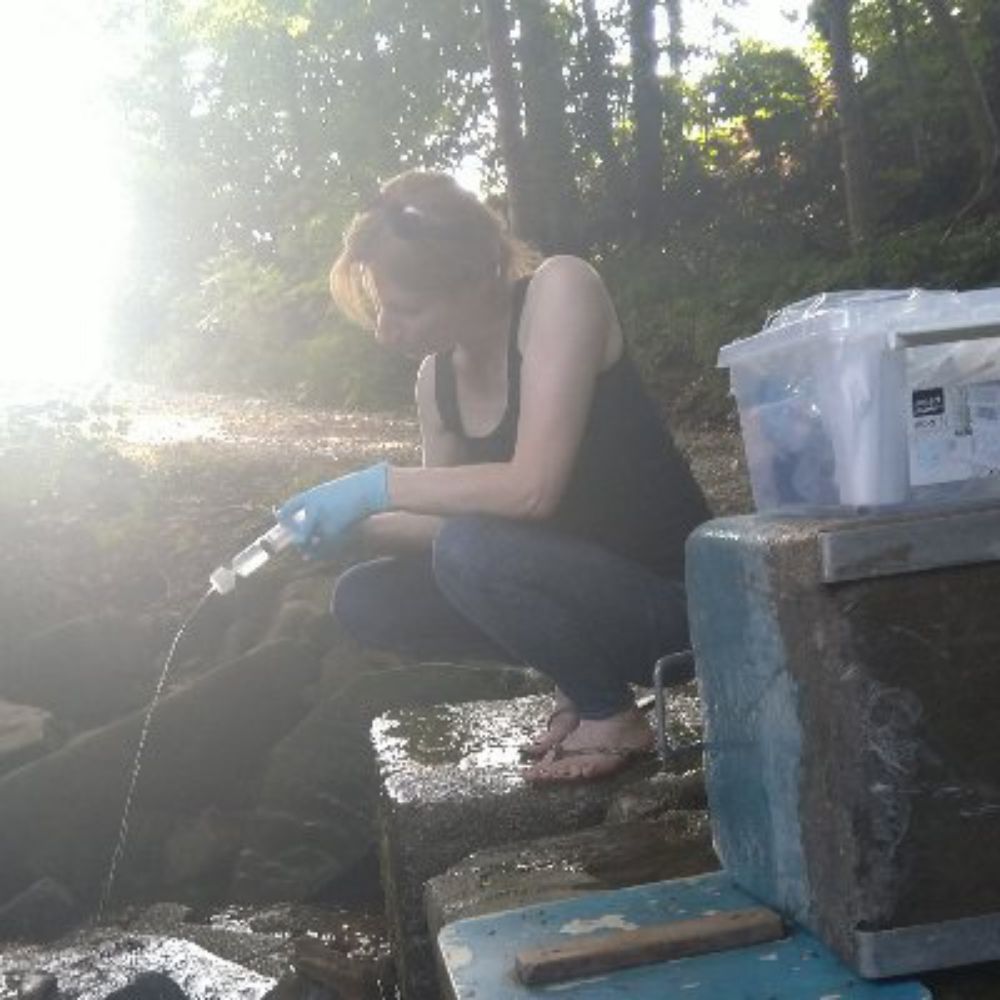
Thanks @rleonsampedro.bsky.social for the great picture !
02.03.2025 20:37 — 👍 2 🔁 0 💬 0 📌 0
Yeah, stuff like this keeps me up at night ...
21.02.2025 10:00 — 👍 1 🔁 0 💬 0 📌 0

Interestingly, these patters were different for ITS plant marker and COI metazoan marker! How does the source organisms impact spatial and particle size distribution of their eDNA? Can we optimise our capture methods depending on the target group? More work to be done! (7/8)
21.02.2025 09:56 — 👍 0 🔁 0 💬 1 📌 0
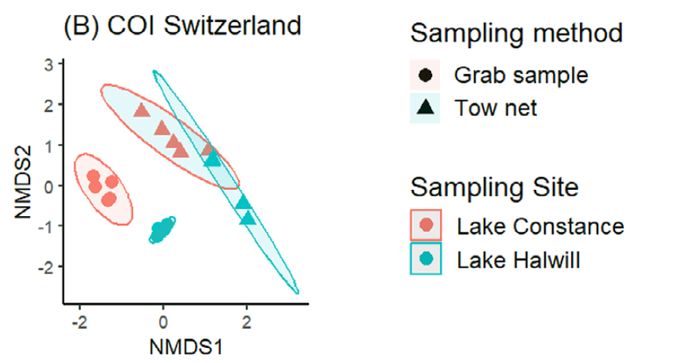
Not just the number but also the type of taxa differ. Beta diversity plots show samples cluster by location (as expected) but also by capture method ! Your choice of methods can dramatically impact your eDNA results ! (6/8)
21.02.2025 09:56 — 👍 0 🔁 0 💬 1 📌 0
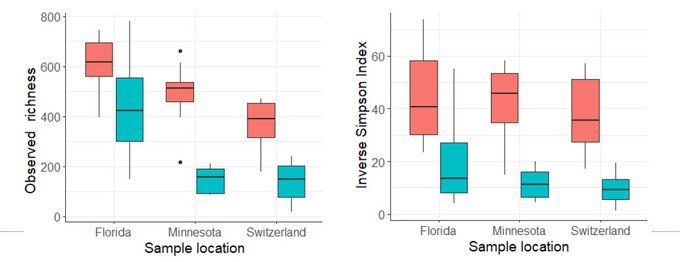
However, the metabarcoding results show more unintuitive patterns. Although the grab samples capture 100 times less DNA, the DNA it does capture represents significantly greater alpha diversity than that captured in tow nets. These results were consistent across all sites. (5/8)
21.02.2025 09:56 — 👍 1 🔁 0 💬 1 📌 0

We conducted the experiment in three different locations with varying water matrices: Switzerland, Montana, and Florida and found surprising consistent results ! First, we see that the tow nets (blue) captured ~100 times for DNA than grab sample filters (red). (4/8)
21.02.2025 09:56 — 👍 1 🔁 0 💬 1 📌 0

So here we tested whether increasing volume of water processed, indeed improved species diversity detection metabarcoding. We compared two extremes of volume-pore size combinations 1) 1L via 0.45 um filter and 2) 3500-7000 L filtered via 64 um tow net. (3/8)
21.02.2025 09:56 — 👍 0 🔁 1 💬 1 📌 0

The paper starts with a review of 300+ studies showing water volume depends on filter pore size. Thus, it may be intuitive to use larger pores to process more water and capture patchily distributed eDNA diversity. (2/8)
21.02.2025 09:56 — 👍 1 🔁 0 💬 1 📌 0
The paper covers key topics in both fields, highlighting what biologists and hydrologists need to know about each other's work. We provide actionable steps on how they can integrate a multidisciplinary approach in their research. Shout out to all the co-authors and participants of the conference !
18.02.2025 10:15 — 👍 0 🔁 0 💬 0 📌 0

In this paper, we discuss how biologists using #eDNA in freshwater systems can benefit from integrating hydrological approaches to track the source of their eDNA, and how our understanding of water movement can be improved by using eDNA as a hydrological tracer (2/n)
18.02.2025 10:15 — 👍 1 🔁 0 💬 1 📌 0
Assistant Professor of Biology at Boston University ::: Science Journalist / Communicator ::: National Geographic Explorer
Postdoc at University of Warwick using #eDNA to map distribution of native and invasive species in urban landscapes.
Passion for combining #CRISPR methods with eDNA to enhance monitoring.
She/her
Molecular ecologist , conservation geneticist & #eDNA fan 🧬 @uni-graz.at. I use non-invasive genetics to track biodiversity - on land 🌄 & in freshwater 💧. Big love for southern African savannas 🐘. Free time? I’m on my road bike 🚴.
Microbial Ecology | Soil Carbon | Land Use & Climate Change | Chancellor's Fellow at University of Edinburgh 🏴 | Global Citizen 🌏 | Green Politics | 🏳️🌈 he/him
Postdoc in the department of Biogeography, University of Trier @unitrier.bsky.social. From the island of Ischia.
https://orcid.org/0000-0002-9115-1941
Scientist👩🔬/Biologist🦁/Conservationist🌍
Formerly @UniLeiden, @CUNY #hickerlab, @uni_copenhagen, currently @NCBS_Bangalore;
Chair #LeoFoundation;
she/her
PhD student at the University of Liverpool researching GHG emissions from peatland waterbodies
Peatland ecologist (she/her)
What happens to biodiversity when you build a solar park on rewetted peatland? 🦉🪲🌿
Researching peatland PV at the University of Greifswald
https://peatecr.com/
NYT columnist. Signal: carlzimmer.51
Newsletter: https://buttondown.com/carlzimmer/
Web: http://carlzimmer.com
[This account includes a tweet archive]
Post-doc at the University of Edinburgh working on #marine and #terrestrial #eDNA. Views my own. She/Her.
International Biodiversity Consultants Ltd (IBC) is an independent biodiversity and ecology specialist consultancy dedicated to conserving and enhancing our environment with experience worldwide. Link: https://linktr.ee/ibioconsultants
Parasitologist working on eDNA, (bird)schistosomes and interested in all other things that like to live in and on other things. 🪱🐌🧬
Postdoc at Charles University in Prague
Formerly at LSTM, UCL & NHM London
Postdoc at Eawag, Environmental Chemistry,
interested in water quality, environmental forensics, metabolomics, carbon cycling, climate change, mass spec, AI/ML, etc.
views are my own.
🔎 Bioinformatics, Comparative/ Biodiversity/ Conservation Genomics & Marine Bio
👩💻 PhD student @DessimozLab @unil_qb
👩🎓 MSci @UoABioSci
Researcher #Molecular_Biology #Bioinformatics #Virology #Fish #environmental_DNA #NGS #Bioengineering at @thuenen.de
Peruvian biologist 🇵🇪
Ecology + Genetics (eDNA) + Bioinformatics + Data analysis/coding.
Particular interest on marine fish 🐟🦈🧬
Urban Ecologist @SWILD and PhD student @ELE_ETHWSL. Interested in: Wildlife Managment, Urban Ecology, Population Ecology, Conservation, SciComm
PhD candidate in Medical Microbiology, University of Zurich | AMR evolution in the gut microbiome
PhD candidate at University of Plymouth studying marine environmental DNA 🧬
#eDNA #Bioinformatics #Marine