YouTube video by TRICUSO
TRICUSO Episode One: Expanding the Capacity of Observation in the Southern Ocean
www.youtube.com/watch?v=IcJl...
03.02.2026 09:13 — 👍 4 🔁 2 💬 0 📌 1

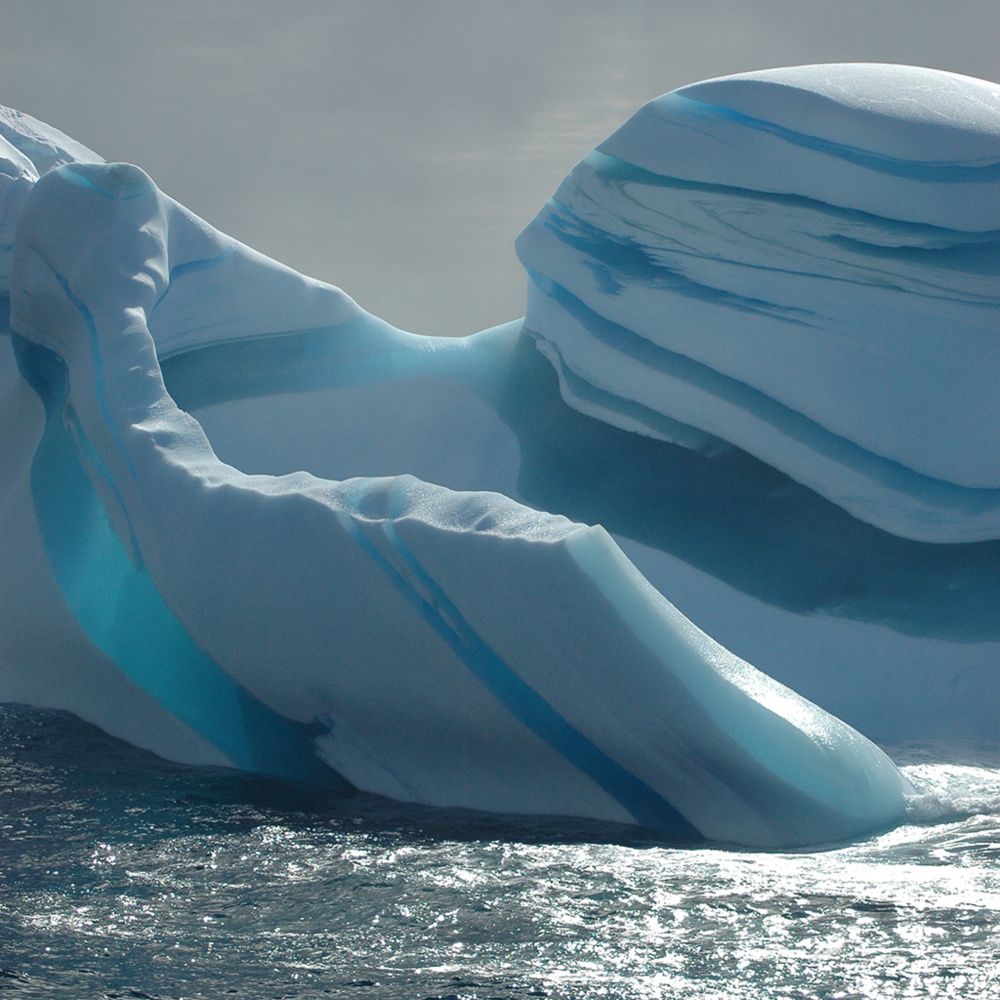
Thumbnail for the first TRICUSO project video. Episode 1: Expanding the capacity of observation in the Southern Ocean. In the background is the beautiful scenery of the floating ice on the Southern Ocean, snowy mountains and a blue sky.
📽️TRICUSO’s first #projectvideo! Featuring the beautiful #SouthernOcean, interviews with our consortium #scientists and our ambitions to innovate #sensor technology and engage #citizenscience platforms.
Special thanks to #60South & #TheOceanRace
🔗Link in comments
@horizoneu.bsky.social #REA
03.02.2026 08:48 — 👍 3 🔁 2 💬 1 📌 0

How do mesoscale eddies modulate CO2 fluxes in the Southern Ocean?
Mesoscale eddies and Southern Ocean carbon sink The Southern Ocean takes up more than a quarter of the anthropogenic CO₂. Its powerful westerly winds, deep overturning circulation, and intense mixing ...
🌊🌀 Learn how mesoscale eddies modulate air–sea CO₂ exchange in the Southern Ocean.
🔍The key findings of a new 27-year high-resolution model study by Salinas-Matus et al. are summarized in this blog post: blogs.egu.eu/divisions/os...
#OceanScience #Oceanography @egu.eu @tatianailyina.bsky.social
23.01.2026 10:20 — 👍 11 🔁 3 💬 0 📌 0
🌊 check out our new paper
16.01.2026 21:11 — 👍 2 🔁 0 💬 0 📌 0

Graphic from the new paper: "Passive acoustic monitoring from profiling floats as a pathway to scalable autonomous observations of global surface wind"
New paper from TRICUSO colleagues & co-authors on how passive #acoustic #sensors on #biogeochemical profiling #floats can retrieve surface #wind speed from hundreds of meters below the #ocean surface.
os.copernicus.org/articles/22/...
@horizoneu.bsky.social #REA
@sorbonne-universite.fr
14.01.2026 11:13 — 👍 9 🔁 3 💬 0 📌 0

Graphic from the new paper: "improved air-sea CO2 flux estimates from sailboat measurements"
New #paper by TRICUSO’s Jacqueline Behncke @geomarkiel.bsky.social & Peter Landschützer @vliz.be demonstrates how integrating #sailboat #data improves estimates of #ocean #carbon uptake
Read the full article, published by @science.org: www.science.org/doi/10.1126/...
@horizoneu.bsky.social #REA
13.01.2026 10:19 — 👍 11 🔁 5 💬 0 📌 1

Ocean Sciences
A blog hosted by the European Geosciences Union
We're thrilled to announce that the #EGU Ocean Sciences Division is now on Bluesky and LinkedIn!🎉 Follow us for the latest updates and many blog posts about the world of ocean science. 🌊🧪
👉 Check out our blog blogs.egu.eu/divisions/os/ & subscribe to stay informed!
LinkedIn: bit.ly/3ItSwVr
@egu.eu
02.10.2025 10:06 — 👍 14 🔁 7 💬 0 📌 0
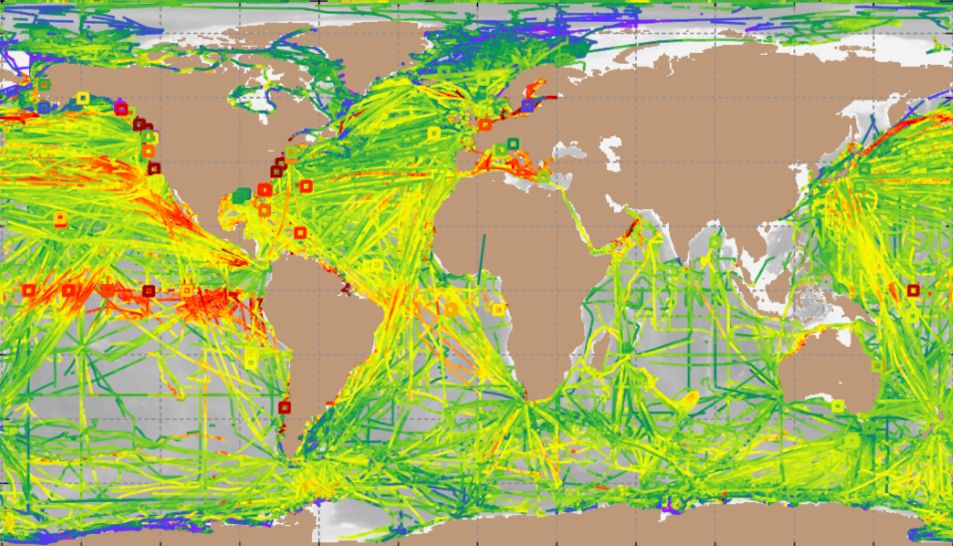
Map showing the surface ocean CO₂ from ships, drifters and autonomous surface platforms and moorings for all data in SOCAT version 2025, coloured by fCO2 concentration (scale not shown).
SOCAT v2025 is released today! A grand total of 49.6 million surface ocean fCO2 observations from dozens of contributors around the world.
www.socat.info/v2025
#ocean #co2
05.06.2025 09:29 — 👍 47 🔁 25 💬 0 📌 4
🌊
12.06.2025 12:19 — 👍 4 🔁 2 💬 0 📌 0

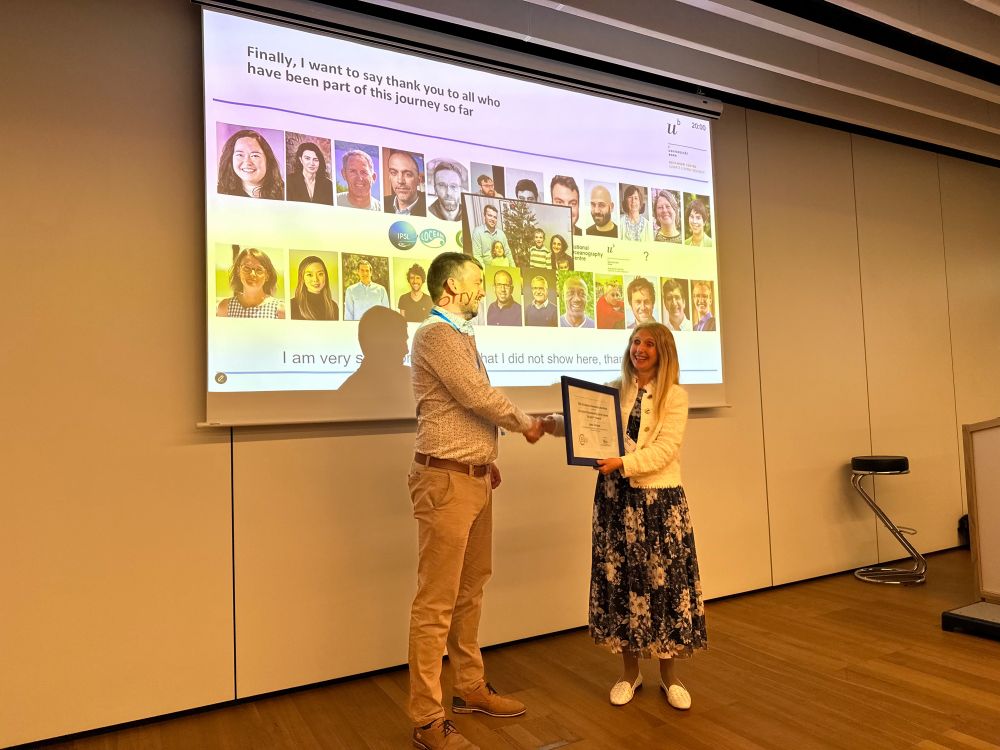
🌊 Great medal and award lecture at #EGU25!
Congrats to @tatianailyina.bsky.social for receiving the Fridtjof Nansen Medal and @polarocean.bsky.social for the Outstanding ECS Award for their outstanding work in oceanography👏 Truly great scientists!
Check out the interviews:
bit.ly/3ScAwQp
@egu.eu
29.04.2025 20:58 — 👍 20 🔁 2 💬 0 📌 1
Session MAL13-OS
I am excited about my Fridtjof Nansen Medal Lecture tonight at #EGU25. It is about ocean carbon cycle, its predictability and feedbacks in the Earth system - topics I am truly passionate about. Hope to see many colleagues there 🧪 🌊
meetingorganizer.copernicus.org/EGU25/sessio...
@egu.eu
29.04.2025 08:29 — 👍 18 🔁 3 💬 0 📌 1
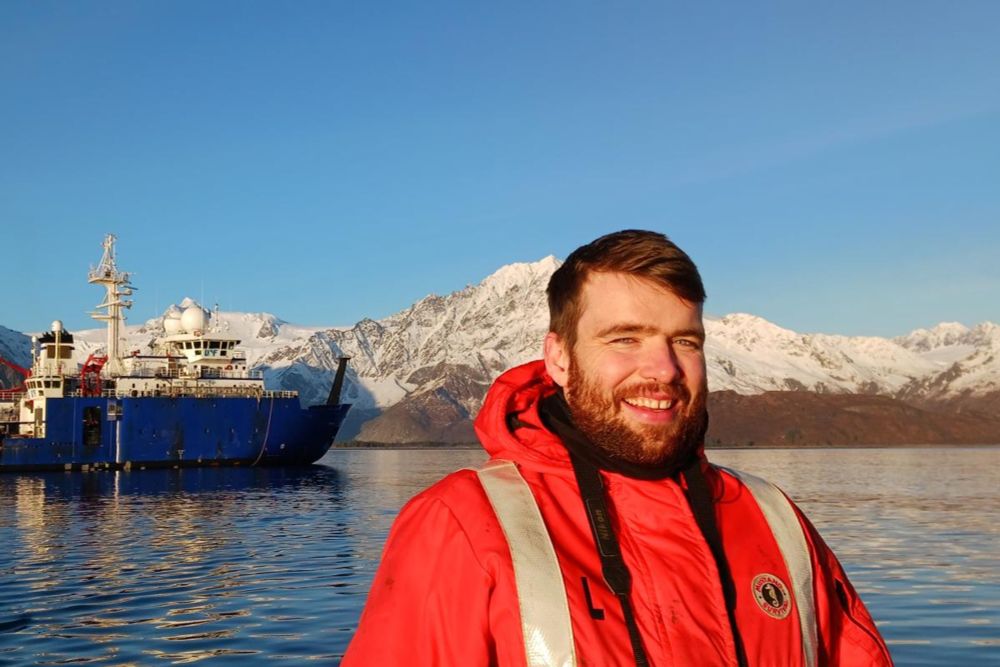
Jens Terhaar Receives the Division Outstanding Early Career Scientist Award – About His Career and Work
Jens Terhaar received the 2025 Division Outstanding Early Career Scientist Award for his research on the ocean carbon cycle and its effects on climate. We spoke with him about his career path and the ...
At #EGU25, I gave an interview with respect to the Ocean Sciences @egu.eu #EarlyCareer Award.
It is about my past, present and future science and also being a parent in academia!
If you want to hear more, please come to my medal lecture tomorrow: meetingorganizer.copernicus.org/EGU25/sessio...
28.04.2025 12:52 — 👍 16 🔁 2 💬 2 📌 0
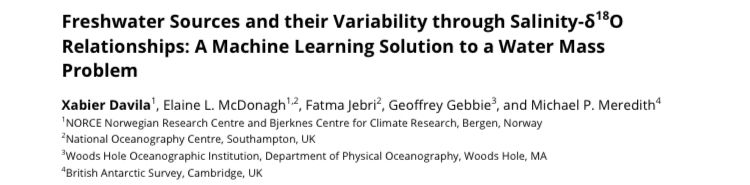
Interested in the freshwater distribution and variability in the Southern Ocean 🌊 ?
Come by my #EGU25 presentation where I will show new insights from oxygen stable isotopes!
🗓️: Monday April 28
🕰️: 14:32 - 14:42
⛓️💥: meetingorganizer.copernicus.org/EGU25/EGU25-...
27.04.2025 14:49 — 👍 18 🔁 6 💬 0 📌 0

1/3🌊 #EGU25 next week !
Come to my talk on our #SOCOMv2 work: strengths & limits of pCO₂ interpolation products to estimate the ocean carbon sink
➡️ Understand biases & uncertainties from data sparsity, mapping methods & CO₂ flux
📅 Mon 28 Apr | ⏰ 11:55 | 📍 Room C
#OceanCarbon #EGU2025
24.04.2025 10:16 — 👍 9 🔁 2 💬 1 📌 0
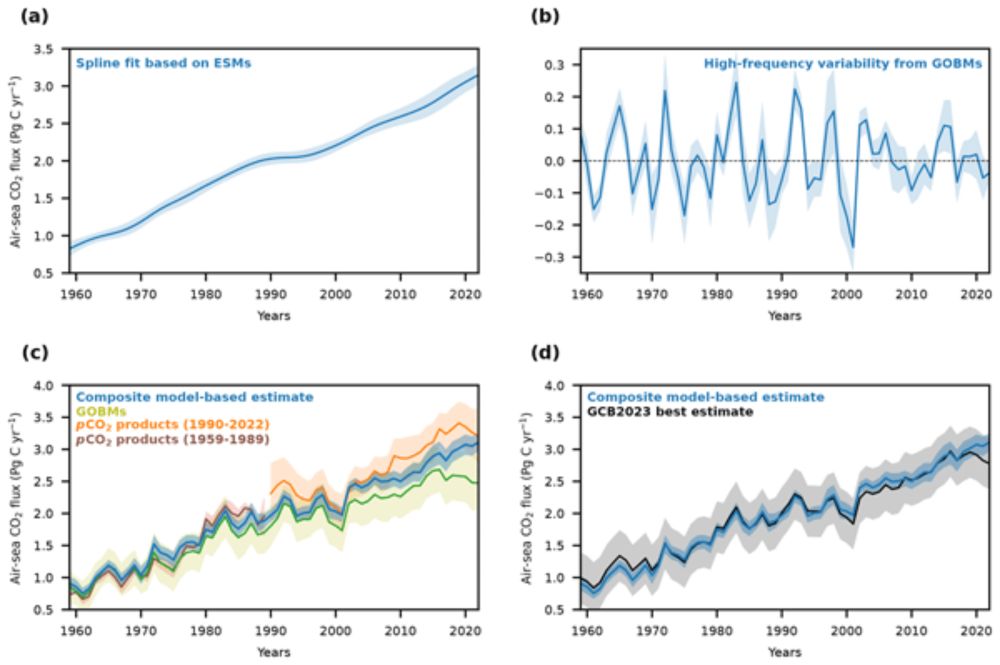
Composite model-based estimate of the ocean carbon sink from 1959 to 2022
Abstract. The ocean takes up around one-quarter of anthropogenically emitted carbon and is projected to remain the main carbon sink once global temperatures stabilize. Despite the importance of this n...
A new estimate of the composite model-based estimate of the annually averaged ocean carbon sink. 🌊
This composite model-based estimate of the ocean carbon sink from 1959 to 2022 is similar in magnitude to the best estimate of the Global Carbon Budget but 70 % less uncertain.
28.03.2025 09:37 — 👍 28 🔁 14 💬 1 📌 0
🌊
21.03.2025 07:40 — 👍 1 🔁 0 💬 0 📌 0
The use of civilian platforms for #oceanobservation is a viable & sensible method to expand the capacity of the observing system. Get the scoop on the proof in the paper by @jacbeh.bsky.social, Peter Landshützer & Toste Tanhua www.nature.com/articles/s41...
@horizoneu.bsky.social #REA #citscience
20.03.2025 12:35 — 👍 8 🔁 1 💬 0 📌 1
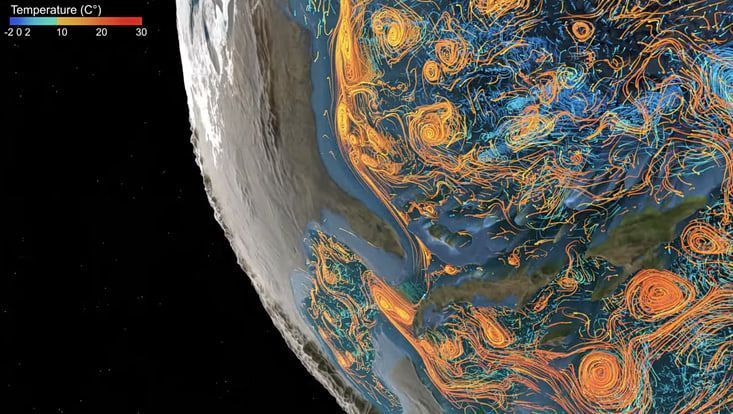
Weaker ocean current could cost trillions
Faculties
💰 Weaker ocean circulation may cost trillions
A new study by @felixschaumann.bsky.social and @edualastrue.bsky.social in @pnas.org reveals that a weakening Atlantic Meridional Overturning Circulation (AMOC) could lead to costs of several trillion euros. #CLICCS #climate #ocean @uni-hamburg.de
25.02.2025 17:03 — 👍 17 🔁 9 💬 0 📌 2
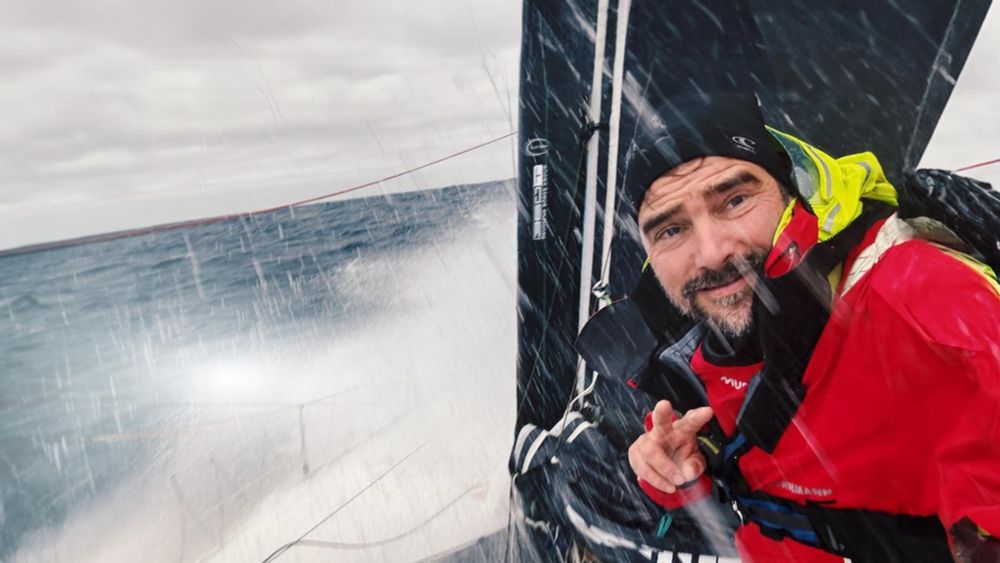
Boris Herrmann - Segeln am Limit: Boris Herrmann - Das Rennen - hier anschauen
In 80 Tagen umrundet Boris Herrmann bei der Vendée Globe den Globus – 45.000 Kilometer nonstop allein auf seinem Segelboot. Er kämpft mit Extremwetter, Blitzeinschlag, Höhenangst und Einsamkeit. Schla...
🌊⛵ In 80 days Boris Herrmann sailed around the world, not just for the sport but also to aid climate research by collecting valuable ocean pCO2 data in remote regions.
🎥 Check out this German documentary focusing on his #ClimateProtection efforts and for which I was also interviewed: bit.ly/4grKcjU
03.02.2025 12:52 — 👍 8 🔁 2 💬 1 📌 0
Hamburg sailor Boris Herrmann crossed the finish line of Vendée Globe. Howling winds and roaring waves was not the only challenge on the way. As in the previous races, his sailboat has been collecting precious CO2 data.
This matters for improving our understanding of the ocean carbon sink! 🧵
🌊🧪
30.01.2025 10:50 — 👍 13 🔁 2 💬 1 📌 0

🌊 Ready to make a big splash, TRICUSO wrapped up its kick-off in Southampton this week having set groundwork for a 4 year journey to develop technology & methods to address the #Carbon #Sink Status of the #Southern #Ocean in support of the #WMO Global Greenhouse Gas Watch. #Climate #research
10.01.2025 10:22 — 👍 11 🔁 2 💬 0 📌 0
Introducing our new project - TRICUSO - Three Research Infrastructures Carbon Uptake Southern Ocean. We aim to integrate effort from surface CO2 observations within ICOS, deep observations from GOSHIP and Argo as a contribution to the WMO Global Greenhouse Gas Watch
@tricuso.bsky.social 🌊
03.01.2025 09:47 — 👍 3 🔁 2 💬 0 📌 0
Session BG1.2
Working on or interested in "Budgets, trends, and drivers of major Greenhouse Gases in the atmosphere, on land, and in the ocean from regional to global scales"?
Please consider submitting to our session at EGU25 (meetingorganizer.copernicus.org/EGU25/sessio...).
See you soon 🌊
06.01.2025 07:49 — 👍 2 🔁 4 💬 1 📌 1

Book Review: Blue Machine by Helen Czerski
The engine that is Earth’s ocean takes sunlight and converts it into giant underwater currents and waterfalls, hauling around the ingredients for life: nutrients, oxygen and trace metals like potassiu...
🌊 Ocean book review on the EGU #OceanSciences blog 🌊
I have read and reviewed "Blue Machine" by @helenczerski.bsky.social, and I highly recommend it. (Btw, it's perfect as a Christmas gift!) Any book recommendations for us to explore next? 📚💙
blogs.egu.eu/divisions/os...
13.12.2024 17:52 — 👍 6 🔁 2 💬 0 📌 0
The ocean was unusually hot in 2023 👇
We found that this caused an unexpected decline of the ocean carbon sink, primarily driven by anomalous outgassing of CO₂ in the northern hemisphere extratropics.
▶️ doi.org/10.21203/rs....
Feedback on our preprint is more than welcome!
🌊
12.12.2024 12:56 — 👍 60 🔁 30 💬 2 📌 2
Oceanographer, climate scientist, programmer, digital artist, from Bretagne, France, Europe, Boston, Massachusetts, USA, MIT
https://gaelforget.net
https://github.com/gaelforget
https://mastodon.mit.edu/@gaelforget
🌊 Oceanographer interested in Operational Oceanography, Ocean Heat Storage and #climate. Views are my own. @ieo-oceanografia.bsky.social @csic.es
GEORGE is a Horizon Europe-funded project that develops novel technologies to improve ocean observations. http://george-project.eu
The GO-BGC Array is a global robotic network of profiling floats carrying sensors that will revolutionize our understanding of ocean and ecosystem health.
https://www.go-bgc.org/
Account representing the Canadian contribution to the global Argo profiling float program. Maintained by @clarkgrichards.bsky.social
The leading European #OceanObserving network of oceanographic institutes and research organizations, operating within IOC Unesco and the Global Ocean Observing System, striving for #EOOS
https://eurogoos.eu/
Physical oceanographer, father, musician, cyclist. Coauthor of the R oce and argoFloats packages. Arctic Ocean change and processes, autonomous systems, and open software. Opinions are my own. he/him
clarkrichards.org
Oceanographer, founder of Tini Scientific. She/her 🏳️🌈. My goal in life was to throw expensive s**t in the ocean.
Then I did it and became a world expert on ocean sensors.
IMOS operates a wide range of observing equipment throughout Australia’s vast and valuable coastal and open ocean estate.
IMOS is enabled by the National Collaborative Research Infrastructure Strategy (NCRIS).
Bsky archive of Official Horizon EU profile for the EU's Research & Innovation Programme.
europa.eu/!Xf47NRP
check out also @creativeeurope.bsky.social and @euerasmusplus.bsky.social
atm powered by @gogash.bsky.social
An extension of the Argo program to include biogeochemical observations
https://biogeochemical-argo.org/
Chemical Oceanographer @ Flanders Marine Institute (VLIZ) 🌊👩🔬 | AI for the Ocean | Outdoors & science communication enthusiast 🌋 (she/her)
Oceanographer interested in the ocean circulation, mixing and the ocean carbon sink. Also likes hiking, rock climbing, and playing guitar.
https://www.socat.info
Posts are for information and are not endorsements.
Ocean Sciences division of the European Geosciences Union (EGU)
https://blogs.egu.eu/divisions/os/
Climate scientist & oceanographer. @royalsociety.org Professor @uniofeastanglia.bsky.social . Member @thecccuk.bsky.social #carbonbudget author.
A Luxemburger in Laxenburg | Researcher at the International Institute for Applied Systems Analysis and PhD Student at Humboldt University of Berlin | Views are my own
Join us in uniting global research communities to tackle environmental challenges and drive sustainability.
Keep up to date with the latest research and news from our journals.🌿https://ioppublishing.org/publications/environmental-research-series #ERL
PhD candidate at the Max Planck Institute for Meteorology / @uni-hamburg.de. Interested in the impacts of climate change and extremes on society, especially agriculture.