New paper out today - Microplastic fibers, not bulkier shapes, disrupt soil carbon cycling, cutting CO₂ emissions ~25%. Grateful for the collaboration with lead author Serra-Willow Buchanan and Marie Sauvadet, Ryan Prosser and Kari Dunfield.
doi.org/10.1093/etoj...
06.10.2025 22:10 — 👍 1 🔁 0 💬 0 📌 0

Illustration of a simple allelopathy model that considers the ith individual of an invasive species and the jth individual of a native competitor, such as the North American invasive plant Alliaria petiolata (garlic mustard), shown on the left, and the native Acer saccharum (sugar maple), on the right.
#Viewpoint: A critical reassessment of the novel weapons hypothesis and allelopathy as an adaptive strategy that facilitates #PlantInvasion
Robert Colautti & Pedro Madeira Antunes
👇
📖 nph.onlinelibrary.wiley.com/doi/10.1111/...
#LatestIssue #PlantScience
22.09.2025 04:19 — 👍 7 🔁 4 💬 0 📌 0

Experimental approaches and key outcomes supporting the Allelopathy Postulates relevant to competitive interactions and the novel weapons hypothesis (NWH). Numbers in red correspond to the 11 postulates summarized in Table 1. The full experimental framework comprises five sequential steps: (a) assess the natural concentrations of a potential allelopathic compound; (b) demonstrate its ability to suppress native vegetation; releasing resources that enhance growth and reproduction of the invader (e.g. light, nutrients, water); (c) confirm that the compound has limited autotoxicity to the invading species; (d) investigate the biogeographical basis of the allelopathic compound as a ‘novel weapon’ by demonstrating that native communities coevolving with the invader in its home range are significantly more resistant to the allelopathic compound compared to those in the introduced (away) range; (e) confirm that genotypes producing higher concentrations of the allelopathic compounds experience a fitness cost in the context of intraspecific competition but gain a fitness advantage under interspecific competition. Investigating the role of soil-mediated interactions (11) is transversal across different components of the framework
Now published in @newphyt.bsky.social, @1pantunes.bsky.social and I review evidence for the "Novel Weapons Hypothesis" and the role of allelopathy during invasion. Bottom line: there is very good reason to be skeptical.
dx.doi.org/10.1111/nph....
18.09.2025 20:20 — 👍 10 🔁 9 💬 1 📌 0
Nice photo and this is fantastic. Congrats César and Nancy!
05.09.2025 21:20 — 👍 1 🔁 0 💬 0 📌 0
The many hours I spent idealizing and drawing this diagram for this review paper are condensed into 25 seconds here. nph.onlinelibrary.wiley.com/doi/10.1111/...
27.08.2025 03:01 — 👍 2 🔁 0 💬 1 📌 0
The many hours spent idealizing and drawing this diagram for this review paper are condensed into 25 seconds here. nph.onlinelibrary.wiley.com/doi/10.1111/...
27.08.2025 03:00 — 👍 1 🔁 0 💬 0 📌 0
In organisms like mycorrhizal fungi, fluid mechanics may be unique as it may extend across Kingdoms of life, between plants & fungi. Who knows if what we learn from these organisms can help us build more efficient pipelines and other human-made fluid transport systems…
26.08.2025 11:11 — 👍 0 🔁 0 💬 0 📌 0
I hope this work sparks new trait-based research that contributes to our understanding of how vascular systems can function and evolve.
26.08.2025 11:11 — 👍 0 🔁 0 💬 1 📌 0
Why does this matter? Because flow through mycorrhizal networks influences:
How plants share or compete for resources
How ecosystems respond to stress and store C
The balance between cooperation and competition in mycorrhizal symbioses and plants
26.08.2025 11:11 — 👍 0 🔁 0 💬 1 📌 0
Linking biology, ecology and physics (Fluid mechanics) gives us traits to measure mycorrhizal network transport efficiency, resilience, and trade-offs in ways biology alone couldn’t.
26.08.2025 11:11 — 👍 0 🔁 0 💬 1 📌 0

Mycorrhizal fungi form networks that connect plants and contribute to shaping plant diversity and ecosystem functioning.
These networks function like a vascular system, but we’ve barely scratched the surface of understanding how they work.
26.08.2025 11:11 — 👍 0 🔁 0 💬 1 📌 0
Thanks James Franklin, @1pantunes.bsky.social and Brian Lanoil for a great collaboration!
22.08.2025 18:11 — 👍 0 🔁 1 💬 1 📌 0

ICOM 2026
Visit the post for more.
If you belong to an organization committed to biodiversity and the environment, consider sponsoring the International Conference on Mycorrhiza. More than an excellent program, the organizers have an impressive sustainability strategy. See sponsor packages: icom2026.org#goto-sponsor
07.08.2025 00:37 — 👍 5 🔁 1 💬 0 📌 0
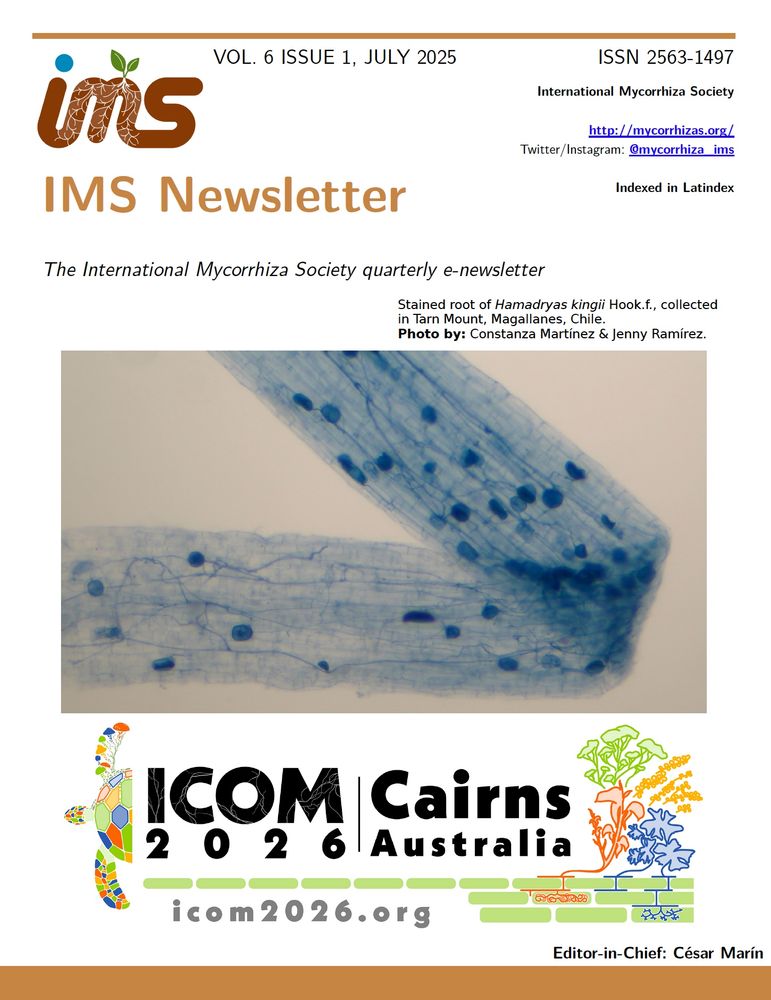
Our new newsletter is now published!
Dig into the latest updates on IMS’s 20th anniversary, ICOM2026 preparations, our new website & logo, top 10 research papers, and upcoming events. Read more at mycorrhizas.org/news. Stay connected! #Mycorrhiza
23.07.2025 19:17 — 👍 6 🔁 5 💬 0 📌 1
Why this matters:
Previous research has primarily focused on how periwinkle suppresses native plants.
Our study reveals that its impact extends below ground, affecting soil invertebrates, which influence decomposition rates and nutrient cycling, potentially affecting the overall forest health.
30.07.2025 17:52 — 👍 3 🔁 0 💬 0 📌 0
The study provides the first piece of evidence that invasion by Common Periwinkle (Vinca minor), an ornamental that people love to put in their gardens but escapes into natural forests, significantly alters soil invertebrate communities in invaded habitats.
30.07.2025 17:52 — 👍 1 🔁 0 💬 1 📌 0

Very happy to announce the very first M.Sc. in Biology thesis defence @algomau.bsky.social . This moment marks a transformative milestone in scientific research, placing our school on the map as a rising hub for advanced knowledge and discovery.
30.07.2025 02:30 — 👍 0 🔁 0 💬 0 📌 0

The takeaway? The NWH needs stronger, more reproducible evidence to move beyond being a metaphor.
30.07.2025 01:47 — 👍 0 🔁 0 💬 0 📌 0

We introduce 11 "Allelopathy Postulates" (like Koch’s postulates in disease ecology) to rigorously test allelopathy as a causal, adaptive strategy. Most published studies don’t pass even half of them.
30.07.2025 01:47 — 👍 0 🔁 0 💬 1 📌 0
- Only 1 (Honor et al. 2025) tested the key trade-off predicted by NWH that allelochemicals help in interspecific but not in intraspecific competition, finding no support
- Most ignored field validation
- Many used extracts, not isolated compounds
30.07.2025 01:47 — 👍 0 🔁 0 💬 1 📌 0
Most published NWH studies fail to meet these criteria. In a systematic review of 41 empirical studies, we found 👇:
30.07.2025 01:47 — 👍 0 🔁 0 💬 1 📌 0

We propose a simple eco-evolutionary model showing that for allelopathy to be adaptive:
✅ It must suppress competitors
✅ Increase invader fitness
✅ Have low autotoxicity
✅ Be cost-effective energetically
30.07.2025 01:47 — 👍 0 🔁 0 💬 1 📌 0
We revisit Harper’s 1975 critiques: Allelopathy studies often rely on lab assays with unrealistic doses, ignore alternative explanations (e.g. pathogens, nutrient shifts), and rarely test for actual fitness benefits.
30.07.2025 01:47 — 👍 0 🔁 0 💬 1 📌 0
Garlic mustard (Alliaria petiolata) was long seen as a poster child for NWH, supposedly suppressing mycorrhizal fungi. But recent field studies challenge this narrative—little to no suppression observed.
30.07.2025 01:47 — 👍 0 🔁 0 💬 1 📌 0
Professor, scientist, mom. Chaser of wildfires and permafrost thaw. I love bogs and want you to join me.
lover of microbes, biocrusts, plants, soils, and our atmosphere. believer in diversity, equity, and the awesomeness of science. opinions my own. she/her/ella
Father, photographer, occasional climber, plant biologist at MIT. Not the geochemist.
Plant biologist interested in photoreceptor signalling and the design of optogenetic tools
father of 3, nature lover, sailor, Homo faber. Prof at Imperial College London, for a little while yet.
Research Fellow at @biology.ox.ac.uk interested in the evolution of plants and algae
ARC DECRA Fellow | Biogeochemist | Senior researcher investigating the role of tree stems and their microbial communities within the global climate cycles. #Treethane #Methane #Wetlands #Carbon #Forests 🌱
Plant Diversity Professor, Department of Biological Sciences, UCalgary, jvamosi.wordpress.com | she/her
Perennial plant diversity, evolution, agriculture, conservation. Danforth Plant Science Center, Saint Louis University, MO Botanical Garden. She/her.
Promoting SciComm, teaching, equity & inclusion in plant biology. #PlantScience
PI NSF RCN: ROOT&SHOOT. https://rootandshoot.org/
Features Editor ThePlantCell, PlantPhysiology
@PlantTeaching@genomic.social
https://linktr.ee/PlantTeaching 🏴
Professor, Ecosystem Modelling, Hawkesbury Institute for the Environment, Western Sydney U. Ecophysiologist and #DeadTreeDetective
UKRI Future Leaders Fellow at the Lancaster Environment Centre (Lancaster University, UK) studying C2 photosynthesis and photosynthetic diversity. 🇺🇸 in 🇬🇧
http://wp.lancs.ac.uk/lundgrenlab/
Peer-reviewed journal publishing innovative research at the interface between plants, society, and the planet.
The home of Kew Science 👩🔬
🌱Collections
📚Archives
🍄Applied research
🤝Partnerships
🥼Training
👉More: linktr.ee/kewscience
One of the largest university-owned botanic gardens in the world, CUBG's diverse collection of 8,000+ plant species supports leading scientific research. Welcoming 350,000+ visitors annually, it also inspires a love of plants, learning & horticulture.
Conservation physiologist | Assistant Professor at Algoma University | Mom | She/her
President-Elect, Botanical Society of America.
#PUI Prof + Herbarium Director at Bucknell.
#FirstGen college.
Sexual systems evolution, conservation, taxonomy.
"Plants are Cool, Too!": https://tinyurl.com/mr3nv85w
#iamabotanist #Botany2026 #botany
Scientific society tweeting for interested audiences in #mycorrhizal #symbiosis. Retweets for informational purposes and not necessarily reflecting IMS members.
Systems Ecology Ph.D. Interested in plant-fungi / fungi-beetle 🌲🍄🟫🪲symbioses in forest ecosystems.