Black-and-white historical photograph of Marie Skłodowska-Curie in a laboratory, holding a glass flask and observing an experiment. Overlaid text reads: “30 years of Marie Skłodowska-Curie Actions (MSCA)”, with the European Commission logo in the bottom left corner.
Europe’s future is built on knowledge.
For 30 years, the Marie Skłodowska-Curie Actions (MSCA) has supported over 150,000 researchers, including 23 Nobel Prize winners.
This programme is built on curiosity, openness and excellence.
Happy birthday MSCA!
31.01.2026 08:29 — 👍 237 🔁 49 💬 4 📌 4
Neural replay is connected to latent cause inference and supports fast generalization https://www.biorxiv.org/content/10.64898/2025.12.12.693963v1
13.12.2025 10:17 — 👍 10 🔁 4 💬 0 📌 0

Bridging Fields in Psychology and Neuroscience with Multidisciplinary Collaboration
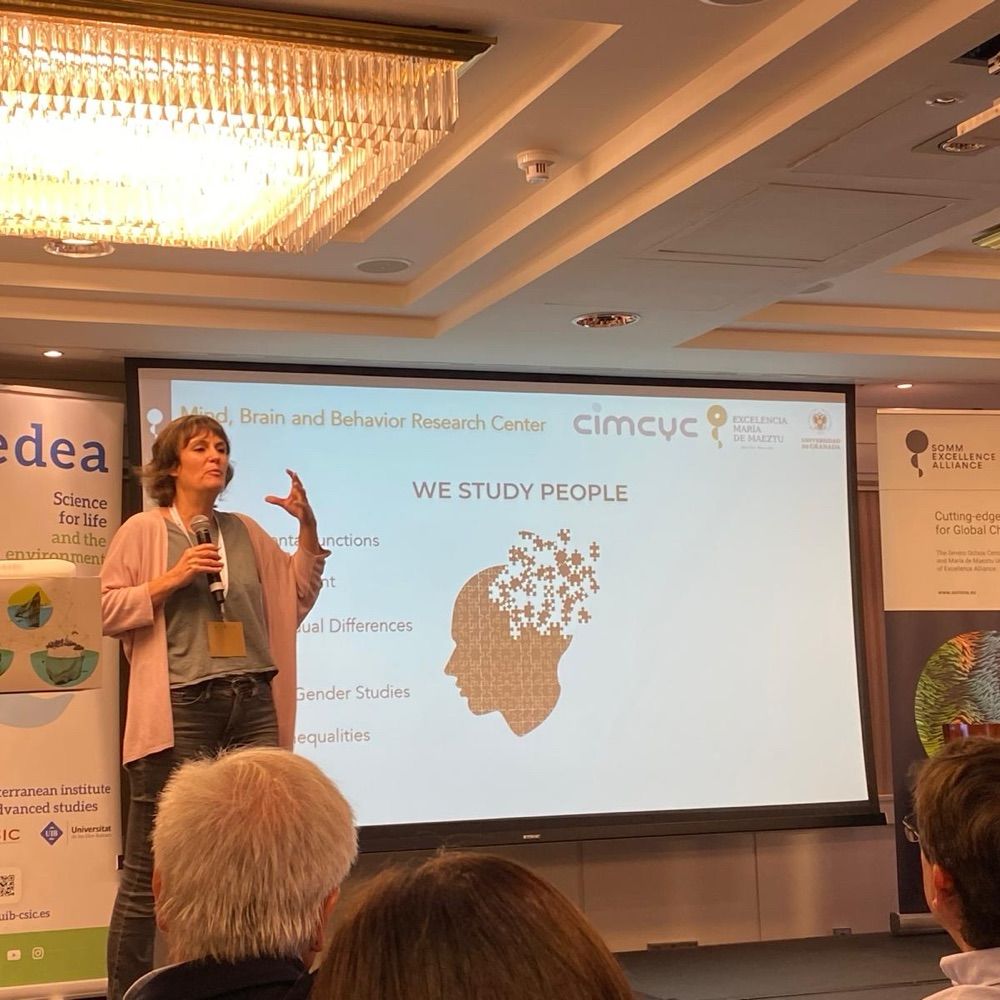
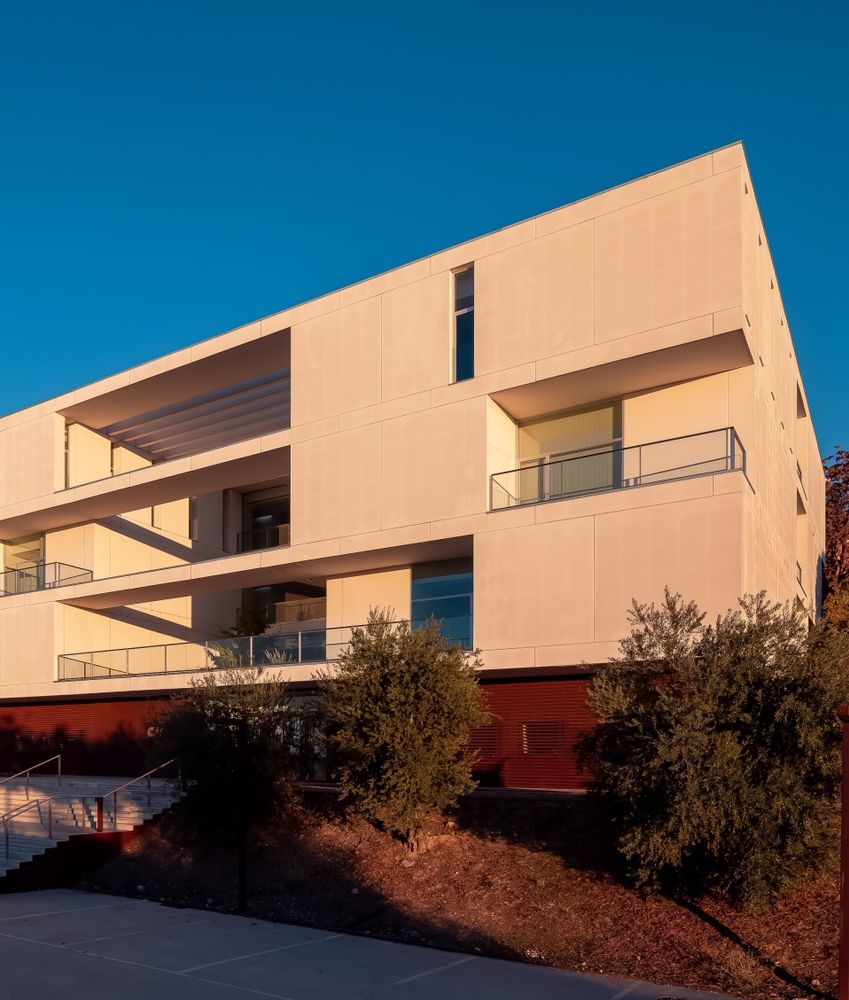
Strengthening collaboration to encourage novel research connections between scientific areas is central to the CIMCYC - María de Maeztu Unit of Excellence strategy . To encourage this, the CIMCYC has ...
Interdisciplinary collaboration is essential for addressing complex scientific challenges, resulting in novel approaches, innovative methodologies and a more holistic understanding of complex phenomena.
🔹To encourage this, the CIMCYC has launched six novel multidisciplinary collaborative projects.
09.12.2025 14:08 — 👍 4 🔁 4 💬 1 📌 2

**How distributed is the brain-wide network that is recruited
for cognition?**
That goes to the top of the list!
#neuroskyence
doi.org/10.1038/s415...
05.12.2025 18:50 — 👍 172 🔁 43 💬 6 📌 2

Rapid computation of high-level visual surprise
Health sciences
High-level visual surprise is rapidly integrated during perceptual inference!
🚨 New paper 🚨 out now in @cp-iscience.bsky.social with @paulapena.bsky.social and @mruz.bsky.social
www.cell.com/iscience/ful...
Summary 🧵 below 👇
05.12.2025 14:37 — 👍 34 🔁 17 💬 2 📌 0

Contents of visual predictions oscillate at alpha frequencies
Predictions of future events have a major impact on how we process sensory signals. However, it remains unclear how the brain keeps predictions online in anticipation of future inputs. Here, we combin...
@dotproduct.bsky.social's first first author paper is finally out in @sfnjournals.bsky.social! Her findings show that content-specific predictions fluctuate with alpha frequencies, suggesting a more specific role for alpha oscillations than we may have thought. With @jhaarsma.bsky.social. 🧠🟦 🧠🤖
21.10.2025 11:05 — 👍 112 🔁 44 💬 7 📌 3

A table showing profit margins of major publishers. A snippet of text related to this table is below.
1. The four-fold drain
1.1 Money
Currently, academic publishing is dominated by profit-oriented, multinational companies for
whom scientific knowledge is a commodity to be sold back to the academic community who
created it. The dominant four are Elsevier, Springer Nature, Wiley and Taylor & Francis,
which collectively generated over US$7.1 billion in revenue from journal publishing in 2024
alone, and over US$12 billion in profits between 2019 and 2024 (Table 1A). Their profit
margins have always been over 30% in the last five years, and for the largest publisher
(Elsevier) always over 37%.
Against many comparators, across many sectors, scientific publishing is one of the most
consistently profitable industries (Table S1). These financial arrangements make a substantial
difference to science budgets. In 2024, 46% of Elsevier revenues and 53% of Taylor &
Francis revenues were generated in North America, meaning that North American
researchers were charged over US$2.27 billion by just two for-profit publishers. The
Canadian research councils and the US National Science Foundation were allocated US$9.3
billion in that year.

A figure detailing the drain on researcher time.
1. The four-fold drain
1.2 Time
The number of papers published each year is growing faster than the scientific workforce,
with the number of papers per researcher almost doubling between 1996 and 2022 (Figure
1A). This reflects the fact that publishers’ commercial desire to publish (sell) more material
has aligned well with the competitive prestige culture in which publications help secure jobs,
grants, promotions, and awards. To the extent that this growth is driven by a pressure for
profit, rather than scholarly imperatives, it distorts the way researchers spend their time.
The publishing system depends on unpaid reviewer labour, estimated to be over 130 million
unpaid hours annually in 2020 alone (9). Researchers have complained about the demands of
peer-review for decades, but the scale of the problem is now worse, with editors reporting
widespread difficulties recruiting reviewers. The growth in publications involves not only the
authors’ time, but that of academic editors and reviewers who are dealing with so many
review demands.
Even more seriously, the imperative to produce ever more articles reshapes the nature of
scientific inquiry. Evidence across multiple fields shows that more papers result in
‘ossification’, not new ideas (10). It may seem paradoxical that more papers can slow
progress until one considers how it affects researchers’ time. While rewards remain tied to
volume, prestige, and impact of publications, researchers will be nudged away from riskier,
local, interdisciplinary, and long-term work. The result is a treadmill of constant activity with
limited progress whereas core scholarly practices – such as reading, reflecting and engaging
with others’ contributions – is de-prioritized. What looks like productivity often masks
intellectual exhaustion built on a demoralizing, narrowing scientific vision.

A table of profit margins across industries. The section of text related to this table is below:
1. The four-fold drain
1.1 Money
Currently, academic publishing is dominated by profit-oriented, multinational companies for
whom scientific knowledge is a commodity to be sold back to the academic community who
created it. The dominant four are Elsevier, Springer Nature, Wiley and Taylor & Francis,
which collectively generated over US$7.1 billion in revenue from journal publishing in 2024
alone, and over US$12 billion in profits between 2019 and 2024 (Table 1A). Their profit
margins have always been over 30% in the last five years, and for the largest publisher
(Elsevier) always over 37%.
Against many comparators, across many sectors, scientific publishing is one of the most
consistently profitable industries (Table S1). These financial arrangements make a substantial
difference to science budgets. In 2024, 46% of Elsevier revenues and 53% of Taylor &
Francis revenues were generated in North America, meaning that North American
researchers were charged over US$2.27 billion by just two for-profit publishers. The
Canadian research councils and the US National Science Foundation were allocated US$9.3
billion in that year.

The costs of inaction are plain: wasted public funds, lost researcher time, compromised
scientific integrity and eroded public trust. Today, the system rewards commercial publishers
first, and science second. Without bold action from the funders we risk continuing to pour
resources into a system that prioritizes profit over the advancement of scientific knowledge.
We wrote the Strain on scientific publishing to highlight the problems of time & trust. With a fantastic group of co-authors, we present The Drain of Scientific Publishing:
a 🧵 1/n
Drain: arxiv.org/abs/2511.04820
Strain: direct.mit.edu/qss/article/...
Oligopoly: direct.mit.edu/qss/article/...
11.11.2025 11:52 — 👍 641 🔁 453 💬 8 📌 66
I see this same pattern in psychology—there is a huge desire among early career scholars to do applied work
This is very important, but including basic science perspectives still improves the research quality
08.11.2025 12:25 — 👍 31 🔁 8 💬 1 📌 0
1. This is a thread on freedom, and how easy it is to lose.
Over the past 2,000 years in Europe, there have been few periods and places of freedom. For much of the time we lived under highly oppressive tyrannies of various kinds, whether small or grand, local or imperial, secular or religious.🧵
07.11.2025 06:35 — 👍 1080 🔁 517 💬 29 📌 48
IMAGINE-decoding-challenge
Predict which words participants were hearing, based upon brain activity recordings of visually seeing these items?
How well do classifiers trained on visual activity actually transfer to non-visual reactivation?
#Decoding studies often rely on training in one (visual) condition and applying it to another (e.g. rest-reactivation). However: How well does this work? Show us what makes it work and win up to 1000$!
24.10.2025 06:55 — 👍 32 🔁 14 💬 3 📌 3

Large Language Muddle | The Editors
The AI upheaval is unique in its ability to metabolize any number of dread-inducing transformations. The university is becoming more corporate, more politically oppressive, and all but hostile to the ...
YES! THIS on GenAI!
Please read this absolutely splendid piece of writing that had me cheering, a little bit weepy, and writing in the margins:
"An extraordinary amount of money is spent by the AI industry to ensure that acquiescence is the only plausible response. But marketing is not destiny."
29.09.2025 19:07 — 👍 1186 🔁 516 💬 21 📌 54

The CIMCYC is recruiting a #postdoctoral researcher with experience in the field of the psychology of disinformation!
Job description, responsibilities, and desired experience and training at the link 👇
cimcyc.ugr.es/en/informati...
09.09.2025 11:28 — 👍 8 🔁 6 💬 1 📌 1
Neural Subspaces Encode Sequential Working Memory, but Neural Sequences Do Not https://www.biorxiv.org/content/10.1101/2025.09.05.674385v1
06.09.2025 07:15 — 👍 12 🔁 3 💬 0 📌 0
🚀Excited to share our project: Canonical Representational Mapping for Cognitive Neuroscience. @schottdorflab.bsky.social and I propose a novel multivariate method to isolate neural representations aligned with specific cognitive hypotheses 🧵https://www.biorxiv.org/content/10.1101/2025.09.01.673485v1
05.09.2025 16:18 — 👍 78 🔁 30 💬 1 📌 2
Launched in 2023, Imaging Neuroscience is now firmly established, with full indexing (PubMed, etc.) and 700 papers to date.
We're very happy to announce that we are able to reduce the APC to $1400.
Huge thanks to all authors, reviewers, editorial team+board, and MIT Press.
05.09.2025 02:59 — 👍 233 🔁 80 💬 2 📌 6
🚨We believe this is a major step forward in how we study hippocampus function in healthy humans.
Using novel behavioral tasks, fMRI, RL & RNN modeling, and transcranial ultrasound stimulation (TUS), we demonstrate the causal role of hippocampus in relational structure learning.
28.08.2025 14:00 — 👍 130 🔁 47 💬 2 📌 6
OSF
(link fixed) New theory: Categorization is Baked Into the Brain
It is not at the end of sensory processing but a core computation that begins at the earliest stages, occurring throughout the cortex as predictive feedback shapes feedforward processing. #neuroscience
doi.org/10.31234/osf...
25.08.2025 12:18 — 👍 68 🔁 21 💬 7 📌 1

Expression of Interest in Serving as a PsyArXiv Moderator
As you might have heard, PsyArXiv is having some issues with an increase in low-quality submissions, ranging from AI generated manuscripts to inflate citation metrics, incoherent or nonsensical docume...
PsyArXiv is seeking new moderators to help combat an increase in AI submissions! If you've ever posted a preprint to PsyArXiv, please consider joining. Minimum commitment 1h/month, there's a training session this Monday @ 1pm ET. More info here: forms.gle/9LB1rEtxHAeZ... #PsychSciSky
15.08.2025 17:31 — 👍 74 🔁 91 💬 0 📌 14
🧠New preprint!
We show that different priorities shape the neural coding of planned actions in working memory. Using EEG+RSA, we find that expected interference leads to anticipatory changes in representational geometry, beyond simple maintenance.
📄 doi.org/10.1101/2025...
🗂️ Data/code: osf.io/5fg7a
24.07.2025 07:20 — 👍 15 🔁 7 💬 1 📌 2
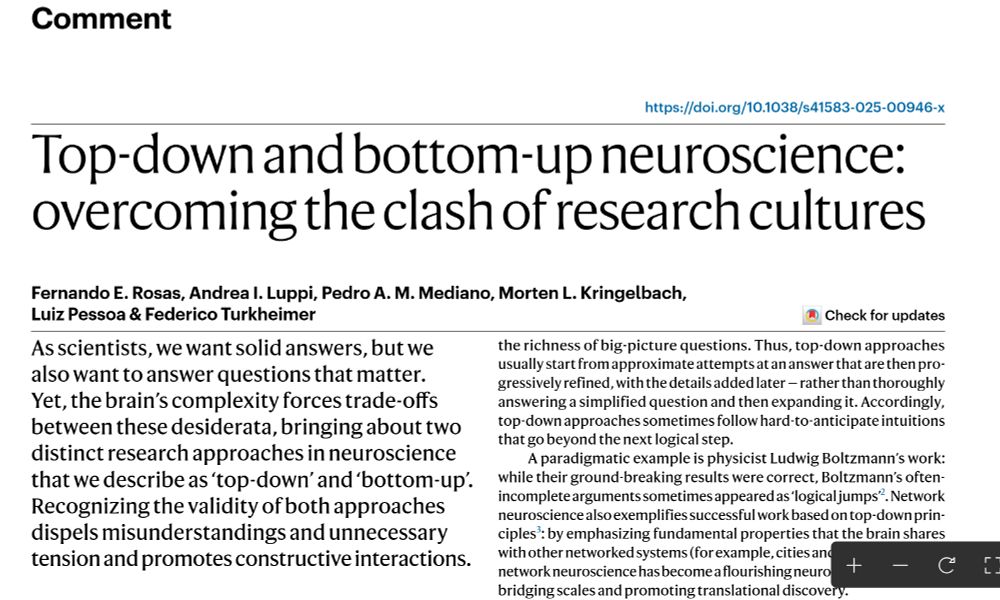
“Top-down and bottom-up neuroscience: overcoming the clash of research cultures”
doi.org/10.1038/s415...
Small contribution in this piece by @frosas.bsky.social and colleagues on how we need both types of research culture in neuroscience.
#neuroskyence
22.07.2025 15:59 — 👍 64 🔁 21 💬 0 📌 1
Postdoc Position – FLARE Project
🚨 We’re hiring a postdoc!
Join the FLARE project @cimcyc.bsky.social to study sudden perceptual learning using fMRI, RSA, and DNNs.
🧠 2 years, fully funded, flexible start
More info 👉 gonzalezgarcia.github.io/postdoc/
DMs or emails welcome! Please share!
18.07.2025 11:17 — 👍 22 🔁 22 💬 1 📌 3
Programming in psychological science
A practical introduction
🧠💻 We (a bunch of colleagues at @cimcyc.bsky.social) just released a programming guide for psych & cog neuro students. Instead of a tutorial, this is a starting point: a collection of reflections, examples, and recommendations.
👉 Still growing, but ready to explore: wobc.github.io/programming_book/
16.07.2025 14:21 — 👍 43 🔁 28 💬 2 📌 3
Associate prof of psychology Vanderbilt Univ, studies how adults and children learn true and false information, she/her, lkfazio.com
Getting started in research 💡
Ramón y Cajal researcher on Cognitive Neuroscience at Universitat Autònoma de Barcelona (Spain). Researcher delving into multisensory perception, prediction, and decision-making. Leading a new research group. 🧠🔍 #Prediction #Cognition #Neuroscience
Postdoc
PhD Cognitive Neuroscience
Exploring how the brain uses specialized knowledge in domain-general cognition.
NeuroSPACE unites 4 labs led by @hansopdebeeck.bsky.social, @bertdesmedt.bsky.social, @kobedesender.bsky.social & @neuropsylab.bsky.social.
🌐 ppw.kuleuven.be/neurospace
Assistant Professor of Neuroscience at
the University of Würzburg, interested in #neuroscience #learning #decisionmaking #mentalhealth
I am ✨ Science & Fiction ✨ a #scicomm project created by @helenahartmann.com. Fictional short stories that explain the science behind them.
New story monthly.
🇬🇧 www.scienceandfiction.net
🇩🇪 www.scienceandfiction.net/de
#ScienceandFiction #wisskomm
Staff software engineer. AWS/CDK/TypeScript.
Interests: Pink Floyd, Star Trek, coding, biking, VR, cats. Not necessarily in this order.
@anydoubts.bsky.social is my better half.
Assistant Professor at the Cajal Neuroscience Center studying the physiological mechanisms underlying action learning, performance and motor dysfunction.
Historian @ruhistorydept.bsky.social
PhD student in Cognitive Neuropsychology @ LMU Munich
Neuroscientist interested in building blocks of adaptive behaviour
Assistant Professor-www.birmingham.ac.uk
PhD candidate. Cognitive neuroscience at the University of Granada @cimcyc.bsky.social #CognitiveControl #Preparation #ProactiveControl #reward #EEG #mvpa
https://orcid.org/0000-0002-6167-9761
We're a neuroscience blog trying to make neuroscience accessible for everyone! Check it out here: https://neurofrontiers.blog
We are international network of researchers, aiming to make a step towards understanding replicability of findings from EEG research
https://www.eegmanylabs.org/
The Consensus Project bridges research and practice to help teams, organizations, and networks—across sectors—navigate the complexity of collaboration.
ML Engineer trying to do neuroscience
A career network featuring science jobs in academia and industry.
Visit our platform at www.science.hr
🎓 PhD student at Cognition & Brain Plasticity Unit (University of Barcelona) | https://www.ub.edu/brainvitge/member/4983/
🎹 Pianist - Classical & contemporary music