Data now in up 5th Feb 2026 and upwelling has returned with a vengeance! The thermocline is now close to the surface and we are hearing reports of surface waters as low as 16 degrees C in some parts of the Gulf.
Is this the strongest upwelling ever recorded? Interesting after last year's failure!
13.02.2026 13:39 — 👍 7 🔁 0 💬 0 📌 0
Our latest piece, just out
12.02.2026 03:32 — 👍 18 🔁 4 💬 1 📌 0

New data in! Now up to the 20th January. 2026 seems to be following a more normal trajectory than 2025, but it's too early to say for sure
29.01.2026 19:25 — 👍 2 🔁 0 💬 1 📌 0

We are closely tracking the 2026 upwelling season in collaboration with STRI's Marine Monitoring Program.
I will present periodic updates on how the thermocline is evolving through the year. So far, too early to say!
More info on data collection and analysis here: odealab.com/upwelling-up...
24.01.2026 15:51 — 👍 1 🔁 0 💬 1 📌 0

New paper out today! "Fossil otolith assemblages reveal millennial-scale changes in reef fish biomass and trophic structure across the Isthmus of Panama"
🔓https://doi.org/10.1098/rstb.2024.0419
We used fossil fish otoliths to reconstruct community structure and energetics over millennia.
22.01.2026 21:16 — 👍 28 🔁 17 💬 1 📌 1
That's the one. Thanks a lot!
17.01.2026 04:47 — 👍 1 🔁 0 💬 0 📌 0
In 2025 the normally predictable upwelling in the Gulf of Panama failed to appear - the first time since our records began 40 years ago (www.pnas.org/doi/10.1073/pnas.2512056122I).
We are studying the gulf carefully to see what will happen in 2026. Will it also fail or was 2025 a one-off?
15.01.2026 15:14 — 👍 15 🔁 2 💬 2 📌 0

So excited to see this out! Metabarcoding shows fishes shift diets on degraded reefs; growth rates similar, condition diverged → species-specific coping strategies buff.ly/kGkEDpw @mattleray.bsky.social @nancyknowlton.bsky.social @odealab.bsky.social @sbac-manmetuni.bsky.social @stri_panama +others
19.12.2025 14:22 — 👍 13 🔁 6 💬 1 📌 1

This beautiful artwork made by Yun-Kae Kiang for the study illustrates the abundance of lanternfishes and other pelagic animals recovered at the Piña site. Love the cookie-cutter shark - we find a lot of their teeth at the site
16.11.2025 21:01 — 👍 2 🔁 0 💬 0 📌 0

We found that more than 96% of the otoliths recovered from the Piña site belonged to the family Myctophidae - the lanternfishes - demonstrating that the Miocene Caribbean waters were highly productive in contrast to the oligotrophic Caribbean today
16.11.2025 21:01 — 👍 1 🔁 0 💬 1 📌 0

Illustration of new species drawn by Natasha Hinojosa

We named 4 new fishspecies: Chiloconger aflorens, Dasyscopelus inopinatus, Malakichthys schwarzhansi, and Hoplostethus boyae. This one after Brigida de Gracia, Ngäbe fossil fish expert who has contributed greatly to understanding Panama's natural history. Her nickname is Boya, hence the species name
16.11.2025 21:01 — 👍 0 🔁 0 💬 1 📌 0


The site is remarkable for many reasons, but the density of otoliths in the sediments really stands out. They are so abundant they are clearly visible as you walk over the wave-cut platform...
16.11.2025 21:01 — 👍 0 🔁 0 💬 1 📌 0
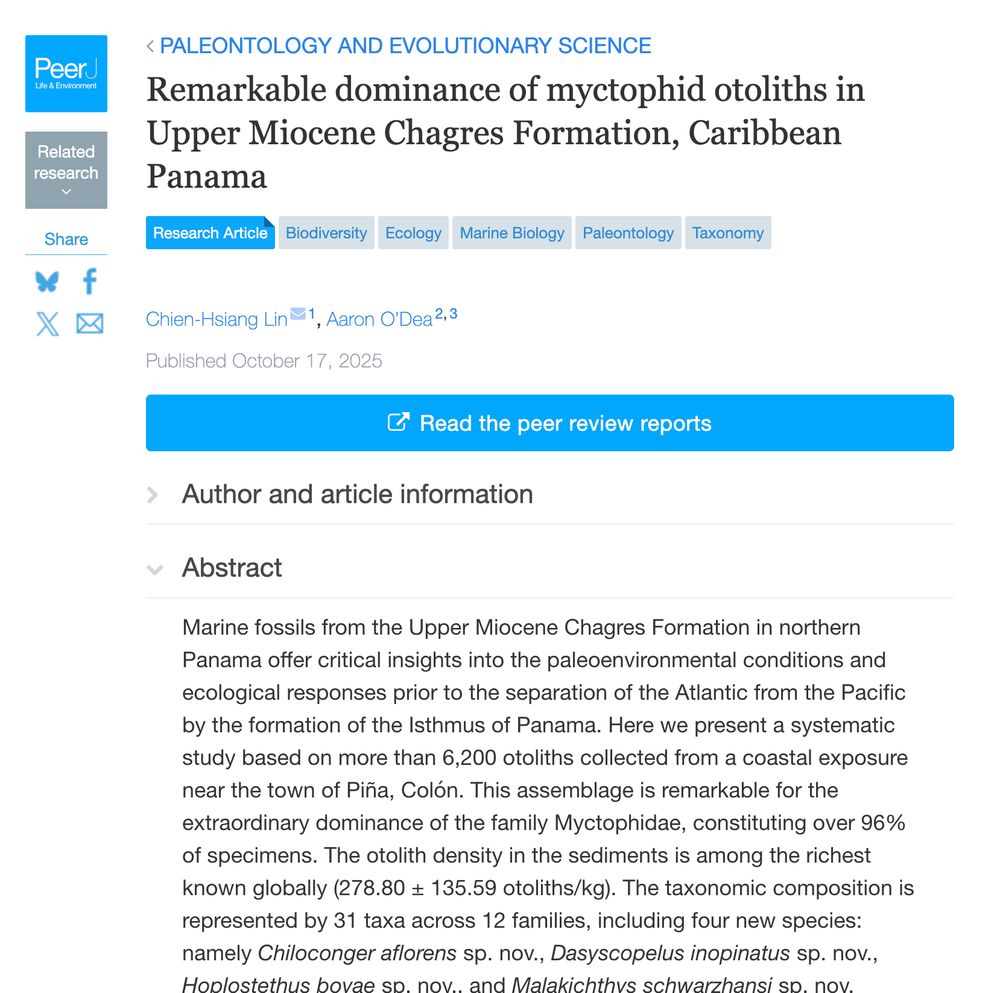
With otolith master Chien-Hsiang Lin, we studied the remarkable fish fauna of the late Miocene Chagres formation in Caribbean Panama peerj.com/articles/201...
16.11.2025 21:01 — 👍 2 🔁 0 💬 1 📌 0
#ICRS is the premier conference for all things coral reef, and a great place to foster thinking and collaboration between ecologists, historical ecologists, and palaeontologists. Consider submitting your abstract to "Reefs through Time", hosted by some top-notch researchers #Coral #Paleobiology
27.09.2025 12:28 — 👍 3 🔁 0 💬 0 📌 0
Identifying the Big Questions in paleontology: a community-driven project | Paleobiology | Cambridge Core
Identifying the Big Questions in paleontology: a community-driven project
In time for #FossilFriday, a new paper by Jansen Smith and many paleontologists (including me) on what questions the field may focus on in the coming decade
Identifying the Big Questions in paleontology: a community-driven project | Paleobiology | Cambridge Core - www.cambridge.org/core/journal...
26.09.2025 21:18 — 👍 12 🔁 6 💬 1 📌 1

Wind-jet upwelling in the GOP. (A) Typical wind vectors and SST through the topographic low in the Isthmus of Panama showing reduced sea surface temperatures in the Gulf (Feb 4, 2019). (B) Daily satellite-derived SST 1985–2025. Dashed line shows the lowest 2025 SST (27.5 °C); gray arrow indicates anomalous 2025.
One of the most-viewed PNAS articles in the last week is “Unprecedented suppression of Panama’s Pacific upwelling in 2025.” Explore the article here: www.pnas.org/doi/10.1073/...
For more trending articles, visit ow.ly/Me2U50SkLRZ.
24.09.2025 18:58 — 👍 12 🔁 7 💬 0 📌 0

Here in the tropics, climate "disruption" can upend predictable processes that coastal communities rely on. There are many regionally-important upwelling zones across the tropics. All need better monitoring and climate predictions. Great collaboration with @mpic.de. OA! www.pnas.org/doi/10.1073/...
02.09.2025 19:20 — 👍 1 🔁 0 💬 0 📌 0

More than 95% biomass of Panama's fisheries comes from the Pacific coast and the #1 largest export of Panama is sea food. Upwelling is economically critical for Panama and its people. Is this a one-off or a vision of the future? Photo: Steve Paton/STRI
02.09.2025 19:20 — 👍 2 🔁 0 💬 1 📌 0

It appears the culprit was dramatically reduced wind patterns—74% fewer northerly winds with much shorter duration when they did occur. Just not enough to kick-start the upwelling...
02.09.2025 19:20 — 👍 1 🔁 0 💬 1 📌 0

We analysed long term records of temperature and wind in collaboration with the Max Planck Institute for Chemistry using the Smithsonian Tropical Research Institute's long term monitoring program data. Here's to institutional monitoring!
02.09.2025 19:20 — 👍 2 🔁 0 💬 1 📌 0


📊 new paper! The natural phenomenon of upwelling, which normally occurs every year in the Gulf of Panama, failed for the first time on record in 2025...
www.pnas.org/doi/10.1073/...
[most co-authors not on bluesky except @javsdiaz.bsky.social @jonscibulski.bsky.social]...
02.09.2025 19:20 — 👍 26 🔁 8 💬 1 📌 1
Just one more week (till 5 Sept) to apply for the postdoc position with me at UA Museums' Department of Museum Research and Collections. NSF-project together with Jill Leonard-Pingel, @odealab.bsky.social, and @sethf.bsky.social focused on marine ecosystems in Panama.
bsky.app/profile/pale...
29.08.2025 12:50 — 👍 9 🔁 7 💬 0 📌 0

#Yourpalaeolife: the experience of early career palaeontologists and fieldwork
Hello everybody!
Welcome to my anonymous survey about fieldwork in palaeontology. I want to know about your experiences: what is the place of fieldwork in our research lives, how to we view it, and h...
Calling all Palaeontology PhD candidates and post-docs everywhere! No matter what your particular field of research or country of institution, please follow forms.gle/cLLkEjdLjPrT... and fill in my ANONYMOUS RESEARCH SURVEY – #Yourpalaeolife : investigating fieldwork by early career palaeontologists
16.08.2025 11:14 — 👍 12 🔁 13 💬 1 📌 0
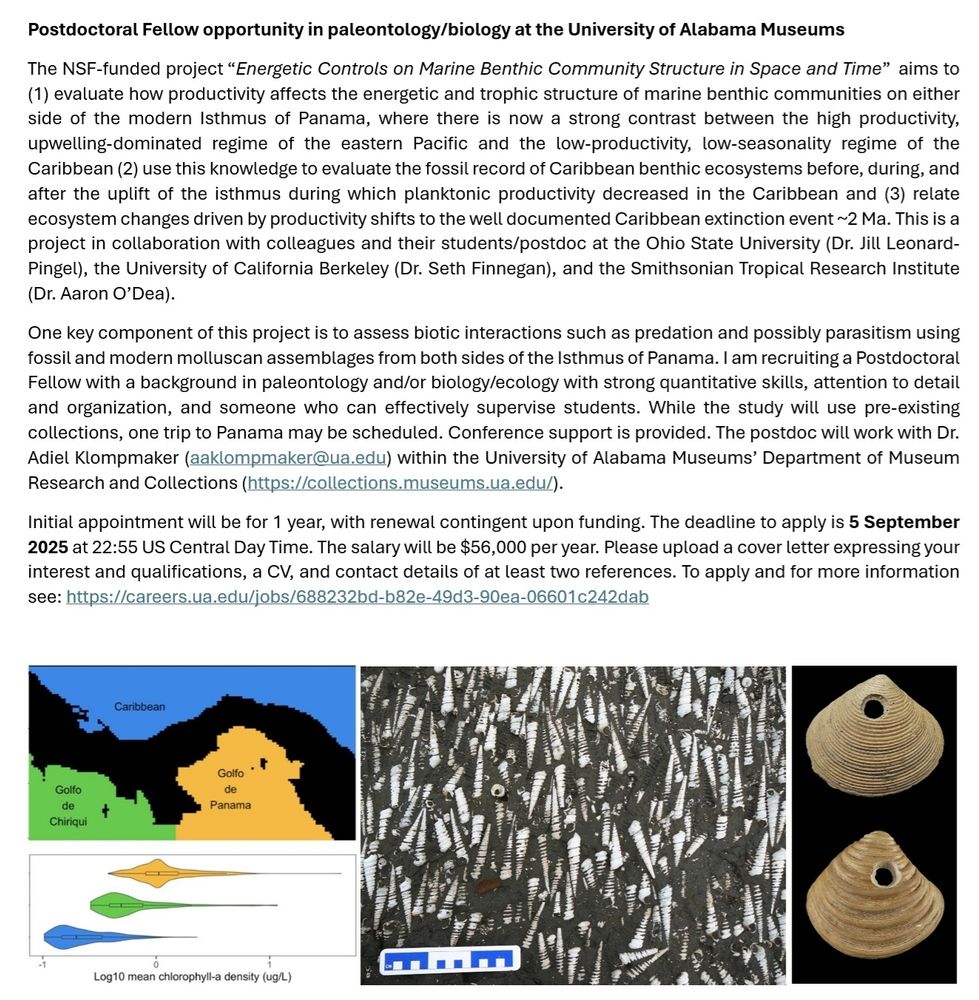
Postdoctoral Fellow opportunity. The NSF-funded project “Energetic Controls on Marine Benthic Community Structure in Space and Time” aims to (1) evaluate how productivity affects the energetic and trophic structure of marine benthic communities on either side of the modern Isthmus of Panama, where there is now a strong contrast between the high productivity, upwelling-dominated regime of the eastern Pacific and the low-productivity, low-seasonality regime of the Caribbean (2) use this knowledge to evaluate the fossil record of Caribbean benthic ecosystems before, during, and after the uplift of the isthmus during which planktonic productivity decreased in the Caribbean and (3) relate ecosystem changes driven by productivity shifts to the well documented Caribbean extinction event ~2 Ma. This is a project in collaboration with Ohio State U, UC Berkeley, and STRI.
One key component of this project is to assess biotic interactions such as predation and possibly parasitism using fossil and modern molluscan assemblages from both sides of the Isthmus of Panama. I am recruiting a Postdoctoral Fellow with a background in paleontology and/or biology/ecology with strong quantitative skills, attention to detail and organization, and someone who can effectively supervise students. Conference support is provided. The postdoc will work with Dr. Adiel Klompmaker (aaklompmaker@ua.edu) within the University of Alabama Museums’ Department of Museum Research and Collections (https://collections.museums.ua.edu/).
Initial appointment will be for 1 year, with renewal contingent upon funding. The deadline to apply is 5 September 2025 at 22:55 US Central Day Time. The salary will be $56,000 per year. Please upload a cover letter expressing your interest and qualifications, a CV, and contact details of at least two references. To apply and for more information see: https://careers.ua.edu/jobs/688232bd-b82e-49d3-90ea-06601c242dab
Job Alert‼️ Postdoctoral Fellow opportunity in paleontology/biology at the University of Alabama Museums:
careers.ua.edu/jobs/688232b... Aim: assess biotic interactions using mollusks from both sides of the Isthmus of Panama. Please share widely! @paleosoc.bsky.social @almnh.bsky.social
08.08.2025 16:21 — 👍 14 🔁 16 💬 1 📌 2
Nature Portfolio’s high-quality products and services across the life, physical, chemical and applied sciences is dedicated to serving the scientific community.
Biogeography is a diamond open access, not-for-profit, peer-reviewed, scientific journal owned by academics, published by the Stanford University Press, and delivered using open-source software by the Public Knowledge Project.
Professor of Palaeobiology at UCL (he/him) | https://profiles.ucl.ac.uk/25923-philip-mannion
PhD candidate studying chemosynthetic symbioses at Harvard University
Prof of Ecology and Evolutionary Biology at University of Michigan, plant curator at MICH, Director of E.S. George Reserve, research on trees, tropical forests; from the Allegheny Front in Pennsylvania
Conservation biologist and behavioural ecologist. Treasurer of Scientists for Labour. Postdoc at @durhamanthropology.bsky.social, DPhil from @biology.ox.ac.uk
Dad • Husband • Cognitive Scientist • Research Lead in Tech • Underwater Photographer • Ocean Conservation • Grieving Cosmopolite • PNW Adventures
Registered veterinary surgeon and Post Graduate Researcher into the biomechanics of Paleocene and Eocene mammals, at the University of Birmingham.
#Yourpalaeolife II survey: https://forms.gle/s5b7WLQLUKxZ4WXM7
She/her
The iMARES (Integrated Marine Ecosystem Assessments) is a marine research group from the @ICMCSIC founded in 2022.
🔗http://imares.science
Sculptor of ridiculously difficult to package porcelain artwork. You’ll see coral, skulls, nudibranchs, moons, mushrooms, lichen and comets, all with complicated textures, some with rainbow colours. Bristol, UK
🏳️🌈🏳️⚧️ally. Free Palestine!
lisaseaurchin.co.uk
A bot by @Climatologist49.bsky.social showing ERA5 maps and charts. It randomly selects one from a folder that is reset every month. DM this account or Climatologist49 for map requests. He will run the script to generate the map/chart.
Paleobiologist/oceanographer; Assistant Scientist at WHOI; Fish teeth and ancient marine ecosystems; circus artist 🌈 She/her
Supporting a diverse journalism ecosystem through stories, trainings and resources.
Archaeology Curator at the Smithsonian Tropical Research Institute | Member SENACYT SNI | Research Associate CIHAC-AIP | BioAnth PhD | #bioarch #paleopath #paleoepi | she/ella
Illustrator/author from Stockholm (Sweden). Extinct animals and dinosaurs in particular are a constant source of inspiration. Debuted with the illustrated non-fiction book about Triassic dinosaurs ‘De första dinosaurierna’ (’The first dinosaurs’) in 2023.
Assistant Professor at the University of Guam.
Coral reef fish. Functional Morphology. Fish Evolution & Ecology
Google Scholar: http://bit.ly/2A7o146
Era @umbrios no finado Twitter. Ambientalista, feminista radical, rpgista, escritora, veterinária, quadrante E -7,38, S: -5.64 do compasso político , redeira, ex-prato feito, limitarianista. Não estou flertando com ninguém, sou bem casada e monogâmica.
Postdoc at University of Michigan
My research focuses on the morphological evolution of living and fossil fishes.
I mainly post about fish and weird things I enjoy
https://emilymtroyer.weebly.com/
Marine ecologist. Currently located in Florida.