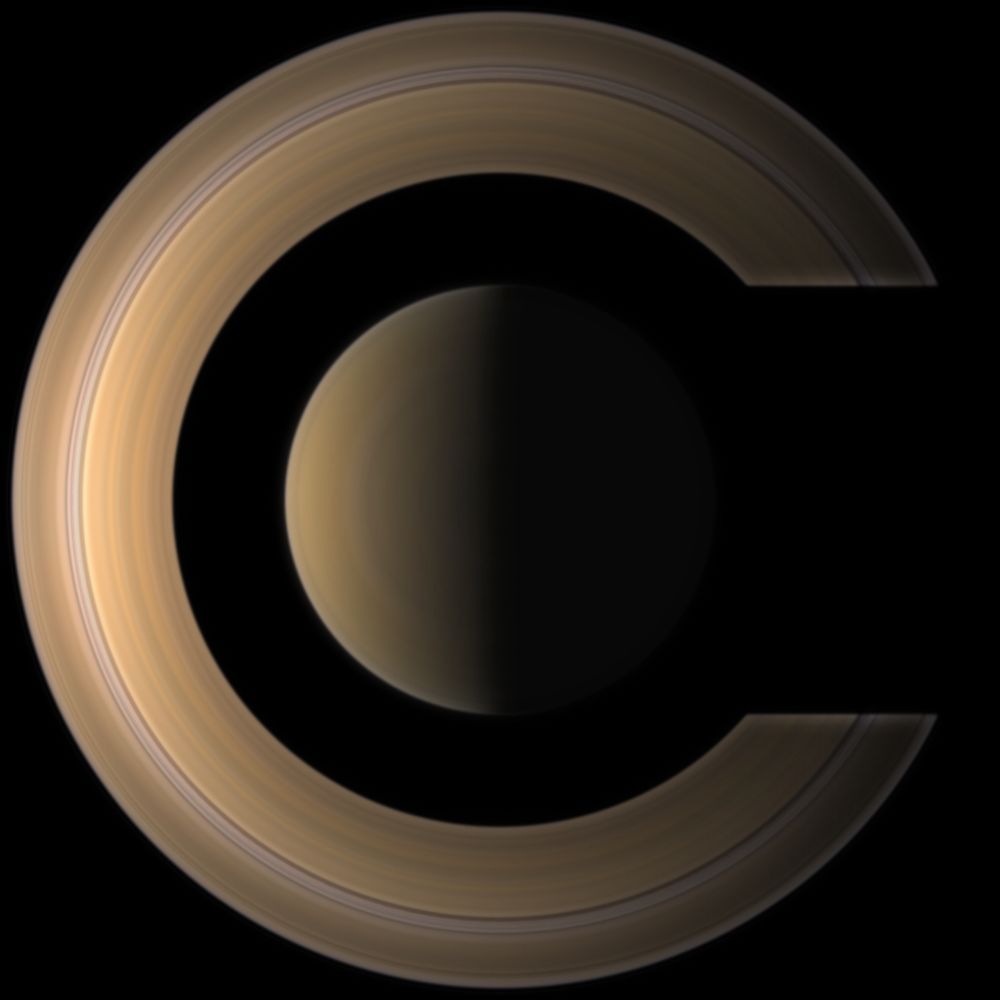
Uranus during equinox #space #astronomy #solarsystem #uranus #hubble
06.02.2026 19:38 — 👍 6 🔁 2 💬 1 📌 0
@askaniy.bsky.social
Astronomy student, Python programmer, occasional artist
Uranus during equinox #space #astronomy #solarsystem #uranus #hubble
06.02.2026 19:38 — 👍 6 🔁 2 💬 1 📌 0
Saturn #astronomy #space #solarsystem #planets #saturn #hubble
31.01.2026 15:59 — 👍 8 🔁 1 💬 0 📌 0The method can be easily extended to cases where smoothness depends on wavelength, or where a characteristic spectral scale is specified instead of smoothness. Unfortunately, a different method is required to use a reference spectrum.
24.01.2026 12:53 — 👍 2 🔁 0 💬 0 📌 0You're right, it was a typo... We need to maximize smoothness = minimize derivatives
24.01.2026 12:18 — 👍 1 🔁 0 💬 1 📌 0In brief, I write the filter profiles as a matrix and the photospectrum as the result of multiplication by the spectrum. I then solve the inverse problem by minimizing the smoothness, a combination of the first and second derivative (in the current implementation).
24.01.2026 11:05 — 👍 2 🔁 0 💬 1 📌 0This is my development, on which I'm currently writing a research paper, for some time 😅
I've reviewed the literature, but it doesn't seem to have been used before.
The current implementation is in TCT and is about to be modified after some experiments.
Simple cylindrical projection, center longitude 0°.
Gamma corrected, albedo scaled.
Color space: sRGB, while point: Illuminant E.
Links for the full resolution (11K, 2 km/pix):
www.flickr.com/photos/19356...
www.deviantart.com/askaniy/art/...
[3/3]
The original paper by Michael et al. (2024): www.sciencedirect.com/science/arti...
The data archive used: psaftp.esac.esa.int#/Guest-Stora...
TrueColorTools: github.com/Askaniy/True...
A related article: www.esa.int/Science_Expl...
[2/3]

Cylindrical map of Mars in true colors
Map of Mars in true colors: images from Mars Express were projected by Michael et al. (2024) and post-processed with TrueColorTools. TCT used the Tikhonov regularization to reconstruct a spectral cube from four High Resolution Stereo Camera (HRSC) channels and simulated human perception of it.
[1/3]

GitHub repository: github.com/Askaniy/Cyli...
In the last update, the GUI became three-column and the mean color/brightness output was added. Processing is no longer limited to cylindrical maps, and a major part has been rewritten using the OOP paradigm. (Not vibe coded).
[5/5]

Bowring's formulas

The curvature tensor and the derived pixel weight formula

A comparison of weight maps for cases of weak and strong oblateness
Cyclic longitude shift function uses a Fourier transform. Alpha channel represents a mask. Bowring's formulas and the curvature tensor are used to derive weights for map pixels. Oblateness is taken into account. The pictures show the main formulas and a comparison of weight maps.
[4/5]

Original map of Jupiter in the planetocentric projection (PIA07782)

Map of Jupiter in the planetographic projection, converted by CTC

Map of Jupiter in the planetographic projection, "true colors" (calibrated with spectrum by Karkoschka et al. 1998 processed in TCT)
Although they are both "simple cylindrical projections", the difference in the latitude systems is significant. For example: PIA07782. In software, the planetographic system is often assumed. However, this map uses the planetocentric system, and I've never seen it rendered correctly before.
[3/5]
The main goal is to simplify specific image processing operations. CTC can (re)color textures, taking into account cylindrical projection distortions. It can reproject maps from planetocentric (and Lambertian) latitudes to planetographic ones. The sRGB gamma correction can easily be applied.
[2/5]

Graphical user interface of Cylindrical Texture Calibrator
Recently updated Cylindrical Texture Calibrator, a Python utility with a GUI that was developed to help the @celestiaproject.bsky.social community with ongoing updates (we need more devs, by the way!). I've included some interesting details in the thread.
[1/5]
Thank you!
10.01.2026 13:57 — 👍 1 🔁 0 💬 0 📌 0You're welcome!
10.01.2026 08:47 — 👍 0 🔁 0 💬 0 📌 0The work was done along the lines of "reasonable guesses are better than nothing". 10% of the sample is fictitious to account for areas not imaged by Huygens. The color of the methane lakes is difficult to determine due to the lack of studies. Contact me for details or full resolution (11K).
08.01.2026 16:20 — 👍 7 🔁 0 💬 2 📌 0Titan's lakes are based on Cassini radar data (PIA17655); the artifacts were filled by hand. Liquid methane and ethane are transparent (DOI: 10.1007/s10509-017-3166-0). The spherical albedo color was calculated from the refractive index "n" with Fresnel equations (DOI: 10.1364/AO.33.008306).
08.01.2026 16:20 — 👍 4 🔁 0 💬 1 📌 0
A screenshot showing model optimization results
Next, I collected a sample of IR map pixels and their corresponding visible colors. Different conversion models were tested, including neural networks. Only a linear model (VIS = M IR + C) showed stable optimization in 12D parametric space. The conversion model was then applied to the entire IR map.
08.01.2026 16:20 — 👍 7 🔁 0 💬 1 📌 0
Screenshot from the TrueColorTools program

Figure 6 from Karkoschka et al. (2016)
Karkoschka et al. (DOI: 10.1016/j.icarus.2015.06.010) processed the Huygens probe observations in the visible bandpasses of CH4. The spectral cube was reconstructed in the TrueColorTools program and resampled in visible colors (CIE sRGB, Illuminant E).
08.01.2026 16:20 — 👍 5 🔁 0 💬 1 📌 0
Titan's global map by Seignovert et al. (2019)
The transparency windows of methane, of which the haze is composed, begin only in the near infrared. The maps are based on data from Seignovert et al. (DOI: 10.22002/D1.1173), available here: data.caltech.edu/records/8q9a.... Manually corrected pixelization and pole projection, color was linearized.
08.01.2026 16:20 — 👍 6 🔁 0 💬 1 📌 0
"True" colors (albedo scaled and gamma corrected)

Enhanced colors (linear albedo scale with a factor of five)

Specular map of the lakes
I present three maps of Titan: one in visible "true" colors (albedo scaled and gamma corrected), one in enhanced colors (linear albedo scale with a factor of five), and one of the lakes. In this thread, I will briefly describe how the impenetrable haze was bypassed.
08.01.2026 16:20 — 👍 40 🔁 10 💬 1 📌 0
Ganymede in 1979 from Voyager 2 (mosaic)
true color, processed from the raw data using @askaniy.bsky.social's TrueColorTools
I used 9 OGBV frames for this processing.
the edge of the disk is slightly cut off, so a small rendered view was inserted and spliced in.
manual processing took ~3.5 hours
🧪🔭
Great result! What color space and white point were used? Was the conversion via CIE XYZ space, or were CIE RGB color matching functions used directly? Or was RGB represented by slices of the spectrum at some wavelengths?
04.09.2025 16:44 — 👍 0 🔁 0 💬 1 📌 0Now published in AJ! Get in here this system is crazy iopscience.iop.org/article/10.3...
02.09.2025 14:28 — 👍 7 🔁 1 💬 1 📌 0(About the contrast: the attached GIF is for IR, where the limb darkening is stronger, and the effect is comparable to dark spots. In the visible range the limb darkening is weaker, and the spots can have fine structures that increase the contrast, according to the modeling)
02.09.2025 14:56 — 👍 0 🔁 0 💬 0 📌 0Great!
The preprint inspired me to explore what this system might look like to the human eye, it is definitely crazy: bsky.app/profile/aska...
Observations indicate that flare spectra resembles that of class A stars in the visible range [DOI 10.1088/0067-0049/207/1/15]. Flares are detected at high latitudes [DOI 10.1093/mnras/stab2159]. I assume them to be similar in appearance to White-Light Flares on the Sun.
[9/9]
The final composite art with the planet uses limb darkening profile computed via LDTk [https://github.com/hpparvi/ldtk], a Python library. Interestingly, for a star with these parameters, the darkening occurs without reddening.
[8/9]
The texture's color was calculated using TCT and calibrated with CTC [https://github.com/Askaniy/CylindricalTextureCalibrator] to match the hue of Proxima Centauri [DOI 10.1051/0004-6361/201730582]. Hand-painted in Krita.
[7/9]