My campaign faces its first test: qualifying for the ballot.
From my work on gerrymandering, I know that New Jersey politicians play dirty. To beat their games, I need at least 1,000 signatures from Democrats and unaffiliated voters in the 12th District. To help, sign up at SamForNJ.org - or DM me!
07.02.2026 14:00 — 👍 44 🔁 24 💬 1 📌 0

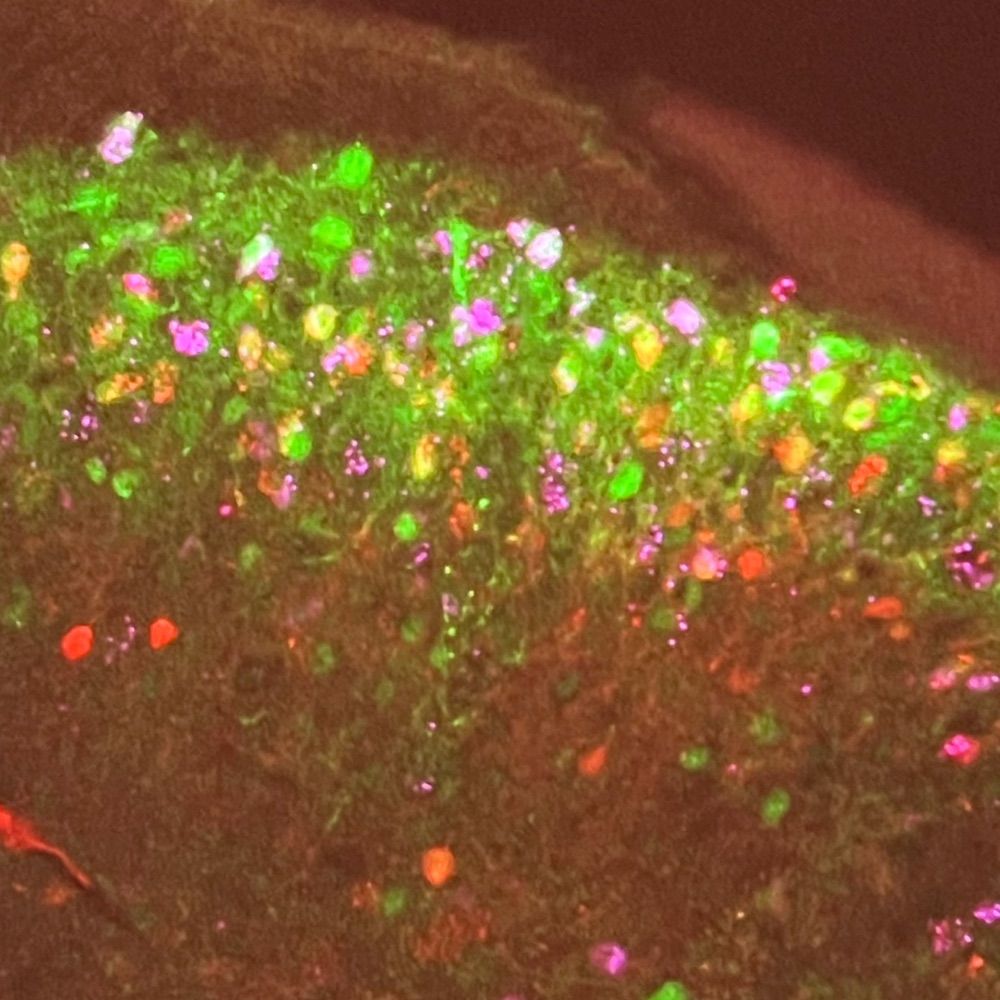
Did you know that pathways activated by bone-innervating neurons post-injury might also be used for accelerating bone fracture repair? Check out @cahanlab.bsky.social et al.’s result in @science.org bit.ly/4rR7Ts7 #PapersoftheWeek #EditorsPick #PRF
09.02.2026 13:00 — 👍 4 🔁 3 💬 0 📌 0
Get in, dorks. We're ready for round two.
RALLY TO TAKE BACK SCIENCE! 🔬🧪✊
March 7th, 2026 in Washington, DC
Learn more at www.standupforscience.net/ma... (link in our bio.)
28.01.2026 17:00 — 👍 456 🔁 207 💬 14 📌 27
@jwoodgett.bsky.social
Pls see this 🤞🏼🤞🏼🤞🏼
22.01.2026 02:18 — 👍 5 🔁 4 💬 1 📌 0
Murphy: The United States Congress should not fund a Department of Homeland Security that is not obeying the laws of the United States of America
13.01.2026 22:38 — 👍 36711 🔁 10121 💬 918 📌 658

Have you registered for tomorrow’s #webinar on neuropeptides in pain? This is the first in a series of monthly #PRF webinars, so do not miss out! Register now - bit.ly/49bCA4H
13.01.2026 13:00 — 👍 3 🔁 1 💬 0 📌 1


Read the latest preclinical and clinical papers published in the pain research field by visiting the painresearchforum.org! This week's editors are Drs. Qiufu Ma and Lanfranco Pellesi. Explore the latest discoveries and read the editors' perspectives. @usasp.bsky.social @iasp.bsky.social
13.01.2026 01:18 — 👍 4 🔁 2 💬 0 📌 0

Department Chair, Duke Neurobiology - Duke University, Durham job with Duke University - School of Medicine | 12852576
The Duke University School of Medicine (SOM) seeks a distinguished neuroscientist to serve as the next Chair of the Department of Neurobiology.
My department, Duke Neurobiology, is searching for a new chair. Ad below. Come work with me, @jmgrohneuro.bsky.social @ennatsew.bsky.social @jorggrandl.bsky.social @jnklab.bsky.social @sbilbo.bsky.social @neurocircuits.bsky.social and many other amazing folks! @dukemedschool.bsky.social
13.01.2026 01:21 — 👍 23 🔁 25 💬 0 📌 2
A Quantitative Benchmark of Visual Information in Human Brain Recordings Across fMRI, MEG, and EEG https://www.biorxiv.org/content/10.64898/2026.01.11.698841v1
13.01.2026 01:15 — 👍 4 🔁 2 💬 0 📌 0

The Pain Research Forum is launching a new monthly Webinar Series. The first event is this Wednesday Jan 14th, 2026 at 12 PM ET. Register using the QR code or visit painresearchforum.org @usasp.bsky.social @dimacd.bsky.social @psalmotoxin.bsky.social @iasp.bsky.social @dimacd.bsky.social
13.01.2026 01:09 — 👍 8 🔁 6 💬 0 📌 1
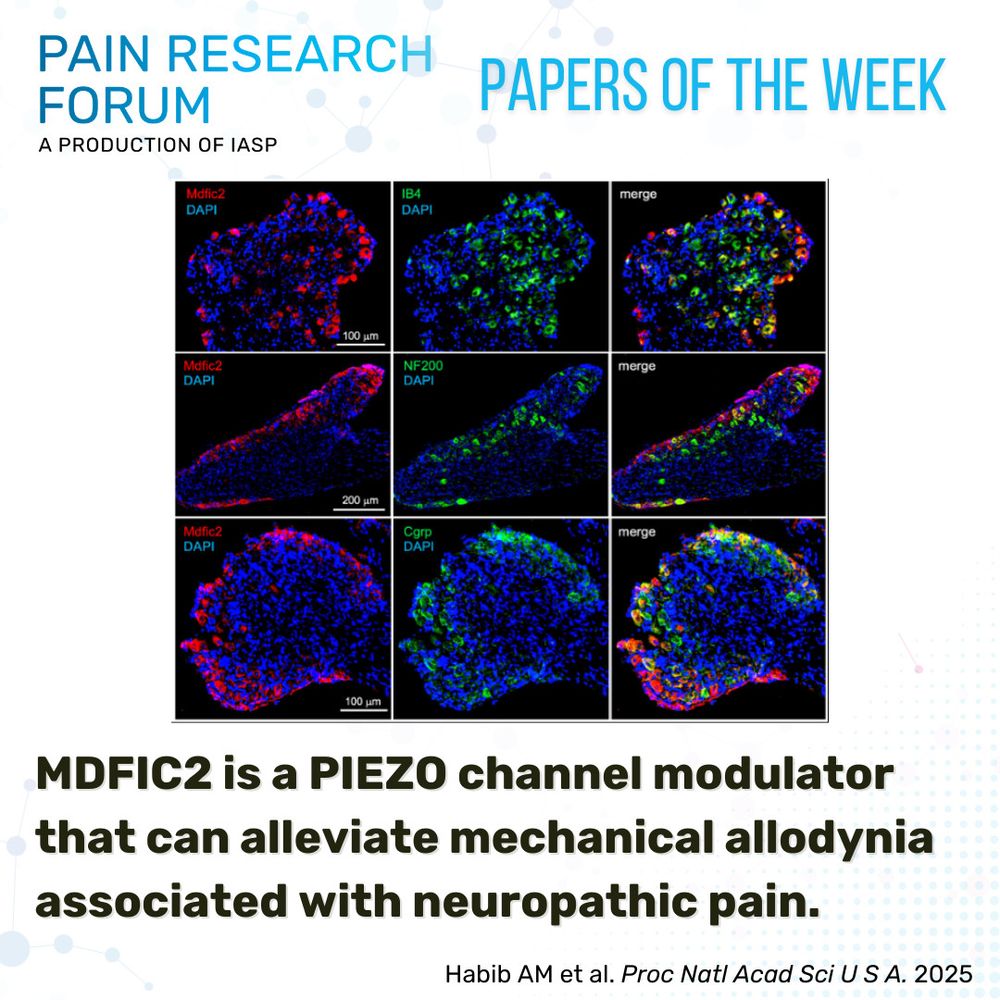
PRF 24 November 2025
Have you heard of MDFIC2, the newly identified sensory neuron-enriched modulator of PIEZO channels? Check out Habib et al. in @pnas.org, one of this week’s #EditorsPick papers chosen by @rpseal.bsky.social bit.ly/4renN08 #PRF
26.11.2025 14:00 — 👍 2 🔁 3 💬 0 📌 0

Have you been wondering what the role is of non-neuronal cells in modulating sensory neuron activity? Check out this review from @psalmotoxin.bsky.social et al. in @sfnjournals.bsky.social’s #JNeurosci, one of this week’s #EditorsPick papers chosen by @rpseal.bsky.social bit.ly/3XEp2rE #PRF
26.11.2025 13:00 — 👍 14 🔁 9 💬 0 📌 1
B. Coste identified Piezos with Ardem and here Habib et al -paper from his group - identify a modulator of piezos that may be important in peripheral mechanisms of mechanical allodynia.
24.11.2025 20:24 — 👍 1 🔁 0 💬 0 📌 0
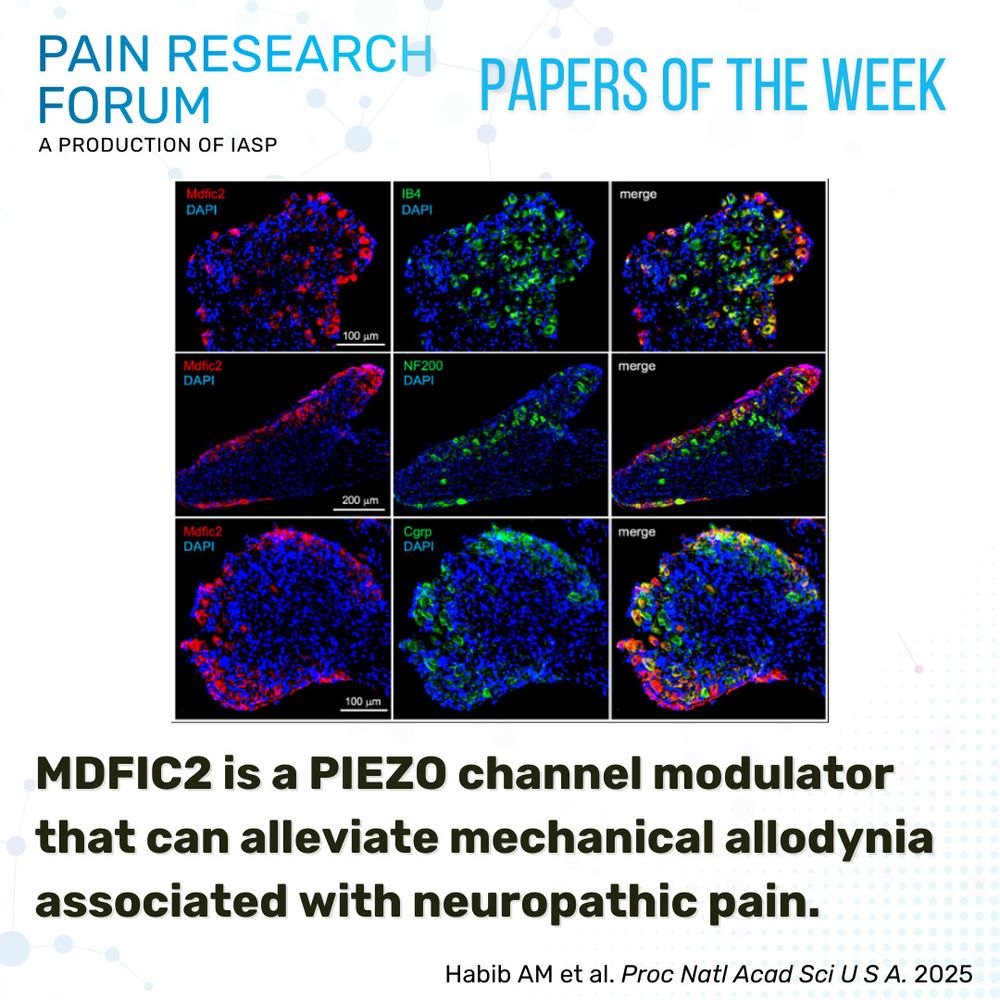
Have you heard of MDFIC2, the newly identified sensory neuron-enriched modulator of PIEZO channels? Check out Habib et al. in @pnas.org, one of this week’s #EditorsPick papers chosen by @rpseal.bsky.social bit.ly/4renN08 #PRF
24.11.2025 13:00 — 👍 4 🔁 2 💬 1 📌 0

As I spent more and more of my life under the care of doctors, nurses, and researchers striving to improve the lives of others, I watched as Bobby cut nearly a half billion dollars for research into mRNA vaccines, technology that could be used against certain cancers; slashed billions in funding from the National Institutes of Health, the world's largest sponsor of medical research; and threatened to oust the panel of medical experts charged with recommending preventive cancer screenings. Hundreds of N.I.H. grants and clinical trials were cancelled, affecting thousands of patients. I worried about funding for leukemia and bone-marrow research at Memorial Sloan Kettering. I worried about the trials that were my only shot at remission. Early in my illness, when I
Just an absolutely gutting essay by Tatiana Schlossberg, a writer, mother of two young children, and cousin of RFK Jr who is dying of leukemia.
www.newyorker.com/culture/the-...
22.11.2025 16:09 — 👍 15051 🔁 5389 💬 374 📌 229
What is that?
19.11.2025 16:26 — 👍 0 🔁 0 💬 1 📌 0
#SfN25 Wednesday 2:30 Sensory and motor spinal cord. Allen Institute, Seal lab, Pool lab and Pfenning labs. Symposium.
18.11.2025 05:31 — 👍 1 🔁 0 💬 0 📌 0

Have you wondered what it’s like creating a special journal issue is like? Listen to Episode 2 of the Pain Exchange #podcast from @iasp.bsky.social with @karenddavis.bsky.social discussing the 50th Anniversary supplement of @painthejournal.bsky.social bit.ly/4ox3B7i #PRF #academicpublishing
30.10.2025 12:00 — 👍 4 🔁 4 💬 0 📌 0

Public engagement: building common ground
How can we help to bridge this divide? Simply producing more excep tional science will not be enough to rebuild public trust. Rather, we must adopt a new model that recognizes communication and advocacy as core pillars of science, on a par with rigor and reproducibility. Public engagement efforts should be valued for faculty promotions, much like obtaining grants and publishing our findings in scientific journals. Researchers should be recognized and rewarded for activities such as giving public talks, working with local schools, engaging with policy makers, developing social media campaigns and platforms or writing accessible articles for general audiences. Developing these skills must be an integral part of scientific training, reinforcing the notion that the responsibility to champion science lies with us. Courses that teach graduate students and postdocs to communicate complex ideas clearly, to use social media effectively and to advocate for evidencebased policies must be deemed critical and supported by our universities. These efforts should not be viewed as distractions from research but woven into the fabric of what we do as scientists. Rebuilding public trust requires a cultural paradigm shift: scientists must see themselves not just as producers of knowledge, but also as its ambassadors and translators. Such a fundamental change will occur only if it is embraced by our scientific leaders and institutions, emphasizing the critical role of public engagement for science to succeed.
A thought-provoking piece in Nature Neuroscience by many neuroscience colleagues: "Science must break its silence to rebuild public trust". Lots to think about here.
www.nature.com/articles/s41...
14.10.2025 20:51 — 👍 57 🔁 22 💬 1 📌 2
You can post this on PRF.
Painresearchforum.org/announcements
08.10.2025 21:29 — 👍 0 🔁 0 💬 1 📌 0

Hey pain scientist, if you are looking for a condensed list of the top pain literature released each week, come check out #PRF's new #PapersoftheWeek selections from Greg Scherrer and
@drjerinmathew.bsky.social,
who also commented on the latest Editor's Picks painresearchforum.org/paper/preval...
08.10.2025 15:42 — 👍 4 🔁 3 💬 0 📌 0

Hey pain scientist, if you are looking for a condensed list of the top pain literature released each week, come check out #PRF's new #PapersoftheWeek selections from Greg Scherrer and @drjerinmathew.bsky.social, who also commented on the latest Editor's Picks painresearchforum.org/paper/preval...
07.10.2025 00:10 — 👍 3 🔁 2 💬 0 📌 0
Yes!!! ‼️
25.09.2025 02:05 — 👍 0 🔁 0 💬 0 📌 0
This is incredible and so inspiring on so many levels. This is what science can do.
24.09.2025 17:00 — 👍 10 🔁 3 💬 1 📌 0
Try asking on pain research forum —- pain researcher. You’ll need to register but it’s free. Alex Chamessian made the site.
17.09.2025 09:55 — 👍 2 🔁 0 💬 1 📌 0

The latest papers published in pain research are now on PRF! Dr. Alex Chesler provides a curated list for Aug. 22-28, 2025 and a commentary on his pick for Paper of the Week! painresearchforum.org/paper @utdpaincenter.bsky.social @nyupainresearch.bsky.social @iasp.bsky.social @usasp.bsky.social
31.08.2025 12:08 — 👍 11 🔁 3 💬 1 📌 0

SLC45A4 is a pain gene encoding a neuronal polyamine transporter - Nature
The SLC45A4 gene encodes a neuronal polyamine transporter and is linked to pain response in humans and mice.
We've found a new gene linked to chronic pain in humans! The gene SLC45A4 encodes (the long-awaited) neuronal polyamine transporter, which is important for pain signalling in nerves. We hope this discovery might lead to new chronic pain treatments in the future!
www.nature.com/articles/s41...
21.08.2025 12:16 — 👍 80 🔁 25 💬 4 📌 0
🇫🇷🇨🇦 - Neuroscientifique - Postdoc - Université de Montréal - Kolta Lab
Synaptic Plasticity, Intrinsic Excitability, Ion Channels, Astrocytes
n-dimensional image viewer for Python
Neuroscientist studying tastes, smells, and the body-brain axis • New York-based researcher with faculty appointments at Nathan Kline Institute | NYU School of Medicine | City College of New York
nki.rfmh.org/people/renee-hartig-ph-d/
Assistant Professor of Psychiatry at Pitt; Interventional psychiatrist; Hoping to learn about psychiatric disease by studying decision-making in rodents.
https://scholar.google.co.uk/citations?hl=en&user=Tq3NsRgAAAAJ
Theoretical neuroscientist interested in brain-body interactions and evolution of adaptive behavior. Associate Professor at Scripps Research Institute in San Diego.
UT Dallas | Neuroscience
axonal transport; miRNA; omics; neuroinformatics; neuropathies; neurodegeneration
https://labs.utdallas.edu/axonlab/
https://sensoryomics.shinyapps.io/human-peripheral-nerves/
Chief Editor of Nature Biomedical Engineering. Ph.D. Previously at Nature Methods. @rita_strack on the place formerly known as twitter.
I enjoy playing with family, reading science fiction and history, gardening, board games, and jazzercise. I'm a father, husband, Navy veteran, and graduate student studying computer science at George Mason University.
Mastodon: https://scicomm.xyz/@David
Leading a lab exploring growth factor pharmacology within COMPARE at Uni of Nottingham. Current Academy of Medical Sciences Springboard Recipient. Former Leon Levy fellow (NYU) & AJ Clark Scholar (British Pharmacological Society).
www.peachlabgroup.com
@ksvesq.bsky.social’s husband; father of daughters; professor @georgetownlaw.bsky.social; #SCOTUS nerd @CNN.com
Bio: www.law.georgetown.edu/faculty/stephen-i-vladeck
"One First" Supreme Court newsletter: stevevladeck.com
Book: tinyurl.com/shadowdocketpb
Assistant professor at the University of Pittsburgh. Medicinal chemistry; drug discovery; TRP channels; neuropathic pain 🌨️❄️💊https://journiganlab.squarespace.com/
@ericgross.bsky.social
Stanford research lab studying how aldehydes (alcohol flushing) impact anesthesiology (organ injury, pain, & anesthetics), and public health.
Assistant professor @ Duke University BME, guerilla knitter, pipettor of small volumes of liquid. Biologist masquerading as engineer, or the other way around.
Computational neuroscientist @princetonneuro.bsky.social deciphering natural and advancing artificial intelligence.
The American Association of University Professors champions academic freedom, advances shared governance, and organizes faculty to ensure higher education's contribution to the common good.
aaup.org
Assistant Professor @UTSW. Interested in neuroscience of pain, pain relief and innate motivations.
Jane Coffin Childs Fund Fellow; postdoc in David Ginty lab at Harvard Medical School.
Former PhD student in Carandini&Harris lab at UCL.
Neuroscientist, retinal circuits, neuro development. UC Berkeley
http://fellerlab.squarespace.com/
Professor @ugent @ResearchUGent - Group leader @VIBLifeSciences - @vdb_lab - fascinated by science -@JongeAcademie member - proud mother of Lore & Febe