I have a fabulous undergrad who has a lot of experience with QIIME2 & using R to analyze microbiome data. She is looking for a job starting in January. Would love to learn more bench and field skills (will be getting some in her last 2 months). Open to academic, industry, government jobs in the US.
06.10.2025 21:34 — 👍 29 🔁 27 💬 1 📌 0

Using IPCRESS for electronic PCR, and parsing output
Using IPCRESS for electronic PCR, and parsing output - In Silico PCR with IPCRESS.ipynb
ipcress is a great and simple tool for in silico PCR. it's pretty fast and can handle mismatches. Here is a gist from someone that have all relevant information: gist.github.com/cfljam/e0d11...
16.09.2025 01:56 — 👍 2 🔁 0 💬 2 📌 0

Save the dates!! @bspparasitology.bsky.social Spring Meeting 2026 will be in Bonnie Glasgow! 7-9 April 2026, with a drinks reception in Glasgow City Chambers on the 6th of April 2026!
Keep an eye on the BSP website for registration and abstract submission!
Logo by @shannaraeilean.bsky.social! 🦟
11.09.2025 11:09 — 👍 32 🔁 21 💬 1 📌 2

Brown sea coconut with yellow fibers between the two lobes of the coconut, going from the upper to the third of the length of the coconut. The coconut lays on a table.
Actually, it is also called "coco-fesses" in French (which literally means "butt coconut"). We have one in the family, with some suggestive fibers, very similar to the picture below (source: lodoiceamaldivica.wordpress.com/cocofesse/)
12.07.2025 23:37 — 👍 7 🔁 0 💬 1 📌 0

GSA logo and "Check out our Schisto Research Update Newsletter with research grants, funding and articles #StopSchisto
Work on #schistosomiasis #research? Check out our latest GSA Research Update newsletter with
- funding opportunities
- training and courses
- research highlights
- upcoming events
And more: us18.campaign-archive.com?u=e14ec03d13...
12.06.2025 15:46 — 👍 1 🔁 1 💬 0 📌 0
Side story: This paper wraps up Lauren’s work (@lvcarruthers on the other site) from her summer internship at @texasbiomed.bsky.social. Stephanie (@StephCara on the other site), former intern and former PhD student, also contributed. Congrats to Lauren, Stephanie, and all co-authors! 🎉
30.05.2025 18:00 — 👍 0 🔁 0 💬 0 📌 0
Overall, these results highlight the need to study microbiomes separately to avoid masking key changes and to better capture microbiome dynamics, especially during parasite infection 🦠🐌🪱. This will be the focus of an upcoming paper from Stephanie.
30.05.2025 18:00 — 👍 0 🔁 0 💬 1 📌 0

Boxplots showing 16S rRNA gene copy number (y-axis) per host cell (left panel) for stomach, gut, hepatopancreas, ovotestis, and whole snail, or per microliter (right panel) for hemolymph, tray water, and tank water. Biomphalaria alexandrina is shown in orange, B. glabrata in green, with boxplots of each species displayed side by side for each sample type.
How many bacteria are in these organs? We performed qPCR and normalized by cell number (organs, whole snails) or volume (hemolymph, water). The digestive system (stomach and gut) showed the highest density, while levels were more variable in the hepatopancreas and low in the ovotestis.
30.05.2025 18:00 — 👍 1 🔁 0 💬 1 📌 0

Two UpSet plots: the top one for Biomphalaria alexandrina, the bottom for Biomphalaria glabrata. Each plot is divided into three sections: the bottom left shows a horizontal barplot representing the number of amplicon sequence variants (ASVs) per sample type, the top right shows a vertical barplot representing the number of ASVs per intersction, and the bottom right is a dot plot displaying the specific intersections between sample types. Dot plot start with sample-type specific set (no intersection) then continue with increasing intersection between sample types to end with set that include all sample types. Sample type: hemolymph, stomach, gut, hepatopancreas, ovotestis, whole snail, tray water, tank water.
How are these taxa shared between organs? They are mostly sample-type specific, especially in the hemolymph and ovotestis. Hemolymph and whole snail share the most taxa. Some taxa are snail-specific, suggesting internal conditions favor them, while others are found in snails and water.
30.05.2025 18:00 — 👍 0 🔁 0 💬 1 📌 0

Taxonomic figure divided in three sections: taxonomic plot for Biomphalaria alexandrina (top), taxonomic plot for B. glabrata (middle), and a legend displayin phylum names (bottom). Taxonomic plots show the relative proportion (y axis) for each sample type (hemolymph, stomach, gut, hepatopancreas, ovotestis, whole snail, tray water, tank water).
Taxonomic diversity revealed a surprising number of unknown taxa in the hepatopancreas and ovotestis. These organ microbiomes warrant further study to characterize these mysterious taxa. Taxonomic diversity of the whole snail microbiomes was similar to the hemolymph microbiome diversity.
30.05.2025 18:00 — 👍 0 🔁 0 💬 1 📌 0

Four distance trees showing relationships between sample types (hemolymph, stomach, gut, hepatopancreas, ovotestis, whole snail, tray water, tank water). The two trees on the left display Unweighted and Weighted UniFrac distances for Biomphalaria alexandrina (Ba); the two on the right show the same for B. glabrata.
These organ microbiomes were different from the hemolymph, specific, and either linked by physical proximity or functionnality, depending on the beta-diversity metrics used. The whole snail microbiome was consistently close to the hemolymph microbiome.
30.05.2025 18:00 — 👍 0 🔁 0 💬 1 📌 0

Boxplots showing observed richness (y axis) by sample types (hemolymph, stomach, gut, hepatopancreas, ovotestis, whole snail, tray water, tank water). Biomphalaria alexandrina is in orange and B. glabrata in green, with boxplots of each species being side by side for each sample type.
Organs harbored microbiomes with varying microbial diversity. Hemolymph showed the highest alpha-diversity, similar to the whole snail microbiome. Sample type (organs and hemolymph) was the primary factor explaining microbial diversity before the snail species.
30.05.2025 18:00 — 👍 0 🔁 0 💬 1 📌 0

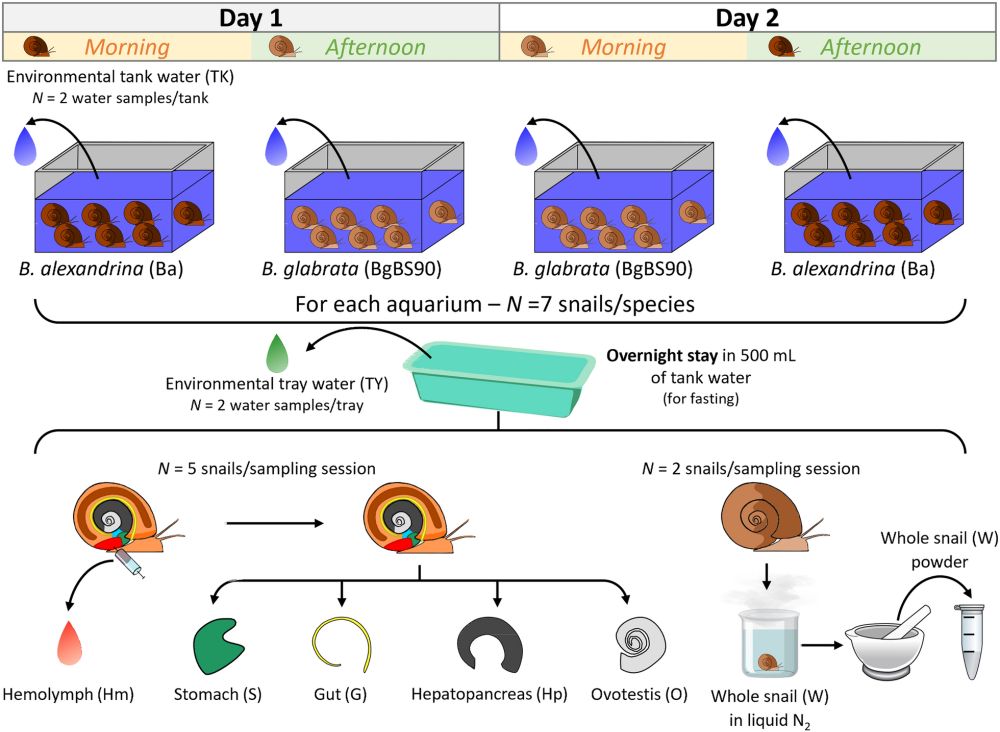
Experimental plan showing tanks of Biomphalaria glabrata and B. alexandrina snails, from which 7 snails per tank were sampled, fasted overnight, and then either dissected to obtain hemolymph, stomach, gut, hepatopancreas, and ovotestis, or snap-frozen in liquid nitrogen and ground into powder. Tank and fasting tray water were also sampled. Samples were used for DNA extractions.
We chose stomach/gut (commonly studied), hepatopancreas (liver), and ovotestis (targeted by schistosomes 🪱) from uninfected snails of 2 Biomphalaria species. We also analyzed whole-snail 🐌 microbiomes (commonly studied) to test if they truly reflect the composite of individual organ microbiomes.
30.05.2025 18:00 — 👍 0 🔁 0 💬 1 📌 0
Organ-specific microbiomes of Biomphalaria snails - Animal Microbiome
Background The microbiome is increasingly recognized to shape many aspects of its host biology and is a key determinant of health and disease. The microbiome may influence transmission of pathogens by...
📣 New paper: Organ-specific microbiomes of Biomphalaria snails
📋 Snails, vector of blood flukes, have specific microbe communities associated with their organs. Whole snail microbiome is not the true composite of these microbiomes. 🧵👇
Go get it: doi.org/10.1186/s425...
A late #NationalSnailDay 🧪
30.05.2025 18:00 — 👍 12 🔁 3 💬 2 📌 0

An infographic of snail anatomy and how to refer to different parts of the shell and body of the animal
Let's continue National Snail Day Shellebrations with the snails in short series, where I collaborated with @franzanth.bsky.social 🐌🦑 #nationalsnailday
first up some snail basics
29.05.2025 16:02 — 👍 165 🔁 77 💬 6 📌 5
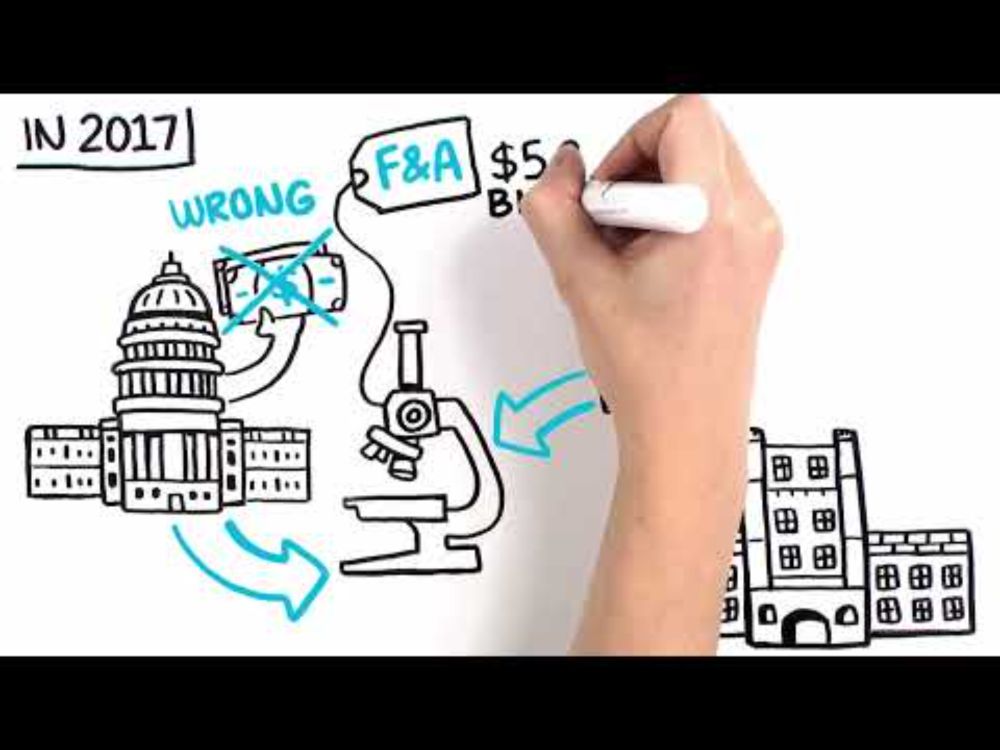
YouTube video by Association of American Universities
Facilities and Administrative (F&A) Costs Explainer
Make sure you, your trainees, and anyone else who might listen to you understands what "indirects" actually are, how they are established, and what Universities contribute. H/T @rodallab.bsky.social
Please share widely!
www.youtube.com/watch?v=yxTD...
11.02.2025 15:00 — 👍 151 🔁 114 💬 6 📌 9
As the Massif Central is a highland between the Alps and the Pyrenees, we more likely see the effect of both the Mistral wind (between the Alps and Massif Central) and the Tramontane wind (between the Massif Central and the Pyrenees).
24.12.2024 23:28 — 👍 3 🔁 0 💬 1 📌 0
ORCID
Hi Erik!
Could you please add me to the Science feed? I am working on schistosome, snail and microbiome. This is me:
ORCID: orcid.org/0000-0003-26...
Webpage: www.txbiomed.org/scientists/f...
Thank you!
25.11.2024 23:03 — 👍 1 🔁 0 💬 0 📌 0
Time for an #introduction!
I'm a Staff Scientist at #TxBiomed working on:
• #schistosome blood fluke (drug resistance, host specificity, etc.) using #genetics and #genomics
• #microbiome 🦠 of snail 🐌 vectors of schistosomes
I do #bioinformatics 💻 using #bash, #R, and #python.
See y'all around!
25.11.2024 21:39 — 👍 4 🔁 1 💬 1 📌 0
This should be our next model organism. What a hell of a snail!
I did not know about the cult though. Should we start one with ours 🤔? We definitely have worms that can make people sick.
Anyway, thank you @c0nc0rdance.bsky.social for point this out to me.
11.04.2024 19:05 — 👍 4 🔁 0 💬 0 📌 0
Co-founder OMGenomics Labs. Creator of Circa https://circa.omgenomics.com, Ribbon, YouTube.com/omgenomics. Worked on DeepVariant+DeepConsensus at Google.
Posts about jobs, conferences, etc. from the Evolution Directory (EvolDir) mailing list https://evol.mcmaster.ca/evoldir.html, run by Brian Golding. This bot is run by @rdmpage.bsky.social. Problems: https://github.com/rdmpage/evoldir-bluesky/issues
Artist, mom, hiker, backpacker, explorer, nature lover. Creator of the style of painting known as Open Impressionism.
Find originals, prints, replicas, calendars, art books, and more at https://www.erinhanson.com
Your favorite aspiring lawyer, history nerd, pedantic as culture
PNW, Cascadia
Cringe is dead and I'm still breathing
Is it a fantasy, or a truth that beggars the soul to admit?
She/Her
🏳️⚧️
Confirmed Lives: 6
my scale says i'm 27, that's enough
40+ yrs in print, 50+ novels, asst'd TV/film, NYT B'seller List every now & then, blah blah blah. Ireland-resident. Ebook store: https://ebooks.direct. Now with added Ko-Fi! (https://ko-fi.com/dianeduane) I miss @peter.petermorwood.com.
A husband, father, actor, director, & a climate justice advocate with an eye out for a better, brighter, cleaner, & more hopeful future for all of us.
medical illustrator, comic and horror artist
meganllewellyn.com
Long career as a dilettante at Bell Labs Research and Google, mostly building weird stuff no one uses, but occasionally getting it right, such as with UTF-8 and Go.
Unofficial account. Automated post via RSS.
Maintained by @danni.id
A blog about Ubuntu – est. 2009! Follow to get news, tips, cool apps, and other content about the world's most popular desktop Linux distro.
Intracellular Parasite Education and Research Labs (iPEARL) is an initiative led by Professor Nishith Gupta at BITS Pilani, Hyderabad.
Outreach Admin vaibsweb.bsky.social
Website: www.ipearl.org
🇪🇸 Group Leader | Julian Lab @ BOKU University 🇦🇹
🔬 Vacuolar defense & plant stress responses
🧬 ATG8ylation | Non-canonical autophagy | VQC
https://boku.ac.at/en/btlw/impb/julian-lab
Assistant Professor at IRCM, University of Montreal; Adjunct at McGill University. Stem cells, islets, vessels & regenerative medicine for T1D. AghazadehLab.com
She/her. Tiohtiá:ke/Montreal. Opinions are my own.
I make silly skits with marshmallows.
👇*ONLY*Other socials
https://linktr.ee/droobiee
Guitarist w/ George Duke, Stanley Clarke, Al Jarreau & more. Founder, programmer, and janitor of Little Green Footballs. Scientist of love. Haole from Hawai'i. Not a clanker. Just a weirdo. The good kind.
https://littlegreenfootballs.com
Fuck everything.
I occasionally stream on Twitch.
GenX
She/Her, cis
I'm me everywhere because I'm not very original.
Sometimes I make things. Mostly I buy supplies to make things, & then don't make the things.
Header image is a resin cabochon I made.
Storyteller about storytellers.
18th century to today & beyond.
J.W.Liles Prof of English
Words: Polygon (RIP), LARB, etc
Next book: THE ACTUAL HISTORY OF ACTUAL PLAY (#TTRPG digital storytelling performance)
ecfriedman.com
(free) patreon.com/ecfriedman
The international job board for scientists, by scientists | https://jobRxiv.org
Are you hiring? ➡️ https://jobrxiv.org/post-a-job
Get all new jobs in your inbox ➡️ https://jobrxiv.org/job-alert-subscription/
All things postgrad, made easy 😎
Helping you find your perfect PhD with the worlds largest PhD database 🌎💡
🧑🎓 Study fairs | 📧 Weekly newsletter | 💡 Postgraduate advice