Thank you Trevon and @franciscaantman.bsky.social for organizing the AEA SMPC where I presented my first draft of this paper!
07.01.2026 19:57 — 👍 2 🔁 0 💬 0 📌 0
My JMP is forthcoming at AEJ:EconPolicy!
Grateful to my diss. cmttee and many who read drafts—@imbernomics.bsky.social @erzoluttmer.bsky.social @joshua-goodman.com @erickaweathers.bsky.social @asheassa.bsky.social @kirabojackson.bsky.social @stephenlross.bsky.social
Excited for upcoming projects!
07.01.2026 19:54 — 👍 32 🔁 6 💬 4 📌 0

📢 #EdWorkingPapers: Do families value school climate?
In Chicago, publishing school social climate ratings raised home prices near better-rated schools. Higher-income families continue to respond after 1st year, highlighting info access gaps.
🔍 @crespin.bsky.social
📄 edworkingpapers.com/ai25-1243
14.08.2025 14:05 — 👍 3 🔁 2 💬 0 📌 0
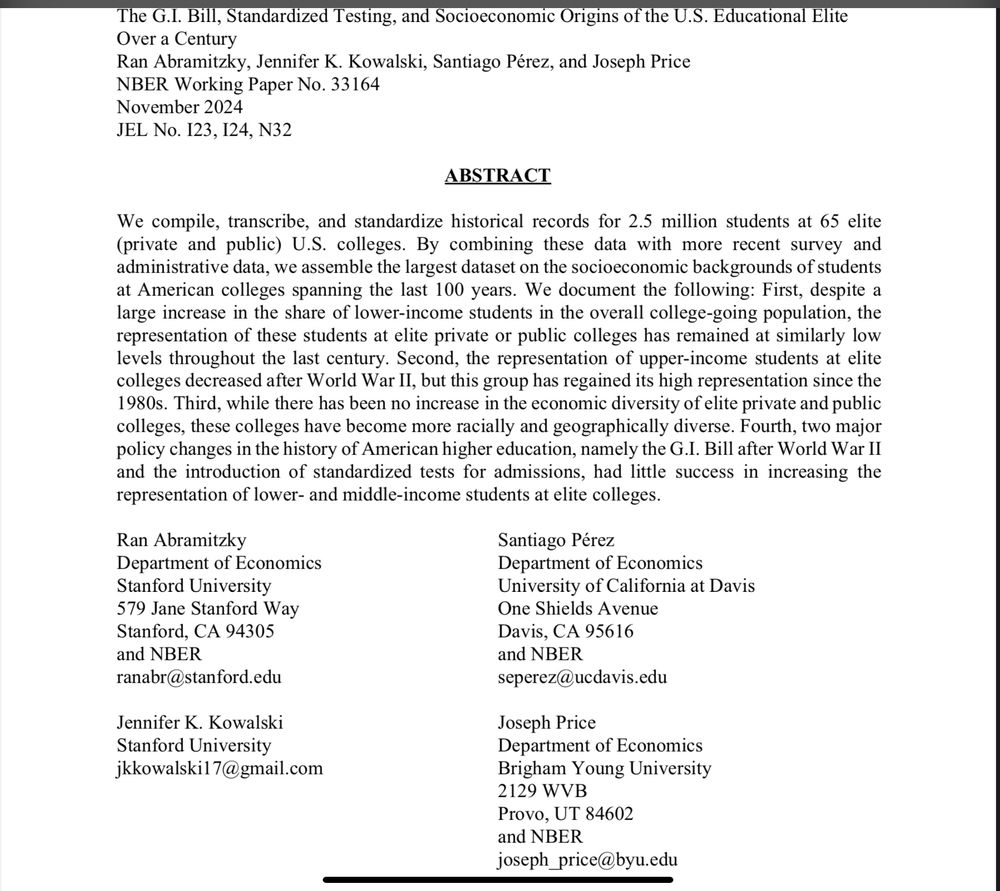
The G.I. Bill, Standardized Testing, and Socioeconomic Origins of the U.S. Educational Elite Over a Century
Ran Abramitzky, Jennifer K. Kowalski, Santiago Pérez, and Joseph Price
NBER Working Paper No. 33164
November 2024
JEL No. 123, 124, N32
ABSTRACT
We compile, transcribe, and standardize historical records for 2.5 million students at 65 elite (private and public) U.S. colleges. By combining these data with more recent survey and administrative data, we assemble the largest dataset on the socioeconomic backgrounds of students at American colleges spanning the last 100 years. We document the following: First, despite a large increase in the share of lower-income students in the overall college-going population, the representation of these students at elite private or public colleges has remained at similarly low levels throughout the last century. Second, the representation of upper-income students at elite colleges decreased after World War II, but this group has regained its high representation since the 1980s. Third, while there has been no increase in the economic diversity of elite private and public colleges, these colleges have become more racially and geographically diverse. Fourth, two major policy changes in the history of American higher education, namely the G.I. Bill after World War II and the introduction of standardized tests for admissions, had little success in increasing the representation of lower- and middle-income students at elite colleges.
Holy crap this is an astounding piece of historical research
Will post ungated link later today unless someone beats me to it
www.nber.org/system/files...
18.11.2024 12:47 — 👍 1381 🔁 468 💬 66 📌 75
Economic Inequality
Join the conversation
One more for the inequality researchers. Writing a book and looking to read research/work from scholars thinking deeply on the topic of socioeconomic inequality. Please reply if you'd like to be added. Viewing this as a really convenient bibliography (thanks @bsky.app): go.bsky.app/L6iReaW
18.11.2024 05:40 — 👍 74 🔁 29 💬 30 📌 3
Thank you for making this list! Could you add me too?
18.11.2024 12:11 — 👍 1 🔁 0 💬 0 📌 0

Screenshot of Guardian Article: Italy revives policy of failing badly behaved pupils to bring back respect
Italy brings back 'Grades for Conduct':
Teachers in Italian middle-schools now have to grade the behavior of students in school. 🏫
Grades will show up on students' report cards. 📃
Whats the evidence this kind of policy? 📉📈
#Econsky #Edusky
13.11.2024 12:41 — 👍 29 🔁 6 💬 4 📌 4
The introduction of Universal Pre-K in various states and cities was linked to an increase in business applications and the overall number of business establishments.
(also effects on enrollment and maternal labor supply, as in other studies)
27.09.2024 23:35 — 👍 93 🔁 44 💬 0 📌 1

The American Society of Hispanic Economists (ASHE) is accepting applications for three awards (Due 𝗦𝗲𝗽𝘁𝗲𝗺𝗯𝗲𝗿 𝟭𝟱, 𝟮𝟬𝟮𝟰, 𝟱:𝟬𝟬 𝗽.𝗺 PT)
1. the ASHE Dissertation Award
2. the ASHE Teaching Award
3. the ASHE Service Award
More info here: t.co/ErEtzZNKEr
05.09.2024 01:30 — 👍 1 🔁 0 💬 0 📌 0

Deeply honored and humbled to receive the 2023 American Society of Hispanic Economists Annual Dissertation Award. A huge thank you to @ASHE_ASSA and to all who have been part of this journey.
18.10.2023 01:44 — 👍 18 🔁 2 💬 2 📌 0
Freelance writer and editor. Formerly of The Atlantic, Boston Review.
Welcoming media and local government to Bluesky.
Ezra Klein’s tweets, articles, clips and podcasts on Bluesky.
A public policy research organization dedicated to individual liberty, limited government, free markets, and peace. https://www.cato.org/
Economic data releases and news, automated with R.
Data from http://fred.stlouisfed.org.
Code/details: http://whyitmatters.netlify.app
All views and errors are mine.
Big Problems Require Bold Solutions | Asst. Professor @BrownUniversity | @Harvard alum
Labor economist at IFAU Uppsala and UCLS Uppsala University: labor, gender, education, @statatexblog.com @repec-nep-gen.bsky.social @ifau.bsky.social @iza.org @rfberlin.bsky.social
https://jansauermann.github.io
Professor in the School of Politics and Global Studies, ASU
Work on climate change impacts, focusing on human mobility
#DevEcon #EnvironEcon #AgEcon #EnvironDemography #PoliticalEcon
Non-resident fellow at IFPRI
Livin’ it up in Spain 2025-6
Professor of Education Policy, UC Santa Barbara. I use (mostly) qualitative research methods to study issues of educational (in)equity for immigrant-origin youth & families.
Economist @ U.S. Census Bureau. Views are my own.
Here as a well-balanced human with many identities. Posting my own views as my full self. K-12 Ed policy researcher. Mom |🪴🏀🏈 lover | Consumer of the Philly food scene | CT native | Hampton alum | 1913 🔺
Assistant professor and director of Human Development Lab at UAndes, Chile. Ph.D. in Economics LSE. Interested in labor, public, and education topics. CEP, CEPR, IZA.
http://andresbarriosf.github.io/
he/him. Economist. In a prolonged love affair with admin data.
SWDC Parent, Ed Researcher, Lover of Graphs, #DCStatehood, 🐺 🏃🏻♀️ 🚴♀️. Re-posts != endorsements and posts are my own. https://betsyjwolf.substack.com
REStat is a 100-year-old general journal of economics. Edited at
@harvardkennedy.bsky.social, the Review shares empirical & theoretical contributions for a wide readership.
mitpressjournals.org/loi/rest
Assistant Professor of Economics at U of Delaware. Labor/Migration
https://www.parag-mahajan.com
Economics PhD candidate at Florida State University | Economics of Education
https://michaeldarisse.github.io/
Research Assoc. at Philly Fed. Interests in labor/public and social safety net. Washed-up classical musician. Organizing with @phillydsa. Formerly UVA math+econ. Tidewater VA born and raised.
Assistant Professor at Denison Econ. I study labor economics and higher education policy. www.johnconzelmann.com
Economist | Scientist @UWMadison | @PurdueKrannert PhD | I study labor and education using econometrics.
Policy consultant @ BSS Economic Consultants, Basel | Economist: Public Sector, Labor Markets, Education | Dad of 3 | German-Swiss musings | trains.
https://sites.google.com/view/lmergele/home