I've slowly been reformatting notes from my population and conservation genetics course at Montana State University into a web book—a rough draft is now live here: elinck.org/popgen_conge...
22.12.2025 21:32 — 👍 130 🔁 61 💬 1 📌 0
@devonderaad.bsky.social
La Kretz Postdoctoral Fellow at UCLA. Evolutionary genomics (usually) of birds! devonderaad.github.io
I've slowly been reformatting notes from my population and conservation genetics course at Montana State University into a web book—a rough draft is now live here: elinck.org/popgen_conge...
22.12.2025 21:32 — 👍 130 🔁 61 💬 1 📌 0
And now an empirical example: @devonderaad.bsky.social, @lhdecicco.bsky.social, @peterhosner.bsky.social and colleagues show how rapid divergence, gene-flow and stepping-stone island colonisation obscure phylogenetic relationships of buzzing flowerpeckers.
(8/n)
doi.org/10.1093/evol...

New special issue in Molecular Ecology on Conservation Genomics #popGen #evolution 🧪🧬🖥️ onlinelibrary.wiley.com/toc/1365294x...
19.12.2025 12:45 — 👍 43 🔁 26 💬 0 📌 0
New paper out. If you like colorful birds, hybridization, and phylogenetics, read on! 🧵https://doi.org/10.1371/journal.pbio.3003501
12.12.2025 15:53 — 👍 98 🔁 44 💬 1 📌 6
BIG day for warbler genomes, with work led by @kevinfpbennett.bsky.social! Whole genomes nearly *every species* of warbler.
Warblers the most "Pokémon" of the bird world? Well, they're also trading their coloration genes like valuable collectors cards ...
www.psu.edu/news/eberly-...
🦉🧪

I have a new preprint demonstrating a genome-architecture-aware approach to inferring species trees and introgression landscapes from a small number of genomes. If you are interested in phylogenomics, birds, or hybridization, this is for you! www.biorxiv.org/content/10.1...
01.12.2025 19:35 — 👍 82 🔁 41 💬 1 📌 1
What makes a mountaineer bird?
We have published the first complete genome assembly for Redstarts (Genus: Phoenicurus), found across Asia, Europe, and Africa.
Black redstarts genome has 30% repeats, second highest known in passerines.
#genomics #ornithology
www.nature.com/articles/s41...
We can observe the complex biogeographic histories that give rise to phylogenomic discordance in real time, by studying groups of closely related organisms in early stages of the diversification process. Studying these "tips of the tree" can reveal the processes shaping global phylogenetic patterns.
25.11.2025 19:10 — 👍 1 🔁 0 💬 0 📌 0Although we will never be able to reconstruct the geography of divergence at difficult nodes deep in the tree of life (at least without a time machine)...
25.11.2025 19:10 — 👍 1 🔁 0 💬 1 📌 0Overall, this implies that the presence of unresolvable nodes in the tree of life may be largely attributable to real biological messiness, like cases of rapid colonization with gene flow across an island archipelago, not just a lack of sequence data or appropriate models.
25.11.2025 19:10 — 👍 2 🔁 0 💬 1 📌 0
Ultimately, the best demographic model was a polytomy, yet a model of rapid divergence with gene flow provided a nearly identical fit to the empirical data. Even though we think true "hard polytomies" are rare in nature, rapid divergence with gene flow is becoming recognized as relatively common.
25.11.2025 19:10 — 👍 2 🔁 0 💬 1 📌 0
The main conclusion is in the title "Rapid divergence with gene flow creates intractable nodes in the tree of life". One favorite result was that random downsampling of the tips resulted in conflicting species trees, at times with high support! Concerning implications for higher-level phylogenetics!
25.11.2025 19:10 — 👍 2 🔁 0 💬 1 📌 0
My 2nd dissertation chapter, entitled "Rapid divergence with gene flow creates intractable nodes in the tree of life: An empirical demonstration in the Buzzing Flowerpecker" will be in the forthcoming special issue of EJLS focused on phylogenomic discordance. Link: academic.oup.com/evolinnean/a...
25.11.2025 19:10 — 👍 11 🔁 0 💬 1 📌 0
Figure with a photo of a member of then Solomons Monarch complex, a map of the Solomon Islands (divided into four island groups, Makira being the most isolated), and a principal component analysis highlighting the distinct between-island-group structure, with moderate structure within the New Georgia Group and weaker structure within the Bukida group (highlighted in an inset).
Just out in Systematic Biology, we explore the role of gene flow in island phylogeography of the Solomons Black-and-white Monarch complex. doi.org/10.1093/sysb...
Up first, strong genetic structure between islands groups and weak (but present!) structure between Pleistocene-connected islands (🧵)

A five panel figure, with four showing photographs of a putative hybrid warbler between a mourning warbler and a common yellowthroat. The final panel shows an illustration of the bird by David Sibley

A three panel figure showing the genetic composition of the hybrid and the putative parental species. Two panels show points on a principal components analysis, with the hybrid falling intermediate. The final panel shows bars illustrating genome-wide admixture, with the hybrid having intermediate ancestry between the two.
I mean, the title says it all: Genetic confirmation of an “uncommon mourningthroat” (Geothlypis philadelphia × G. trichas): A rare but persistent hybrid warbler. Fun stuff with @kevinfpbennett.bsky.social and Kurt Gielow, OA in @wilsonornithsoc.bsky.social!
🦉 🧪
www.tandfonline.com/doi/full/10....

A hand holding an eastern nashville warbler (Leiothlypis ruficapilla ruficapilla) during bird banding

Going to be a big month for warbler science! First out of the gates is @lannhiphung.bsky.social, with song & genomics of Nashville warblers. Eastern and western subspecies: non-overlapping and super distinct. Keep an eye on your life list 😉
🦉🧪@journal-evo.bsky.social
academic.oup.com/evolut/advan...

A poster for Else's exit seminar titled "The Role of Hybridization in the Speciation of Birds". The poster shows illustrations of several bird species (skuas and manakins) above a background of a subarctic coastline and a tropical rainforest river.
Almost PhDone! I'll be giving my PhD exit seminar in the morning (Thursday), and defending on Friday.
06.11.2025 05:24 — 👍 49 🔁 6 💬 2 📌 0
Check out the latest paper from the CCGP on California Quail and the ecological and anthropogenic factors that impact genomic variation. Led by Phred Benham and the Bowie group: onlinelibrary.wiley.com/doi/10.1111/...
16.10.2025 20:40 — 👍 7 🔁 4 💬 0 📌 0
Congratulations to @jeffgroh.bsky.social on the publication of his paper on an ancient balanced polymorphisms controlling heterodichogamy in two genera of wingnuts. The paper shows the putative turnover & reversal of dominance of a mating type polymorphism
www.sciencedirect.com/science/arti...
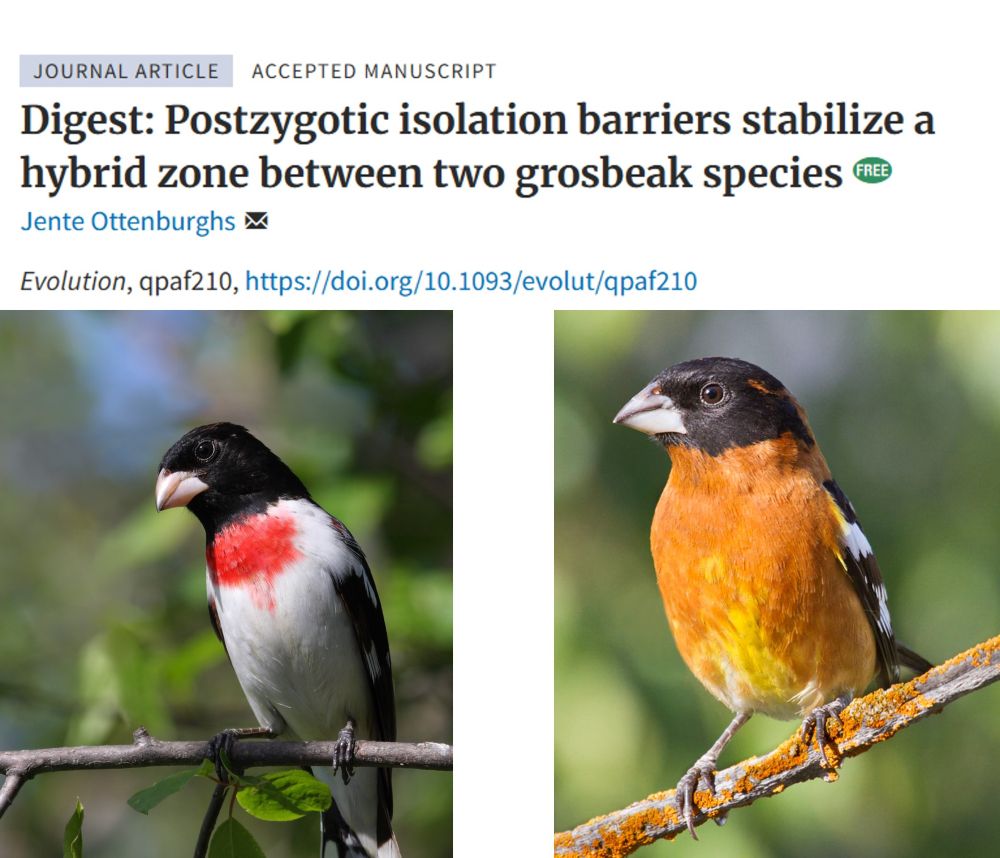
🥳 My latest digest for Evolution is now available online!
Digest: Postzygotic isolation barriers stabilize a hybrid zone between two grosbeak species
academic.oup.com/evolut/advan...
Original paper: academic.oup.com/evolut/advan...
#ornithology
So great to have this work led by @devonderaad.bsky.social covered by an Evolution Digest!
11.10.2025 14:38 — 👍 5 🔁 2 💬 0 📌 0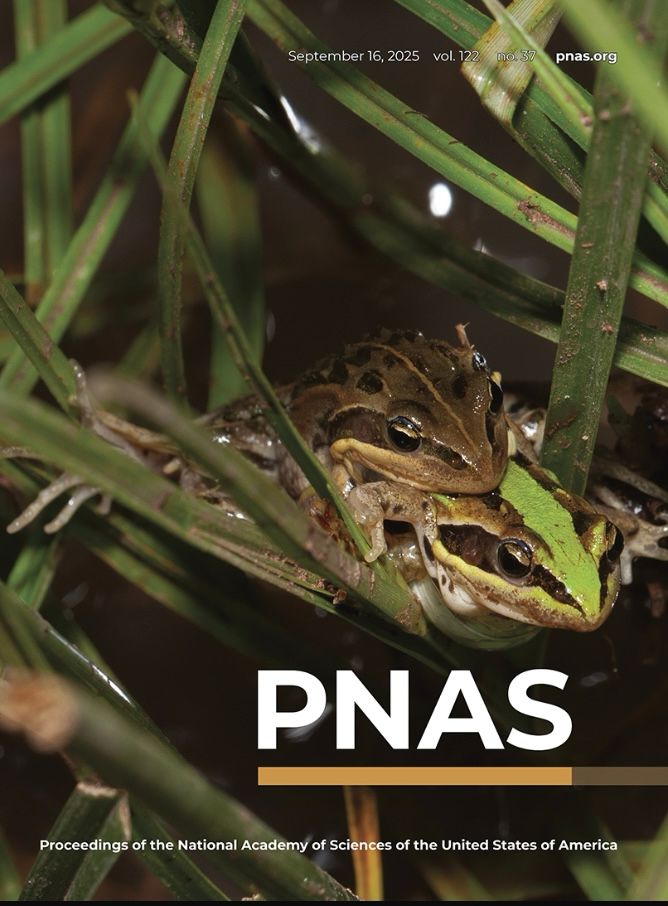
A pair of Ehiopian grass frogs (Ptychadena nana) on the cover of PNAS this week!
Happy to share that our paper on the #evolution and #genomics of the most common #color polymorphism in #frogs is now out in @pnas.org! My favorite frogs even made the cover of this week’s issue! 🎉🐸🎉
Read the paper here: www.pnas.org/doi/10.1073/...

Some species had an outsized role in shaping evolutionary theory. The Fiji Whistlers featured heavily in Ernst Mayr's development of the biological species concept and its application to allopatric taxa. In our new paper, we revisited this system with genomic data 🧵
doi.org/10.1093/sysb...
Like woodpeckers? Or population genomics? Or three-species hybridization? Or selective sweeps?
Then this is for you!
The typeset version of "Evidence for ancient selective sweeps followed by differentiation among three species of Sphyrapicus sapsuckers" is published today:
doi.org/10.1093/jeb/...

Figure 1A from the paper shows the distribution of black-headed (western) and rose-breasted grosbeaks (eastern) throughout North America. Small illustrations of males of each species are shown. Black-headed has a rusty orange breast and black head, while rose-breasted has a small reddish bib with a bright white belly. There is an inset map of South Dakota showing the transect across the hybrid zone
The first Aguillon Lab paper is officially out in early view at Evolution!! Led by postdoc @devonderaad.bsky.social, we’ve explored the hybrid zone between black-headed and rose-breasted grosbeaks in the Great Plains. #ornithology #hybridization #speciation #evolution doi.org/10.1093/evol...
12.09.2025 15:49 — 👍 147 🔁 48 💬 4 📌 1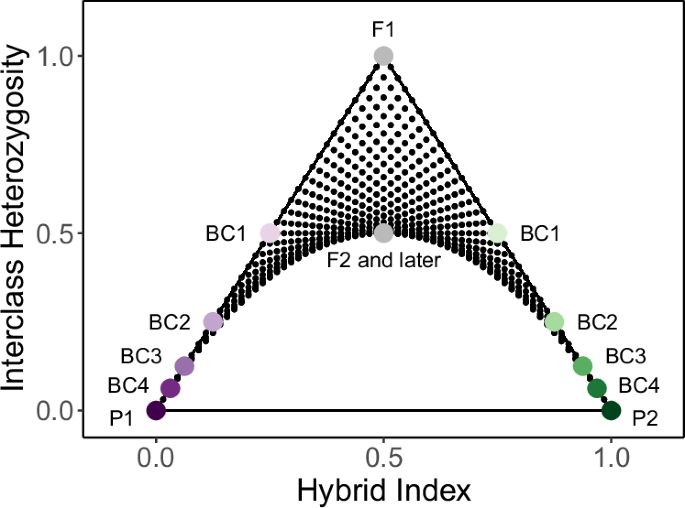
The paper for my R package is published! This has been a fun process learning more about hybrid zones and triangle plots. Thanks everyone who has contributed and tested it out already!
www.nature.com/articles/s41...

After a brief hiatus, the R package SNPfiltR is back on CRAN for easy installation (cran.r-project.org/web/packages...). Be sure to check out the documentation (devonderaad.github.io/SNPfiltR/ind...) to get ideas for the visualizations and filters you can use to better understand your SNP datasets!
04.09.2025 16:50 — 👍 4 🔁 1 💬 0 📌 0