Seconded. If anything, it has never been a better time to be a biophysicist, a complex system physicists, etc…. And it is a bit sad that much of it now happens *outside* of physics departments (for good and bad reasons…)
29.01.2026 17:24 — 👍 10 🔁 5 💬 1 📌 0

I Tried to Be the Government. It Did Not Go Well.
My five-month quest to monitor the weather, track inflation, and inspect milk for harmful microorganisms
Check out this story! Atlantic writer Alexandra Petri visited my lab and played with some fruit flies and human organoids as she wrote about experiencing things that were affected by government cuts.
www.theatlantic.com/magazine/202...
09.01.2026 14:17 — 👍 26 🔁 7 💬 2 📌 1
This is actually a pretty big deal - it gives people whose eligibility to renew is expiring a shot at submitting with the additional data and productivity of the last half year. It would be better if NIH delayed the deadline but I know a bunch of PIs who are now slightly less screwed by the shutdown
19.12.2025 22:26 — 👍 6 🔁 2 💬 1 📌 0
She let me know that they recently received guidance that, ONLY for the January EI deadline (1/27/2026) and the February ESI deadline (2/3/2026), PIs can submit MIRAs even if their previous application (R35, R01, R15, R21, and R37) is still considered under review.
19.12.2025 19:17 — 👍 28 🔁 23 💬 3 📌 0
The path to this paper has so many stories.
Today I want to tell one about the value of saying so when you don't have the answer - and of the importance of community.
10.12.2025 18:25 — 👍 11 🔁 5 💬 1 📌 1

Fishing email saying that a student has filed a report for my class
This fishing email *almost* got me….its that time of year when semester is almost over and weird stuff happens and tired profs are almost the perfect targets here
08.12.2025 17:20 — 👍 6 🔁 1 💬 2 📌 1
We’re hiring!
The Department of Physics
@sfuphysics.bsky.social
at Simon Fraser U (in beautiful and vibrant Vancouver) seeks applications for an Assistant or Associate Professor in Experimental Biophysics, encompassing all scales of life from molecules to ecosystems.
@sfuscience.bsky.social
05.12.2025 17:54 — 👍 15 🔁 9 💬 1 📌 0
University Assistant/Associate Professor in Control Theory and Systems Biology
Applications are invited for a University Assistant/Associate Professorship in the broad area of Control Theory and Systems Biology. The successful candidate will join the Control Group
We are opening a FACULTY POSITION (tenure track, permanent) in the University of Cambridge at the interface of control and biology, interpreted broadly. Theorists and wet lab quantitative biologists with backgrounds in control, EE, applied math, ... apply by Jan 28!
www.cam.ac.uk/jobs/univers...
03.12.2025 12:19 — 👍 42 🔁 41 💬 0 📌 1
Recognizing bad mentors: "One problem student is a concern. Two problem students is a trend. Three problem students is an established pattern." But this is also why evaluating mentorship is hard. Faculty are tenured with small-n student count - and sometimes the victims won't show up in that count
25.11.2025 22:37 — 👍 5 🔁 0 💬 0 📌 0

Intracellular competition shapes plasmid population dynamics
From populations of multicellular organisms to selfish genetic elements, conflicts between levels of biological organization are central to evolution. Plasmids are extrachromosomal, self-replicating g...
Hot off the press! Our latest paper led by @fernpizza.bsky.social, understanding how plasmids evolve inside cells. These small, self-replicating DNA circles live inside bacteria and carry antibiotic resistance genes, but also compete with one another to replicate. 1/
www.science.org/doi/10.1126/...
20.11.2025 21:42 — 👍 436 🔁 200 💬 11 📌 18

screenshot of nature's search feature that shows you can only enter "start page / article no."
Is there an easy way to actually find an article for Nature Communications without a title if you know its article number? Nature's search has the same problem - if you look for article 1, you find all the other articles: www.nature.com/search/advan...
13.11.2025 15:55 — 👍 2 🔁 0 💬 0 📌 0

We’re hiring! 🚨
Assistant Professor (TT) in Theoretical or Computational Biological Physics @univmiami.bsky.social 😀
Come build the future of interdisciplinary biophysics with us!
Apply by Dec 15 → tinyurl.com/5n9bk836
#Biophysics #PhysicsJobs #AcademicJobs #UMiami
08.11.2025 17:53 — 👍 12 🔁 9 💬 0 📌 0
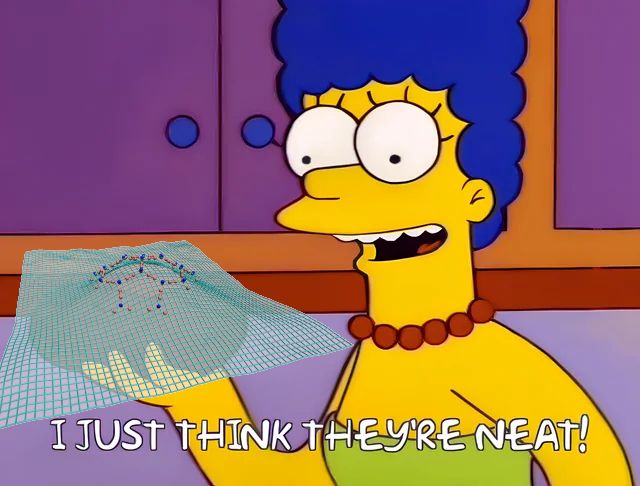
Marge Simpson, holding a CG membrane simulation snapshot: "I just think they're neat!"
"Why do you like membrane bending simulations so much?"
06.11.2025 17:42 — 👍 19 🔁 3 💬 0 📌 0
Ten years ago, I saw a paper with some data that has bothered me ever since: B cells in a 0-100 ng/mL gradient of CCL19 are attracted to CCL19, but B cells in 0-500 ng/mL are repelled (see movie, ignoring the big clusters for now!). Why? Here's our model! doi.org/10.1101/2025...
30.10.2025 17:32 — 👍 26 🔁 8 💬 1 📌 2
This is the work of Grace Luettgen, a very talented @jhu.edu Physics + Biophysics undergraduate - so keep an eye out for her!
30.10.2025 18:51 — 👍 5 🔁 0 💬 0 📌 0

Model showing SNR predicted to switch sign as a function of distance along a device so cells to the left are attracted and cells to the right are repelled, leading to a stable equilibrium
Lots of other predictions, tests. We are hoping this stimulates some further experiments to try to prove us wrong! In particular, our model would predict that cells should be attracted to a particular point in the device - and we don't see this immediately in the data (but can't rule it out).
30.10.2025 18:51 — 👍 5 🔁 0 💬 1 📌 0

Fig. 4B of the preprint shows SNR is mostly positive if CCR7 cannot internalize
Why does internalization matter for chemorepulsion? Internalization decreases the amount of bound receptor. If you inhibit it, you get more bound receptor - and you get attraction again!
30.10.2025 18:51 — 👍 3 🔁 1 💬 1 📌 0
![Fig. 4A of the preprint shows SNR switches from positive to negative to positive as a function of ligand concentration [L]mid in a linear gradient from 0 to 2 [L]mid](https://cdn.bsky.app/img/feed_thumbnail/plain/did:plc:bzr3ca2nj6spdmqkrmj72p5y/bafkreiajddzmtnjohu546j6eslwhptb2asibn4sotbntoaumq7rqopxjxm@jpeg)
Fig. 4A of the preprint shows SNR switches from positive to negative to positive as a function of ligand concentration [L]mid in a linear gradient from 0 to 2 [L]mid
We then propagate error from the noise in the ligand-receptor binding to the noise in the response, and work out the signal-to-noise. The triangle is the 0-500 ng/mL experiment - repelled! The square is the 0-100 ng/mL experiment - attracted!
30.10.2025 18:51 — 👍 3 🔁 1 💬 1 📌 0

Description of Fig. 3 AB from the text: "The form of Eq. (11) as a ratio of two nonlinear functions can lead to multiple switches between chemorepulsion and attraction. We show an example in Fig. 3A in which I undergoes a rapid transition between its basal level and a high level as pb increases (i.e. a large hI), and A slowly saturates as pb increases. We see that at small pb, I does not change much, while A increases – leading to an increase in R = A/I. Then, at the transition point where pb ≈ KI, I increases rapidly with pb, leading to a decrease in R. Then, as I saturates, while A continues to increase, R will increase again. We plot dR/dpb for this case in Fig. 3B, seeing that we have chemoattraction at small pb and large pb, but in the intermediate range
where dR/dpb is negative, there will be chemorepulsion; this
chemorepulsive region is shaded in blue throughout Fig. 3."
Why does response switch from increasing to decreasing as you go toward larger chemoattractant (larger probability of bound receptor)? If A and I are nonlinear functions of the bound receptor, the ratio of the two R = A/I can easily switch between being increasing and decreasing- chemorepulsion!
30.10.2025 18:51 — 👍 4 🔁 0 💬 1 📌 0

Nonlinear feedforward loop with bound receptor activating A, I nonlinearly, and A activating R, I inhibiting R, and R the response - sets the direction the cell travels
Then we take an idea from earlier work on growth cones and assume bound receptor regulates the eventual response of the cell via a nonlinear feedforward loop.
30.10.2025 18:51 — 👍 3 🔁 0 💬 1 📌 0

Fig 1AB of the paper, 1A showing the model for ligand-dependent internalization, Fig 1B showing how the % surface receptor decreases with time in model and experiment
Because we know internalization is important, we start with the simplest possible model for ligand-dependent internalization, which does reasonably at capturing the timescale for the experiments.
30.10.2025 18:51 — 👍 2 🔁 0 💬 1 📌 0
Malet-Engra et al. find chemorepulsion depends on endocytosis doi.org/10.1016/j.cu... - so maybe cells take in CCL19, shaping the gradient around them, somehow reversing it, akin to self-generated gradients? We don't rule this out, but think the data can be explained at a single-cell level.
30.10.2025 18:51 — 👍 2 🔁 0 💬 1 📌 0
Using endocytosis to switch between chemoattraction and chemorepulsion https://www.biorxiv.org/content/10.1101/2025.10.28.685129v1
30.10.2025 10:30 — 👍 3 🔁 3 💬 0 📌 0
Ten years ago, I saw a paper with some data that has bothered me ever since: B cells in a 0-100 ng/mL gradient of CCL19 are attracted to CCL19, but B cells in 0-500 ng/mL are repelled (see movie, ignoring the big clusters for now!). Why? Here's our model! doi.org/10.1101/2025...
30.10.2025 17:32 — 👍 26 🔁 8 💬 1 📌 2
I am teaching Intro to Math Bio (ugrad math about junior level) next semester and I wanted to ask around:
1. If you have taught a similar class, which book have you used and what did you like/dislike about it? (I have the one used previously from another prof and I have a few of my own and
29.10.2025 16:02 — 👍 1 🔁 1 💬 1 📌 0
Fair!
27.10.2025 15:43 — 👍 0 🔁 0 💬 0 📌 0
Hey there, I’m Andrew! I’m a dad and a dinosaur lover, and I review stuff occasionally. (he/him)
🦖📚🦕
dinodadreviews.com
Quantitative Developmental Biology @Duke
Lecturer (Assistant Professor) in the Dept of Mathematics @citystgeorges.bsky.social
Developing and applying mathematical and philosophical tools to pose and address questions at the interface of cancer, evolutionary ecology, and social dynamics.
Physicist and Professor at a university in Chicago.
Black holes, quantum gravity, cosmology.
Rocky Top, Tar Heel.
Reposts are spooky action at a distance.
My views, not my employer's.
https://jacobi.luc.edu, https://mcnees.github.io
Cell Mechanics, Mechanobiology, Biomedical Engineering, Biophysics, Computational Biology, Postdoctoral Researcher in Ian Wong’s Lab at Brown University
Likes to study dynamics of fluid and soft matter. PhD from Clemson and postdoc currently at UNC Chapel Hill.
https://sites.google.com/view/stamim
Writer of the horrific and weird, recovering sociology PhD w/focus on war and genocide. Christian Druid. Creator of the GONE podcast. Author of YOUR SHADOW HALF REMAINS, out now from Tor Nightfire. They/them.
https://linktr.ee/dynamicsymmetry
2nd year computational neuro PhD student at Boston University (advisors Cynthia Bradham & Gabe Ocker)
Mathematically modeling embryonic neurodevelopment
I write trippy scifi & mathfiction.
Ignyte Award Finalist 2025
6 stories in Clarkesworld
Assistant Professor, Department of Physics, Princeton University
Postdoctoral Fellow, Center for the Physics of Biological Function, Princeton University
https://orcid.org/0000-0002-2757-5870
We study how living things build themselves. Core approaches are molecular biophysics and cryo-ET. We also work closely with developmental and computational biologists. Will post about new results, relevant meetings, and cool papers from collaborators.
Professional nerd (science journalist). USian in Austria, language geek, and collector of fine yellow zigzagged sweaters and etymology fun facts. Get my newsletter about big questions at the frontiers of science: www.reviewertoo.com 👽🌀🦋
Quantum Computing boffin, Condensed Matter Physics, Reproducibility.
Professor of Experimental Physics, University of Pittsburgh
Blog: https://espressospin.org/
YouTube: https://www.youtube.com/@spinespresso
Lab: http://frolovlab.org/
https://www.kcl.ac.uk/people/snezhana-oliferenko
Physics Reporter at New Scientist. Author of ENTANGLED STATES, forthcoming from Beacon Press in May 2026. Former teacher. Vegan baker. Aspiring gym rat. Croatian in Queens. Queer.
Bioscientist. Bioengineer. A few other things.
Professor of Statistics, Bayesian, computational systems biologist and functional programmer, https://darrenjw.github.io/
god created him and demanded that he die
Structural cell biology, biophysics, fluorescence, electron microscopy, art, nature. All opinions are my own.