Several independent occurrence of motifs assoc. plasminogen-recruitment across the N1 NA phylogeny including 2 severe H6N1 outbreaks - conclude PLG-recruitment by NA is a general virulence mechanism of N1 LPAIVs
16.02.2026 18:04 — 👍 1 🔁 0 💬 0 📌 0
@willharv.bsky.social
Virus evolution and epidemiology 🦠🧬💻
Several independent occurrence of motifs assoc. plasminogen-recruitment across the N1 NA phylogeny including 2 severe H6N1 outbreaks - conclude PLG-recruitment by NA is a general virulence mechanism of N1 LPAIVs
16.02.2026 18:04 — 👍 1 🔁 0 💬 0 📌 0Colleagues have recently shown NA 122S and HA 345K are both assoc. plasminogen-mediated HA cleavage in a variety of avian cell lines and chicken organoids
16.02.2026 18:04 — 👍 1 🔁 0 💬 1 📌 0
supports proposal of Schön et al. that loss of the NA glycosylation site enables plasminogen-associated, trypsin-independent, HA cleavage allowing systemic viral spread across organs/tissues resulting in higher pathogenicity
16.02.2026 18:04 — 👍 1 🔁 0 💬 1 📌 0
High virulence assoc. loss of a glycosylation site at NA position 122 in wt field strains, with pathogenicity reversed in mutant with NA S122N
16.02.2026 17:16 — 👍 2 🔁 0 💬 1 📌 0
High pathogenicity avian influenza viruses (of subtypes H5 or H7) typically have a modified polybasic cleavage site in HA (haemagglutinin). Growing evidence for other determinants of high pathogenicity such as a change in NA (neuraminidase) observed in field strains of H3N1
16.02.2026 17:16 — 👍 5 🔁 2 💬 1 📌 0Lovely new work shows how mutations adapted a lineage of bird flu to a vastly different host: dairy cattle! This enabled cow-to-cow transmission across the USA www.nature.com/articles/s41...
11.02.2026 15:22 — 👍 0 🔁 0 💬 0 📌 0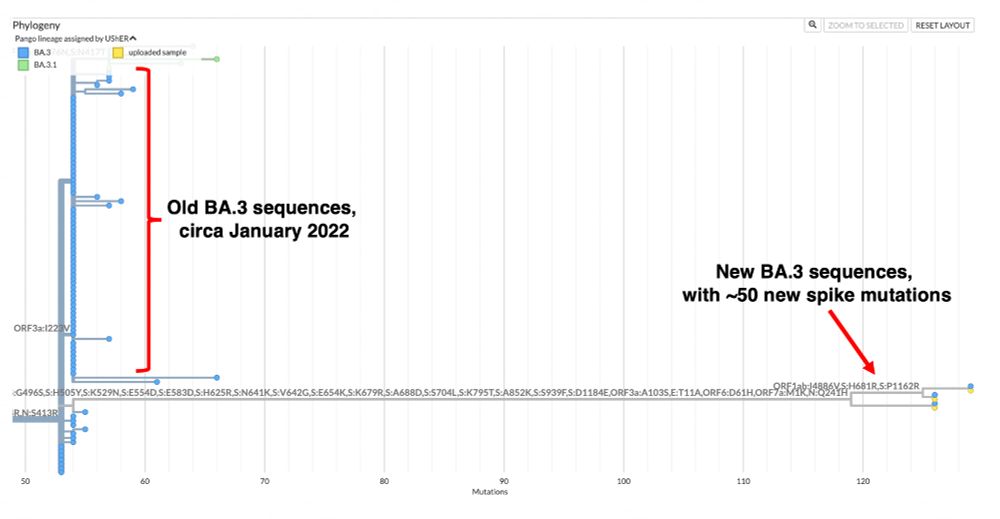
Do you remember BA.3—the weakling cousin of BA.1 & BA.2 that seemed to take the worst from each & had weaker ACE2 binding than even the ancestral Wuhan Virus?
After three years, BA.3 is back.
And it is transmitting.
Who saw this coming?
1/13
I first read the famous 1925 Yule paper at its 80th birthday - during my Master thesis work, and it shaped my research profoundly. It was a pleasure and honour to lead this special 100 anniversary issue celebrating Yule's legacy and phylogenetic models with @noahrosenberg.bsky.social and Mike Steel!
21.02.2025 08:46 — 👍 32 🔁 17 💬 1 📌 0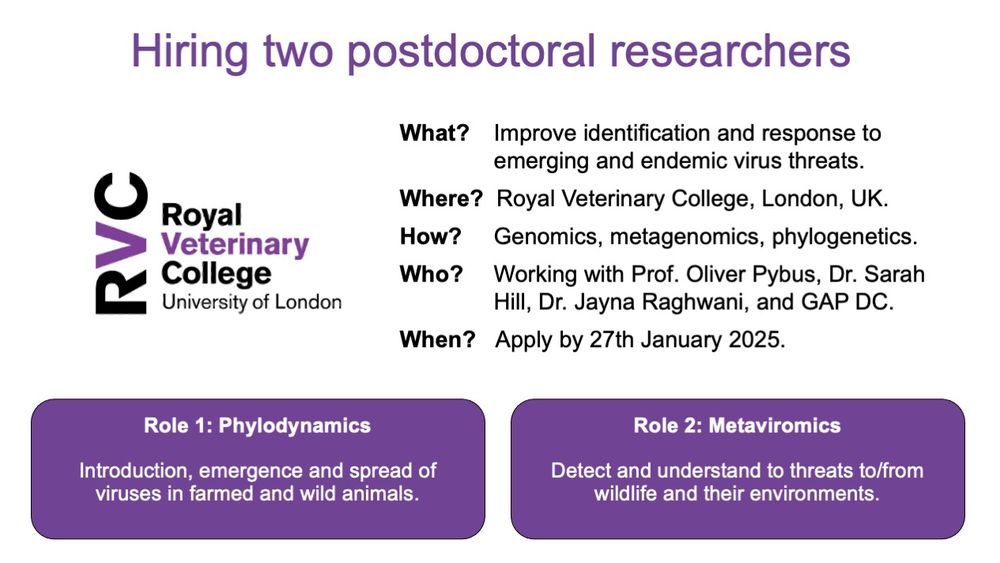
An image with text describing the jobs, and the logo of the Royal Veterinary College. The text says: Title: Hiring two postdoctoral researchers. What? Improve identification and response to emerging and endemic virus threats. Where? Royal Veterinary College. How? Genomics, metagenomics, phylogenetics. Who: Working with Prof Oliver Pybus, Dr Sarah Hill, Dr Jayna Rahgwani, and GAP DC. When? Apply by 27th January 2025. Underneath this, there are two boxes describing the two roles: Role 1: Phylodynamics: Introduction, emergence and spread of viruses in farmed and wild animals. Role 2: Detect and understand threats to/from wildlife and their environments.
🦠 We are recruiting two 2-year postdocs to work at the intersection of virus genomics and infectious disease. jobs.rvc.ac.uk/vacancy.aspx... Please share widely!
18.12.2024 18:03 — 👍 22 🔁 18 💬 1 📌 4Crick in January perhaps. Artwork is great by the way!
28.11.2024 00:01 — 👍 1 🔁 0 💬 1 📌 0Hope it goes well Ed! Went to sign up a couple of weeks ago but sold out… tickets hotter than Oasis this year!
27.11.2024 16:22 — 👍 1 🔁 0 💬 1 📌 0Hi Simon, would love to be added if there’s space. Thanks
26.11.2024 09:57 — 👍 0 🔁 0 💬 1 📌 0If there’s space, I’d love to be added. Thanks Pedro
26.11.2024 09:56 — 👍 0 🔁 0 💬 1 📌 0
Chu-like viruses are weird and wonderful and now infect Tasmanian devils! Definitely worth adding to the reading list 📚
Awesome work by @julienmelade.bsky.social @erinharvey.bsky.social
@eddieholmes.bsky.social
🔗 www.biorxiv.org/content/10.1...
Very well deserved. Congrats 😄
26.11.2024 09:43 — 👍 1 🔁 0 💬 0 📌 0Hey @sjurdur.bsky.social I see you’re ahead of the curve over here. How’s things with you? How were the bonxies in the Faroes this summer?
25.11.2024 12:10 — 👍 1 🔁 0 💬 1 📌 0
Wendy Barclay and I will soon be recruiting a postdoc to work on a virology project investigating the evolution of swine influenza viruses and how this impacts future pandemic potential.
Job will be based at Imperial's South Kensington campus. Drop me a DM/email for more details.
165 years later and some of us are still using trees to think about fitness and competition between types.
24.11.2024 16:35 — 👍 1 🔁 0 💬 0 📌 0"we may, I think, assume that the modified descendants of any one species will succeed by so much the better as they become more diversified in structure, and are thus enabled to encroach on places occupied by other beings"
24.11.2024 16:35 — 👍 0 🔁 0 💬 1 📌 0
It included this developed version of a tree illustrating the evolutionary success of the fittest types (A and I), their diversification and survival into future generations and while others become extinct.
24.11.2024 16:35 — 👍 0 🔁 0 💬 1 📌 0

On this day in 1859, Darwin's 'On the Origin of Species' was published, around 22 years after he sketched perhaps the first phylogenetic tree...
"The affinities of all the beings of the same class have sometimes been represented by a great tree. I believe this simile largely speaks the truth."