Taking a Deep – and Wider – Breath
Examining one of our ocean’s lungs reveals some surprises
Do you like (ocean) science, fun interactive graphics, or cake metaphors? Then check out this StoryMap about our paper created by Annette deCharon & ODYSEA! arcg.is/1PXPSH1
Full paper: agupubs.onlinelibrary.wiley.com/doi/10.1029/...
More StoryMaps: ecco-group.org/publications...
🌊🧪
12.01.2026 16:07 — 👍 8 🔁 2 💬 1 📌 0
The meeting didn't happen yet but I'll make sure to go there when I'm in Glasgow, thanks for the suggestion!
10.01.2026 01:08 — 👍 1 🔁 0 💬 0 📌 0
Hi, could you add me to the feed please? Thanks!
Google scholar link: scholar.google.com/citations?us...
Website: jkoell.github.io
09.01.2026 21:57 — 👍 1 🔁 0 💬 2 📌 0
Yes the form should still work, so just fill it out if you’d like to join!
28.12.2025 06:25 — 👍 1 🔁 0 💬 0 📌 0
🌊⚽ Coming to Ocean Sciences Meeting '26 in Glasgow and looking for some non-science fun?
Then fill out this interest form for the second ever edition of OSM football*: forms.gle/GbjvxnhCBDVy...
Everyone's welcome, and no firm commitment required (yet 👀)
*soccer for my American friends
#OSM26
02.12.2025 22:30 — 👍 5 🔁 2 💬 3 📌 0
Finally Bach decides to drop some new tracks, feels like it’s been 200 years since the last one
17.11.2025 21:39 — 👍 0 🔁 0 💬 0 📌 0
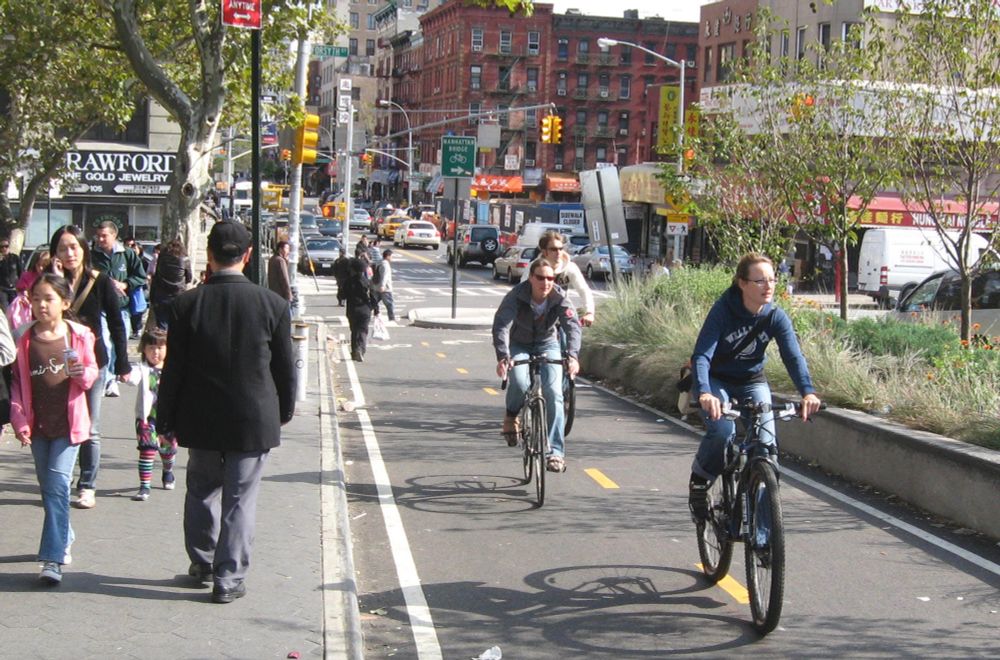
Separated Bike Lanes Means Safer Streets, Study Says — Streetsblog USA
Cities that build protected lanes for cyclists end up with safer roads for people on bikes and people in cars and on foot, a new study of 12 large metropolises revealed Wednesday.
Another reminder that a 13-year study found that protected bike-lanes led to a drastic decline in fatalities for all road users.
ALL ROAD USERS.
And painted bike-lanes? No safety improvement at all.
For sharrows, it’s actually safer to NOT have them.
Via @usa.streetsblog.org @nyc.streetsblog.org
17.11.2025 05:19 — 👍 606 🔁 218 💬 8 📌 8

A Katie Wilson campaign graphic that says Seattle! did your vote count? swipe to make sure. followed by a King County elections graphic showing challenged ballots by age, challenge ballots by language, and challenge ballads by gender.

A Katie Wilson for mayor campaign graphic with a QR code to track your ballot

A Katie Wilson for mayor graphic with a QR code for those with ballots whose signature has been challenged
Katie’s path to the Mayor’s office depends upon your ballot — and probably your friends’ and coworkers’, too! Track your ballot and fix any issues at the following links! Next, send these links to 10 friends and family to make sure Katie wins. #thisisyourcity
10.11.2025 21:41 — 👍 188 🔁 68 💬 0 📌 10
“Essentially we are adding more carbon debt to our planetary credit card, leaving future generations with an unpayable liability.”
07.11.2025 08:21 — 👍 0 🔁 0 💬 0 📌 0

Graphic showing the ocean’s importance for producing oxygen on geological vs biological time scales
There’s also this (much longer, but very helpful) science brief: oceanrep.geomar.de/id/eprint/59... which includes a nice graphic on it:
05.11.2025 17:50 — 👍 2 🔁 0 💬 0 📌 0
The change in the figure is mostly spatial (eastern vs western SPNA), but certainly would expect these processes to change over time too.
I’m currently looking at that, and preliminary results indicate O2 uptake & change are strongest in 2015/16, possibly related to North Atlantic Oscillation
04.11.2025 16:42 — 👍 1 🔁 1 💬 0 📌 0
YouTube video by SciShow
How Climate Change is Strangling our Oceans
And as a bonus, here is a video by @scishow.bsky.social which does a great job explaining ventilation based in part on my previous work: youtu.be/rIvt4s7CX2M - though I’d now argue the whole subpolar North Atlantic is the “lung” of the ocean rather than just the Labrador Sea 🙂
15/🧵
03.11.2025 20:48 — 👍 7 🔁 0 💬 0 📌 1
Lastly, a big thanks to my coauthors - @aj-fassbender.bsky.social, @jdsharp.bsky.social, @dcarrollsci.bsky.social, Alison Gray, and Greg Johnson - to Sarah Battle for creating the schematic, our two reviewers, and everyone involved with @bgc-argo.bsky.social and @globaloceanbgc.bsky.social!
14/🧵
03.11.2025 20:48 — 👍 4 🔁 1 💬 1 📌 0
Read the paper for much more than I could fit here, including
- Actual numbers and uncertainties
- Which gas exchange parameterization we used (and why)
- All the nitty gritty calculations - also available @ github.com/jkoell
- What all this means for how we define ocean ventilation in models
13/🧵
03.11.2025 20:47 — 👍 2 🔁 0 💬 1 📌 0
Not at all! As shown in the schematic, the Labrador Sea is where the accumulated O2 can reach the deep ocean. Exactly how that happens still needs to be researched further - luckily Una Miller (et al) is doing just that, so stay tuned (and go to @jaimepalter.bsky.social’s talk at #OSM26!)
12/🧵
03.11.2025 20:46 — 👍 2 🔁 0 💬 1 📌 0

Which brings us back to our lovely schematic. Our results highlight that ventilation occurs all along the subpolar gyre pathway, in contrast to previous studies (including my own) that focused largely on the Labrador Sea for O2 uptake/ventilation
So does this mean the Lab Sea doesn’t matter?
11/🧵
03.11.2025 20:45 — 👍 4 🔁 0 💬 2 📌 0

To understand why, we turned to an Argo float that tracked the circulation through the SPNA.
The data shows that water is progressively modified: light water becomes SPMW, which becomes denser SPMW, which becomes LSW. The high O2 of LSW is the end result of uptake throughout this process
10/🧵
03.11.2025 20:45 — 👍 4 🔁 0 💬 1 📌 0

Going back to the observational data, O2 levels increase during winter in different water masses - ocean layers defined by their density - as a result of the uptake.
Surprisingly, the change is strongest in subpolar mode water (SPMW), not Labrador Sea Water (LSW), the highest O2 water mass
9/🧵
03.11.2025 20:44 — 👍 3 🔁 0 💬 1 📌 0

Map showing annual air-sea exchange , biological sources and sinks, and physical transport of oxygen in the North Atlantic from an ocean model
Analyzing data from an ocean model we find similar patterns, and also see that the positive oxygen uptake is balanced by a negative transport divergence - implying that the oxygen absorbed from the atmosphere is subsequently carried away by ocean currents.
8/🧵
03.11.2025 20:44 — 👍 2 🔁 0 💬 1 📌 0
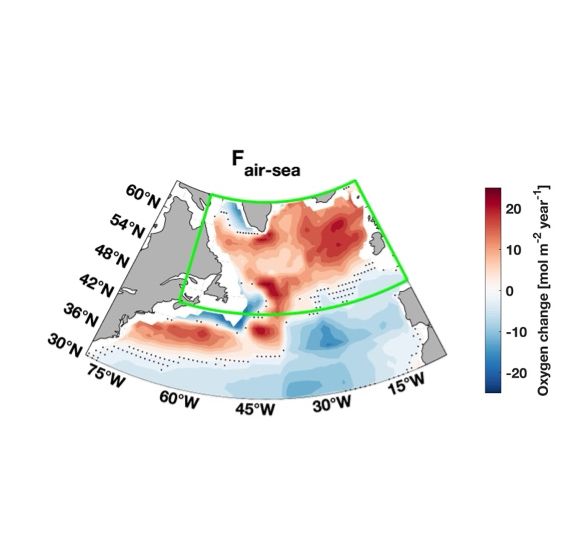
Map showing annual air-sea exchange of oxygen in the North Atlantic
This allowed us to estimate the air-sea exchange of oxygen for the whole SPNA; previous studies had only been able to sample at a single location.
We find that almost the entire SPNA (green box) is an annual oxygen sink, meaning O2 flows from the atmosphere into the ocean year after year
7/🧵
03.11.2025 20:43 — 👍 3 🔁 0 💬 1 📌 0

Global map showing locations of biogeochemical-Argo floats
Which is where our study comes in - improving our understanding of how the North Atlantic is ventilated currently
To find out, we used GOBAI-O2, a data product created by @jdsharp.bsky.social with the help of an army of ocean robots that sample all over the world (@bgc-argo.bsky.social)
6/🧵
03.11.2025 20:42 — 👍 4 🔁 1 💬 1 📌 0
Deoxygenation is projected to further accelerate in the future, and decreased ventilation is a likely reason (doi.org/10.1038/s415...)
But we don’t fully understand when, where, or how much O2 the ocean “breathes in” now, making it difficult to accurately predict future changes
5/🧵
03.11.2025 20:40 — 👍 2 🔁 0 💬 1 📌 0
Oxygen levels in the ocean interior are set by the balance between this supply and oxygen demand from organisms. ⚖️
But - surprise surprise - this delicate balance is threatened by climate change. The ocean has lost 2% of its oxygen since the 1950s, with serious consequences for marine life
4/🧵
03.11.2025 20:40 — 👍 6 🔁 0 💬 1 📌 0
Why do we care about oxygen in the ocean? Well, because things living there need to breathe
And unlike those of us breathing air, ocean organisms can’t always rely on there being enough O2. Without sunlight for plants to grow below ~200m, ventilation is the main O2 supply for most of the ocean
3/🧵
03.11.2025 20:39 — 👍 4 🔁 0 💬 1 📌 0
We looked at ocean ventilation - uptake of oxygen from the atmosphere and its spreading to the rest of the globe - in the subpolar North Atlantic (SPNA), where surface and deep ocean are connected
The goal was to better understand present-day SPNA ventilation to help improve future projections
2/🧵
03.11.2025 20:37 — 👍 2 🔁 0 💬 1 📌 0
Schematic showing oxygen dynamics in the subpolar North Atlantic Ocean
Our new 🌊 paper “Progressive oxygenation of the North Atlantic Subpolar Gyre” is out @jgroceans.bsky.social (open access): agupubs.onlinelibrary.wiley.com/doi/10.1029/...
We examined the breathing of one of the ocean’s lungs 🩺 and found some surprises
Paper summary in schematic, more info ⬇️
1/🧵
03.11.2025 20:36 — 👍 42 🔁 16 💬 5 📌 3

An idealized view of the subpolar gyre circulation, with colors corresponding to oxygen concentration
The subpolar North Atlantic is one region where the deep ocean is in direct contact with the atmosphere, making it a key site for ocean ventilation. Koelling et al., use a new data product to study North Atlantic ventilation in unprecedented detail 🌊
agupubs.onlinelibrary.wiley.com/doi/10.1029/...
01.11.2025 06:56 — 👍 8 🔁 2 💬 0 📌 1
🌊
30.10.2025 20:41 — 👍 2 🔁 0 💬 0 📌 0
Independent conservation journalist writing a book about fish. Author of CROSSINGS, on #roadecology, and EAGER, on beaver belief.
Official account of Seattle Mayor Katie Wilson. Community organizer, coalition builder, and Mayor of Seattle. This is your city — let's make it a great place to live, work, and raise a family. View the City’s digital policies at http://seattle.gov/digital.
Postdoctoral Researcher at the Max Planck Institute for Chemistry
Mainz, Germany
Martinez-Garcia Laboratory - Organic Isotope Geochemistry
Avid diver, surfer, occasional (middling) triathlete
climate science, geochemistry, paleoceanography, rare earth elements
Marie Curie Fellow @ GEOMAR & Uni Lausanne
http://patrick-blaser.github.io
Physical oceanographer working at the MPI for Meteorology, Hamburg
Geological Oceanographer | Researching sediments from the Deep Sea to Mars
• Ph.D. in tiny Arctic rocks, oceans, + squiggly lines
• Exploring extreme environments w/ robot friends
✍️ https://geoshanz.blogspot.com
Prev: @ MarsRoverMapper (ODU+NASA-JPL)
Asst. Prof. of Oceanography. Interested in fluid mechanics, waves, air-sea interaction, physics, geometry, applied math and the history of science. He/him. https://www.nickpizzooceans.com
Physical Oceanographer
Assistant Professor at UC Irvine
https://faculty.sites.uci.edu/drakelab/
Opinions my own, not my employer's
Geoscientist👨🏾🔬 | Visiting Professor at Imperial College | Ex-Academic | 🏃🏾♂️🚴🏾♂️ 🧗🏾♀️🎸🍺| he/him | 🏳️🌈🏳️⚧️| I do all my own stunts | “Self-declared King of Geotwitter” (Palin, 2022) | Professional (East)Midlander 😎| Co-founder of @EarthArxiv
Sea-level and tidal scientist. Liverpool, UK.
Opinions own!
Oceanographer, parent, ally for diversity and inclusion work
Progressive coalition-builder, mom, Mayor-elect of Seattle.
https://linktr.ee/Wilsonforseattle
Your story. Your platform. Follow our live coverage on aljazeera.com
Senior Scientist of Coastal and Marine Ecology Division at GUIDE. Oceanography and Marine biologist.
Climate scientist and writer. IPCC AR6 WG1. Honorary Associate Professor of Climate Science at the University of Melbourne. Author of 'Sunburnt Country', ‘Humanity's Moment' and ‘Highway to Hell’. www.joellegergis.com
Oceanography and paleoclimate scientist at @pik-potsdam.bsky.social |formerly @ccrc.bsky.social | Loves photography | AI hater
Oceanographer and lead of MBARI's Carbon Flux Ecology team. I think a lot about sinking particles, the carbon cycle, and microscopic creatures. Otherwise: fiber art, designing/making clothes, chickens. Views expressed here are my own.
Microbial Oceanographer
@noc.ac.uk
@ird-fr.bsky.social
www.ocean-bridges.net
Science & stories from the sea (& occasionally the other 30% of the planet)
🌊 Marine science, tech, policy, sustainability writer
🤿 Founder of Ocean Oculus, the ocean-focused communications studio
📈 Researcher
☕ Tea drinker
🧀 Cheese eater
🐧 Bird admirer