BREAKING Ukrainian skeleton racer Vladyslav Heraskevych is disqualified from the Winter Olympics after refusing to back down over his banned helmet, which depicts victims of his country's war with Russia
12.02.2026 08:24 — 👍 501 🔁 158 💬 32 📌 74
@sierkdoesscience.bsky.social
I'm an astronomer working with ALMA on the destruction and chemistry of protoplanetary disks. Currently a postdoc at the IWF and no longer living from boxes!
BREAKING Ukrainian skeleton racer Vladyslav Heraskevych is disqualified from the Winter Olympics after refusing to back down over his banned helmet, which depicts victims of his country's war with Russia
12.02.2026 08:24 — 👍 501 🔁 158 💬 32 📌 74
The Royal Astronomical Society is gravely concerned at the drastic cuts to support for UK astronomy outlined by the Science and Technology Facilities Council.
Read our statement 👉 ras.ac.uk/news-and-pre...

To extend her argument, as a Media Studies graduate the author of this couldn't possibly have the context or knowledge to produce an earth-shattering work of genius with unassailable proof everybody was entirely deluded about Shakespeare for over 400 years.
[checks notes]
And I see she hasn't...

Graz, ready for lift-off? The very first event of Astronomy on Tap in Graz launches this Tuesday, January 27th. Join us at 20:00 in Hops Pub!
T-2 days! Join us on Tuesday the 27th at HOPS Craft Beer Pub for the launch event of AoT Graz with two great talks from professional astronomers over some tasty beer! Stay tuned after the talks for some science trivia with the chance to win fun prizes!
Begin at 8pm. See you all on Tuesday!
Looking forward to giving a talk in the inaugural Astronomy on Tap event in Graz! I will be talking about where - and how - we look for disks around young stars where planets are forming.
22.01.2026 18:12 — 👍 4 🔁 0 💬 0 📌 0Wow! Those are some sharp disks.
20.01.2026 14:51 — 👍 1 🔁 0 💬 0 📌 0
Rocks and sand, mostly obscured by clouds. JAXA/ISAS/DARTS/Kevin M. Gill
On the left, Venus with an overexposed sunlit side and infrared night side. On the right, and a little further away, are Earth and the Moon. Observed in ultraviolet and infrared by Japan’s Akatsuki orbiter at Venus on October 21, 2016.
flic.kr/p/2maa5QV
The application for the ESO Summer Research Programme 2026 has just opened!
It‘s a six week programme in Garching close to Munich where pre-Ph.D students can work on a hands-on project.
Working at @eso.org is a fabulous experience, so please help me spread the word ✨
🔗 eso.org/sci/meetings...

A menorah in a window across the street from a building displaying a Nazi flag.
Happy Hanukkah to our friends who celebrate. Rachel Posner, a rabbi’s wife in Kiel, Germany, took this photograph in 1931 -- a potent reminder that fascism must be fought in every generation, even if it's wrapped in an American flag and a red hat.
08.12.2023 01:50 — 👍 2283 🔁 683 💬 13 📌 27
You'll like the Economist's take then: www.economist.com/culture/2025...
13.12.2025 22:04 — 👍 0 🔁 0 💬 0 📌 0
Christ the swarm is out! Now fly & come here my cattle. In the Lord’s peace; in the protection of God; come home in good health. Sit, sit, bees, St Mary impels you. You have no furlough. Do not fly into the woods. Neither will you escape me nor will you elude me. Sit... still; work God’s will.
2/
Wat ik me ook afvraag als ik dit zie: voor wie is dit bedoeld? De 8460 mensen die op de Libertarische Partij hebben gestemd? Of is er een onaangeboord electoraat dat graag wil dat heel Nederland overgaat op de dollar?
03.12.2025 11:58 — 👍 0 🔁 0 💬 0 📌 0
browser.ml.enable browser.ml.chat.enabled browser.ml.chat.menu browser.ml.chat.page browser.ml.chat.page.footerBadge browser.ml.chat.page.menuBadge browser.ml.linkPreview.enabled browser.ml.pageAssist.enabled browser.tabs.groups.smart.enabled browser.tabs.groups.smart.userEnabled extensions.ml.enabled browser.search.visualSearch.featureGate
firefox AI and slop disablers from tumblr for the people from local hero mckitterick. Tried it on my end and the browser is significantly faster now
(copy paste-able in the alt text)
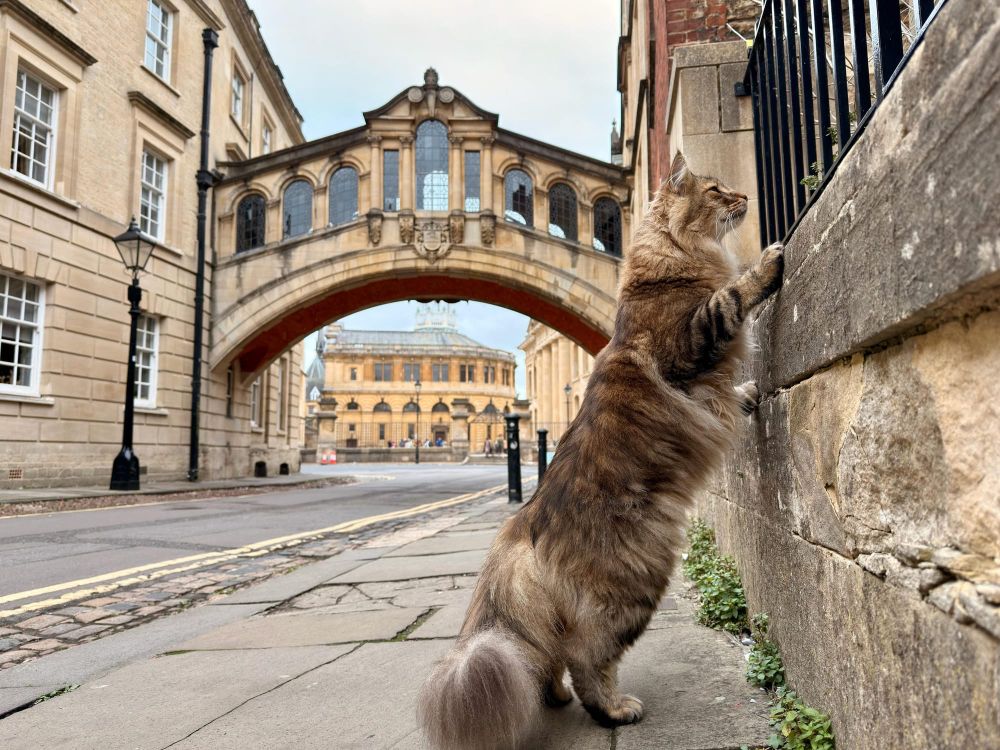
Walter de Staplecat, Simpkin IV, Teabag, Balthasar and Benny D Cat take the stage as we meet the college cats of Oxford. And, of course, Magdalen’s Ozymandias. Read on for our photo special. (Includes a cat map.) oxfordclarion.uk/college-cats...
20.11.2025 11:44 — 👍 361 🔁 135 💬 17 📌 31Avi Loeb's calculations about 3I/ATLAS are 100% wrong because he has never understood that dust in the tail(s) responds to solar radiation pressure. Solar wind shapes the ion tail. But the radiation pressure is about 1000 times larger than the solar wind ram pressure, for particles that feel it.
13.11.2025 21:36 — 👍 160 🔁 30 💬 10 📌 11
A table showing profit margins of major publishers. A snippet of text related to this table is below. 1. The four-fold drain 1.1 Money Currently, academic publishing is dominated by profit-oriented, multinational companies for whom scientific knowledge is a commodity to be sold back to the academic community who created it. The dominant four are Elsevier, Springer Nature, Wiley and Taylor & Francis, which collectively generated over US$7.1 billion in revenue from journal publishing in 2024 alone, and over US$12 billion in profits between 2019 and 2024 (Table 1A). Their profit margins have always been over 30% in the last five years, and for the largest publisher (Elsevier) always over 37%. Against many comparators, across many sectors, scientific publishing is one of the most consistently profitable industries (Table S1). These financial arrangements make a substantial difference to science budgets. In 2024, 46% of Elsevier revenues and 53% of Taylor & Francis revenues were generated in North America, meaning that North American researchers were charged over US$2.27 billion by just two for-profit publishers. The Canadian research councils and the US National Science Foundation were allocated US$9.3 billion in that year.

A figure detailing the drain on researcher time. 1. The four-fold drain 1.2 Time The number of papers published each year is growing faster than the scientific workforce, with the number of papers per researcher almost doubling between 1996 and 2022 (Figure 1A). This reflects the fact that publishers’ commercial desire to publish (sell) more material has aligned well with the competitive prestige culture in which publications help secure jobs, grants, promotions, and awards. To the extent that this growth is driven by a pressure for profit, rather than scholarly imperatives, it distorts the way researchers spend their time. The publishing system depends on unpaid reviewer labour, estimated to be over 130 million unpaid hours annually in 2020 alone (9). Researchers have complained about the demands of peer-review for decades, but the scale of the problem is now worse, with editors reporting widespread difficulties recruiting reviewers. The growth in publications involves not only the authors’ time, but that of academic editors and reviewers who are dealing with so many review demands. Even more seriously, the imperative to produce ever more articles reshapes the nature of scientific inquiry. Evidence across multiple fields shows that more papers result in ‘ossification’, not new ideas (10). It may seem paradoxical that more papers can slow progress until one considers how it affects researchers’ time. While rewards remain tied to volume, prestige, and impact of publications, researchers will be nudged away from riskier, local, interdisciplinary, and long-term work. The result is a treadmill of constant activity with limited progress whereas core scholarly practices – such as reading, reflecting and engaging with others’ contributions – is de-prioritized. What looks like productivity often masks intellectual exhaustion built on a demoralizing, narrowing scientific vision.

A table of profit margins across industries. The section of text related to this table is below: 1. The four-fold drain 1.1 Money Currently, academic publishing is dominated by profit-oriented, multinational companies for whom scientific knowledge is a commodity to be sold back to the academic community who created it. The dominant four are Elsevier, Springer Nature, Wiley and Taylor & Francis, which collectively generated over US$7.1 billion in revenue from journal publishing in 2024 alone, and over US$12 billion in profits between 2019 and 2024 (Table 1A). Their profit margins have always been over 30% in the last five years, and for the largest publisher (Elsevier) always over 37%. Against many comparators, across many sectors, scientific publishing is one of the most consistently profitable industries (Table S1). These financial arrangements make a substantial difference to science budgets. In 2024, 46% of Elsevier revenues and 53% of Taylor & Francis revenues were generated in North America, meaning that North American researchers were charged over US$2.27 billion by just two for-profit publishers. The Canadian research councils and the US National Science Foundation were allocated US$9.3 billion in that year.

The costs of inaction are plain: wasted public funds, lost researcher time, compromised scientific integrity and eroded public trust. Today, the system rewards commercial publishers first, and science second. Without bold action from the funders we risk continuing to pour resources into a system that prioritizes profit over the advancement of scientific knowledge.
We wrote the Strain on scientific publishing to highlight the problems of time & trust. With a fantastic group of co-authors, we present The Drain of Scientific Publishing:
a 🧵 1/n
Drain: arxiv.org/abs/2511.04820
Strain: direct.mit.edu/qss/article/...
Oligopoly: direct.mit.edu/qss/article/...

Artwork depicting a fantasy town with a pair of orc guards with glowing scars looking at a group of heroes, a white-maned lion man, a young woman with blonde flowing curls, a half-giant bard, a vampire-esq noble woman and a handsome humanoid dragon man running through the streets. A stylised logo reads ALTHEYA the Dragon Empire.
We are 35 people away from hitting 3000 sign ups for Kickstarter notifications on this project! Have you signed up?!
rollandplaypress.com/highrollers
A High Fantasy Campaign Setting, with Dragon Nobility, Magical Dimensional Dungeons, & so much more! #dnd #ttrpg #dnd5e @highrollersdnd.bsky.social
At that range of semimajor axes, it's starting to overlap the protoplanetary disk gap population very nicely as well!
07.11.2025 16:17 — 👍 1 🔁 0 💬 0 📌 0We can also make predictions for what we will be able to see if we have better stellar mass measurements: as Gavin points out, with those, it becomes possible to determine how important magnetohydrodynamic winds are for removing angular momentum from a disk.
07.11.2025 15:19 — 👍 1 🔁 0 💬 0 📌 0The idea here was to take Gavin's large grid of disk models (which includes all kinds of physics for disk evolution, and crucially external photoevaporation), and see how the median disk mass evolves with external UV. It matches up really well to observational data in Orion: the environment matters!
07.11.2025 15:19 — 👍 0 🔁 0 💬 1 📌 0
Bit of shameless self-promotion on a Friday afternoon: there's a cool new paper on the arxiv today, by Gavin Coleman and myself, in which we look at the evolution of the trend between disk mass and external UV irradiation from nearby massive stars, and what it tells us: arxiv.org/abs/2511.04410 🪐🔭
07.11.2025 15:19 — 👍 8 🔁 0 💬 1 📌 0Modern astronomy has, of course, progressed a lot since then: we now have peer review and (distributed) time allocation duties instead of corvées.
03.11.2025 12:52 — 👍 2 🔁 0 💬 0 📌 0I think adding stakes would make it a ho-ho, per Pratchett, but I am not a landscape architect.
03.11.2025 09:48 — 👍 0 🔁 0 💬 1 📌 0Open Sesame!
The ELT doors have moved for the first time. This was no small feat, as each door will weigh 650 tonnes once completed.
The ELT dome & its doors will guard the telescope from the harsh conditions of the Atacama Desert.
https://www.eso.org/public/videos/potw2544a/
🔭 🧪
📹 ESO/ACe

In #NatureAstronomy präsentiert ein internationales Team die erste 3D-Temperaturkarte eines Exoplaneten. Mithilfe von Beobachtungen durch #JWST wurde bei #WASP-18b eine Atmosphäre mit unterschiedlichen Temperaturzonen enthüllt. Analysiert und interpretiert wurde diese unter der Leitung des #IWFGraz.
28.10.2025 11:16 — 👍 5 🔁 3 💬 0 📌 1Fantastic article in which actual experts on AI and higher education cut through the nonsense surrounding the infinite garbage engines and expose a system captured by the techbro sales pitch. "A general ban is necessary, but nobody dares to say so."
25.10.2025 10:54 — 👍 175 🔁 64 💬 2 📌 1
A dramatic three-colour Hubble image of an edge-on disk, with distant stars in the background. The disks' midplane forms a dark lane in the middle and hides a young star. Above and below it, dramatic wisps of backlit dust can be seen. To the north of the disk, faint filaments of material connect to the disk. On the left side of the dust lane, there is a hint of a spiral. Descriptions of the disk features are based on Fig. 2 in the paper.
Very cool work from Monsch et al. on the arxiv today, on a recently-discovered protoplanetary disk seen very nearly edge-on. It has weird, wispy structures and asymmetries - far more dynamic than we normally imagine disks to be! And, of course, it makes for beautiful images.
arxiv.org/abs/2510.11819

GOOD NEWS !
"A team of musicologists has unearthed the printed score of a previously unknown Purcell song, as well as the original manuscript for various keyboard compositions."
#baroque #music
www.theguardian.com/music/2025/o...
We bail out banks. We bail the steel industry, the water industry, airlines and hotels.
The UK higher education sector directly employs nearly 1M people. It's the envy of the world and benefits almost every area of UK society. But apparently it can go burn.
Another argument against these things is that, if someone else's missile defense is 90% effective, you have no reason to not try it anyway and maybe blow up just one major city instead of ten, lowering the barrier to a nuclear exchange between superpowers.
18.09.2025 16:04 — 👍 0 🔁 0 💬 1 📌 0