Replication studies: a win-win for early-career training and behavioral ecology
Replicating previous research builds confidence that results are real and meaningful. But close replications are rare due to limitations in resources and d
How do we know our research results are REAL? We replicate them! Most folks agree but lament on how hard it is to publish these replications.
My dearest gentle reader, lament no more! Delighted to unveil: Replication Studies, a new section of Behavioral Ecology 1/
academic.oup.com/beheco/artic...
10.02.2026 19:42 — 👍 210 🔁 107 💬 4 📌 8
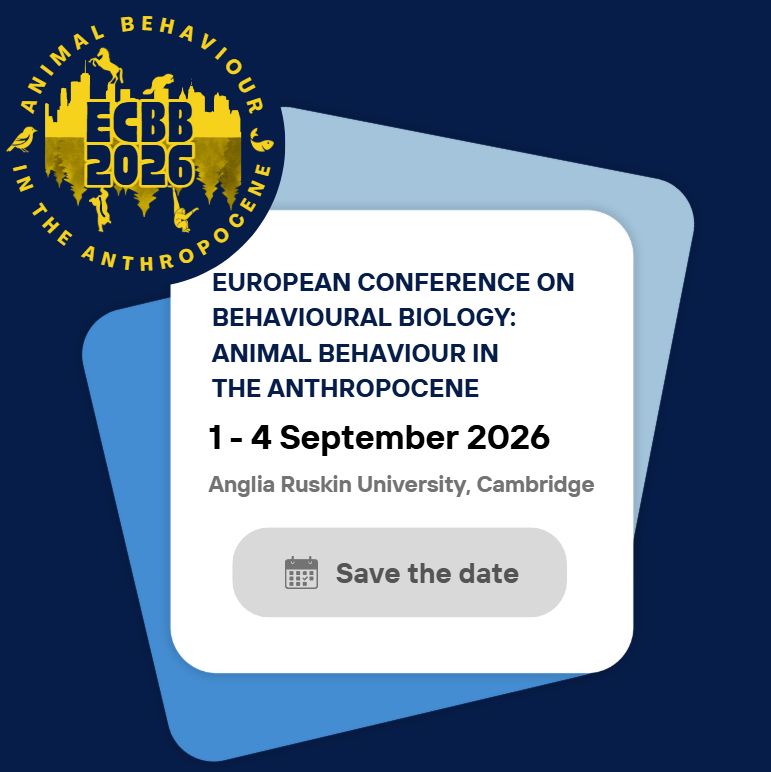
Save the date information for the upcoming European Conference on Behavioural Biology: Animal Behaviour in the Anthropocene. 1-4 September 2026 at Anglia Ruskin University, Cambridge, UK.
Save the date for the next European Conference on Behavioural Biology!
Animal Behaviour in the Anthropocene, 1-4 September 2026 at Anglia Ruskin University.
Watch this space for updates on speakers, plenaries, and calls for abstracts!
#AcademicSky #UpcomingConferences
18.07.2025 10:38 — 👍 24 🔁 17 💬 1 📌 2
CORVIDATA: A global dataset of morphology, ecology, sociality, and life-history in Corvidae - Scientific Data
Scientific Data - CORVIDATA: A global dataset of morphology, ecology, sociality, and life-history in Corvidae
If you work on corvid ecology, behaviour, cognition, or conservation, this might be useful for you 👇
I’ve just published CORVIDATA in Scientific Data 🐦
doi.org/10.1038/s415... (1/4)
06.01.2026 10:40 — 👍 72 🔁 55 💬 2 📌 1

In this blog post, Guest Editor @rachkendal.bsky.social discusses their #PhilTransB issue, 'Transforming cultural evolution research and its application to global futures': royalsociety.org/blog/2025/12...
13.12.2025 14:01 — 👍 8 🔁 4 💬 0 📌 0

Anthropogenic change and the loss of behavioural diversity
Abstract. Behavioural diversity is an important but understudied facet of biodiversity that enables wildlife populations to cope with rapidly changing envi
What are the causes & consequences of behavioural diversity loss in a changing world? And how do we harness this knowledge for conservation? New open access paper led by @odedberger-tal.bsky.social with David Saltz and @mrmic1.bsky.social
#BobWongLab
royalsocietypublishing.org/rspb/article...
10.12.2025 20:58 — 👍 46 🔁 27 💬 2 📌 0
New paper out today w @dalmaijer.bsky.social @barbaraklump.bsky.social and @lucymaplin.bsky.social as part of the Phil Trans special issue doi.org/10.1098/rstb.... Over 2 years, we studied a population of cockatoos thought to be the source of the innovation of bin-opening.
04.12.2025 13:31 — 👍 104 🔁 42 💬 3 📌 8
Enjoyed giving an invited research talk today for the Behaviour & Ecology Research Group at @uniofhull.bsky.social - thanks very much for inviting and hosting me, @drblakemorton.bsky.social :)
28.11.2025 20:11 — 👍 6 🔁 0 💬 1 📌 0

Bad mentors hurt people
What to do about bad mentors?
You know those labs that keep harming students, again and again? Some reflections on why it's so hard to stop this from happening and where our responsibilities lie.
scienceforeveryone.science/bad-mentors-... 🧪
25.11.2025 18:38 — 👍 78 🔁 30 💬 5 📌 8
New amazing open Postdoc position, w/t opportunities to 1) get closely involved in our next @themanybirds.bsky.social study on innovation and problem-solving; 2) work with @ecobird.bsky.social on avian innovation, cognition & invasiveness. Advert: www.ugent.be/en/work/scie...
14.11.2025 06:20 — 👍 13 🔁 17 💬 0 📌 0
New amazing open Postdoc position, w/t opportunities to 1) get closely involved in our next @themanybirds.bsky.social study on innovation and problem-solving; 2) work with @ecobird.bsky.social on avian innovation, cognition & invasiveness. Advert: www.ugent.be/en/work/scie...
14.11.2025 06:16 — 👍 12 🔁 8 💬 0 📌 0
Amazing opportunity for a PhD position with the wonderful Dr Megan Lambert in Vienna and her fascinating kea parrots! 10/10 recommend working with Dr Lambert. See advert linked below for more info.
14.11.2025 06:08 — 👍 5 🔁 1 💬 0 📌 0

Postdoctoral fellow
🐦 EcoBird is hiring a Postdoc in animal cognition!
Join us + @themanybirds.bsky.social to investigate innovation & problem-solving in birds.
📅 Start: as early as Jan 2026
🌍 Funded through UGent’s international mobility scheme
More info & how to apply ↓
www.ugent.be/en/work/scie...
13.11.2025 14:23 — 👍 35 🔁 47 💬 1 📌 3

Playing dice with behavior: drivers of stochastic individuality
Animal behavior is often viewed as stemming from predictable genetic and environmental factors. However, despite our best attempts to control genetic …
Our new paper offers an explanation for the universal law that "under carefully controlled conditions.... an animal behaves as it damn well pleases." We explore how stochastic mechanisms may play an underappreciated role in generating individuality. (1/7 🧵)
www.sciencedirect.com/science/arti...
10.11.2025 18:32 — 👍 48 🔁 18 💬 1 📌 1
The MBirds paper is out! Congratulations to all collaborators on this major accomplishment 🧪 The study found interesting differences in neophobia between migratory and non-migratory species: doi.org/10.1371/jour...
16.10.2025 11:46 — 👍 6 🔁 1 💬 0 📌 0

Left: Examples of novel objects used. Each black/white bar is 5 cm long. The objects ranged in size from a third to half the size of the subjects: (a) Southern cassowary, Casuarius casuarius, (b) Moluccan eclectus, Eclectus roratus, (c) Rüppell’s vulture, Gyps rueppelli, (d) gray-winged trumpeter, Psophia crepitans, (e) common waxbill, Estrilda astrild. Right: Secretary bird (Sagittarius serpentarius) at Adlerwarte Berlebeck, Germany, interacting with a novel object. Image credit Kai Caspar.
Fear of novelty varies across species & individuals, impacting adaptability & survival. @themanybirds.bsky.social @drrmiller.bsky.social &co assess #neophobia in 1400 subjects from 136 #bird species, identifying phylogenetic influences & broad ecological drivers @plosbiology.org 🧪 plos.io/4haLEsN
15.10.2025 12:55 — 👍 9 🔁 6 💬 1 📌 0
It was such an incredible, enriching, and fun experience — I learned so much ❤️ So thankful to the amazing leadership team who welcomed me! @drrmiller.bsky.social @vedranaslipogor.bsky.social @nomascus.bsky.social @stephanreber.bsky.social @cds-york.bsky.social Megan Lambert & Claudia Mettke-Hofmann
15.10.2025 13:40 — 👍 6 🔁 3 💬 1 📌 0
So excited that our first major empirical @themanybirds.bsky.social paper is now out in @plosbiology.org!
Leading this big team science project, with our excellent core leadership team, is a labour of love for me, delighted to see our hard work over the past 4 years has reached this milestone!
14.10.2025 19:40 — 👍 45 🔁 14 💬 0 📌 3
Planning was not linked with theory of mind, thus thinking about one's own future may rely on a different skill set than switching perspectives. Using this under-represented sample, we show managing one's own thoughts/actions is a crucial building block for learning how to prepare for tomorrow. 6/6
10.09.2025 12:14 — 👍 0 🔁 0 💬 0 📌 0

Figure shows mean scores of children’s responses in Card in Basket task, i.e. one of the 4 future-oriented cognition tasks
Our findings: age four seems to be a turning point, 4- and 5-year-olds outperformed 3-year-olds - consistent with Western findings, suggesting a common developmental milestone. Planning & executive functions were linked: children with stronger executive functions were better at future planning. 5/
10.09.2025 12:14 — 👍 1 🔁 0 💬 1 📌 0
We tested future-oriented cognition (imagining/ constructing mental representations of future & future planning), executive function (working memory, inhibition, cognitive flexibility) and theory of mind (understanding/ attributing mental states to others). 4/
10.09.2025 12:14 — 👍 0 🔁 0 💬 1 📌 0
Most research on this topic has focused on children in Western countries. To broaden our understanding, we conducted a study with 87 3 to 5-year olds in China to see if their development followed similar patterns. 3/
10.09.2025 12:14 — 👍 0 🔁 0 💬 1 📌 0
As researchers, we're fascinated by how children learn to think about the future. You might see this challenge in your own life - ever tried to convince a preschooler to bring a jacket because it might get cold later, only for them to refuse because they're warm now? 2/
10.09.2025 12:14 — 👍 0 🔁 0 💬 1 📌 0

Cognitive correlates of future-oriented cognition in young Chinese children
Future-oriented cognition, which broadly encompasses an array of cognitive processes involved in understanding, constructing, imagining and planning f…
New paper just out: Rachael Miller @drrmiller.bsky.social, Ning Ding & Nicky Clayton in Cognitive Development: www.sciencedirect.com/science/arti... on the “Cognitive correlates of future-oriented cognition in young Chinese children”. @campsydept.bsky.social @cam.ac.uk 1/
10.09.2025 12:14 — 👍 2 🔁 0 💬 1 📌 0
Stay tuned for a very exciting update coming shortly from the ManyBirds Project! Eeek!
09.09.2025 10:30 — 👍 6 🔁 3 💬 1 📌 0
Dream team: Alessandroni @drrmiller.bsky.social @dremalt.bsky.social @marinabazhydai.bsky.social @mamsmandrill.bsky.social @jespinosa.bsky.social Gjoneska @izziehb.bsky.social @valmazza.bsky.social Paukner @epronizius.bsky.social Proulx, Qadri, Reilly, Schwing ...
13.07.2025 13:22 — 👍 3 🔁 2 💬 1 📌 0
It's been a busy few weeks, with also giving a research talk at the Behaviour Discussion Group, Department of Ecology and Conservation, University of Exeter in June - thank you again to @cornishjackdaws.bsky.social for hosting me! 2/2
16.07.2025 11:40 — 👍 2 🔁 0 💬 0 📌 0

Powerpoint title slide
Really enjoyed giving an invited research talk today at the Behaviour and Evolution seminar series, Departments of Behavioural Ecology, Evolutionary Biology and Theoretical Biology at Bielefeld University. Thank you @kpg13.bsky.social for inviting me! 1/2
16.07.2025 11:40 — 👍 7 🔁 1 💬 2 📌 0
Check our new preprint! Our systematic review of 206 reversal learning studies shows that behavioural flexibility research is heavily biased towards birds, rodents, and humans, with most animal diversity virtually untested. #Manymanys #BigTeamScience #ComparativeCognition
13.07.2025 13:22 — 👍 16 🔁 6 💬 1 📌 1
Early-Midcareer terrestrial ecologist studying mammals, habitat, and invaded ecosystems. Founder & Director of ReHabitat - making biodegradable wildlife habit units. On the land of the Wallamattagul Clan of the Dharug Nation.
RyC fellow at BETA-UVic & BiBio research team, interested on how biodiversity is organized and how it can be impacted by humans. Focus on terrestrial vertebrates 🦜🐯🧑🏽💻 #biodiversity #macroecology #macroevolution #extinction #vertebrates
Professor of Animal Behaviour. Posts mostly about The Lizard Lab - research group investigating behaviour, ecology, evolution of lizards (mostly). https://whitinglab.com/ for research, members, photos, blog. All other links: https://linktr.ee/lizard_lab
Environmental Conservation. Journal promoting interdisciplinary environmental conservation science and practice since 1973. Editor Prof. Nick Polunin. https://www.cambridge.org/core/journals/environmental-conservation
With over 400 years of history and a strong commitment to innovation and academic excellence, we offer a wide range of programs and opportunities to learn, grow and make an impact.
Follow for the latest #utrechtuniversity news, research & information
Our mission is to increase openness, integrity, and trustworthiness of research.
PhD candidate, Behavioural Ecology,
Max Planck Institute for Evolutionary Biology
Scientific journal publishing research, overview and commentary across all of biology. All of it!
https://www.cell.com/current-biology/home
Part of CellPress @cellpress.bsky.social
Max Planck Research Institute
Anthropologist interested in hunter-gatherer egalitarianism | Asst Prof @BaylorAnthro.bsky.social | Editor-in-Chief, Hunter-Gatherer Research | Spelling errors my own
🐭 innovation, individual differences and social learning | Postdoc @ Uni Hildesheim | PhD @mpi-evolbio.bsky.social
Your daily source for only good news: Inspiring stories and images from around the world will make you feel uplifted, optimistic and positive about life.
🌉 bridged from 🌐 https://goodnewsnetwork.org/: https://fed.brid.gy/web/goodnewsnetwork.org
Max Planck Institute investigating how animals acquire, store, apply and pass on knowledge about their environment.
The Research Whisperer is dedicated to the topic of doing research in academia. We’re here to support, encourage, and work towards better academic lives. Created and managed by @tseenster and @jod999
Blog: https://researchwhisperer.org/
Postdoctoral researcher at Ruhr-University Bochum. Philosophy of mind and cognitive science, animal minds, rationality and emotions, inference, philosophy of science, did some work on AI (before it was cool)
Professor at UCL, Restoration of freshwaters, ponds, lakes, rivers, meadows, plants, diatoms, fish, eels, burbot, crucians, palaeoecology, rewilding, Norfolk: https://www.ucl.ac.uk/geography/carl-sayer
Biology, physics, data science, and coral reefs! On May 4, Star Wars Facts.
Promoting Cognitive Science as a discipline and fostering scientific interchange among researchers in various areas.
🌐 https://cognitivesciencesociety.org
Co-founder of BES Evolutionary Ecology Group.
Loves Dartmoor, Sweden, XC skiing, fell running, sunsets, knitwear, teaching & cream teas. And evolutionary ecology, obvs.
PhD Candidate at the Australian National University, working on innovativeness, cognitive ecology and social learning in sulphur-crested cockatoos 🦜