Why Peer Review Does Not Guarantee Reliable Research
An examination of the limits of peer review and why reliable scientific knowledge emerges through accumulation rather than publication alone.
Peer review is often treated as a seal of truth.
In reality, it answers a narrower question:
Is this defensible right now?
Reliability usually emerges after publication, through reuse, comparison, and time.
Why peer review alone does not guarantee reliable research 👇
05.02.2026 19:25 — 👍 0 🔁 0 💬 0 📌 0

How to Evaluate Research Papers Beyond Journal Prestige
A practical framework for evaluating research papers under time pressure. Learn how to assess study design, bias, transparency, and credibility beyond journal prestige.
Journal prestige is a weak proxy for study quality.
If you want reliable evidence, you need to evaluate papers at the study level, not the venue level.
Here’s a practical system that scales under time pressure.
03.02.2026 16:30 — 👍 1 🔁 0 💬 0 📌 0

How Scientists Evaluate What Counts as Good Evidence
Why scientists often disagree about evidence, and how disciplinary norms shape what counts as rigorous, credible research.
Good evidence isn’t universal.
It’s shaped by constraints, risks, and the questions a field can realistically ask.
How scientists evaluate evidence across disciplines.
29.01.2026 16:48 — 👍 0 🔁 0 💬 0 📌 0

When to Trust a Preprint (And When Not To)
A practical guide for scientists on when to trust preprints and when to be cautious. Learn how to evaluate unreviewed research responsibly.
Preprints are now central to how science moves.
That doesn’t make them unreliable by default. It makes reader judgment more important.
When to trust them, and when to slow down.
27.01.2026 16:45 — 👍 0 🔁 0 💬 0 📌 0

What makes lightning choose where to strike?
Sky’s Wild Guess
sciweave.com/share/b3877e...
23.01.2026 15:25 — 👍 0 🔁 0 💬 0 📌 0

Why Most AI Tools Fail Researchers (And What Actually Works)
Most AI tools fail researchers not because of intelligence, but misalignment. Learn what actually works for evidence, traceability, and trustworthy research.
Most AI tools optimize for fluency and speed.
Research requires traceability, uncertainty, and accountability.
That mismatch is why many AI tools quietly fail researchers.
What actually works instead.
22.01.2026 03:44 — 👍 0 🔁 0 💬 0 📌 0

From Research Question to a Defensible Literature Review
A step-by-step workflow for turning a research question into a defensible literature review. Learn how experienced researchers search, evaluate, and synthesize evidence.
A defensible literature review isn’t about how many papers you cite.
It’s about whether someone else could reconstruct why each paper is there.
Here’s a workflow that makes reviews auditable, updatable, and defensible.
20.01.2026 16:30 — 👍 0 🔁 0 💬 0 📌 0

Is the universe infinite, or does it loop back on itself?
Cosmic Cliffhanger
sciweave.com/share/807347...
16.01.2026 16:25 — 👍 0 🔁 0 💬 0 📌 0

DeSci Codex: Decentralized Infrastructure for Scientific Publishing
DeSci Codex is a decentralized protocol for publishing durable, reusable, and AI-ready research objects beyond PDFs. Built for developers and open science.
Research shouldn’t disappear when platforms change.
Codex uses persistent identifiers, versioning, and decentralized resolution to keep science accessible and reusable over time.
Why durability matters more than ever:
15.01.2026 16:45 — 👍 0 🔁 0 💬 0 📌 0

Top 5 Research & Science GPTs Available on ChatGPT
Discover the best Custom GPTs on ChatGPT for scientific and academic research, including tools for literature review, citations, and study analysis.
Not all research GPTs are created equal.
Here are the 5 Custom GPTs that actually work for academic and scientific research, not generic web summaries.
Full list 👇
🔗
13.01.2026 18:30 — 👍 0 🔁 0 💬 0 📌 0

How do birds migrate thousands of miles without getting lost?
Feathered GPS
sciweave.com/share/60b1e6...
09.01.2026 16:25 — 👍 1 🔁 0 💬 0 📌 0

How to Avoid Fake Citations When Using ChatGPT for Research
ChatGPT can generate convincing but fake citations. Learn why this happens and how to use ChatGPT safely for academic and scientific research.
Ever pasted a ChatGPT citation into Google Scholar…
and found nothing?
That paper probably never existed.
Here’s why fake citations happen and how to avoid them when doing research 👇
08.01.2026 16:30 — 👍 1 🔁 0 💬 0 📌 0
Happy New Year, DeSci community! 🎇🔬
Thank you for supporting open science, better research infrastructure, and new tools for sharing and accessing knowledge throughout 2025.
We’re excited for what’s ahead - more collaboration, more innovation, and a more open science ecosystem in 2026. 🥂
01.01.2026 11:30 — 👍 3 🔁 0 💬 0 📌 0

Productive Mornings for Researchers: Habits That Save Time
Practical morning habits top researchers rely on to protect focus, reduce decision fatigue, and save hours each week without adding more work to the day.
Some researchers get more done by noon than others do all day. It’s because their mornings are structured around focus, clarity & small habits that compound.
This blog breaks down what those habits look like, from research queues to literature windows to warm-start rituals.
30.12.2025 18:30 — 👍 0 🔁 0 💬 0 📌 0

DeSci - Recognizing True Novelty in Scientific Research
A practical guide to spotting genuine novelty in scientific research without being misled by buzzwords, inflated claims, or superficial innovation.
Everyone claims their work is “novel.” But true novelty changes how a field thinks, asks questions or collects evidence.
This post breaks down how to recognize genuine innovation, avoid buzzword traps and understand the leverage a study really provides.
26.12.2025 19:25 — 👍 0 🔁 0 💬 0 📌 0

Christmas tree close up
Wishing everyone in the DeSci community a warm and joyful holiday season! 🎄💫
Thanks for supporting open science, transparent peer review, and better tools for researchers.
Here’s to more innovation and collaboration in the year ahead.
Happy Holidays from DeSci Labs! 🎁🔬
25.12.2025 14:42 — 👍 1 🔁 0 💬 0 📌 0

How Can Scientists Avoid Confirmation Bias in Research?
Discover practical habits scientists can use to avoid confirmation bias, improve the reliability of their research, and strengthen evidence based conclusions.
Every scientist is vulnerable to confirmation bias.
This blog breaks down practical habits to keep your reasoning sharp: rewriting questions, pre-registering methods, reading contradictory work, and using tools like SciWeave to see the full evidence picture.
Worth a read:
23.12.2025 16:02 — 👍 2 🔁 0 💬 0 📌 0

How did water first arrive on Earth?
Hydration origins
sciweave.com/share/d4dc19...
19.12.2025 17:25 — 👍 2 🔁 0 💬 0 📌 0

DeSci Labs - Blog | How to Read Academic Papers Faster
Practical strategies to help students and researchers read academic papers faster while still catching the arguments, methods, and insights that matter most.
Most academic papers are slower to read than they need to be.
This post shows how to scan effectively, focus on the core structure, use figures first, and avoid getting pulled into unnecessary details.
18.12.2025 16:40 — 👍 2 🔁 1 💬 0 📌 0

Using AI to Validate Scientific Claims in Legal Briefs
Learn how legal teams can use AI to verify scientific claims, strengthen evidence-based policy, and avoid unreliable research in legal briefs. A practical guide for lawyers, policymakers, and…
Courts are seeing more scientific claims than ever, but evaluating the research behind them is tough. AI can help lawyers check whether a study is actually strong, whether it’s been contradicted, and where the consensus really sits.
Find out how:
16.12.2025 16:30 — 👍 0 🔁 0 💬 0 📌 0

If atoms are mostly empty space, why can't we walk through walls?
Empty but off-limits
sciweave.com/share/d4541f...
12.12.2025 15:25 — 👍 1 🔁 0 💬 0 📌 0

How to Build a High-Quality Literature List for Assignments
Learn how to find, evaluate, and organize high quality academic sources with a step by step framework for building a strong literature list.
Good writing depends on good sources.
This post breaks down how to build a solid literature list: where to search, how to judge study quality, how many sources you actually need, and how tools like SciWeave can speed up the process.
Check it out:
11.12.2025 16:46 — 👍 3 🔁 0 💬 0 📌 0

How Clinicians Can Use AI to Stay Ahead of Medical Knowledge
Learn how clinicians can use AI research tools to stay ahead of rapidly evolving medical knowledge. Discover how platforms help doctors verify evidence, interpret new studies, and more.
Clinicians are drowning in new studies, shifting guidelines, & contradictory evidence.
This article looks at how AI tools fit into real clinical workflows, from rapid evidence checks to clarifying study quality.
09.12.2025 18:30 — 👍 1 🔁 0 💬 0 📌 0

Why doesn't the Sun burn out if it's been shining for billions of years?
Solar show-off
sciweave.com/share/e2cb07...
05.12.2025 15:25 — 👍 0 🔁 0 💬 0 📌 0

How to Prepare for Comprehensive Exams Without Burning Out
A practical guide to preparing for comprehensive exams with focus, confidence, and sustainable habits that help you avoid burnout and stay sharp through the entire process.
Exams can feel overwhelming, but you don’t have to grind yourself into burnout.
Our latest post shares practical ways to study with focus, build sustainable habits, and keep your brain (and sanity) intact.
04.12.2025 16:27 — 👍 0 🔁 0 💬 0 📌 0

DeSci – Students Guide: How to Read Academic Papers Faster
Learn how to read academic papers faster without losing understanding. Practical tips for students to find key ideas, stay focused, and save time.
Academic papers can feel slow and overwhelming. This guide breaks down simple ways to read with more focus, pick out what matters, and use tools like SciWeave to make tough sections clearer.
Worth a look if you want to read research more efficiently 👇
02.12.2025 15:24 — 👍 1 🔁 1 💬 0 📌 0
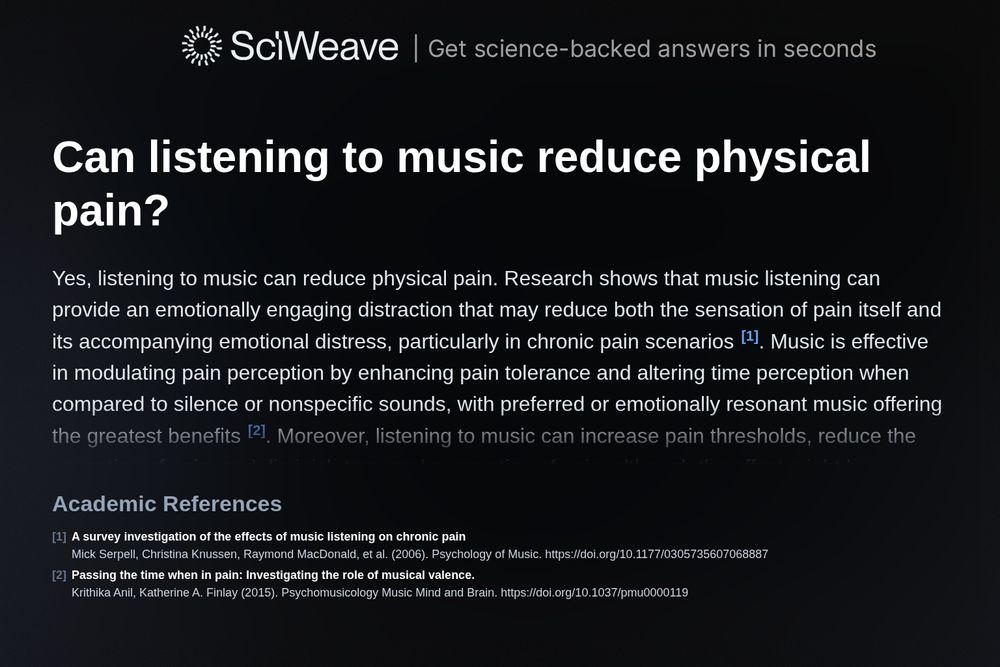
Can listening to music reduce physical pain?
Music Heals Pain
sciweave.com/share/046246...
28.11.2025 16:25 — 👍 0 🔁 0 💬 0 📌 0

DeSci - Blog | Finding Reliable Sources When ChatGPT Fails
ChatGPT isn’t always accurate. Learn how to find reliable research sources, fact-check AI answers, and use trusted tools for credible academic work.
ChatGPT can explain anything, except where its info comes from.
When citations matter, you need tools built for evidence.
Here’s how to find reliable research sources when AI gets it wrong:
27.11.2025 16:33 — 👍 0 🔁 0 💬 0 📌 0
Prof of Infectious Diseases working across continents & disciplines.
#HBV #hepatitis research
@Crick.ac.uk @UCL.ac.uk @uclh.bsky.social
https://www.crick.ac.uk/research/labs/philippa-matthews
🦠🧬🧪🩺🌍🇿🇦🇰🇪🇺🇬🇪🇺
#globalhealth #NHS #IDSky #MedSky #HepSky #European
RSE @caltech.edu
Bicycles, fluid dynamics, Python, open source, open science, reproducibility. https://petebachant.me | https://calkit.org
Sentientism, food policy for desired/anticipated consumption patterns, plant-based food for climate, consumption behaviour, history and reporting of global goals, framing.
Co-Creating Ireland's Public Involvement in Open Research Roadmap
ENGAGED is building a national roadmap to shape public involvement in open research in Ireland. We believe that research can and does play an important role in tackling societal challenges.
Create and share social media content anywhere, consistently.
Built with 💙 by a global, remote team.
⬇️ Learn more about Buffer & Bluesky
https://buffer.com/bluesky
I am a PhD candidate studying small RNAs by applying novel computational methods 💻🥼 Also 🧗♂️🏀⚽️🎦📷⛰️🌊
posting about labor 🤰 & labor ✊
@thielfellowship @stanfordmed @cornell
I'm an artist and aspiring writer, who's happily married and working on managing my mental health
editor, climate journalist | CalMatters | Los Angeles | i ❤️local news | flop goes spiritual love
Bilingual TV/Radio personality & community ambassador in FL! 🎙️ Catch me on 96.9 WINKFM, 977Latino, LaMega-LaKalle, or as the Toyota of Orlando-Clermont-North Charlotte spokesperson. 🎃 Holiday decor enthusiast
Nurse, public health advocate, critical thinker, listening for the ancestors, friend of the Fae.
Postdoc at the University of Reading looking at data assimilation in the solar wind
This is the only official channel of Don Doneli, contact for order Euros, frank, pounds etc…
AHRC PhD student at Newcastle University | Late-Victorian print culture, the environmental humanities, periodical studies, aestheticism/decadence, Celtic studies, & the history of science | she/her