Stockholm
07.01.2026 21:09 — 👍 8 🔁 0 💬 0 📌 0
@maurizio79.bsky.social
Dr Maurizio Cinquegrani (he/him) University of Kent Senior Lecturer in Film and Media EDI Lead (School of Arts and Architecture) Exhibitions, Arts, Media and Books Editor (The London Journal)
Stockholm
07.01.2026 21:09 — 👍 8 🔁 0 💬 0 📌 0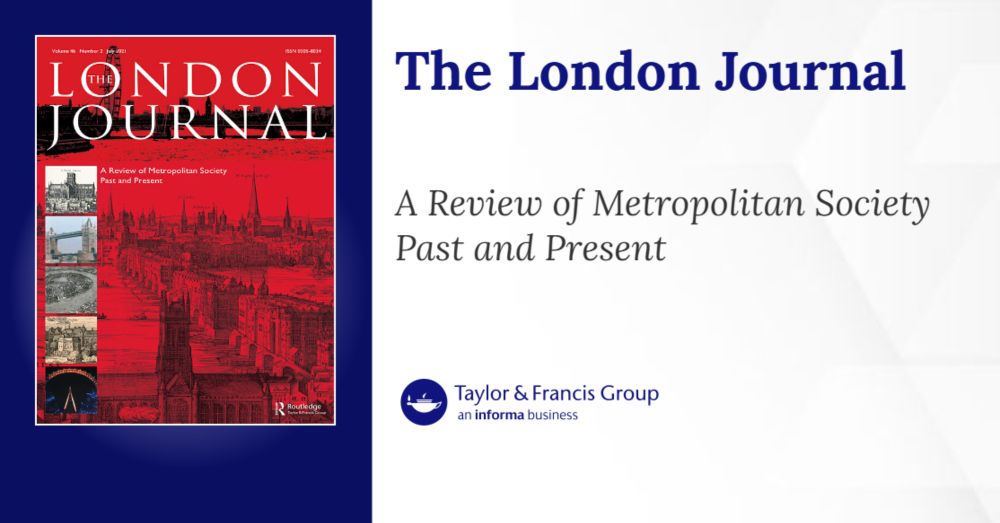
Christmas shopping season is an apt time for our latest 🧵 on our editorial board's favourite past London Journal articles, as this one is on @jackhanlon.bsky.social's pick: Victoria Kelley's 2020 article, 'London's Street Markets: The Shifting interiors of Informal Architecture'.
12.12.2025 16:59 — 👍 5 🔁 4 💬 1 📌 1
Applications are now open for the Curriers Prize, awarded by the Worshipful Company of Curriers in association with ourselves and the @ihr.bsky.social for the best entered essay on any aspect of London's history from Roman times to the present.
12.11.2025 13:36 — 👍 10 🔁 12 💬 2 📌 3Nocturnal London - call for papers.
15.12.2025 11:41 — 👍 6 🔁 8 💬 1 📌 0
My YouTube Channel with a couple of trailers and the film Aran Diary.
www.youtube.com/@mauriziocin...

Deaf Architecture Front - we hosted a phenomenal EDI event on Thursday at the School of Arts and Architecture at the University of Kent. It was an honour to organise the day with Chris Laing.
MEGA - Make EDI Great Again!
 14.12.2025 11:56 — 👍 8 🔁 0 💬 0 📌 0

Nocturnal London: From Torches to Neon Signs in a City After Dark Edited by Maurizio Cinquegrani, Yihong Zhu and Michael McCluskey The editors of this special issue, Maurizio Cinquegrani, Yihong Zhu and Michael McCluskey invite submissions on the theme of London nights. This volume of the London Journal will examine the histories of the city after dark, from its origins in Roman London to the present. Often overlooked, night has long been an essential dimension of urban life: as the city’s appearance change in the lightening of torches, oil lamps, gaslight, incendiary bombs and neon signs, nocturnal imagery, sounds, smells and professions – legal and not legal – emerge from the darkness. For Londoners, the night was never simply the absence of day; it was a time of danger, sociability, and creativity; a theatre of crime and vice, but also of performance, work, and pleasure. The special issue will place particular emphasis on moments when the character of London’s nights was especially contested, including – but not limited to – the Elizabethan, the eighteenth century, the Victorian, the wartime and the postwar city. The Elizabethan period witnessed the emergence of the city’s playhouses, taverns, and nocturnal entertainments, alongside concerns about disorder and moral decline. Eighteenth-century coffee-houses and club meetings reflected the nocturnal city’s uneasy mix of polite sociability and transgressive undercurrents, while pleasure gardens flourished as spaces of spectacle, employment, cross-class mingling, and erotic charge

under cover of darkness. In the Victorian era, the introduction of gaslight transformed both the material and imaginative experience of the night, making the city’s streets newly navigable while also exposing poverty, vice, and vulnerability to the gaze of reformers, police, photographers, and journalists. Wartime London, by contrast, was marked by darkness and silence imposed from above: the blackout and the Blitz remade the urban night as a zone of danger, solidarity, and belonging. The postwar decades, and especially the 1960s, brought the era of Swinging London, in which nightlife became emblematic of youth, fashion, music, and cultural revolution. Equally important are the particular districts that have defined London’s reputation after dark, including – but again not limited to – the West End and the East End. The East End has been imagined as a zone of poverty, danger, and cultural resilience, alive with street-level economies that flourished under cover of night. The West End has long been associated with theatres, clubs, and the rituals of fashionable display. Soho, especially in the twentieth century, became a microcosm of cosmopolitanism, transgression, and reinvention, providing a home for migrants, artists, musicians, and London’s gay community, who together redefined the possibilities of nocturnal sociability. Beyond districts and periods, we also invite reflections on the people who navigated, transformed, and reimagined the nocturnal city. The editors are especially keen to foreground questions of diversity and difference. How have London’s nights been inhabited, shaped,

and contested by women, by queer citizens, by migrants and racialised communities, and by those whose working lives were tied to the hours of darkness? How was night both policed and celebrated? How did nocturnal spaces serve as arenas of negotiation between surveillance and resistance, authority and anonymity, privilege and precarity? How have representations in literature, theatre, music, art, and film contributed to the cultural meanings of the nocturnal city? We welcome submissions from across the disciplines, including history, literary and cultural studies, art history, archaeology, urban geography, sociology, performance and media studies, as well as ecology, environmental humanities, and architecture and urbanism. Interdisciplinary approaches are encouraged, as are contributions that combine archival research with theoretical or methodological innovation. Abstracts of 300–400 words, accompanied by a short biographical statement, should be submitted by 31 March 2026. Full-length articles will be in the range of 6,000–8,000 words and are due by 31 March 2027. Please send proposals and queries to Maurizio Cinquegrani, Yihong Zhu, and Michael McCluskey (m.cinquegrani@kent.ac.uk, scarlett.zhu24@gmail.com, and m.mccluskey@northeastern.edu) with the subject line Nocturnal London Special Issue.
Call for papers for our new special issue on 'Nocturnal London', edited by Maurizio Cinquegrani, Yihong Zhu, and @mcmccluskey.bsky.social. Abstracts due in by 31 March 2026.
All submissions and reposts much appreciated.