Here's a short thread about the EATH model! 👇
bsky.app/profile/marc...
2/2
10.11.2025 09:27 — 👍 1 🔁 0 💬 0 📌 0


The conference is officially underway – here are some moments from the opening session.
01.09.2025 07:14 — 👍 7 🔁 4 💬 0 📌 0
Our work opens several perspectives, from the generation of synthetic realistic hypergraphs describing contexts where data collection is difficult to a deeper understanding of dynamical processes on temporal hypergraphs. 8/8
03.07.2025 08:21 — 👍 2 🔁 0 💬 0 📌 0

Finally, we illustrate the flexibility of the model, which can generate synthetic hypergraphs with tunable properties: as an example, we generate ”hybrid” temporal hypergraphs, which mix properties of different empirical datasets, and artificial hypergraphs with specifically tuned properties. 7/8
03.07.2025 08:20 — 👍 1 🔁 0 💬 1 📌 0

We also showcase the possibility to use the resulting synthetic data in simulations of higher-order contagion dynamics, comparing the outcome of such process on original and surrogate datasets. 6/8
03.07.2025 08:20 — 👍 1 🔁 0 💬 1 📌 0

We first show that the EATH model can generate surrogate hypergraphs of several empirical datasets of face-to-face interactions, mimicking temporal and topological properties at the node and hyperedge level. 5/8
03.07.2025 08:18 — 👍 1 🔁 0 💬 1 📌 0

We present a new model, the Emerging Activity Temporal Hypergraph (EATH), which can create synthetic time-varying hypergraphs. Each node has an independent activity dynamics, the system activity emerges from it, with temporal group interactions resulting from activity and memory mechanisms. 4/8
03.07.2025 08:18 — 👍 1 🔁 0 💬 1 📌 0

Delighted to announce the #CCS25 Scientific Dissemination Event!
🌐Free public event in italian called "La complessità è semplice?"
📅 Wednesday, September 3rd, 20:30
📍Teatro dei Rinnovati in the Palazzo Pubblico of Siena
🔗 ccs25.cssociety.org/public-disse...
11.06.2025 13:37 — 👍 5 🔁 1 💬 0 📌 0

@xgi.bsky.social in the wild 👀
03.06.2025 08:28 — 👍 5 🔁 2 💬 1 📌 0

Cosimo giving a compelling overview of his pairwise and higher-order network comparison measures
03.06.2025 08:37 — 👍 2 🔁 1 💬 1 📌 0
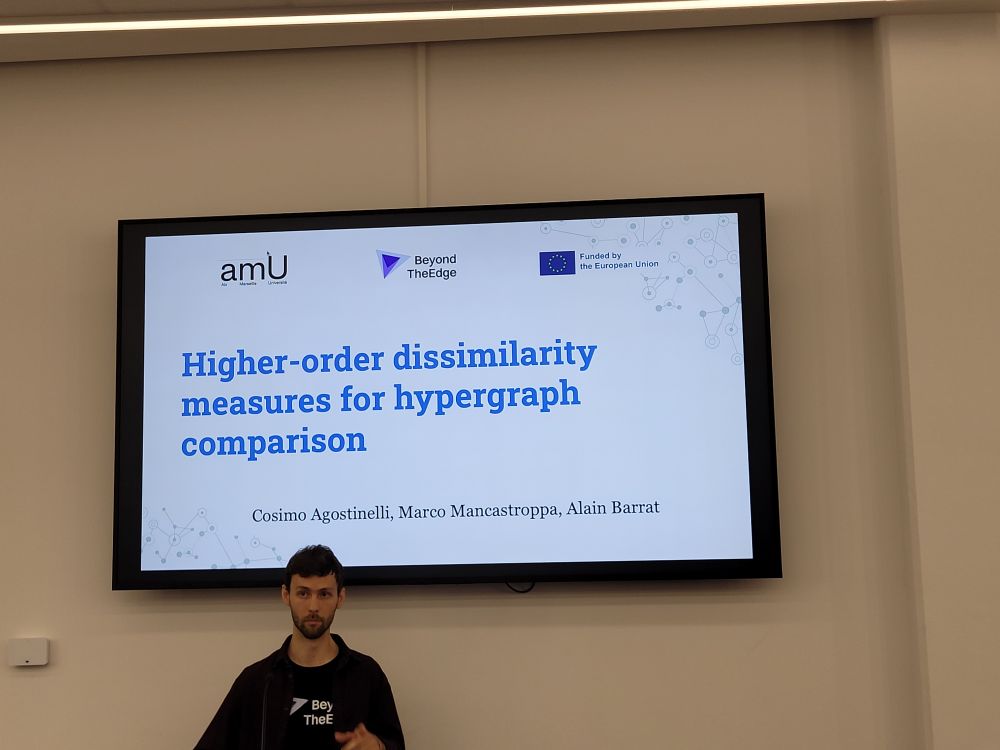
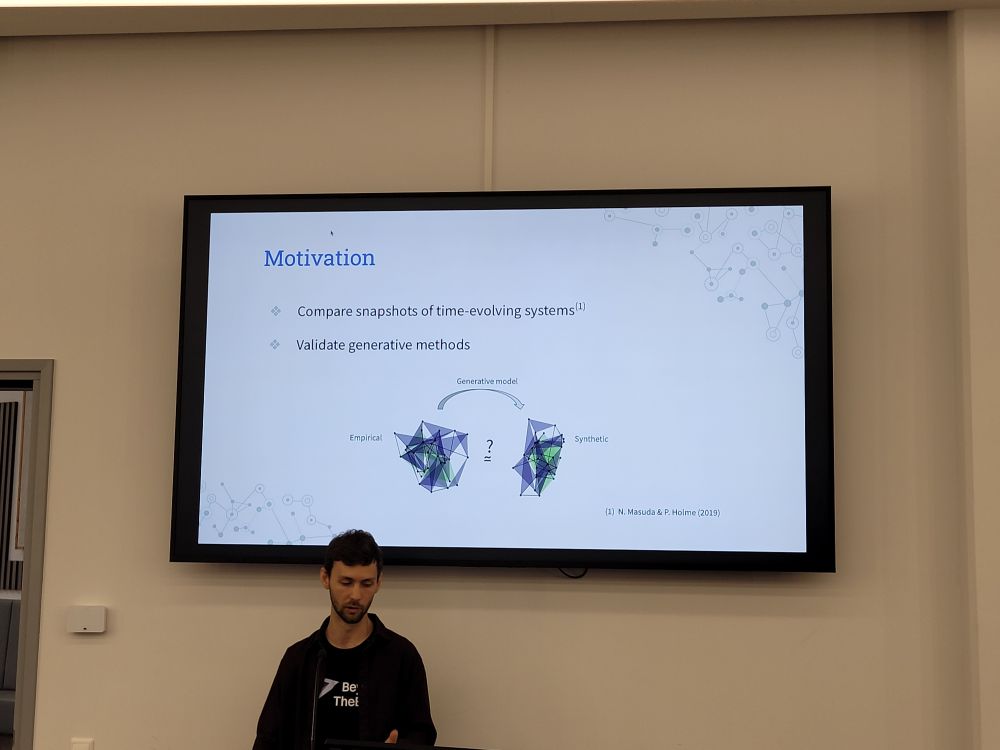
@beyondtheedge.network student Cosimo Agostinelli presenting higher-order dissimilarity measures as a way to compare temporal snapshots, empirical data to synthetic null models, etc.
03.06.2025 08:27 — 👍 5 🔁 3 💬 1 📌 0

Very nice higher-order generative model to try and reproduce the empirical dynamics
03.06.2025 08:14 — 👍 4 🔁 2 💬 1 📌 0

The hypercoreness ranking correlation between two timestamps is strongly dependent on the timescale (negative correlations for long enough time gap)
03.06.2025 08:11 — 👍 3 🔁 2 💬 1 📌 0
YouTube video by fisica di tutti i giorni
Interview with Nicole Yunger Halpern
Towards StatPhys2025: interview with
@nicoleyh11.bsky.social
(University of Maryland) by Franco Bagnoli (Dept. Physics and Astronomy, University of Florence & Caffè-Scienza).
youtu.be/oyIJTOGSmZE
09.05.2025 12:15 — 👍 1 🔁 0 💬 0 📌 0
YouTube video by fisica di tutti i giorni
Interview with Lenka Zdeborova
Towards StatPhys2025: interview with @zdeborova.bsky.social (EPFL) by Franco Bagnoli (Dept. Physics and Astronomy, University of Florence & Caffè-Scienza).
youtu.be/hplPGzFSRyo
07.05.2025 11:51 — 👍 2 🔁 1 💬 0 📌 0
Our results highlight the advantages of using higher-order dissimilarity measures over traditional pairwise representations in capturing the full structural complexity of the systems considered. 5/5
25.03.2025 14:56 — 👍 1 🔁 0 💬 0 📌 0

We illustrate the effectiveness of these metrics through clustering experiments on synthetic and empirical higher-order networks, showing their ability to correctly group hypergraphs generated by different models and to distinguish real-world systems coming from different contexts. 4/5
25.03.2025 14:55 — 👍 2 🔁 0 💬 1 📌 0
Here we introduce two novel measures, Hyper NetSimile and Hyperedge Portrait Divergence, specifically designed for comparing hypergraphs, that take explicitly into account the properties of multi-node interactions, using complementary approaches. 3/5
25.03.2025 14:55 — 👍 1 🔁 0 💬 1 📌 0

What Are Higher-Order Networks? | SIAM Review
Network-based modeling of complex systems and data using the language of graphs has become an essential topic across a range of different disciplines. Arguably, this graph-based perspective derives it...
Networks with higher-order interactions have emerged as a powerful tool to model complex systems. Comparing higher-order systems remains a challenge, since similarity measures designed for pairwise networks fail to capture salient features of hypergraphs. [ epubs.siam.org/doi/10.1137/... ] 2/5
25.03.2025 14:54 — 👍 0 🔁 0 💬 1 📌 0
YouTube video by fisica di tutti i giorni
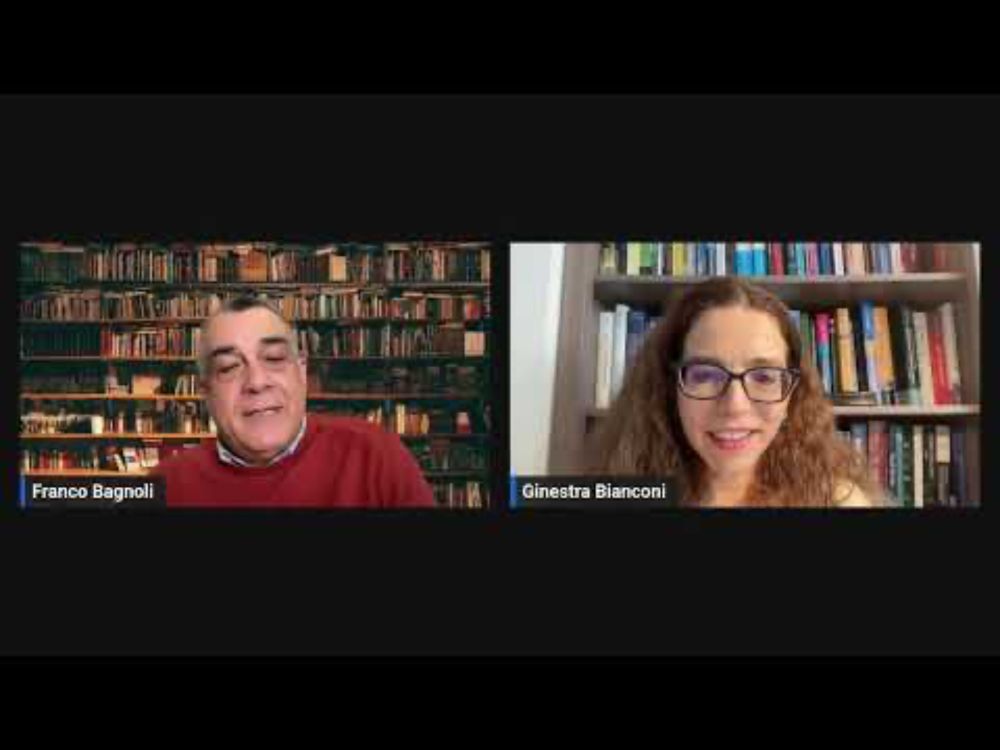
Intervista a Ginestra Bianconi
Verso StatPhys2025: intervista a @gin-bianconi.bsky.social (Queen Mary University of London) di Franco Bagnoli (Dip. Fisica e Astronomia, UNIFI & Caffè-Scienza).
www.youtube.com/watch?v=VZ_b...
05.03.2025 18:12 — 👍 6 🔁 1 💬 0 📌 0
Complex Systems Society
The Complex Systems Society has taken a stance! Read about the Manifesto on the Publishing and Evaluation Systems at:
cssociety.org/about/manife...
#CSSManifesto
28.02.2025 07:35 — 👍 48 🔁 30 💬 0 📌 1
Complex Systems Society
Now out the Complex Systems Society manifesto about the publishing and evaluation systems. Check it out!
cssociety.org/about/manife...
25.02.2025 09:51 — 👍 1 🔁 0 💬 0 📌 0
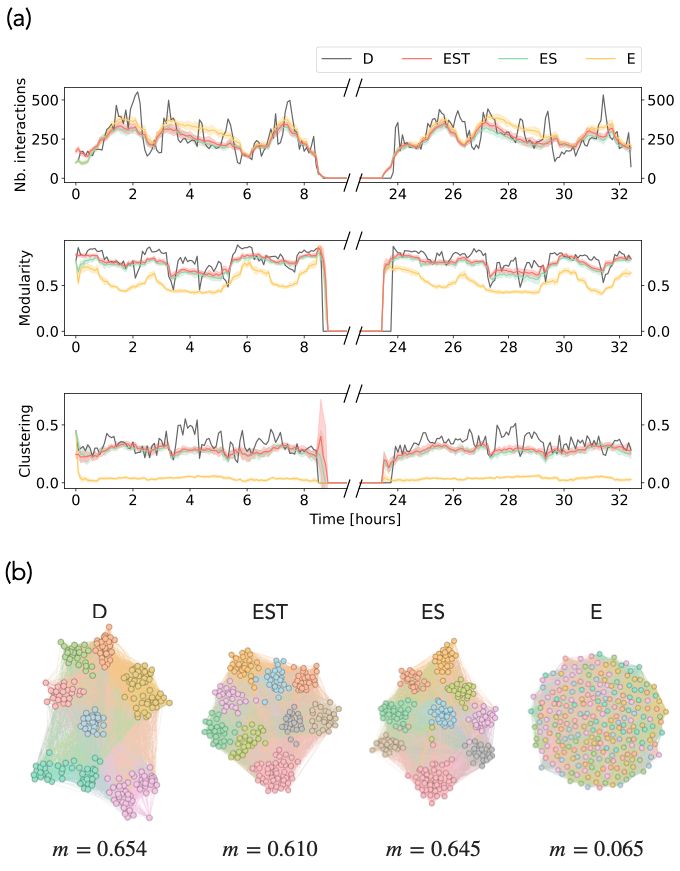
New work with @alainbarrat.bsky.social!
How to generate surrogate temporal networks to replace real ones:
arxiv.org/abs/2411.05477
Surrogates will have:
- no temporal length limit
- local dynamics similar to the real one
- mesoscale features like clustering and modularity
- long-term memory effects
18.11.2024 09:25 — 👍 28 🔁 11 💬 1 📌 1
🌱 Data Science 4 Environment & 🤖 AI Scientist
🎙️ Podcasting & Co-host of AZERTY
👨🔬 Comm. Scientifique
✊ Activisme
Find everything here:
https://bento.me/guglielmofernandezgarcia
PhD candidate, Complex Systems/Network Science, IT:U Linz
Inverse Complexity Lab @invcomplexity.skewed.de
Website: https://bastikusch.github.io/
Co-organizer @netplace.bsky.social
Contributor @complexity-core.bsky.social
Portrait photography. Based in the United States, Seattle Area.
IG: https://www.instagram.com/valeter_portraits/
Web: https://portraits.valeter.net/
Assistant Professor at Aarhus University, Denmark. Working with Zebrafish to understand the gut-brain axis
Hi 👋 I'm a postdoc in the #Neuroimmunology and #Imaging group at the @dzne.science Bonn 🧪🔬 Passionate about #ComputationalNeuroscience 🧠💻 and #NeuralModeling 🧮
🌍 fabriziomusacchio.com
👨💻 github.com/FabrizioMusacchio
🐘 sigmoid.social/@pixeltracker
A career network featuring science jobs in academia and industry.
Visit our platform at www.science.hr
At @chub-fbk.bsky.social 🌿🌻
Assistant Professor at the Department of Computer Science, University of Liverpool.
https://lutzoe.github.io/
PhD Student in Network Science at the Department of Network and Data Science, Central European University
CNRS Research Director in Paris. Head of the Complex Systems Institute of Paris IdF Complex systems, cognitive sciences, social dynamics, cultural evolution, text-mining, epistemology, computational social sciences. Posts are my own.
http://chavalarias.org
Decentralised networks of humans and machines
https://www.andreabaronchelli.com/
What I do not understand, I can still create. -- unknown アメリカで大学教員やっています.いつもヘンなことばかり考えています.意識低い系.
SUNY Empire Innovation Professor at Binghamton University https://tendrel.binghamton.edu
President Complex Systems Society @cssociety.bsky.social
FWF Cluster of Excellence Postdoc at the Bergthaler Lab
https://gergelyodor.com/
looking for order in messy systems
statistical physics
Publisher at IOP Publishing (Classical and Quantum Gravity, Journal of Physics B: Atomic, Molecular and Optical Physics, Journal of Physics: Complexity)
Interdisciplinary. Analytical. Challenging. • Where #networkscience and #socialdatascience meet.
An international department with students and faculty from all over the world: networkdatascience.ceu.edu
Come join us! Take your career to the next level 🚀
Physicist • Postdoc @chub-fbk.bsky.social 👩🏼💻
• Interested in human social behavior and network science 🕸️ and random stuff bc why not 🎨
ella | she | her • from 🇦🇷