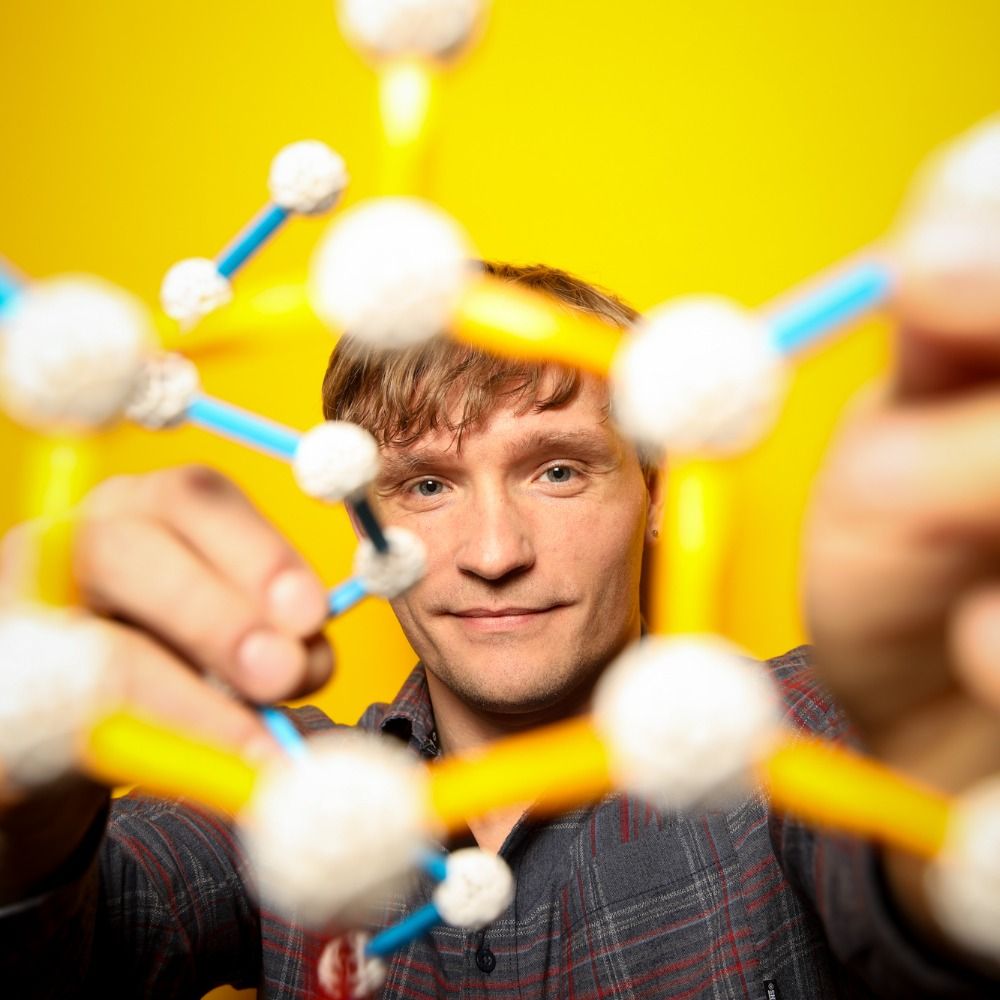
Looking ahead, Kyle will be contributing to the QuASAR project at the Boulby Underground Laboratory, supporting cutting edge quantum sensing research deep underground.
We’re excited to see his journey unfold.

@durhamqlm.bsky.social
The Durham Quantum Light and Matter (QLM) research section encompasses several research groups sharing a common interest in the study of the quantum properties of atoms, molecules and solids and their interactions with light. Website: https://durham-qlm.uk
Looking ahead, Kyle will be contributing to the QuASAR project at the Boulby Underground Laboratory, supporting cutting edge quantum sensing research deep underground.
We’re excited to see his journey unfold.
Kyle joined us at the start of the year and has already thrown himself into the world of high powered lasers, learning how to align and operate them with precision. This week, he also delivered an impressive introductory talk to the Institute of Physics. @iop.org
13.02.2026 15:01 — 👍 0 🔁 0 💬 1 📌 0
As we celebrate National Apprenticeship Week 2026 and the closing of the International Year of Quantum Science and Technology, we're delighted to introduce Kyle Tate — the QLM research group’s new Quantum Apprentice. 1/n
#NAW2026


Thank you Sarah Thomas for your interesting talk on light-matter interactions for quantum memories, their importance in quantum networking and recent work in improving the efficiency and storage time of memories.
11.02.2026 12:34 — 👍 2 🔁 0 💬 0 📌 0
Opening slide of my presentation on Quantum Error Correction at Durham Uninversity. Slide features a picture of the Durham student union and Kingsgate bridge, famously designed by legendary North Eastern arcitect Ove Arup and considered to be one of the world's finest examples of brutalist architecture.

A slide from my presentation comparing surface codes to QLDPC codes. Background: surface codes are a leading approach to QEC, favoured for their local connectivity and straightforward ability to scale to arbitrary distance. However, from a coding theory perspective, they are far from optimal codes, owing to the fact that only a single logical qubit is encoded per patch. In practice, it is estimated that ~1000 qubits will be required per logical qubit in a surface code architecture, making them much less efficient than classical LDPC codes (of the type used in 5G and WiFi) where encoding ratios can be as low as 2-to-1. Quantum LDPC are modelled on classical codes, and it is has been shown (through simulation) that they code achieve encoding densities as low as 50-to-1 (some 20x improvement than surface codes). The tradeoff is that QLDPC codes are much less structured than surface codes, requiring long-range interactions between qubits. The QLDPC Tanner graph shown on the slide depicts a naive layout that I usefully refer to as the "spaghetti connectivity".

Language is redundant by design. The town of Llanfairpwllgwyngyllgogerychwyrndrobwllllantysiliogogogoch in Anglesey Wales is probably the best error corrected placename in the world!
Great day back in Durham visiting @durhamqlm.bsky.social to give a seminar on QEC and our recent work at Quantum Software Lab. Also fun to discuss the fault-tolerance of the Welsh towname Llanfairpwllgwyngyllgogerychwyrndrobwllllantysiliogogogoch w/ @ifanghughes.bsky.social @tobifranzen.bsky.social
04.02.2026 15:55 — 👍 15 🔁 4 💬 1 📌 0
An image with an aperture in the form of the letter K in the plane z=-2f. There is a lens in the plane z=-f. We see the Fourier transform in the plane z=0. (Fourier analysis). There is a lens in the plane z=f. An inverted image of K is seen in the plane z =2f (Fourier synthesis).
In this week’s Fourier Optics course we shall be looking at spatial filtering – how a pair of lenses performs a Fourier analysis and subsequently Fourier synthesis in the 4f set up. The importance of the f to f set up with a single lens is emphasised.
🧪 #physics ⚛️ #optics 💡 #iTeachPhysics 🎢

A four by six array of images. Images in the top row are labelled A, B, ... F. Images in the second row are labelled G, H, ... L. In the top two rows each image is of a collection of simple shapes, such as three identical circles displaced uniformly horizontally. The lower two rows are Fourier intensity diffraction patterns. The images in row three are labelled 1, 2, ... 6, and in row four 7, 8, ...12.
In this week’s Fourier Optics course we shall be looking at diffraction from 2D apertures, with arrays of identical structures.
A quiz to test your understanding of the array theorem. Can you match the apertures to their Fraunhofer diffraction patterns?
🧪 #physics ⚛️ #optics 💡 #iTeachPhysics 🎢
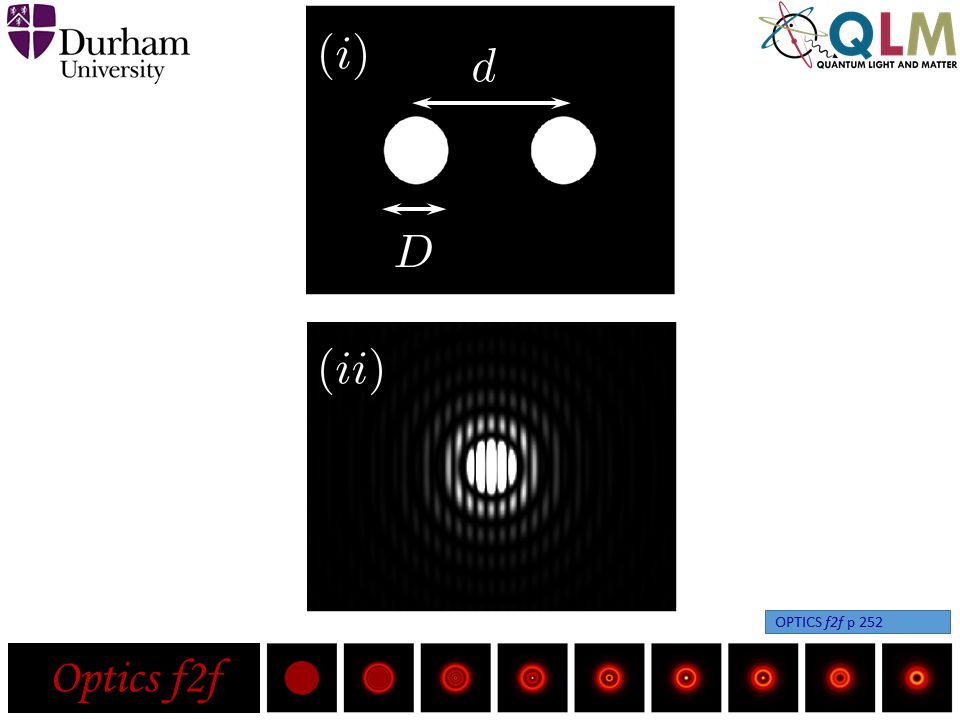
Two images. The upper shoes to identical circles of diameter D separated horizontally by d. The lower shows the corresponding intensity diffraction pattern; an Airy disk modulated with cosine-squared fringes.
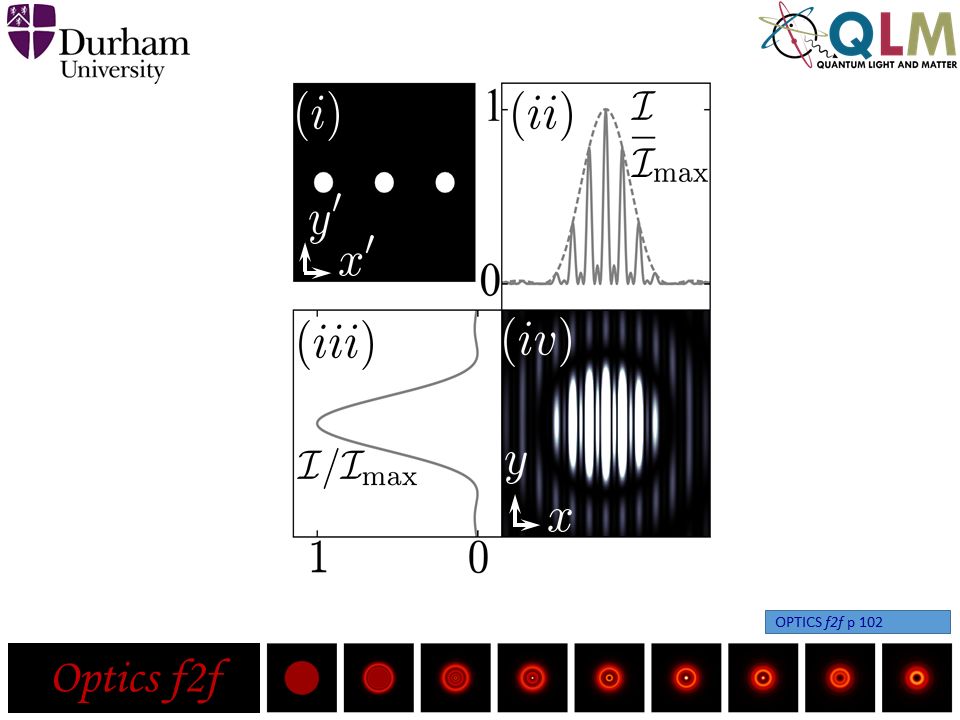
A two by two array of images. The top left shows three identical circles separated equally along the horizontal axis. The bottom right panel shows the corresponding intensity diffraction pattern: an Airy patter modulated with the characteristic pattern for three identical objects, "big-little-big-little" fringes. The other two panels show slices of the diffraction pattern along the horizontal and vertical (no fringes) axes.
In this week’s Fourier Optics course we shall be looking at diffraction from 2D apertures.
Fourier techniques provide an elegant way of calculating the patters for regular arrays
🧪 #physics ⚛️ #optics 💡 #iTeachPhysics 🎢


Thank you Rob Harris for making the arduous journey from the Ogden Centre West to present us a seminar on his work in the CfAI on multicore fibres, two-photon polymerisation, and laser inscribed waveguides.
21.01.2026 14:09 — 👍 2 🔁 0 💬 0 📌 0
5 graduates in red robes and black flat hats stand in front of Durham cathedral during evening time, with colleagues from QLM Durham.
Heartfelt congratulations to our newest Drs from the Quantum Light and Matter section at Durham, pictured here in front of the cathedral. We wish you all the best with your next steps, and we'll be seeing some of you around the department as new PDRAs!
21.01.2026 11:14 — 👍 7 🔁 3 💬 0 📌 0
QLM colleague Alex Matthies showing the CaF experiment the CfAI researchers.

CfAI researchers looking at optical tables in the CaF experiment at QLM.
Fun morning running lab tours for researchers from the Advanced Instrumentation section at @durhamphysics.bsky.social around a selection of @durhamqlm.bsky.social labs (pictured QLM colleague Alex Matthies explaining the CaF experiment)
14.01.2026 13:09 — 👍 7 🔁 2 💬 0 📌 0
Two mathematical definitions: those of the Fourier transform of a two dimensional function; and that of the inverse Fourier transform.
In this week’s Fourier Optics course we shall be looking at diffraction.
The central idea is:
decompose an arbitrary light distribution in one plane into a sum of plane waves with Fourier transform to solve the Helmholtz equation for light propagation.
🧪 #physics ⚛️ #optics 💡 #iTeachPhysics 🎢

Raising some issues for discussion at our postgraduate forum. Thanks to everyone who came along and contributed to the discussion!
15.12.2025 11:48 — 👍 0 🔁 0 💬 0 📌 0


Ryan Doran of Newcastle University gives us an exciting talk on superfluid flow in a disordered potential, in one- and two-component BECs.
10.12.2025 08:47 — 👍 2 🔁 0 💬 0 📌 0
A 2 by 2 array of images. They depict the four Stokes parameters for potassium vapour as a function of frequency in the vicinity of the D1 resonance. For a natural abundance potassium vapour cell of length 25 mm containing 60 Torr of neon buffer gas. The applied magnetic field is 1160 G, with the vapour cell stem temperature, increasing from 75∘C to 135∘C , in 15∘C increments.

Theoretical ElecSus calculations of the on-resonance (i.e. = 0 GHz) normalised Stokes parameter magnitude for (a) S0, (b) S1, (c) S2 and (d) S3 for a vapour cell stem temperature range between 75–135∘C and magnetic fields, in Faraday geometry, of 750 G, 1000 G, and 1200 G for three neon buffer gas filling pressures of 0 Torr, 60 Torr, and 100 Torr .

Experimental and theoretical Stokes parameters of the potassium D1 line as a function of linear detuning in a 25 mm natural abundance potassium vapour cell with 60 Torr of neon buffer gas, when filled at room temperature and atmospheric pressure, subject to a magnetic field of (1160 ± 4) G. The solid lines represent the experimental data, while the dashed lines represent the ElecSus theoretical fit to the data. The Stokes parameters shown are (a) S0, (b) S1, (c) S2 and (d) S3 for five vapour cell stem temperatures of 93 ∘C, 103 ∘C, 110 ∘C, 118 ∘C, and 129 ∘C . The vapour cell body temperature was maintained at 20 ∘C above the stem temperature. The residuals, shown below each main subplot, for = 93 ∘C are shown as a demonstration of excellent agreement between experimental data and the ElecSus model.
Hot off the press!
Experimental and theoretical characterisation of Stokes polarimetry of the K D1 line with neon buffer gas broadening
doi.org/10.1088/1361...
via @ioppublishing.bsky.social
Performed with colleagues at
@durhamqlm.bsky.social
Atoms, lasers, and magnets!
🧪 #physics ⚛️ #optics 💡


Thank you to David Wellnitz (Julich Institute) for his interesting talk on molecular interactions in deep and shallow lattices, as well as in tweezers.
26.11.2025 14:19 — 👍 2 🔁 0 💬 0 📌 0

Thanks to Alex Jenkins (University of Cambridge) for his fascinating talk last week on false vacuum decay, and how we can use ultracold atomic condensates to investigate it in the lab.
24.11.2025 10:55 — 👍 1 🔁 0 💬 0 📌 0
Nicholas Spong stands in front of his talk slide on PsiQuantum, presenting to an audience in a seminar room.

Phil introduces Nicholas in front of his first seminar slide.

Nicholas covers the timeline on UK National Quantum Strategy Missions
Thanks to Nicholas Spong of the NQCC for his talk on neutral atoms as a platform for quantum computing, and the NQCCs role as an advisor to the UK government in achieving QM1 - to create devices capable of delivering a trillion coherent quantum operations.
12.11.2025 12:56 — 👍 1 🔁 0 💬 0 📌 0
Tobias stands in front of his title slide: towards quantum networking with arrays of Yb atoms.
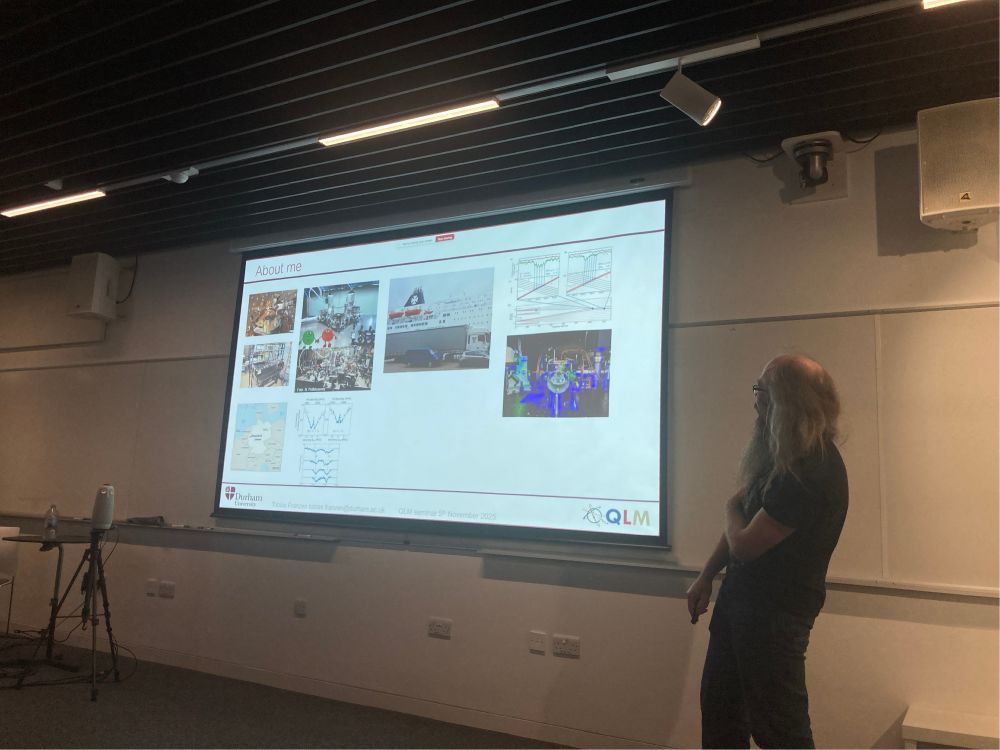
Tobias presents a slide describing his academic journey prior to being awarded his fellowship.
In this weeks QLM seminar, our very own @tobifranzen.bsky.social tells us about his fellowship plans to use micro cavities to efficiently couple single photons emitted from Yb atoms into standard telecom fibres, in the hopes of generating entanglement between Yb qubits.
05.11.2025 14:31 — 👍 7 🔁 1 💬 0 📌 0
Jonathan Mortlock of QLM fame (left) and Yansheng Zhang (right) stand either side of a title slide titled "How interacting Bose gases scatter light?"

Yansheng Zhang stands next to a slide displaying his labs experimental setup.
Thanks to Yansheng Zhang of @cam.ac.uk for visiting Durham QLM to give a seminar on how bosons scatter light.
29.10.2025 14:47 — 👍 2 🔁 0 💬 0 📌 0
A man in a purple tshirt stands in front of a out lamp and an orange lamp. They are on a table in front of a train.

An orange lamp glows within a clear plastic enclosure
@durhamqlm.bsky.social members all ready to Celebrate Science this week at @locomotionshd.bsky.social ! Come and see how we use light to identify atoms and make your own colour-changing picture using nothing but sellotape 💡🌈
28.10.2025 10:51 — 👍 10 🔁 3 💬 0 📌 0
Via #OPG_Optica: Visualizing strongly focused 3D light fields in an atomic vapor https://opg.optica.org/optica/fulltext.cfm?uri=optica-12-10-1553 #StructuredLight #QuantumSensing @uofglasgow.bsky.social
26.10.2025 14:57 — 👍 2 🔁 1 💬 0 📌 1
PhD applications are open! We'd love to have you visit Durham Physics to find out more about the(currently!) 17 available projects we have for October 2026 start.
Our open day is November 26th, we hope to see you there!
Find project descriptions and open day sign up links below.

Liam stands in front of his title slide "Rydberg excitons: beyond cuprous oxide" in a seminar room

Liam stands in front of an introductory slide describing his journey from undergraduate to fellow

Liams slide describing the self-Kerr effect
Homegrown fellow @lapgallagher.bsky.social describes his fellowship plans to investigate rydberg excitons in zinc diphosphide.
22.10.2025 11:43 — 👍 7 🔁 2 💬 0 📌 0
PDRA Luca Donini stands in front of an introductory slide titled "Frustrated physics in triangular and kagome optical lattices at negative absolute temperature" in white seminar room, with audience.

Luca Donini presents a slide on current progress in his lab, to a seated audience.

Luca Donini presents a slide explaining the experimental sequence in his lab.
Thank you Luca Donini of @cam.ac.uk for visiting us all the way up in Durham, to talk about frustrated physics in triangular and kagome optical lattices at negative absolute temperature.
15.10.2025 11:23 — 👍 3 🔁 0 💬 0 📌 0
A seminar room filled with older and newer members of our parish seated to listen to the whirlwind talks group meeting.

A photo from behind of a full seminar room of QLM members listening to the whirlwind talks group meeting.

A speaker standing next to their slide introducing one of many physics labs in Durham QLM while the rest of the section listens.
QLM certainly looks a lot bigger than it did a few years ago...
A whirlwind introduction to all of the wonderful physics happening in QLM at our largest group meeting yet for our new members of the parish, and a refresher for some of our older members.

Prof Michael Holynski stands in seminar room presenting a slide describing the UK national quantum technologies programme and its locations across the UK

Prof Michael Holynski stands in seminar room presenting a slide describing the UK quantum technology research hub and its partners
A wonderful turnout from QLM for our first seminar of the academic year: Prof Michael Holynski, PI at
@qusit.bsky.social, talks about quantum sensing, imaging, and timing.

A photo of three physicists: Prof C Stuart Adams (left); Prof Ifan Hughes (right); and successful PhD candidate Oliver Hughes (centre).
Congratulations to Oliver Hughes on passing his viva. Thesis entitled "Preparation and Coherent
Control of a Rydberg Qutrit in
a Cold Atomic Ensemble". Supervised by @etotheipiequals.bsky.social and @kjweatherill.bsky.social
Seen here with Stuart and internal examiner @ifanghughes.bsky.social