NatSCA's Avatar

NatSCA

@natsca.bsky.social

The Natural Sciences Collections Association is a charity that supports natural science collections and the people who work with them.

142 Followers  |  30 Following  |  41 Posts  |  Joined: 07.01.2025
Posts Following

Posts by NatSCA (@natsca.bsky.social)

Preview
Darwin and Marx in the museum. A review of Joel Wainwright’s The End: Marx, Darwin and the Natural History of the Climate Crisis. Written by Joe Rigby, Senior Lecturer, University of Chester: Faculty of Arts, Humanities and Social Sciences. 'Storehouses for dinosaur bones, mineral samples, and fading dioramas portraying early humans. Do such places have something to tell us about capitalism and the climate crisis?' (Wainwright 2025, p. 8) As readers of the Natsca blog will appreciate, the discipline of ‘natural history’ encompasses a wide range of what today have become institutionalised as more or less separate fields of knowledge, including geology, biology, geography, anthropology, and history.

Darwin and Marx in the museum. A review of Joel Wainwright’s The End: Marx, Darwin and the Natural History of the Climate Crisis.

Written by Joe Rigby, Senior Lecturer, University of Chester: Faculty of Arts, Humanities and Social Sciences. 'Storehouses for dinosaur bones, mineral samples, and…

26.02.2026 12:13 — 👍 1    🔁 0    💬 0    📌 0
Preview
NatSCA Digital Digest – February 2026 Compiled by Ellie Clark, Curator of Fossil Cnidaria at the Natural History Museum. Welcome to the February edition of NatSCA Digital Digest. Digital Digest is a monthly blog series featuring the latest on where to go, what to see and do in the natural history sector including jobs, exhibitions, conferences, and training opportunities. We are keen to hear from you if you have any top tips and recommendations for our next Digest, please drop an email to 

NatSCA Digital Digest – February 2026

Compiled by Ellie Clark, Curator of Fossil Cnidaria at the Natural History Museum. Welcome to the February edition of NatSCA Digital Digest. Digital Digest is a monthly blog series featuring the latest on where to go, what to see and do in the natural history…

19.02.2026 11:01 — 👍 0    🔁 0    💬 0    📌 0
Preview
Liverpool, Natural History and Extinction: The Case of a Real Liver Bird Written by John-James Wilson (Lead Curator of Zoology, World Museum), Jude Piesse (Senior Lecturer in English Literature, LJMU) & Alyssa Grossman (Senior Lecturer in Communication and Media, University of Liverpool). The interdisciplinary public engagement project ‘ENLivEN: Empire, Nature and Liverpool: Investigating and Engaging with Natural History’, is a collaboration between University of Liverpool, Liverpool John Moores University (LJMU) and 14 city-wide partners.

Liverpool, Natural History and Extinction: The Case of a Real Liver Bird

Written by John-James Wilson (Lead Curator of Zoology, World Museum), Jude Piesse (Senior Lecturer in English Literature, LJMU) & Alyssa Grossman (Senior Lecturer in Communication and Media, University of Liverpool). The…

05.02.2026 11:01 — 👍 1    🔁 0    💬 0    📌 0
Preview
The Life and Work of Botanist Catherine Muriel Rob – New Herbarium Exhibition at the Yorkshire Museum Written by Anna Robson, Associate Collections Curator – Biology, York Museums Trust A new foyer case exhibition titled ‘The Life and Work of Botanist Catherine ‘Kit’ Rob: An insider’s look at the Yorkshire Museum’s Herbarium’ is now on display at the Yorkshire Museum. This exhibition displays the herbarium in a new light, being one of the only times the museum has exhibited the dried plant specimens to the public.

The Life and Work of Botanist Catherine Muriel Rob – New Herbarium Exhibition at the Yorkshire Museum

Written by Anna Robson, Associate Collections Curator – Biology, York Museums Trust A new foyer case exhibition titled ‘The Life and Work of Botanist Catherine ‘Kit’ Rob: An insider’s look at the…

22.01.2026 11:01 — 👍 1    🔁 0    💬 0    📌 0
Preview
A New Generation of Bolton Field Naturalists. Written by Lauren Field, Curator of Natural History, Bolton Museum.  In 1895 The Borough of Bolton Botanical Society was formed. This group concerned itself, as the name implies, with botany alone but eventually a feeling emerged among naturalists in Bolton that other aspects of natural history should be covered. On February 7th 1907 a group of keen local naturalists met at the Chadwick Museum (Bolton Museum’s first building).

A New Generation of Bolton Field Naturalists.

Written by Lauren Field, Curator of Natural History, Bolton Museum.  In 1895 The Borough of Bolton Botanical Society was formed. This group concerned itself, as the name implies, with botany alone but eventually a feeling emerged among naturalists in…

15.01.2026 11:01 — 👍 4    🔁 2    💬 0    📌 0
Preview
NatSCA Digital Digest – January 2026 Compiled by Milo Phillips, Digitisation Co-ordinator at the Royal Botanic Garden Edinburgh. Welcome to the January edition of NatSCA Digital Digest. A monthly blog series featuring the latest on where to go, what to see and do in the natural history sector including jobs, exhibitions, conferences, and training opportunities. We are keen to hear from you if you have any top tips and recommendations for our next Digest, please drop an email to 

NatSCA Digital Digest – January 2026

Compiled by Milo Phillips, Digitisation Co-ordinator at the Royal Botanic Garden Edinburgh. Welcome to the January edition of NatSCA Digital Digest. A monthly blog series featuring the latest on where to go, what to see and do in the natural history sector…

09.01.2026 11:05 — 👍 1    🔁 0    💬 0    📌 0
NatSCA Conference 2026 - Call for Papers | Natural Sciences Collections Association Collaborating and Connecting with Natural History The Annual Conference & AGM of the Natural Sciences Collections Association (NatSCA) will be held on Thursday 14th and Friday 15th May 2026 at The Uls...

Call for papers for the 2026 NatSCA conference ‘Collaborating and Connecting with Natural History’. Join us in Belfast May 14-15!
Submission deadline Feb 8. natsca.org/natsca-2026

03.01.2026 14:29 — 👍 1    🔁 1    💬 0    📌 0
Top NatSCA Blogs of 2025 Compiled by Jennifer Gallichan, NatSCA Blog Editor. It has come to the end of another year and we have had some fantastic contributions to the blog. I would like to take this opportunity in the last blog of 2025, to celebrate the ten most read articles of those published this year. As a whole, they represent the huge amount of work that is going on across the sector, from collection decants, to specimen conservation, getting the collections out there, and researching the incredible histories they contain.

Top NatSCA Blogs of 2025

Compiled by Jennifer Gallichan, NatSCA Blog Editor. It has come to the end of another year and we have had some fantastic contributions to the blog. I would like to take this opportunity in the last blog of 2025, to celebrate the ten most read articles of those published…

18.12.2025 11:01 — 👍 0    🔁 0    💬 0    📌 0
Preview
NatSCA Digital Digest – December 2025 Compiled by Olivia Beavers, Assistant Curator of Vertebrate Zoology at World Museum, National Museums Liverpool. Welcome to the December edition of NatSCA Digital Digest. A monthly blog series featuring the latest on where to go, what to see and do in the natural history sector including jobs, exhibitions, conferences, and training opportunities. We are keen to hear from you if you have any top tips and recommendations for our next Digest, please drop an email to 

NatSCA Digital Digest – December 2025

Compiled by Olivia Beavers, Assistant Curator of Vertebrate Zoology at World Museum, National Museums Liverpool. Welcome to the December edition of NatSCA Digital Digest. A monthly blog series featuring the latest on where to go, what to see and do in the…

11.12.2025 11:00 — 👍 3    🔁 0    💬 0    📌 0
Preview
The Rediscovery of a Challenger Expedition Specimen in William Herdman’s Zoology Museum Collection at the University of Liverpool (and how digitisation is transformative). Written by Leonie Sedman, Curator of Heritage & Collections Care, University of Liverpool. Along with many other NatSCA members, I care for a mixed collection, meaning that one inevitably becomes something of a 'Jack of all trades’ missing out on the academic satisfaction created by specialisation. As a curator who finds collections research to be the most satisfying part of my job, it can be frustrating when that research is often only possible on a ‘need-to-know’ basis - usually when a new display or exhibition is being planned, or when the specimens are to be used in teaching.

The Rediscovery of a Challenger Expedition Specimen in William Herdman’s Zoology Museum Collection at the University of Liverpool (and how digitisation is transformative).

Written by Leonie Sedman, Curator of Heritage & Collections Care, University of Liverpool. Along with many other NatSCA…

20.11.2025 11:01 — 👍 5    🔁 2    💬 0    📌 0
Preview
NatSCA Digital Digest – November 2025 Compiled by Ellie Clark, Curator of Fossil Cnidaria at the Natural History Museum. Welcome to the November edition of NatSCA Digital Digest. Digital Digest is a monthly blog series featuring the latest on where to go, what to see and do in the natural history sector including jobs, exhibitions, conferences, and training opportunities. We are keen to hear from you if you have any top tips and recommendations for our next Digest, please drop an email to 

NatSCA Digital Digest – November 2025

Compiled by Ellie Clark, Curator of Fossil Cnidaria at the Natural History Museum. Welcome to the November edition of NatSCA Digital Digest. Digital Digest is a monthly blog series featuring the latest on where to go, what to see and do in the natural history…

13.11.2025 11:00 — 👍 1    🔁 0    💬 0    📌 0
Preview
Splits and Distortion of a “Hisstoric” Snakeskin: Humidification as Part of Remedial Conservation Treatment of a Boa constrictor Skin” Written by Claire Kelly, Conservator at Natural History Museum, London. Boa Constrictor in Fishes, Amphibians and Reptiles Gallery at NHM ©The Trustees of the Natural History Museum A Boa Constrictor on display in the Fishes, Amphibians and Reptiles Gallery at the Natural History Museum in London, UK was removed to undergo a considerable amount of remedial conservation treatment.

Splits and Distortion of a “Hisstoric” Snakeskin: Humidification as Part of Remedial Conservation Treatment of a Boa constrictor Skin”

Written by Claire Kelly, Conservator at Natural History Museum, London. Boa Constrictor in Fishes, Amphibians and Reptiles Gallery at NHM ©The Trustees of the…

06.11.2025 11:00 — 👍 3    🔁 0    💬 0    📌 0
Preview
“Our Irish Natural History”: Increasing the Accessibility of Natural History Collections through Community-Driven Interpretation Written by Adriana Ballinger, Yale University Charles P. Howland Postgraduate Research Fellow at the National Museum of Ireland, Natural History. Natural history specimens are often inaccessible to the communities from which they were collected. As a result, source communities lack opportunities to connect with elements of their local heritage, and museums and their publics overlook the place-based expertise that many of these communities hold about the specimens we research and see on display.

“Our Irish Natural History”: Increasing the Accessibility of Natural History Collections through Community-Driven Interpretation

Written by Adriana Ballinger, Yale University Charles P. Howland Postgraduate Research Fellow at the National Museum of Ireland, Natural History. Natural history…

23.10.2025 10:03 — 👍 5    🔁 2    💬 0    📌 1
Preview
How to Get a Job Working with Museum Collections Written by Sarah Burhouse, Caitlin Jamison, Bethany Palumbo & Vicky Ward. Compiled by Jennifer Gallichan, Vertebrate Curator, Amgueddfa Cymru – Museum Wales. Those of us that that are lucky enough to work with natural science collections will be familiar with the question ‘How do you get a job in a museum’? At a time when cuts to the sector mean that museum jobs seem even fewer and farther between, I felt it was important that we share some of our combined experiences to hopefully give some tips (and hope) for emerging museum professionals.

How to Get a Job Working with Museum Collections

Written by Sarah Burhouse, Caitlin Jamison, Bethany Palumbo & Vicky Ward. Compiled by Jennifer Gallichan, Vertebrate Curator, Amgueddfa Cymru – Museum Wales. Those of us that that are lucky enough to work with natural science collections will be…

16.10.2025 10:00 — 👍 5    🔁 5    💬 0    📌 0
NatSCA Digital Digest – October 2025 Compiled by Milo Phillips, Digitisation Co-ordinator at the Royal Botanic Garden Edinburgh. Welcome to the October edition of NatSCA Digital Digest. A monthly blog series featuring the latest on where to go, what to see and do in the natural history sector including jobs, exhibitions, conferences, and training opportunities. We are keen to hear from you if you have any top tips and recommendations for our next Digest, please drop an email to 

NatSCA Digital Digest – October 2025

Compiled by Milo Phillips, Digitisation Co-ordinator at the Royal Botanic Garden Edinburgh. Welcome to the October edition of NatSCA Digital Digest. A monthly blog series featuring the latest on where to go, what to see and do in the natural history sector…

09.10.2025 11:33 — 👍 1    🔁 1    💬 0    📌 0
Preview
From Deck to Decant: A Marine Biologist’s Déjà Vu After a Year in a Natural History Museum Written by Dr Jamie Maxwell, Collections Assistant, National Museum of Ireland, Natural History. Not every job takes you to a windswept beach on Ireland’s west coast to recover the head of a stranded True’s beaked whale calf. But then again, my past year as a Collections Assistant at the Natural History Museum in Dublin has been anything but ordinary. As we collected the head of the slightly decomposed whale calf, I was reminded of my previous fieldwork experiences, mainly on research cruises during my academic career.

From Deck to Decant: A Marine Biologist’s Déjà Vu After a Year in a Natural History Museum

Written by Dr Jamie Maxwell, Collections Assistant, National Museum of Ireland, Natural History. Not every job takes you to a windswept beach on Ireland’s west coast to recover the head of a stranded True’s…

18.09.2025 10:01 — 👍 2    🔁 0    💬 0    📌 0
Preview
NatSCA Digital Digest – September 2025 Compiled by Olivia Beavers, Assistant Curator of Vertebrate Zoology at World Museum, National Museums Liverpool. Welcome to the September edition of NatSCA Digital Digest. A monthly blog series featuring the latest on where to go, what to see and do in the natural history sector including jobs, exhibitions, conferences, and training opportunities. We are keen to hear from you if you have any top tips and recommendations for our next Digest, please drop an email to 

NatSCA Digital Digest – September 2025

Compiled by Olivia Beavers, Assistant Curator of Vertebrate Zoology at World Museum, National Museums Liverpool. Welcome to the September edition of NatSCA Digital Digest. A monthly blog series featuring the latest on where to go, what to see and do in the…

11.09.2025 10:00 — 👍 2    🔁 0    💬 0    📌 0
Preview
Seeing With Their Eyes A Poetic Reflection on the 2025 ‘From Collections to Connections’ NatSCA Conference Presentation Written by Pauline Rutter – Independent Archival Artist, Community and Organisation Poet. These words look out from the page with eyes I have borrowed. Eyes not shaped for vision through the specific disciplinary scientific lens. Eyes that strain to see beyond past centuries of debate on what, of all origins, is knowable and what is not. With these original eyes, would ways of seeing allow the light to travel outwards resisting funnelled perspectives and interpretations descended from imperialistic systems of Enlightenment science, colonial ideologies and narratives?

Seeing With Their Eyes A Poetic Reflection on the 2025 ‘From Collections to Connections’ NatSCA Conference Presentation

Written by Pauline Rutter – Independent Archival Artist, Community and Organisation Poet. These words look out from the page with eyes I have borrowed. Eyes not shaped for vision…

04.09.2025 10:01 — 👍 2    🔁 0    💬 0    📌 0
Preview
Crispy, Brown and Far Too Delicate – Are Herbarium Specimens Just Too Difficult to Use? Written by Clare Brown, Leeds Museums and Galleries. Taking a walk through a forest, running through fields of wheat or even just gazing at trees, all a far-cry from dealing with the sheets of pressed, long-dead dried plants you come across in museum collections. Good taxidermy at least looks like the original animal. Other problems with plant specimens include their need for low light, extremely careful handling and, occasionally, mercuric chloride.

Crispy, Brown and Far Too Delicate – Are Herbarium Specimens Just Too Difficult to Use?

Written by Clare Brown, Leeds Museums and Galleries. Taking a walk through a forest, running through fields of wheat or even just gazing at trees, all a far-cry from dealing with the sheets of pressed,…

21.08.2025 10:02 — 👍 0    🔁 0    💬 0    📌 0
Preview
NatSCA Digital Digest – August 2025 Compiled by Ellie Clark, Collections Moves Team Leader at the Natural History Museum. Welcome to the August edition of NatSCA Digital Digest. Digital Digest is a monthly blog series featuring the latest on where to go, what to see and do in the natural history sector including jobs, exhibitions, conferences, and training opportunities. We are keen to hear from you if you have any top tips and recommendations for our next Digest, please drop an email to 

NatSCA Digital Digest – August 2025

Compiled by Ellie Clark, Collections Moves Team Leader at the Natural History Museum. Welcome to the August edition of NatSCA Digital Digest. Digital Digest is a monthly blog series featuring the latest on where to go, what to see and do in the natural history…

14.08.2025 10:00 — 👍 2    🔁 0    💬 0    📌 0
Preview
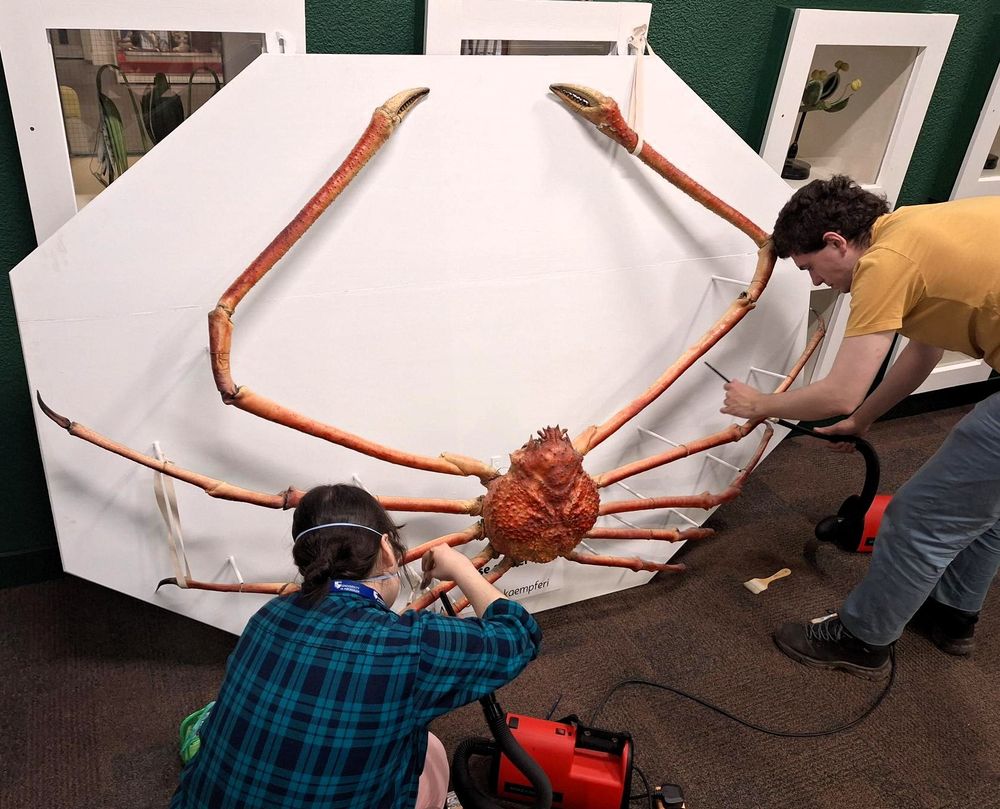
Moving a ‘Monster’ – the Ups and Downs of Exhibiting a Japanese Spider Crab Written by Hannah Clarke – Assistant Curator (Collections Access), University of Aberdeen. In May this year, I was given the slightly terrifying task of overseeing the removal and transportation of Aberdeen University’s much-loved Japanese Spider Crab (Macrocheira kaempferi) specimen. The crab, who is usually proudly displayed in the foyer of the University’s Zoology Building, had been requested for loan by Aberdeen Art Gallery & Museums, for their exciting new exhibition ‘Monsters of the Deep.’

Moving a ‘Monster’ – the Ups and Downs of Exhibiting a Japanese Spider Crab

Written by Hannah Clarke – Assistant Curator (Collections Access), University of Aberdeen. In May this year, I was given the slightly terrifying task of overseeing the removal and transportation of Aberdeen University’s…

07.08.2025 10:00 — 👍 5    🔁 3    💬 0    📌 1
Preview
How to Foster Empathy with Endangered Animals: Developing a Creative Writing and Drawing Workshop Toolkit Written by Dr Christina Thatcher, Lecturer in Creative Writing & Dr Lisa El Refaie, Reader in Language and Communication, Cardiff University. With biodiversity declining at an alarming rate, we need to find ways of encouraging people to care about all endangered animal species, not just the ones with the most obvious appeal, such as pandas and polar bears, for example.

How to Foster Empathy with Endangered Animals: Developing a Creative Writing and Drawing Workshop Toolkit

Written by Dr Christina Thatcher, Lecturer in Creative Writing & Dr Lisa El Refaie, Reader in Language and Communication, Cardiff University. With biodiversity declining at an alarming rate,…

24.07.2025 10:04 — 👍 1    🔁 0    💬 0    📌 0
Preview
A Refresher Course on Fluid Specimen Conservation at the Natural History Museum of Denmark Written by Anastasia van Gaver (Conservator) & Bethany Palumbo (Head of Conservation) Natural History Museum Denmark). As conservators, it’s essential we keep up to date with developments in the techniques used in specimen treatments. With hundreds of fluid-preserved specimens to make and conserve for the new exhibitions at the Natural History Museum of Denmark, we sought the best in the field to give us a refresher course.

A Refresher Course on Fluid Specimen Conservation at the Natural History Museum of Denmark

Written by Anastasia van Gaver (Conservator) & Bethany Palumbo (Head of Conservation) Natural History Museum Denmark). As conservators, it’s essential we keep up to date with developments in the techniques…

17.07.2025 10:00 — 👍 1    🔁 0    💬 0    📌 0
Preview
NatSCA Digital Digest – July 2025 Compiled by Milo Phillips, Digitisation Co-ordinator at the Royal Botanic Garden Edinburgh. Welcome to the July edition of NatSCA Digital Digest. A monthly blog series featuring the latest on where to go, what to see and do in the natural history sector including jobs, exhibitions, conferences, and training opportunities. We are keen to hear from you if you have any top tips and recommendations for our next Digest, please drop an email to…

NatSCA Digital Digest – July 2025

Compiled by Milo Phillips, Digitisation Co-ordinator at the Royal Botanic Garden Edinburgh. Welcome to the July edition of NatSCA Digital Digest. A monthly blog series featuring the latest on where to go, what to see and do in the natural history sector including…

10.07.2025 10:00 — 👍 0    🔁 0    💬 0    📌 0
Preview
Bark Tanning Skins into Leather for Taxidermy – A Sustainable, Natural and Non-harmful Alternative to Commercial Tanning Products? Written by Jazmine Miles Long, Taxidermist. When a taxidermy mount is made, the skin of the mammal (and in some cases reptiles and birds) is usually tanned. Tanning is the process of turning a raw skin into leather using chemistry. By turning the skin into leather, we are changing a fragile perusable material into something durable that can be sculpted into taxidermy and be more resistant to insect attack.

Bark Tanning Skins into Leather for Taxidermy – A Sustainable, Natural and Non-harmful Alternative to Commercial Tanning Products?

Written by Jazmine Miles Long, Taxidermist. When a taxidermy mount is made, the skin of the mammal (and in some cases reptiles and birds) is usually tanned. Tanning is…

26.06.2025 10:01 — 👍 2    🔁 0    💬 0    📌 0
Preview
Planet Ocean: Using Local Collections to Celebrate Global Climate Action Written by Sarah Marden, Curator of Natural History at The Box, Plymouth. From March 2024 to April 2025, a new exhibition at The Box called Planet Ocean explored Plymouth’s marine heritage and contemporary identity as “Britain’s Ocean City”. Specimens from our natural history collections, including spirit-preserved marine invertebrates, molluscs, corals, mounted sea birds and seaweed folios were displayed alongside art, world cultures collections, image and film and loan material from local partners.

Planet Ocean: Using Local Collections to Celebrate Global Climate Action

Written by Sarah Marden, Curator of Natural History at The Box, Plymouth. From March 2024 to April 2025, a new exhibition at The Box called Planet Ocean explored Plymouth’s marine heritage and contemporary identity as…

19.06.2025 10:01 — 👍 1    🔁 0    💬 0    📌 0
Preview
NatSCA Digital Digest – June 2025 Compiled by Olivia Beavers, Assistant Curator of Vertebrate Zoology at World Museum, National Museums Liverpool. Welcome to the June edition of NatSCA Digital Digest. A monthly blog series featuring the latest on where to go, what to see and do in the natural history sector including jobs, exhibitions, conferences, and training opportunities. We are keen to hear from you if you have any top tips and recommendations for our next Digest, please drop an email to 

NatSCA Digital Digest – June 2025

Compiled by Olivia Beavers, Assistant Curator of Vertebrate Zoology at World Museum, National Museums Liverpool. Welcome to the June edition of NatSCA Digital Digest. A monthly blog series featuring the latest on where to go, what to see and do in the natural…

12.06.2025 10:01 — 👍 1    🔁 0    💬 0    📌 0
A Hundred Feet Through the Door – A Chance Encounter with some Centipedes set me on a Curatorial Path… Written by Dan Gordon, Keeper of Biology, The Great North Museum: Hancock. So, how did I get started in museums? Like perhaps many people, it began with a stroke of luck. I’d decided to study Biology at university—I suppose I’d vaguely pictured myself at some point in the future, white-coated in the lab, pouring over spectrophotometer readings or agar plates.

A Hundred Feet Through the Door – A Chance Encounter with some Centipedes set me on a Curatorial Path…

Written by Dan Gordon, Keeper of Biology, The Great North Museum: Hancock. So, how did I get started in museums? Like perhaps many people, it began with a stroke of luck. I’d decided to study…

22.05.2025 13:24 — 👍 2    🔁 0    💬 0    📌 1
Preview
5 Top Tips on How to Decant your Museum By Eimear Ashe, Collections Moves Project Manager, National Museum of Ireland Having recently completed a major decant of Natural History collections in the National Museum of Ireland, I thought it a perfect opportunity to share my learnings with fellow NatSCA colleagues. National Museum of Ireland – Natural History Tip 1. Start with the staff! What skills do you need to recruit in or increase capacity in?

5 Top Tips on How to Decant your Museum

By Eimear Ashe, Collections Moves Project Manager, National Museum of Ireland Having recently completed a major decant of Natural History collections in the National Museum of Ireland, I thought it a perfect opportunity to share my learnings with fellow…

15.05.2025 10:00 — 👍 0    🔁 0    💬 0    📌 0
Preview
NatSCA Digital Digest – May 2025 Compiled by Ellie Clark, Collections Moves Team Leader at the Natural History Museum, London. Welcome to the May edition of NatSCA Digital Digest Digital Digest is a monthly blog series featuring the latest on where to go, what to see and do in the natural history sector including jobs, exhibitions, conferences, and training opportunities. We are keen to hear from you if you have any top tips and recommendations for our next Digest, please drop an email to…

NatSCA Digital Digest – May 2025

Compiled by Ellie Clark, Collections Moves Team Leader at the Natural History Museum, London. Welcome to the May edition of NatSCA Digital Digest Digital Digest is a monthly blog series featuring the latest on where to go, what to see and do in the natural history…

08.05.2025 10:00 — 👍 2    🔁 0    💬 0    📌 0