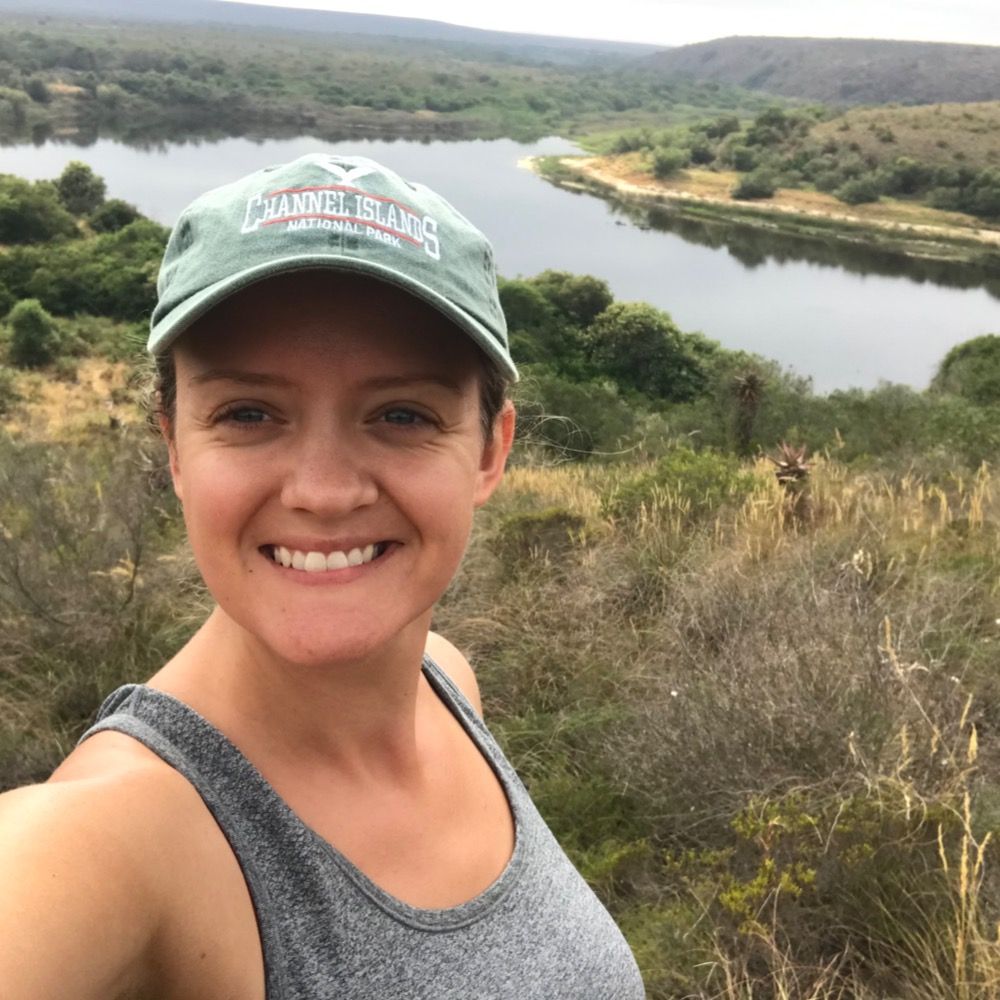
Field intern William @robotowilliam.bsky.social has a recent Master's in Animal Behaviour and is currently seeking a PhD position 👀
He's also an excellent drone photographer, check it out: bsky.app/profile/robo...
23.01.2026 14:45 — 👍 2 🔁 1 💬 0 📌 0
Field intern Mathis is a food science student from France with a keen interest in animals. He did top-notch lizard husbandry and made friends with every cow he met at the field site.
23.01.2026 14:44 — 👍 1 🔁 1 💬 1 📌 0
Field intern Emma (not pictured) recently completed an MSc and is working on gaining experience through the lizard project and previous internships. She is now at the Max Planck Institute for Biological Intelligence lab, based in Loro Parque, Tenerife.
23.01.2026 14:43 — 👍 1 🔁 1 💬 1 📌 0
PhD student Molly @mhuzzell.bsky.social was also on her 3rd Zootoca field season this year. Her MSc project used molecular methods to search for new Zootoca hybrid zones and her PhD is focused on parents and offspring in this one, analysing mechanisms of reproductive isolation between the lineages.
23.01.2026 14:42 — 👍 3 🔁 1 💬 1 📌 0
Field tech Blaž is an MSc student and technician at the University of Ljubljana, active in the Herpetological Society of Slovenia, and invaluable for his expertise in Alpine herps. This was his third Zootoca field season, and 2nd with this team.
23.01.2026 14:37 — 👍 1 🔁 1 💬 1 📌 0

J. stands behind arrayed laboratory equipment, wearing nitrile gloves and examining an unseen object in one hand while holding a pencil and lab notebook in the other. They are dressed in a tank top, illustrating the heat of the environment. Behind them, dappled sunlight and fallen leaves show through the brown and white fabric of a single-layer tent that they are standing inside. Their workbench is a white shelf wrapped with blue plastic sheeting, to protect its contents from dust and rain. Photo by K. Elmer.
Research technician J. is a veteran of 5 field seasons with Team Lizard, leading the field team for the last two seasons. They spent the 2025 season working on a new method for genotyping lizards using the MinION platform from @nanoporetech.com Follow them at @j.ecoevo.social.ap.brid.gy
23.01.2026 14:35 — 👍 2 🔁 1 💬 1 📌 0

Eight people stand or crouch on a wooden porch in front of a backdrop of Alpine trees: William, Kathryn, Molly, J., Jean-Francois, Nicolas, Mathis, Blaž. Jean-Francois holds a hand broom/dust brush, which we learned is inexplicably called a 'whisk' by at least some Canadians. Cultural exchange is a great part of science!
Who's catching all these lizards? Meet the 2025 field team! It's a long season (May–September), so not everyone was there all at once, but here's most of us—including PI @profkathrynelmer.bsky.social and visiting ecophysiology collaborators, @jflegalliard.bsky.social and his PhD student Nicolas.
23.01.2026 14:19 — 👍 3 🔁 1 💬 1 📌 1
Oops, that was meant to be threaded, sorry. But that's enough for now. Stay tuned for a meet-the-team thread coming soon, plus sporadic skeets of fieldwork memories, fun lizard facts, and updates on the analyses we're working on over the winter, while the lizards are sleeping.
22.01.2026 18:53 — 👍 0 🔁 0 💬 0 📌 0

An adult lizard in her summer enclosure. She is brown with reticulated black and beige markings on her back. She is on a substrate of dirt and moss and is in the corner of a plastic container. A bright yellow object is just barely visible behind her; this is an infertile egg. Photo by M. Uzzell.

Three oviparous lizard hatchlings, in an incubation box next to their three empty eggshells and one still-unhatched egg. They are on a substrate of moist vermiculite, which can be seen lying flat in adjacent chambers but in this one has been kicked messily around the box, partially covering the unhatched egg. The babies are dark brown with grey-black tails. Photo by M. Uzzell.

A close-up photo of a lizard hatchling among some light brown sphagnum moss. The hatchling is dark brown with a darker tail, and has tiny beige spots along the length of its body. Its toes are very long. This is an oviparous hatchling on the day of its birth. Photo my M. Uzzell.
Interbreeding means overwintering controlled crosses in shared enclosures. This means that after catching lizards from the hybrid zone, the field team then had to care for them until they went into their enclosures, as well as incubate their eggs and care for the young. A lot of lizard husbandry!
22.01.2026 18:50 — 👍 1 🔁 1 💬 1 📌 0
Teams led by PI @profkathrynelmer.bsky.social have been studying this hybrid zone since 2013. This paper gives a good overview of the first set of outcomes: nature.com/articles/s41559-…
We're now working on a very exciting in-situ, common-garden interbreeding experiment.
22.01.2026 18:38 — 👍 3 🔁 1 💬 0 📌 0

A sunny hillside, with a marshy foreground giving way to grass and shrubs, with larch and spruce trees in the background. Several cows are grazing and one human is visible near them. A dirt road runs between the field and the trees, where a jeep has just driven past and kicked up a large cloud of dust.
And! There are cows in this story, too! The hybrid zone is in a high Alpine summer pasture, on a working dairy farm. The clearing for the pasture may also be contributing to the hybrid zone, by being an area of ideal habitat at juuuuust the right altitude. Photo by @robotowilliam.bsky.social
22.01.2026 18:36 — 👍 2 🔁 1 💬 1 📌 0
These hybrids are rare. Where they're in contact, we find the viviparous lineage at higher altitudes and the oviparous at lower altitudes. But the tricky part is, they can't be distinguished by eye. The only way to reliably tell them apart is to observe their reproduction, or test them genetically.
22.01.2026 18:29 — 👍 2 🔁 1 💬 1 📌 0

Viviparous (left), hybrid (top right), and oviparous (bottom right) eggs on the day they are laid. The viviparous young are laid in a membrane that looks like a large black egg, and the young emerge after a few hours or days. Oviparous eggs are laid small and white, and hybrids are larger and often look pink due to reduced calcification. Both will expand over their development and will be around the same size as the viviparous membranes when they hatch. Left photo (viviparous) has been size-matched to right photo (hybrid and oviparous). Left photo shows two baby lizards and six shiny, black, gelatinous-looking globules, alongside a little bit of moss. Right photo shows eight splotchy pink eggs that are a little smaller than the globules, a plastic divider, then seven small white eggs that are noticeably smaller than the pink eggs.
As the name suggests, Z. vivipara is viviparous (live-bearing) over most of its range, but two ssp. lineages are oviparous (egg-laying). In the Gail valley, one is in contact with the viviparous ssp., and hybridises! Hybrids lay a thin-shelled egg late in development. Photos by @mhuzzell@bsky.social
22.01.2026 18:27 — 👍 7 🔁 1 💬 1 📌 0

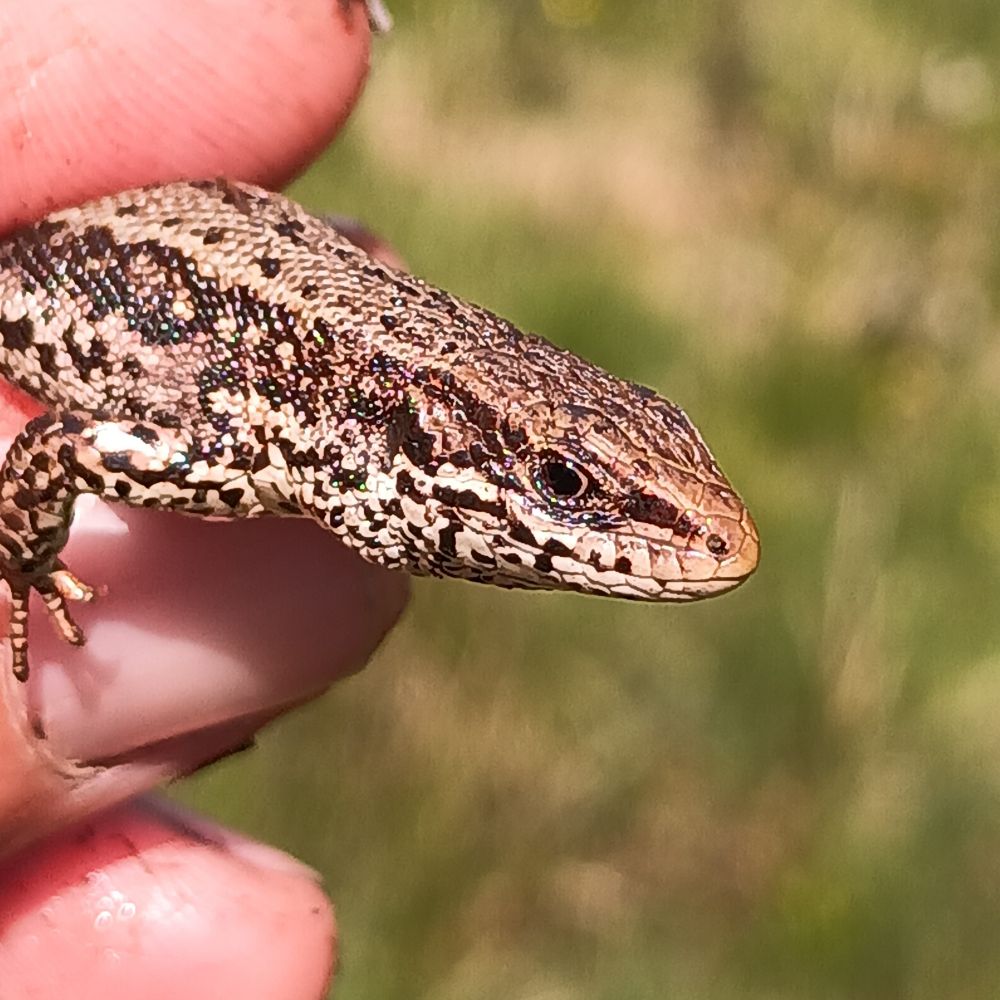
A Eurasian common lizard on a grey tree stump, with grass and brush in the background. Photo by J. Smout.
You've heard of COW TOOLS, but did you know the Gail Valley is also home to an incredibly cool lizard hybrid zone?
Here's a thread about our work on the Eurasian common lizard, Zootoca vivipara, and its egg-laying x live-bearing hybrids.
(Thanks @biotay.bsky.social for the spur to get posting!)
22.01.2026 18:13 — 👍 9 🔁 4 💬 2 📌 1
We'll have some Actual Content soon, we promise -- but to get you started, check out Molly's thread from last year about what we're doing here:
24.07.2025 09:50 — 👍 0 🔁 0 💬 0 📌 0
Hello world!
We led a tour of the field site yesterday, and one of our guests was asking if we had social media. We didn't ... until now!
24.07.2025 09:21 — 👍 0 🔁 0 💬 0 📌 0
Antonio J. Osuna Mascaró, Goffin Lab, Vienna, Austria
PhD^2 and Ninja Biologist.
Animal Behavior and Comparative Cognition.
Human perch for cockatoos.
Also here: twitter.com/BioTay
More about me here: https://osunamascaro.weebly.com/
#ScienceWriter & instructional designer. Post-academia. Neach-ionnsachaidh na Gàidhlig. 🇪🇺 🏳️🌈 (he/him) "@JamesBurgon" on the old place.
The JMS Scholarship Programme supports Black UK PhD students at the University of Glasgow. https://www.gla.ac.uk/scholarships/mccune-smith/
At the heart of the University of Glasgow since 1807, The Hunterian connects people with stories, individuals and ideas.
#societyjournal (ESEB), covering #evolution across all organisms
#genetics #genomics #selection #lifehistory #evodevo #popgen #theory #speciation #morphometrics #phylogenetics #phylogeography
https://academic.oup.com/jeb
http://jevbio.net
Official profile of the European Society for Evolutionary Biology (ESEB) - an international academic society supporting the study of #evolution
https://eseb.org
Publisher of @jevbio.bsky.social
Co-publisher of @evolletters.bsky.social
University of Glasgow (@uofglasgow.bsky.social), College of Medical, Veterinary and Life Sciences. #TeamUofG 💘
Multidisciplinary network of researchers at the University of Glasgow and affiliated Schools. Interested in integrative physiology, ageing and animal welfare.
Paleontologist and professor at University of Edinburgh, dinosaur enthusiast and writer. Free born man of the USA. Immigrant. Husband & father. (views mine)
Open-access, peer-reviewed journal of the Austrian Herpetological Society covering all aspects of the study of amphibians and reptiles.
Published by @pensoft.net. Powered by ARPHA.
Website: herpetozoa.pensoft.net
A @britishecologicalsociety.org journal, publishing papers that significantly advance the field of ecology, including physiological, behavioural and evolutionary ecology.
PhD, Senior researcher @cnrs.bsky.social. #Ecology and #Evolution. #Wildlife. #Herpetology. Adj director CEREEP-Ecotron, Associated professor ENS, Coordinator AnaEE France. Views my own 🐍🦎🇨🇵
PhD Researcher of the Medfly microbiota at UEA.
• Researching host-microbe symbioses in Tephritid flies.
• Also a big fan of statistics, modelling and general programming #RStats.
• Other interests are teaching, scientific outreach and engagement.
Changing the world since 1451 🌍 | #TeamUofG #WorldChangingGlasgow https://www.gla.ac.uk/
Bridgy Fed (https://fed.brid.gy/) bot user for the fediverse. To bridge your Bluesky account to the fediverse, follow this account.
To ask a fediverse user to bridge their account, send their address (eg @user@instance) to this account in a chat message.…
Researcher studying the genetic and cellular basis of viviparity and oviparity in lizards. University of Glasgow, School of Biodiversity. Follow for memes, rants and lizard […]
🌉 bridged from ⁂ https://ecoevo.social/@j, follow @ap.brid.gy to interact
He/him | 38 | Lifelong explorer and learner
🦋 Reylo
⏹️ Stop AI
Teacher, MSc Animal Behaviour (Queen's University Belfast), interested in animal cognition and social behaviours
https://linktr.ee/robotowilliam
Behavioural and evolutionary ecologist, lecturer in Bangor, Wales - sociality, stress, thermal ecology, mostly in reptiles macleodlab.weebly.com
Just a bunch of crabs in a trench coat, but also a professional marine biologist. My social media is separate from, and does not represent, my employer. Please bring croissants 🥐
https://linktr.ee/rebeccarhelm