Authors reflect on why listening to adults with disabilities matters, what's lost when care is only reported by those without disabilities, and how recognizing overlapping care roles reshapes policy: bit.ly/3M9mDTR
Explore what more responsive care systems could look like in Colombia and beyond.
03.02.2026 14:26 — 👍 1 🔁 0 💬 0 📌 0

Inside Armenia’s Disability Assessment Reform | Center for Inclusive Policy
A behind-the-scenes interview exploring Armenia’s digital disability assessment reform and its shift from a medical to a social, functioning-based model.
Armenia replaced a medical disability assessment with a social, digital, functioning-based model.
Follow us behind the scenes with an evaluation of Armenia’s Disability Assessment Reform, a joint effort by the
@cipofficial.bsky.social and ADB.
Read the interview:
28.01.2026 14:14 — 👍 1 🔁 1 💬 0 📌 0

New Article! Unsatisfied Care Needs of Adults with Disabilities in Bogota, Colombia.
66.3% of adults with disabilities in Bogota, Colombia, have unmet care needs.
35.7% provide care.
New Center for Inclusive Policy research shows how care needs and disability intersect in practice.
Article published in @mdpiopenaccess.bsky.social: www.mdpi.com/2673-7272/6/...
22.01.2026 13:22 — 👍 4 🔁 3 💬 0 📌 1
Government budgets drive action, so they must be analyzed before numbers lock in.
Pacta’s final report on allocations for persons with disabilities, released ahead of India’s Union Budget 2026–27.
We contributed CIP’s budget analysis approach and input on the Union Budget.
Here: bit.ly/49DBHAW
15.01.2026 15:53 — 👍 2 🔁 2 💬 0 📌 0
YouTube video by Center for Inclusive Policy
INSIDE Armenia’s Disability Assessment REFORM | The STORY BEHIND the RESEARCH
Armenia replaced a medical disability assessment with a social, digital, functioning-based model.
Follow us behind the scenes with an evaluation of Armenia’s Disability Assessment Reform, a joint effort by the @inclusivepolicy.bsky.social and ADB.
13.01.2026 15:03 — 👍 2 🔁 2 💬 0 📌 0

The way forward: Everyone deserves to live independently and participate fully. Bridging the care and disability agendas is essential. We must move from fragmented programs to integrated systems, built with and for all people.
If care and disability matter to you, help move the conversation forward.
Sharing evidence is one way to push for better policy: inclusive-policy.org/disability-p...
🧵 6/6
17.12.2025 12:58 — 👍 2 🔁 1 💬 0 📌 0

Care and disability sectors have long worked in silos. It’s time to change that. We need gender-responsive, disability-inclusive, age-sensitive care systems; support that promotes autonomy; and recognition and resources for caregivers.
When care and disability policies are designed separately, gaps are inevitable.
Bringing these agendas together isn’t optional, it’s essential for effective systems.
🧵 5/6
17.12.2025 12:58 — 👍 1 🔁 0 💬 1 📌 0

Many caregivers are also women with disabilities. Over 15% of adults with disabilities in Bogotá care for others, often without support themselves, according to an ongoing study. Caregivers of people with disabilities are often women over 50, who may need support themselves due to their age, in Costa Rica, Chile, Mexico, and Nicaragua. Sources cited: Pinilla-Roncancio et al. and Pereira, Center for Inclusive Policy.
Caregivers are often invisible in policy, especially when they are older women or women with disabilities themselves.
Ignoring this reality means designing systems that don’t work for those who rely on them most.
🧵 4/6
17.12.2025 12:58 — 👍 1 🔁 0 💬 1 📌 0

People with disabilities often need more care and support, but most don’t receive it. Support isn’t optional: it’s essential and should be provided in a way that preserves autonomy. Over 45% report unmet care and support needs across seven countries studied. Source: Pereira, Center for Inclusive Policy.
Care systems should enable choice, dignity, and autonomy, not force people to cope alone.
🧵 3/6
17.12.2025 12:58 — 👍 1 🔁 0 💬 1 📌 0

In Chile or Nicaragua, over 82% of caregivers of people with disabilities are women. Source cited as Pereira, Center for Inclusive Policy, based on disability survey estimates.
When disability enters the picture, gender inequalities in care become even sharper.
🧵 2/6
17.12.2025 12:58 — 👍 1 🔁 0 💬 1 📌 0

Women and girls undertake most care and support work. But one essential dimension remains overlooked in the global care agenda: disability inclusion. Without it, millions lack the support to live independently and participate fully.
EVIDENCE DROP! Care and disability are often discussed separately, but people don’t live their lives that way.
We’re reflecting on why addressing care and disability together is essential to building systems that support autonomy, independent living, and full participation in society.
🧵 1/6
17.12.2025 12:58 — 👍 1 🔁 0 💬 1 📌 0

Graphic announcing a new report titled “Armenia’s Disability Assessment Reform.” The cover shows the logos of the Center for Inclusive Policy and the Asian Development Bank, with illustrated icons representing law, rights, and social protection over a map of Armenia, in green and blue tones.
Armenia is setting a regional precedent by transforming its disability assessment system.
This new report, co-published with the @adb.org, explores the shift to a rights-based, digitally enabled approach to disability benefits.
Read it here: inclusive-policy.org/wp-content/u...
15.12.2025 13:58 — 👍 3 🔁 1 💬 0 📌 0

Graphic titled Disability and the Care Agenda. It states that across seven low and middle income countries, more than 45 percent of persons with disabilities have unmet care and support needs. Illustration of a person sitting alone inside a house, imagining being outdoors with support.
You can explore the full Care Agenda Brief here: inclusive-policy.org/wp-content/u...
And for a closer look at the stories behind the data, watch our video: www.youtube.com/watch?v=USa3...
🧵5/5
10.12.2025 16:25 — 👍 1 🔁 1 💬 0 📌 0

Graphic explaining that in some contexts, disability-related costs for children can reach 68 to 100 percent of average household income, making equal participation nearly impossible without adequate support. Illustration of an open wallet on a blue background.
Our video dives deeper into why these numbers matter.
Watch it here: www.youtube.com/watch?v=ksrj...
🧵4/5
10.12.2025 16:22 — 👍 0 🔁 0 💬 1 📌 0

Graphic titled Social Protection. It explains that persons with disabilities face higher costs of living, which can push households below the poverty line when disability-related expenses are included. Illustration of a piggy bank, coins, and a downward line on a blue background.
Find the full picture in our Social Protection Brief: inclusive-policy.org/wp-content/u...
🧵3/5
10.12.2025 16:16 — 👍 0 🔁 0 💬 1 📌 0

Graphic explaining that in several countries, 96% of disability spending goes almost entirely to cash transfers, leaving very limited funding for assistive devices or community support, even though many persons with disabilities need these services to participate equally. The image includes a long green bar labeled ‘cash transfers’ and a very small bar labeled ‘assistive devices or community support,’ on a black background.
See the full breakdown in our Budget Analysis Brief: inclusive-policy.org/wp-content/u...
And if you prefer visuals or audio, here’s the video: www.youtube.com/watch?v=4jmX...
🧵2/5
10.12.2025 16:16 — 👍 0 🔁 0 💬 1 📌 0

Graphic titled ‘Budget Analysis.’ It highlights that in low- and middle-income countries, government spending on disability-related programs ranges from 0.01% to 0.80% of GDP. The text notes that it’s not only about how much is being spent but how it is being spent. The illustration includes a calculator, a clipboard, and a pencil on a black background.
Our Disability Policy Insight series was created to break down complex policy topics into accessible insights that support inclusive decision-making.
Because when policy becomes clearer, participation becomes possible.
Explore all reports and videos here: inclusive-policy.org/disability-p...
🧵1/5
10.12.2025 16:16 — 👍 1 🔁 0 💬 1 📌 0
Donate | Center for Inclusive Policy
A policy, research, and training “think and do” tank building inclusive futures. Donate now to advance disability inclusion globally.
If CIP’s work has supported yours, here are ways to support us:
Donate.
U.S. federal employees: give through the CFC (ID 44639).
Sign up for our newsletter.
Share our posts.
If you work with a foundation on disability-inclusive policy, let’s connect.
Thanks for helping data open doors.
08.12.2025 14:50 — 👍 1 🔁 1 💬 0 📌 0

Meenakshi Balasubramanian, CIP Senior Research Associate, sits in her wheelchair.A text overlay shows her quote: “This day informs the community that a group of people are marginalised, invisible, and experience discrimination on a daily basis. It reminds us of the gap between what needs to be done and what is happening to reduce inequality.”
During the International Day of Persons with Disabilities, our team reflected on what this day represents. Here is one of those voices.
Thank you, Meenakshi, for your commitment at @inclusivepolicy.bsky.social to building the inclusive society we all deserve, with data lighting the way.
04.12.2025 14:27 — 👍 1 🔁 1 💬 0 📌 0

New CIP Instagram account: @centerforinclusivepolicy
To wrap up this International Day of Persons with Disabilities, we’re excited to share that we’ve officially launched our Instagram account: www.instagram.com/centerforinc...
We’ll be sharing our disability data, evidence, and key insights: all in one place. Follow us and stay connected!
03.12.2025 21:35 — 👍 1 🔁 2 💬 0 📌 0

Evidence is our roadmap. Action is our responsibility.
This International Day of Persons with Disabilities, we call for:
better data, stronger financing, and policies that enable participation, autonomy, and equality for all.
EVIDENCE IS OUR ROADMAP.
Learn more: inclusive-policy.org/reports-and-...
🧵 7/7
03.12.2025 15:24 — 👍 1 🔁 1 💬 0 📌 0

Disability creates significant extra costs for households. Once extra costs of living are considered, the measured poverty rate for people with disabilities increases.
For example, in the US once accounting for extra costs the poverty rate for persons with disabilities rises from 24% to 35%.
In Ghana, from 38.5 %to 52.9%.
Source | Methodological Guidelines on Assessing Household Disability: Related Costs and Their Implication for Participation (The World Bank, with the support of @inclusivepolicy.bsky.social): bit.ly/48xn3dI
🧵 6/7
03.12.2025 15:24 — 👍 2 🔁 0 💬 1 📌 0

In five of these countries, 40% or more report either
• receiving less support than they need, or
• needing support but receiving none at all.
Why it matters: Without adequate support, autonomy and participation remain out of reach.
Source | The Care Economy and Disability Inclusion in Low and Middle-Income Countries (The World Bank, with the support of @inclusivepolicy.bsky.social): bit.ly/4po3xYE
🧵 5/7
03.12.2025 15:24 — 👍 1 🔁 0 💬 1 📌 0

More than 20% of persons with disabilities report unmet care and support needs, across the nine countries analyzed.
Source | The Care Economy and Disability Inclusion in Low and Middle-Income Countries (The World Bank, with the support of @inclusivepolicy.bsky.social): bit.ly/4po3xYE
🧵 4/7
03.12.2025 15:24 — 👍 1 🔁 0 💬 1 📌 0

Poverty multiplies exclusion: among the poorest households, children with disabilities are 4× more likely to be out of school.
Why it matters: Education is the foundation for participation, and millions are still left behind.
Source: Global Disability Inclusion Report (Co-edited by @inclusivepolicy.bsky.social with @unicef.org & @lshtm.bsky.social): bit.ly/48f9m4m
🧵 3/7
03.12.2025 15:24 — 👍 0 🔁 0 💬 1 📌 0

Massive inequalities persist in education. Children with disabilities are 47% more likely to be out of school (In 34 low- and middle-income countries analyzed.) This isn’t a gap, it’s a systemic barrier to a full and independent life.
Source: Global Disability Inclusion Report (Co-edited by @inclusivepolicy.bsky.social with @unicef.org & @lshtm.bsky.social): bit.ly/48f9m4m
🧵 2/7
03.12.2025 15:24 — 👍 0 🔁 0 💬 1 📌 0

This year, CIP and our partners generated new evidence to understand where progress is happening, and where urgent action is still needed.
For the International Day of Persons with Disabilities, we’re highlighting some of the MOST POWERFUL INSIGHTS from our recent reports and contributions.
🧵 1/7
03.12.2025 15:24 — 👍 2 🔁 1 💬 1 📌 0
YouTube video by Center for Inclusive Policy
International Day of Persons with Disabilities: What does this day mean to you?
International Day of Persons with Disabilities.
A day to pause, reflect, and recommit.
At CIP, we work to ensure public policies truly include persons with disabilities. So we asked our team what this occasion means to them.
Your turn... What does it mean to you?
03.12.2025 11:23 — 👍 2 🔁 1 💬 0 📌 0

Module on Child Functioning – Teacher Version: A Comparative Evaluation - UNICEF DATA
Historically, different definitions, methodologies and tools have been used to identify children with disabilities in population-level data collections, resulting in…
We’re proud to share new work we contributed to, published by @unicef.org with the WG.
CIP supported the validation and review of “Module on Child Functioning – Teacher Version”.
Why it matters: it shows whether teachers can reliably report on children’s functional status.
01.12.2025 15:48 — 👍 2 🔁 1 💬 0 📌 0
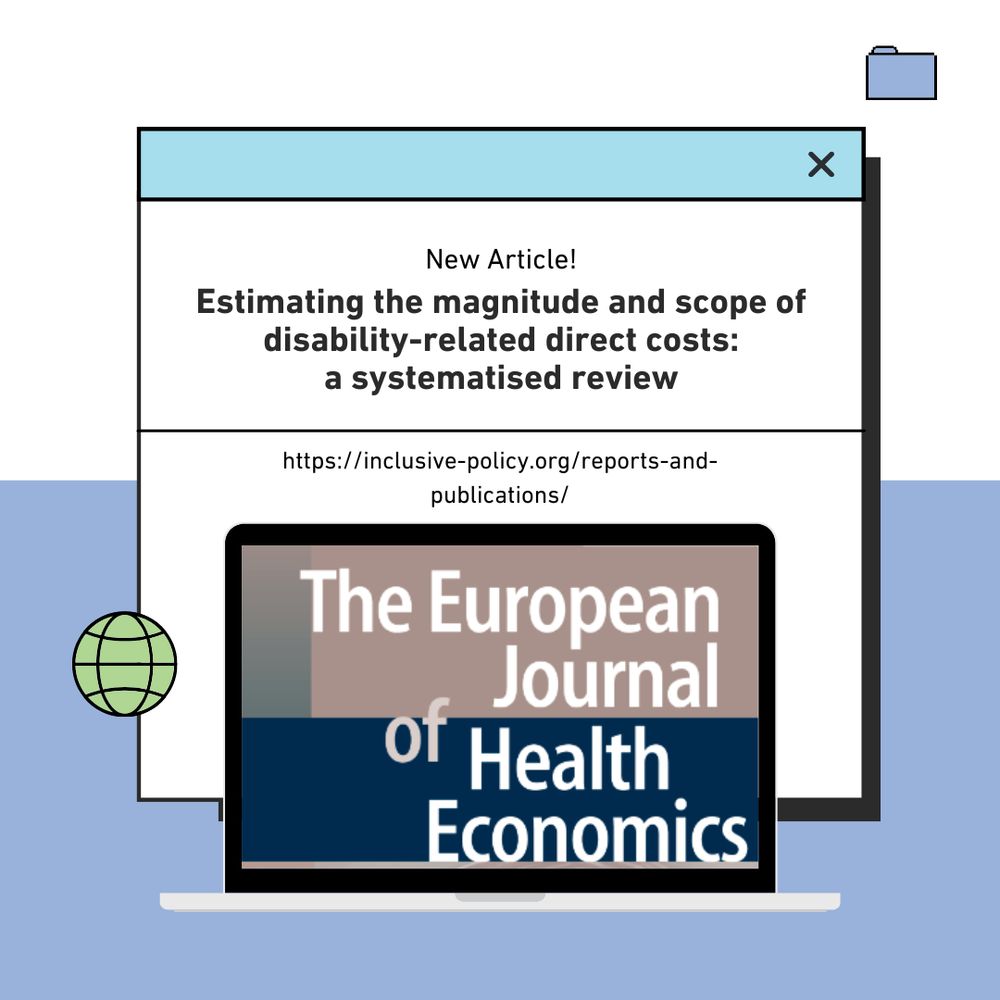
Graphic announcing a new article titled Estimating the magnitude and scope of disability-related direct costs: a systematised review, with a link to inclusive-policy.org. Below, a laptop displays the cover of The European Journal of Health Economics. Decorative icons of a globe and folder appear around the graphic.
NEW ARTICLE ALERT!
We’re pleased to contribute to this systematised review on estimating disability-related extra costs, published in The European Journal of Health Economics.
It has been a long time coming, and we’re excited for how useful it will be.
Here: link.springer.com/content/pdf/...
24.11.2025 16:06 — 👍 4 🔁 3 💬 0 📌 0
Research + evaluation at U of Iowa College of Law
Advancing evidence-based policies and universally designed communities to eliminate disparities and support health, stability, and independence for people of all abilities.
https://lhpdc.law.uiowa.edu/
Associate Professor of Social Welfare at Stony Brook. Disability policy researcher. Host of The Disability Squeeze podcast. Opinions= mine.
chicago + oxford | disability, hsmt, inclusive ed
SMA Europe is a non-profit umbrella organisation of spinal muscular atrophy (SMA) patient organisations from across Europe. All together. One goal.
Visit our website: https://www.sma-europe.eu/
Improving health by understanding hidden experience.
Supported by Wellcome.
durham.ac.uk/imh
medhumsplatform.org
Communications & advocacy to help you navigate the digital landscape. Be heard! Creators of #TRSroadbook & #TheDScale.
Part trauma, part #adhd • Cumbia dancing queen • Norestense • Spanglish • bubbly introvert • views my own • MX/USA
Oxfam is a world-wide development organization that mobilizes the power of people against poverty. #TheFutureisEqual
Association for Women's Rights in Development.
Supporting feminist & gender justice movements to challenge oppressions & co-create #FeministRealities
Visit awid.org | awid.org/csw69
Can we stand for something?
https://linktr.ee/tiagofortuna
Lecturer @ University of Leicester. She/Her
All things Law, Disabilities, and Queer.
A student once called me a 'girlie pop icon'
T&Cs apply.
Research on development, geography, and inclusion.
Fellow - Institute of Development Studies/University of Sussex
Research Ireland Government of Ireland Fellow at the Centre for Disability Law and Policy, University of Galway. PhD on #Article12CRPD & young people with disabilities. She/her
The official Bluesky account of the Centre for Disability Law and Policy (CDLP) at @UniOfGalwayLaw.bsky.social @UniOfGalway.bsky.social
On Facebook at https://tinyurl.com/mr3t76tn
We spark lasting change on disability rights and eye health!
https://www.light-for-the-world.org
A transformar experiências de pessoas com deficiência, Surdas e neurodivergentes.
ADD is a participatory grant-maker for
disability justice.
Deaf. NZSL (second language). Cis/she/her. Pākehā. Advocate for accessibility & inclusion. Trans rights are human rights. Aotearoa
Toitū Te Tiriti. Land back. Free Palestine. Free Sudan. Free Congo. Free Kanaky...
Formally kiwi_curly on Twitter
Pākehā, disabled. They/them. Researcher, story-teller, organiser - scheming in disability community for climate justice, migrant rights, Tiriti justice. PhD student University of Otago.
https://linktr.ee/ainekc/
Exploring the politics (+ theory) of disablement & precarious work of all forms under capitalism | @cerasellachis.bsky.social
disability politics | work | precarity | resistance | social security | rest | anti-disablement