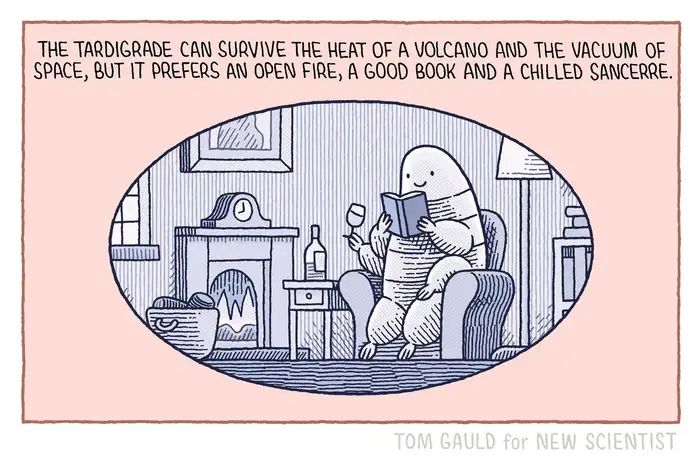
Caption: The Tardigrade can survive the heat of a volcano and the vacuum of space, but it prefers an open fire, a good book and a chilled Sancerre.
Image: A tardigrade (a cute, plump micro-animal with eight legs - six of which are in view) sits in a tiny armchair, reading with a glass of wine in one hand and a smile on its face.
My cartoon for this week’s @newscientist.com
06.04.2025 11:46 — 👍 1982 🔁 517 💬 25 📌 36

MASSIVELY excited to see Tityus achilles, South America's first #venom spraying #scorpion, finally described in
@zoojlinnsoc.bsky.social !
This new species from #Colombia can spray venom at potential predators, a striking case of convergent #evolution 🧵 (1/n)
academic.oup.com/zoolinnean/a...
17.12.2024 15:17 — 👍 9 🔁 3 💬 1 📌 1

An image showing a range of fossil scorpions, arranged by age. These are lovely fossils, ranging from scorpions in rocks, through ones dissolved out of rocks or resolved using CT scans, to photos of more recent scorpions in Amber. If you want the full details: (A) Palaeophonus caledonicus Hunter, 1886 (Dick Institute, Kilmarnock, UK) from the mid-Silurian (Llandovery to Wenlock) of Lesmahagow, Scotland, UK, image courtesy of Lyndsay C. Jess, and by permission of East Ayrshire Council/East Ayrshire Leisure Trust, and a reconstruction from Pocock (1901). (B) mid-Silurian Eramoscorpius brucensis Waddington, Rudkin & Dunlop, 2015 from Canada. (C) Proscorpius osborni Whitfield (1885b), Yale Peabody Museum (YPM IP 545850); photo by Jessica Utrup 2019. (D) Lower Devonian Waeringoscorpio hefteri Størmer (1970, image source Poschmann et al., 2008). (E) Pulmonoscorpius kirktonensis from the Lower Carboniferous of the UK (courtesy of Andrew Jeram). (F) Compsoscorpius buthiformis from the Upper Carboniferous of the UK (left: courtesy of Lorenzo Prendini, AMNH; right: Legg et al., 2012). (G) Carboniferous taxon Cyclophthalmus senior from the Yale Peabody Museum collections (YPM IP 029827), photo by Jessica Utrup 2013. (H) Mesophonus perornatus from from the Triassic of the UK (courtesy of Lorenzo Prendini, AMNH). (I) Protoischnurus axelrodorum from the Cretaceous Crato Formation, Brazil (courtesy of Christian Neumann, Berlin). (J) Centruroides knodeli from Neogene Dominican amber (courtesy of Wilson Lourenço, Paris). (K) Tityus azari from Neogene Dominican Amber (courtesy of Wilson Lourenço, Paris).
For #FossilFriday have you ever considered the scorpion fossil record? This is surprisingly rich, but how we categorize these animals transcends being a hot mess. It's a spicy disaster. My colleague Jason and I wrote a paper on it which came out today:
peerj.com/articles/185...
⚒️🧪🦀🦑 #evosky
06.12.2024 15:43 — 👍 105 🔁 33 💬 2 📌 1

We always encourage diverse perspectives in our research group and aim to cater to a broad audience, but sometimes lab meetings are not for the faint of heart 😂
22.11.2024 18:42 — 👍 6 🔁 0 💬 0 📌 0
QRP with your sketch vs final #art!
#arttrain #sciart
One of my rare legible sketches, the two fossil tardigrades trapped in amber: Beorn & Aerobius
20.11.2024 16:32 — 👍 93 🔁 10 💬 3 📌 4
This OA study was published with the support of the MCZ at Harvard, and is part of Marc's dissertation on the origin and evolution of the tardigrade body plan. Thanks to collaborators Frank Smith and Mandy Game from UNF for hosting land supporting Marc during the experimental phase of this work 🤩
19.11.2024 14:30 — 👍 3 🔁 0 💬 1 📌 0

At long last, the Lab for Invertebrate Paleobiology and Evolution @harvardoeb.bsky.social is getting on the bandwagon! Thanks for the early adopter followers making the transition easier 😁 Will soon resume posting news about our crew and research, stay tuned!
ortega-hernandezlab.oeb.harvard.edu
18.11.2024 13:01 — 👍 24 🔁 5 💬 1 📌 0
Ecosystem ecology, global change biology, biogeochemistry lab at Harvard University
Studying why and how behavior evolves, from mosquitoes to mole-rats | Postdoc/Leon Levy Scholar @Columbia working with Ishmail Abdus-Saboor | PhD @Princeton with Lindy McBride | 麻布/東大 alum 🇯🇵 | yukihaba.github.io
HHMI Hanna Gray Postdoctoral Fellow. EvoDevo of endosymbioses in a changing world. 🏳️🌈 Missing the Ediacaran.
Postdoc at Harvard OEB; brains, behavior, evolution, acoels. Jane Coffin Childs Fellow (‘21-24). Previously: social evolution PhD at the Rockefeller
https://scholar.google.com/citations?user=z8ttnIMAAAAJ&hl=en
🍀 4th year PhD student at the University of Portsmouth investigating the effects of wave processes on arthropod taphonomy and ancient arthropod communities 🦀🦐🦞
Palaeobiologist at the University of Bristol
http://patreon.com/Kiabugboy
Research, news, and commentary from Nature, the international science journal. For daily science news, get Nature Briefing: https://go.nature.com/get-Nature-Briefing
Official Bluesky of The Palaeontological Association (palass.org). Re-post of jobs and other events doesn't mean endorsement.
Associate Professor @ Colgate University. Paleobiologist, science educator, engaged citizen. He/him.
PhD Student studying traits of Ediacaran fossils @Dept of Zoology, Uni of Cambridge. MSci Geology Graduate 2023 @UCL. 🐚🐢🇵🇭🇬🇧 She/Her
Postdoc at PalaeoFAU Germany, currently studying range shifts in forams. From Bangladesh, previously at University of Cambridge Zoology & British Antarctic Survey (PhD) studying Antarctic benthic ecology; PalaeoFAU (MSc); and Cornell University (BS).
Doctor of Decay. Palaeontologist studying the dark art of taphonomy: how squishy animals become fossils. Loves 🐙♥️ (he/him).
Precambrian palaeontologist and RA at the University of Essex | Adjusting to life back in the UK | Whisky fanatic and reluctant Essex Boy
Paleobiologist 🦴, Software Engineer 💻, and Open Scientist 🔍
Postdoctoral Researcher at Syracuse University (He/Him)
Assistant Professor @Princeton EEB. #phylogenetics/#macroevolution/#paleobiology
http://simoes-lab.com
Posts and views are of my own.
We are based in the Department of Zoology and University Museum of Zoology Cambridge working on how ecology impacts evolution from the first animals to our modern oceans
Palaeo and Marine Ecologist, Palaeontologist. Asst. Prof @camzoology.bsky.social & @zoologymuseum.bsky.social at the University of Cambridge. PI @deeptimeecology.bsky.social She/Her
PhD student at the University of Cambridge studying coral reef and Ediacaran ecology
He/him 🪸🪼🦈
PhD from Harvard MCZ. I study how limbs evolved from sprawling 🦎 to upright 🐆. Passionate about teaching anatomy. I like to run 🏃🏻. he/him
awrightmark.github.io