For anyone in London next weekend - get yourself down to this absolutely wonderful combination of art & astronomy. It’s a really special place.
11.02.2026 21:41 — 👍 2 🔁 1 💬 0 📌 0
Advanced Fellows Response to UKRI Investment Approach
The future of fundamental physics research in the UK is under serious threat because of the massive government cuts to STFC funding. Please read this open letter by advanced fellows.
advancedfellows-openletter-stfc.github.io/index.html
10.02.2026 06:34 — 👍 3 🔁 3 💬 0 📌 0
Very interesting to see this laid out by someone who was, until very recently, on STFC's Science Board.
08.02.2026 17:55 — 👍 2 🔁 1 💬 0 📌 0

BBC Radio 4 - BBC Inside Science
A weekly programme looking at the science that's changing our world.
Listeners to Radio 4’s Inside Science today get an essay from me in defence of astronomy as pure research. Please listen in and let me know what you think.
Show starts 4.30pm GMT here: www.bbc.co.uk/programmes/b...
05.02.2026 14:07 — 👍 73 🔁 23 💬 1 📌 3
Vital science cut in "devastating blow"
Cutting edge science cut by up to 60% as Institute of Physics warns of “devastating blow” to physics.
Read our full response here: www.iop.org/about/news/v...
The IOP have set up a mechanism to measure the impact of this news, and ask that anyone impacted to please complete this form and provide as much information as they can along with any evidence: www.iop.org/feedback-fol...
(3/3)
29.01.2026 11:57 — 👍 3 🔁 1 💬 0 📌 0
Another positive is that the community response to the planned cuts 16 years ago actually had an effect. Some extra funding was found at the last minute. So, it is worth speaking out and pointing out these planned cuts will do a lot of damage to very active, and successful, research areas. 4/4
29.01.2026 11:15 — 👍 6 🔁 2 💬 1 📌 0

We're so excited to share the results of the ALMA large program ARKS that studied the distribution of dust and gas in a sample of 24 exoKuiper belts. With @lucaroundtheworld.bsky.social, Meredith Hughes and a large collaboration, we just published 10 papers presenting our first results arkslp.org
20.01.2026 09:18 — 👍 85 🔁 27 💬 4 📌 3

YEMS is hiring a postdoc to work on planet formation, exoplanet detection, high contrast imaging, and/or related topics.
🫸https://aas.org/jobregister/ad/811cf8bb
04.12.2025 14:57 — 👍 1 🔁 1 💬 0 📌 0
🔊Announcing a new Physics/Astro PhD scholarship scheme in Edinburgh, for students from a Black heritage, inc mixed Black background. Please help me spread the word. The scholarship covers all tuition fees, living costs & research travel. #blackinSTEM 🔭👩🔬⚛️
ℹ️: www.ph.ed.ac.uk/studying/pos...
20.10.2025 15:52 — 👍 123 🔁 114 💬 3 📌 4
We can see Io rotate slightly over the hour-long timelapse, tracking volcanoes on its surface!
And check out the Conversation piece for a cool slider showing how NGC 1068 lines up perfectly with previous data from LBTI.
14.10.2025 03:33 — 👍 39 🔁 4 💬 1 📌 0
So, the main takeaway: you need to correctly account for dust evolution and ice chemistry when trying to understand complex molecules in planet forming disks!
07.10.2025 11:11 — 👍 1 🔁 0 💬 0 📌 0
Unfortunately including this is time consuming and computationally difficult, but ultimately we think this is going to be the only way to reconcile the models with the observations in the future.
07.10.2025 11:11 — 👍 0 🔁 0 💬 1 📌 0
So what is this telling us? A big limitation of the modelling here is that it is static, but we know dust grains move radially and vertically in disks and can redistribute molecules when they do so.
07.10.2025 11:11 — 👍 0 🔁 0 💬 1 📌 0

The second surprising result is that even after throwing the chemical kitchen sink at the model (honestly, see Table 2) we could *not* reproduce the column density profile of methanol. We didn't have enough of it (short by ~1-2 orders of magnitude) and it was all in the wrong place (the outer disk).
07.10.2025 11:11 — 👍 0 🔁 0 💬 1 📌 0

TW Hya is great because it's so well studied and there is a wealth of information on the disk physical structure. We combined some pretty advanced chemical modelling (thanks to Catherine) with a really well benchmarked model of the disk (thanks to Jenny).
07.10.2025 11:11 — 👍 0 🔁 0 💬 1 📌 0
Our first surprising result was than the methanol was cold (~35K) suggesting it wasn't coming from thermal desorption of ices on dust grains, but instead by non-thermal processes. This led us to start looking more into how it could be formed chemically…
07.10.2025 11:11 — 👍 0 🔁 0 💬 1 📌 0

We can look at the relative intensities of each of these transitions to pull out physical information like excitation temperature and column density for the methanol gas, and since the observations were spatially resolved, we see how these change radially through the disk.
07.10.2025 11:11 — 👍 0 🔁 0 💬 1 📌 0
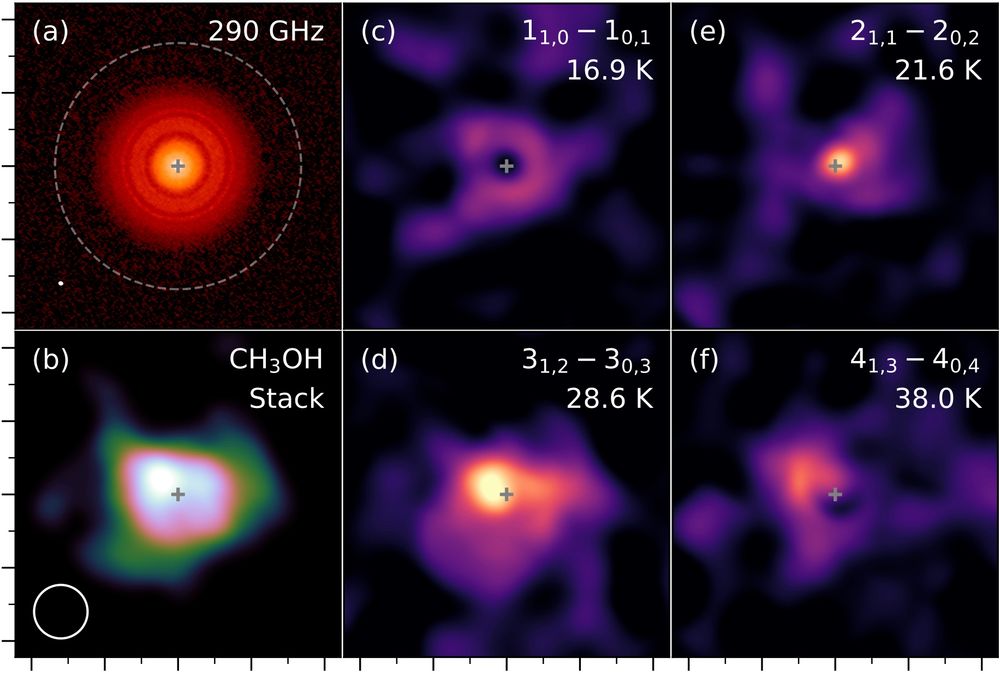
Methanol is the starting point for lots of important prebiotic chemistry. So far it has only been detected in a disk around one solar-type star, TW Hya. We used #ALMA to go back and get some very sensitive, high-resolution observations of multiple transitions for the first time.
07.10.2025 11:11 — 👍 0 🔁 0 💬 1 📌 0
Great to see our paper on methanol in TW Hya finally come out today (with Catherine Walsh and Jenny Calahan). A quick overview.... 🔭 ☄️ #radioastro
arxiv.org/abs/2510.04106
07.10.2025 11:11 — 👍 7 🔁 3 💬 1 📌 0
Ultimately, we think including these types of processes is going to be the only way to reconcile the models with the observations. But the main takeaway is that the distribution of important prebiotic molecules in disks is likely highly dependent on treating dust (and ice) evolution correctly!
07.10.2025 08:59 — 👍 0 🔁 0 💬 0 📌 0
So what is this telling us? A big limitation of the modelling here is that it is static, but we know dust grains move radially and vertically in disks and can redistribute molecules when they do so.
07.10.2025 08:59 — 👍 0 🔁 0 💬 1 📌 0
The second surprising result is that, even after throwing the chemical kitchen sink at the model, we could *not* reproduce the column density profile of methanol. We didn’t have enough of it (short by ~1-2 orders of magnitude) and it was all in the wrong place (the outer disk).
07.10.2025 08:59 — 👍 0 🔁 0 💬 1 📌 0
TW Hya is great because it’s so well studied and there is a wealth of information on the disk physical structure. We combined some pretty advanced chemical modelling (Catherine) with a benchmarked model of the disk (Jenny).
07.10.2025 08:59 — 👍 0 🔁 0 💬 1 📌 0
Our first surprising result was than the methanol was cold (~35K) suggesting it wasn’t coming from thermal desorption of ices on dust grains, but instead by non-thermal processes. This led us to start looking more into how it could be formed chemically.
07.10.2025 08:59 — 👍 0 🔁 0 💬 1 📌 0
We can look at the relative intensities of each of these transitions to pull out physical information like excitation temperature and column density for the methanol gas, and since the observations were spatially resolved, we can look at how these change radially through the disk.
07.10.2025 08:59 — 👍 0 🔁 0 💬 1 📌 0
Methanol is the starting point for lots of important prebiotic chemistry. So far it has only been detected in a disk around one solar-type star, TW Hya. We used #ALMA to go back and get some very sensitive, high-resolution observations of multiple transitions for the first time.
07.10.2025 08:59 — 👍 0 🔁 0 💬 1 📌 0
Since 1992, the Star Formation Newsletter has been the premier destination for news about star & protoplanetary disk formation. We publish a monthly newsletter of papers, interviews, upcoming conferences, and more!
Web: https://starformationnews.org
Astrophysics professor, Director Jodrell Bank Centre for Engagement, exploding stars, science bluedot festival, red, two dogs rule the roost.
Interested in #scicomm, in particular about astronomy and climate change. Professor of Computational Astrophysics and Head of Institute for Astronomy, Univ. of Edinburgh. Views own, of course.
Astrophysicist, postdoc, cat mom, she/her kamberschwarz.com
Guy interested in (exo)planets and stars, and everything in between. Statements and opinions posted here are my own.
I'm an astronomer working with ALMA on the destruction and chemistry of protoplanetary disks. Currently a postdoc at the IWF and no longer living from boxes!
ESA/AURA astronomer at STScI. Opinions my own. I study exoplanets and disks around stars.
Master’s Student at Wesleyan University. Astronomy & a little quantitative education research. Usually thinking about circumstellar disks
PhD candidate @UVic 🪐 Planet formation 📡 ALMA 🔗jspeedie.com 🇿🇦🇨🇦🏳️🌈
🤖 I deliver recent arXiv/astro-ph.EP articles to Bluesky. I am maintained by @astronasko.com.
Astronomer, guitarist, professor.
Project Manager for DARA (Development in Africa with Radio Astronomy) @ University of Leeds, UK.
Science Education 🤓 | Glaciology 🧊 | Geophysics 🫨
Cycle tourist 🚴 | Climber 🧗| Runner🏃 | Podcast addict 🎙️| (she/they) 🏳️🌈
All views my own.
Professor of astronomy working at Leiden Observatory in the Netherlands on the direct imaging of extrasolar planets and transits of giant ring systems || Opinions my own || Will tell Dad jokes for cash. https://kenworthy.space/
Astronomer at Lowell Observatory.
Aurora and eclipse chaser.
Lover of coffee and beer.
Assistant Professor of Planetary Physics at Kapteyn Astronomical Institute, University of Groningen 🇪🇺 he/him | formingworlds.space | born at 351 ppm
Astrophysicist at Monash Uni in Melbourne, Australia
Carnegie Fellow at the Earth and Planets Laboratory. Protoplanetary + circumplanetary disks. Formerly at MPE, BU, and University of Michigan. She/her. #BiInSci 🏳️🌈✨🔭 Opinions are my own.
sierragrant.com
Chilean astrophysicist and Dr/Prof at USACH. Planet formation and young exoplanets. Artsci interplay.
Professor for Astrophysics at LMU Munich. www.til-birnstiel.de