Step 1: Insert bacteria ("Wolbachia") into mosquitoes.
Step 2: Release mosquitoes.
Step 3: Watch Dengue rates plummet.
Phenomenal results from Singapore.
Link: tinyurl.com/59c9t67u, by Lim et al.

@bquilty.bsky.social
Infectious disease epidemiologist and modeller based at Charité Berlin, LSHTM (honorary), WHO Pandemic Hub (consultant) | PhD LSHTM | MSc ImperialCollege | Twitter: @BQuilty
Step 1: Insert bacteria ("Wolbachia") into mosquitoes.
Step 2: Release mosquitoes.
Step 3: Watch Dengue rates plummet.
Phenomenal results from Singapore.
Link: tinyurl.com/59c9t67u, by Lim et al.

It’s a mistake to dismiss AI as just slop, or a bubble that will pop and fade away - it will likely be revolutionary, but we're on a dark path leaving its future entirely in the hands of private corporations with zero regulation. AI needs to be regulated and the benefits democratised ASAP.
02.12.2025 14:53 — 👍 1 🔁 0 💬 0 📌 0I'm taking part in this webinar on Friday to discuss my experience in #SciComm as an ECR during the Covid-19 pandemic - should be a really interesting conversation! Sign up below:
07.07.2025 10:37 — 👍 2 🔁 0 💬 0 📌 0
For better or worse (and there's lots of arguments for both) the genie is out of the bottle - it's here to stay, and that means we should be trying to maximise it's usefulness to society, and at the same time, trying to minimise harms. This is just wishing it away.
03.06.2025 14:18 — 👍 1 🔁 0 💬 0 📌 0
While the Inquiry's focus on improving quarantine adherence is important (summary: www.bbc.co.uk/sounds/play/...), it's a shame it overlooks DCT - one of the few pandemic policies validated through modelling + RCTs and then rolled out to reduce societal impacts while controlling transmission.
02.06.2025 10:52 — 👍 1 🔁 0 💬 0 📌 0

Great to see @christophraser.bsky.social discuss daily contact testing as a way of reducing quarantine burden at the UK Covid Inquiry. However, it is disappointing this is the only mention of this policy in the entire 12 days of the Test, Trace, and Isolate Module.
02.06.2025 10:52 — 👍 3 🔁 0 💬 1 📌 0
Now to make the most mid latte art of all time 🤩
05.05.2025 14:32 — 👍 3 🔁 0 💬 0 📌 0Just a few days left to apply for a PhD integrating behavioural data in infectious disease modelling using AI at Charité Berlin with me and Prof Stefan Flasche.
Deadline 6th April!
In Britain, we pride ourselves on authenticity, tradition, and cultural heritage.
*sips pint of Madri*
I'm mainly talking about when it's already at the point where it's pandemic, so high R and high N, lots of cases, widely distributed.
I think for containment at source it's a different question, I think there's more reason to throw the book at it there to stop it becoming a pandemic.
I think the West could have done all those things and had a better experience (I think a comprehensive rapid testing approach could allow us to avoid lockdowns) but I don't think global eradication was or is feasible for something like Covid.
24.03.2025 12:48 — 👍 0 🔁 0 💬 1 📌 0But to test efficacy/effectiveness of vaccines, you need to have cases somewhere. So the success of countries like Australia/NZ owes a lot to other countries like the having big epidemics which allowed for vaccine trials. A very tricky issue (potentially solvable with human challenge studies - TBD)
24.03.2025 11:59 — 👍 1 🔁 0 💬 1 📌 0
Like I think the below is rather simplistic, as the success of NPIs in large part is determined by timely development and rollout of PIs. Hard lockdown early isn't going to be effective if you haven't rolled out good vaccines by the time you loosen it - look at experience of Australia/NZ vs China.
24.03.2025 11:54 — 👍 0 🔁 0 💬 1 📌 0My two pence on lockdowns/NPIs is that for high R resp. pathogens we should really talk about effectiveness in terms of capacity to delay, rather than prevent. So the question is then: what reduces R but also carries lowest societal costs so it can be maintained until we get vaccines/antivirals out?
24.03.2025 11:39 — 👍 7 🔁 0 💬 1 📌 0
Do we worry too much about misinformation? I've got a piece in today's Guardian about aliens, vaccines and social media - and the dual risks of believing falsehoods and ignoring truth: www.theguardian.com/books/2025/m...
17.03.2025 14:22 — 👍 26 🔁 9 💬 3 📌 3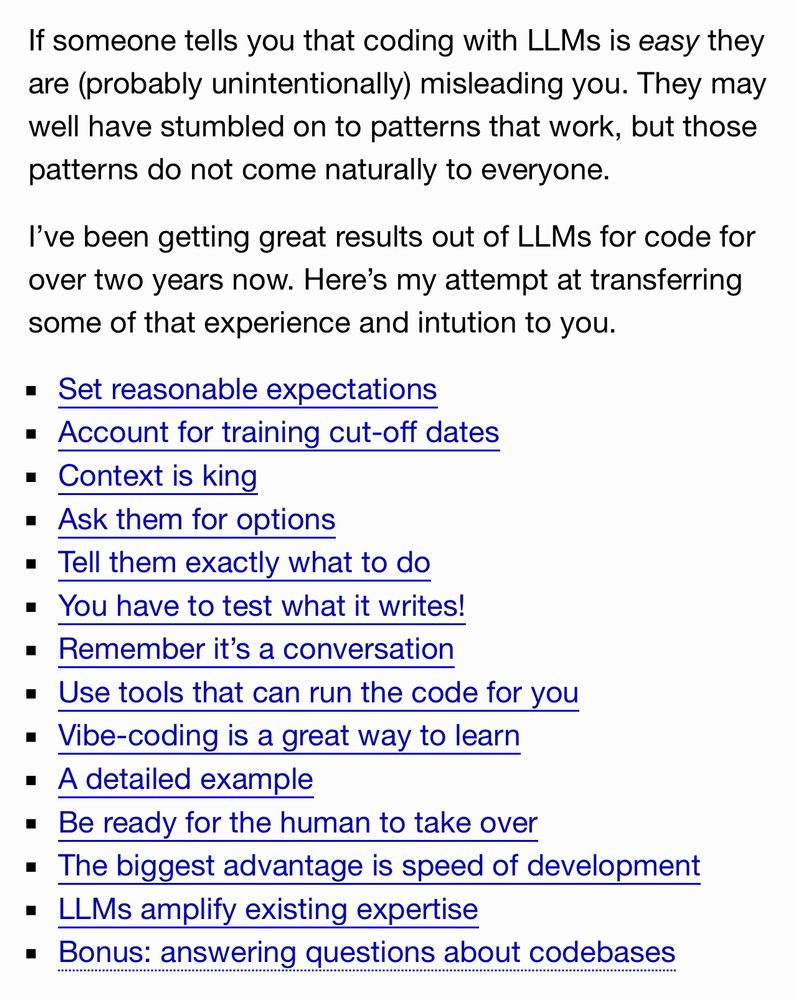
If someone tells you that coding with LLMs is easy they are (probably unintentionally) misleading you. They may well have stumbled on to patterns that work, but those patterns do not come naturally to everyone. I’ve been getting great results out of LLMs for code for over two years now. Here’s my attempt at transferring some of that experience and intution to you. Set reasonable expectations Account for training cut-off dates Context is king Ask them for options Tell them exactly what to do You have to test what it writes! Remember it’s a conversation Use tools that can run the code for you Vibe-coding is a great way to learn A detailed example Be ready for the human to take over The biggest advantage is speed of development LLMs amplify existing expertise Bonus: answering questions about codebases
Here's the table of contents for my lengthy new piece on how I use LLMs to help me write code simonwillison.net/2025/Mar/11/...
11.03.2025 14:11 — 👍 336 🔁 67 💬 14 📌 15
Of course its already a thing: knowyourmeme.com/memes/accide...
Article: www.theguardian.com/business/202...

This photo in @theguardian.com looks like a screenshot from an isometric strategy video game:
12.03.2025 15:21 — 👍 2 🔁 1 💬 1 📌 0Interested in pursing a PhD in infectious disease dynamics, artificial intelligence, and behavioural science?
Come and join myself and Professor Stefan Flasche at the Charité Center for Global Health in Berlin:
karriere.charite.de/en/job-vacan...

When an epidemic hits, how long does it take to get going with common epidemic analysis tasks?
A couple of weeks ago, we asked representatives from over a dozen UK organisations and universities who work actively on epidemic analysis and modelling how long the below tasks would take them....
1/
Though interesting that Neukölln - which was in the West - has gone to Die Linke, for the first time ever
24.02.2025 07:38 — 👍 1 🔁 0 💬 0 📌 0
What wall?
24.02.2025 07:13 — 👍 2 🔁 0 💬 1 📌 0Can't vote but #FUKAFD and #FUKNZS! #BTW2025
23.02.2025 10:30 — 👍 1 🔁 0 💬 0 📌 0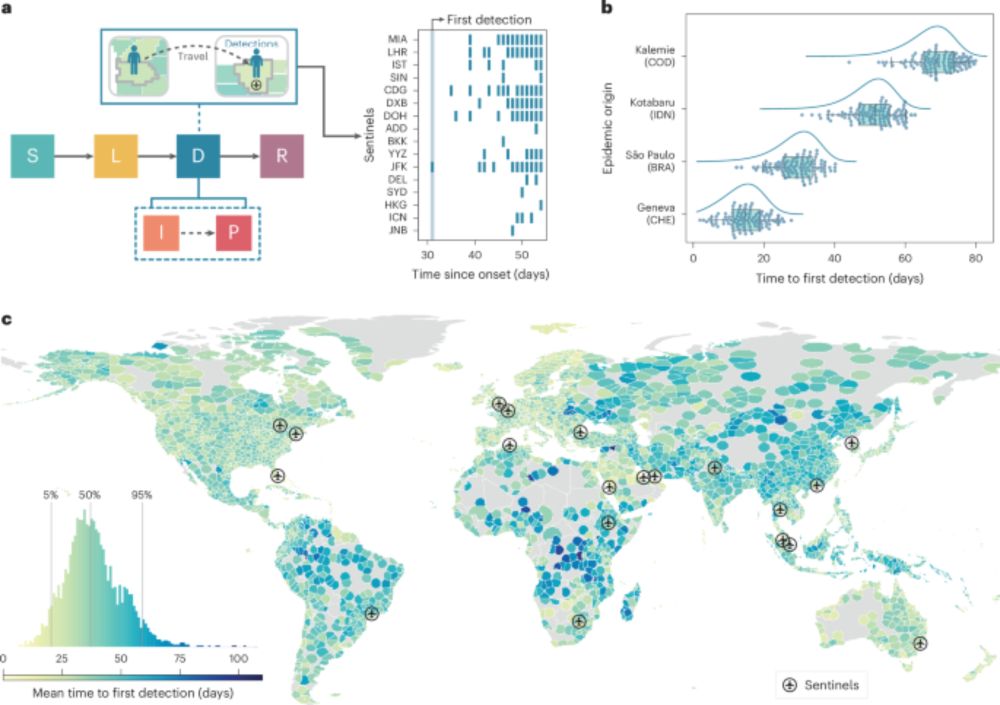
Wastewater from airplane toilets?
We introduce a global Aircraft-Based Wastewater Surveillance Network (WWSN) for pandemic monitoring in Nature Medicine 🔗 doi.org/10.1038/s415...
Aircraft-based wastewater surveillance allows for real-time, non-invasive monitoring of global pathogen spread
Short 🧵
The success of and belated market response to DeepSeek doesn’t really prove many AI-skeptic takes right. This is evidence of powerful generative AI being easier and cheaper to make and run than anyone expected so soon.
27.01.2025 18:49 — 👍 193 🔁 38 💬 18 📌 19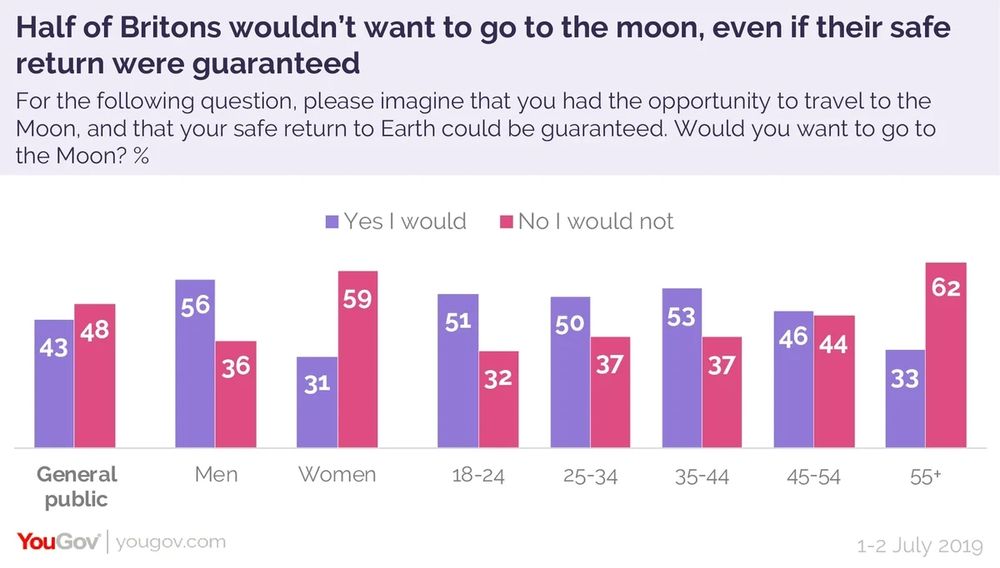
Gotta be that guy and say it's the proportion of people within those that said they wouldn't want to go to the moon, so it's a smaller fraction of the overall population (0.23*0.48 = ~11%)
22.01.2025 17:27 — 👍 13 🔁 1 💬 2 📌 1It's more of a bottle shape imo
19.01.2025 17:35 — 👍 1 🔁 0 💬 0 📌 0
Ryanair: we should limit people to two drinks at European airports
Berlin airport: BIERTOWER

Well if you go see a film in IMAX 70mm then that's roughly equivalent to 18K (though as it's film, it doesn't technically have a resolution as there are no pixels): blog.sciencemuseum.org.uk/a-projection...
Only a few places do it in the UK, including the BFI IMAX and sometimes the Science Museum.